
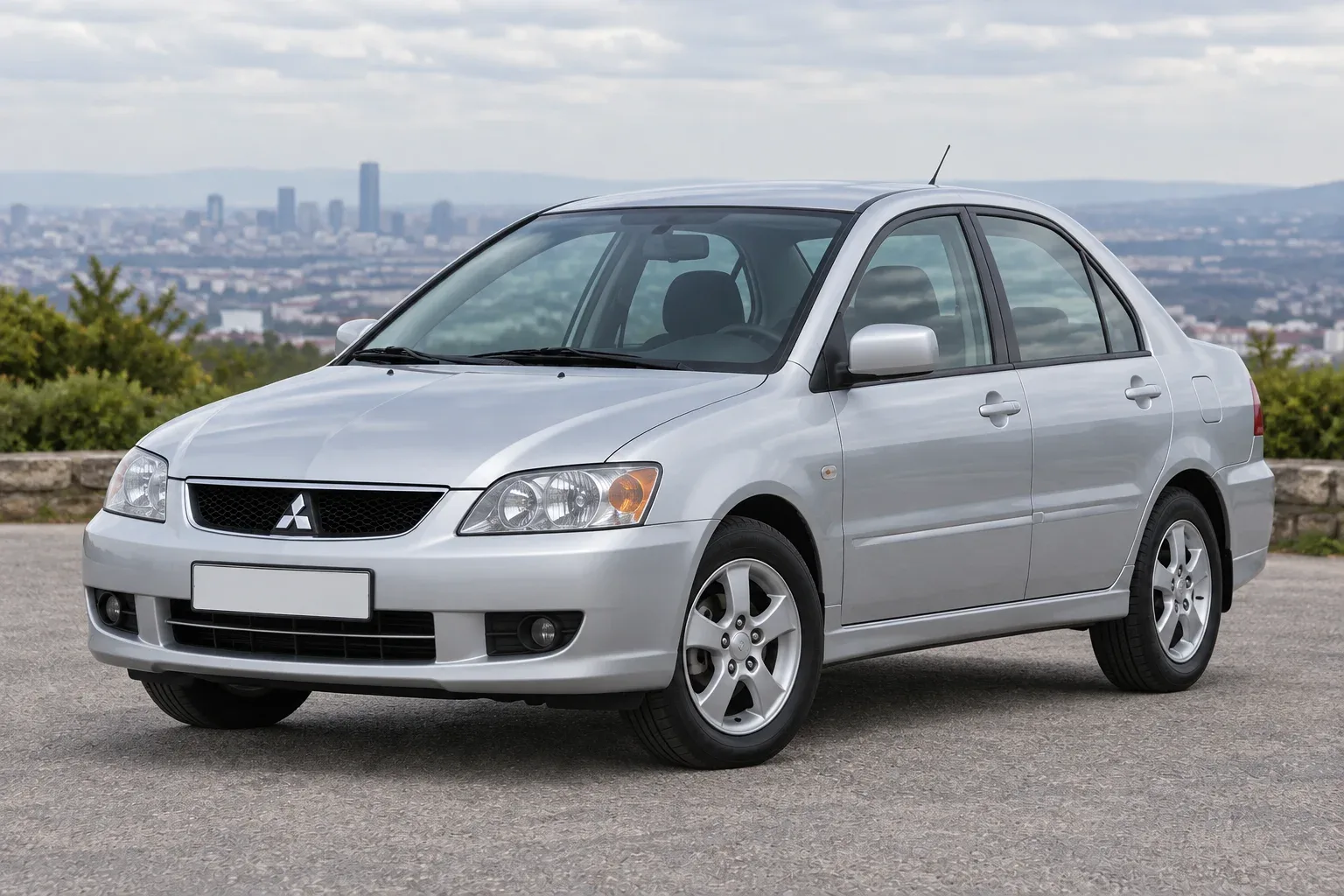
Mitsubishi Lancer 9
Valuation of the Mitsubishi Lancer 9 (2000–2011): condition, paperwork, inspection and terms of sale.
Indicative purchase price
Below market value
Final price agreed after inspection.
Value my car1Why buyers choose this model
The Lancer model appeared in the Mitsubishi range in 1972 and exists today in the tenth generation. In Europe, Lanzer never gained popularity. The thing is, this car never stood out and offered anything that cheaper and more popular competitors could. The Japanese were not alien and flaws. Even the modern Lancer, despite its impressiveness, plays the role of a gray mouse in its segment.
2What buyers check
Model history
Mitsubishi Lancer 9 debuted in 2000, but it didn’t make its debut on the European continent until three years later. In 2005, the Japanese experienced a light facelift, in which the front part and the cabin were updated (the ventilation control unit was moved below). There are many more such small changes, but they are not so significant and almost not noticeable.
Depending on the engine version, equipment and destination market, the body may vary slightly even among the units of one year of production. Mass production of the car was completed in 2007, but for some countries small-scale assembly was still ongoing. In particular, sales of the ninth generation model resumed in 2009 under the name Lancer Classic and continued until early 2011.
Features
It’s basically a regular compact, but a little different than the others. It was never offered in the back of a hatchback, which was one of the reasons for the lack of interest in it in Europe. Mitsubishi Lancer has a fairly long wheelbase – 2600 mm. Like modern Golf cars, the Lancer 9 is quite spacious inside. Even the backseat passengers can’t complain about the lack of space. It will not disappoint the trunk of 430 liters. Lancer, in addition to independent rear suspension, nothing special stands out from the competition. In its creation, quite simple constructive solutions were used. Even the independent rear suspension is simple compared to similar schemes. Advanced multimedia systems should be forgotten. The front panel is so primitive that it seems that the stylists were devoid of imagination. But for those who appreciate simplicity, the best dashboard in this segment is not to be found. Due to the small number of switches, it seems that the car is equipped very poorly. Mitsubishi offered only the bare minimum: two airbags, electrically controlled glass and mirrors, and air conditioning. There was also ABS. However, in the sports version you will be fascinated by the steering wheel, aluminum inserts, real sports signs from the Evo version, leather upholstery and very comfortable seats with developed lateral support. The biggest advantage of this car is obedience on the road. There is a perception among drivers that the Lancer is so good that the ESP system is a waste of money.
Engines
European Mitsubishi Lancer was equipped with three gasoline engines with a working volume of 1.3, 1.6 and 2.0 liters. The smallest motor is a misunderstanding. Even the 1.6-liter unit with a capacity of 98 hp does not allow you to confidently move on the highway. In addition, it consumes fuel no less than a 2-liter atmospheric. 2. 0 DOHC return 135 hp One of the best engines in the history of Mitsubishi. In addition to these units in the US and Japan, the Lancer was available with 1.5 liters, 1.8 liters and 2.4 liters engines equipped with variable MIVEC gas distribution phases. Diesel engines are completely absent in the range of models. Powertrains, for the most part, do not require attention, except for regular replacement of liquids and filters, as well as washing the throttle. Progressive pollution over time leads to uneven engine operation at idle. Sometimes the idle regulator also fails. In some cases, oil leaks through the crankshaft or the sealing ring of the oil pump are detected. Oxygen sensors (lambda probes), generator, starter and gas pump fail at large runs (after 200-300 thousand km). From time to time you have to face and with a faulty control unit fans of the cooling system (from 1,500 rubles for an analog). Motors easily cross the line of 400-500 thousand km. However, there is an opinion that the pump of the liquid cooling system is weak, or even the belt of the timing system is broken.
Transmission
Sometimes there are problems within the transmission. So in the manual transmission, paired with engines 1.6 and 1.3, owners are faced with premature wear of bearings of the primary or secondary shaft, and sometimes differential bearings.
Clutch, even in difficult conditions, lasts a long time (more than 150-200 thousand km), and a good set will cost about 4-5 thousand rubles.
Walking
In the running room, you mainly have to change consumables. By 150-200 thousand km, the Silentblocks and ball supports of the front levers wear out. The original lever costs astronomical money - from 17 000 rubles. Prices for analogues start from 1 600 rubles. It is worth admitting that the non-original levers significantly lose in durability - walk a little more than 40-50 thousand km. The rear levers will serve more than 200-250 thousand km.
When replacing the front levers, difficulties often arise with the bolt of fastening the front silent block. The nut is fixed inside the subframe, and it often turns. The service immediately takes on the Bulgarian and cut the subframe to access the nut. Then the locksmith grabs the welding - they brew a hole. In the future, corrosion develops, and the subframe becomes unusable. The cost of a new subframe is about 26 000 rubles, used in good condition - in the region of 7 000 rubles. Another 7 000 rubles will be required for work on replacement and adjustment of convergence.
Over time, the steering rack can leak or knock. The original rake will cost 39,000 rubles, and the analogue is available for 16,000 rubles. In a specialized service for repairs will ask about 9 000 rubles.
Owners also note “weak” brake discs, which lead due to too small diameter and insufficient resistance to overheating. After 200-250 thousand km, the guides of the brake calipers often acidify, or the piston attacks corrosion. Remake with a piston can be purchased for 1,000 rubles.
Other problems and malfunctions
Corrosion "loves" Lanzer, but not excessively. Mitsubishi, like many Japanese manufacturers of the time, applied a very thin layer of lacquer of poor quality to the car. Therefore, numerous scratches, chips and corrosion of bare metal is a quite expected picture. However, few of the Lancer, painted in an expensive and rich color, and therefore cosmetic repair will be inexpensive. More often, the problems concern the rear wheel arches.
Materials used for interior decoration may seem unattractive and low quality. But it's just an illusion. The stability of interior parts to wear is high. The salon doesn't bother with creaking.
In winter, the locks of the back doors often freeze. In the future, the actuators of locks may refuse. New motor-actuator can be found for 300 rubles
After 150,000 km, the fan of the heater sometimes starts working only at the 4th speed position. The heater resistor is out of order (5,000 rubles). One of the reasons is the wedging of the motor due to pollution and lack of lubrication.
Soon it may be necessary to replace the steering plume (from 1,500 rubles).
Prices and availability of spare parts
Most parts are not expensive, but the car likes good quality substitutes. It is worth it, as the resource of parts is much higher than in the German or French models. It is better not to count on original spare parts, the prices for them are prohibitively high. The valve timing kit can be bought for $40. But it's better to add $70-100 and buy quality items along with the pomp. The same applies to brake discs, steering rods and silenth-blocks of levers. Unfortunately, not all parts have good substitutes.
3Pre-purchase checklist
Engines
- In some cases, oil leaks through the crankshaft or the sealing ring of the oil pump are detected.
- Oxygen sensors (lambda probes), generator, starter and gas pump fail at large runs (after 200-300 thousand km).
- But this applies, first of all, to “economical” customers who want to service the car at the price of Lada, delay with the replacement of the belt, and the state of the pump is assessed by eye, although it must be changed along with the timing.
- After the second replacement of the rings, it is almost impossible to avoid the overhaul - 50-60 thousand rubles.
- km is detected wear cams cams camshaft.
Transmission
- 3, owners are faced with premature wear of the primary or secondary shaft bearings, and sometimes differential bearings.
Walking
- In the future, corrosion develops, and the subframe becomes unusable.
- Over time, the steering rack can leak or knock.
- In a specialized service for repairs will ask about 9 000 rubles.
- km often soured guide brake calipers, or piston attacks corrosion.
Other problems and malfunctions
- Corrosion "loves" Lanzer, but not excessively.
- Therefore, numerous scratches, chips and corrosion of bare metal is a quite expected picture.
- However, few of the Lancer, painted in an expensive and rich color, and therefore cosmetic repair will be inexpensive.
- More often, the problems concern the rear wheel arches.
- The stability of interior parts to wear is high. The salon doesn't bother with creaking.
- In winter, the locks of the back doors often freeze.
- In the future, the actuators of locks may refuse.
- The heater resistor is out of order (5,000 rubles).
4Challenges of selling privately
Mitsubishi Lancer is a car with good reliability and no insoluble problems. If you are looking for a spacious, dynamic compact, you are not afraid of a medium-sized design, and you want the car not to let down on the road, then the Mitsubishi Lancer ninth generation is one of the best options for you.
- Mitsubishi Lancer 9 debuted in 2000, but it appeared on the European continent only three years later.
- Features: It’s essentially a regular compact, but a little different than the others.
- Engines: In some cases, oil leaks through the crankshaft or the oil pump sealing ring are detected.
- Transmission: 3, owners face premature wear of primary or secondary shaft bearings and sometimes differential bearings.
- Chasing: In the future, corrosion develops, and the subframe becomes unusable.
- Other problems and malfunctions: Corrosion "loves" Lanzer, but not excessively.
- Prices and spare parts availability: Most parts are not expensive, but the car likes good quality substitutes.
Shows, bargaining and re-registration take time: buyers look, promise to think and disappear. Fair price after inspection closes the auction on the spot. If money is needed urgently, the purchase takes away waiting and repeat displays.
5How selling to us works
Leave a request with the car data. We will discuss the preliminary assessment and inspection. After checking the status and documents, we agree on the final price and terms of the transaction.