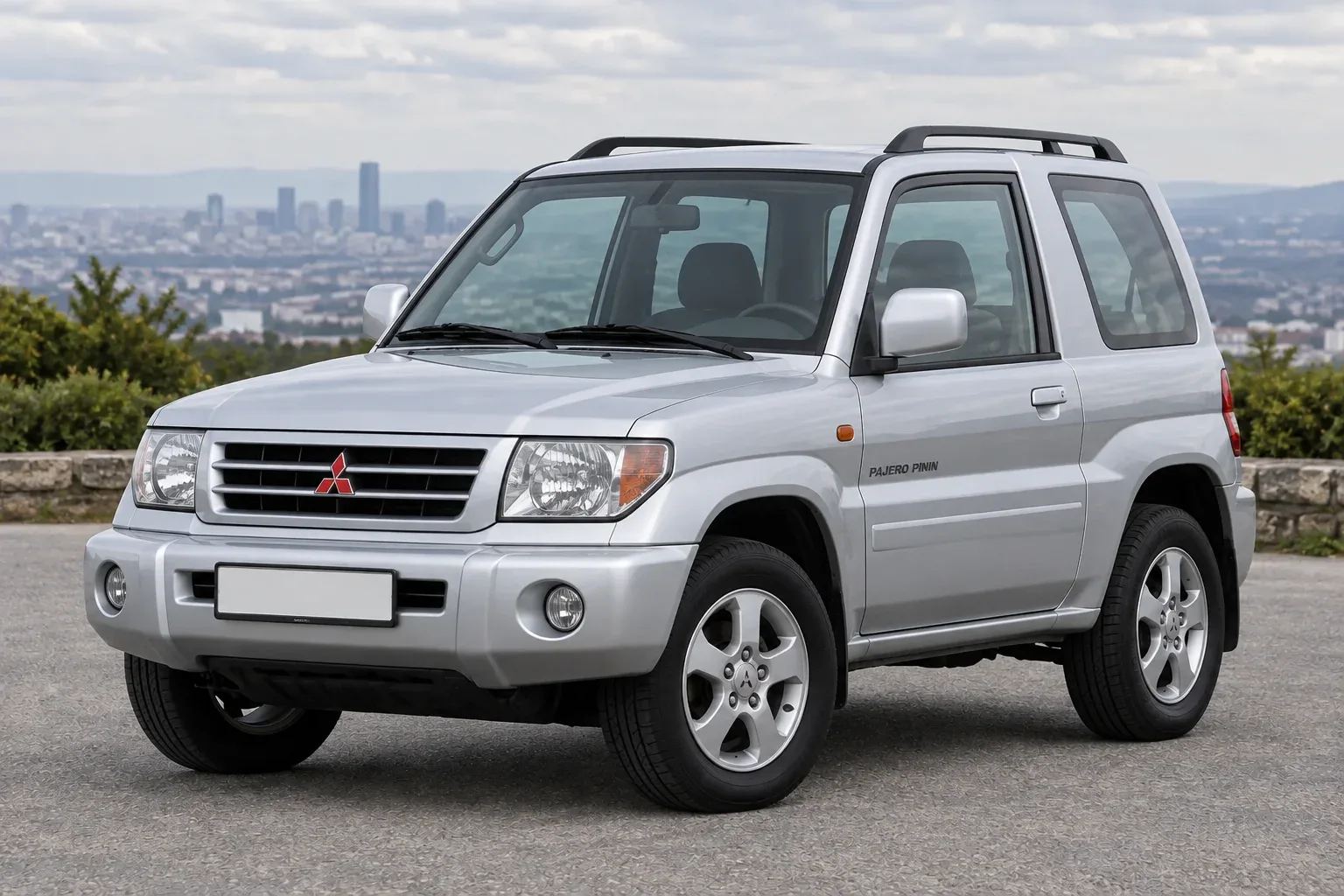
Mitsubishi Pajero Pinin
Valuation of the Mitsubishi Pajero Pinin (1999–2005): condition, paperwork, inspection and terms of sale.
Indicative purchase price
Below market value
Final price agreed after inspection.
Value my car1Why buyers choose this model
Mitsubishi Pajero Pinin, referring to the name and appearance of the iconic Pajero, at one time offered everything that modern crossovers give us. But unlike them, he had the makings of a real SUV. Today, you can enjoy the uniqueness of Pinin for relatively little money.
2What buyers check
Model history
Mitsubishi Pajero Pinin debuted in 1998. It was a combination of a passenger car with an SUV and was a response to crossovers from Japanese manufacturers. Pinin had more advantages. First of all, thanks to the brand associated with the Paris-Dakar Rally. It is not so much about Mitsubishi, but about Pajero, which in the world of off-road has become a household name.
Pinin is short for Pininfarina, a well-known Italian design studio that was entrusted with drawing a Japanese car. In Italy, in 1994-2004, production for the European market was organized. The SUV was assembled in Japan and later in Brazil.
Statistics show that Europe was not yet ready for such a car. In the first two years alone, more Pajero IO (Japanese name) was produced in Japan than in the entire period on the old continent. After a while, Pinin’s popularity in his homeland began to fall rapidly, and Mitsubishi refused to create a successor. Today, Pajero Pinin could compete with Suzuki Jimny.
Interesting fact. The Mitsubishi Pajero Pinin was produced in Brazil under the name TR4 until 2014.
Design features
Pajero Pinin has a body based on a spatial frame (integrated into the body) – not to be confused with a load-bearing body. At the time, Pajero had exactly the same scheme. In addition, a small SUV was equipped with a four-wheel drive system, a gearbox, a lock and a rigid rear axle. The small ground clearance (only 200 mm) was compensated by short overhangs. Note that some versions of Pinin did not have a gearbox.
Unfortunately, in the body length of 3975 mm (5-door version) it is difficult to accommodate more than 4 people and a little luggage. Although in theory the car is 5-seater, in practice, such a number of passengers can not be considered - because of the small width. The trunk holds only 175 liters, and access to it is through a door that opens to the right side. It's got a spare wheel on it.
Even less roomy 3-door version (3730 mm), designed for 4 people. And his 166-liter trunk is just tiny.
But Mitsubishi is simple and practical, easily copes with off-road, dexterous in the city and in the parking lot. However, at high speeds, it doesn’t drive as well as the RAV4 or CR-V. The engines provide acceptable dynamics but require a lot of fuel. Regardless of the version, you will have to reckon with high fuel consumption - about 8 l / 100 km on the highway and 11-12 liters in the city.
Engines
Mitsubishi has offered three engines, which are actually a modification of one unit. They differ slightly in capacity and type of fuel system. These are the 4G93 and 4G94 engines, known from models such as the Lancer, Carisma, Space Star and Space Wagon. 4G93 has a displacement of 1.8 liters, and 4G94 – 2.0 liters. In addition, the engines have a different piston stroke and a crank-shaking mechanism.
More significant differences relate to the food system. Both engines were equipped with direct fuel injection and received an additional GDI index. The unit with a capacity of 1.8 liters was equipped with distributed injection MPI. Unfortunately, it developed less power - 114 hp (160 Nm). The GDI version produced 120 hp (174 Nm). 2-liter GDI - the most dynamic: 129 hp. and 190 Nm of torque.
Which engine should you choose?
The most preferred 1.8-liter MPI. It is quite unpretentious and does not require special maintenance. Problems with it are possible only in case of neglect of timely replacement of the belt of the HRM. But if you redesign the belt every 60,000 km, nothing serious will happen.
The engine allows you to install gas equipment. In this case, every 15-20 thousand km it is necessary to control the gaps of the valves, take care of the technical condition of the ignition system and the gas plant. In practice, sooner or later, you have to change the head of the block, but the game is worth a candle.
The GDI series engines cause more hassle in operation. They make you reckon with the pollution of the intake system, which is quite natural for engines with direct fuel injection. Unfortunately, even a small amount of sodium is enough to stop the engine working normally. Start to float idling speed, and the car twitches under loads. Cleaning the intake system from scorching is expensive.
In addition, poor-quality and dirty fuel disables the high-pressure pump, which is very expensive (from 77 000 rubles). Failures in the injection system cause a fuel overflow. GDI motors from a technical point of view allow the use of HBO, but it is not recommended to install it.
The GDI project was a failure, as evidenced by the fact that in the future the Japanese abandoned such engines in favor of conventional ones. Mitsubishi still successfully uses distributed fuel injection despite strict environmental regulations.
So which engine to choose?
It all depends on your needs and the condition of the offered car. The market is dominated by GDI machines. If you are going to regularly travel to difficult places, then this is the best choice. For daily trips on paved roads, the option without a gearbox and with distributed injection (not GDI) should be preferred.
Typical problems and malfunctions
Mitsubishi Pajero Pinin, as a rule, does not cause serious problems, but has several ailments. One of them is corrosion. Fortunately, its scope is small. Foci of rust can be found in the lower part of the body: on the rapids, wheel arches and door frames. Strongly rusted specimens are best avoided, since it is not easy to find body iron. Corrosion also affects the elements of the exhaust system. You have to reckon with corrosion and in electrical wiring and, as a result, with minor failures.
With extreme caution, you should approach the choice of versions with GDI, which can be real traps.
The suspension is very simple and quite stable. Usually you have to change the rubber bands and bushings. The front lever is to be restored, as are the four guide rods of the rear axle.
Over time, backlash appears in the steering, the elimination of which will not require large costs. The braking system is quite reliable, especially in the rear, where the drum mechanism is used.
The transmission needs the usual checks for leaks, driveshaft backlash and connection of the front axle. Clutch has a low resource, which significantly reduces regular off-road trips. The cost of a new set is from 10 000 rubles.
Operating costs
If you buy a Pajero Pinin with an MPI engine, you will have no reason to worry. The car will not disappoint if you are not fundamentally off-road capabilities. Such a Pinin is quite reliable and inexpensive in operation and repair.
The GDI series engines require more in-depth knowledge. The most expensive and vulnerable element is the TNVD, which can be replaced by a new or “bow”. In the latter case, you need to be careful, since the pumps had different numbers and slightly differed in design.
3Pre-purchase checklist
Model history
- After a while, Pinin’s popularity in his homeland began to fall rapidly, and Mitsubishi refused to create a successor.
Design features
- Note that some versions of Pinin did not have a gearbox.
Which engine should you choose?
- Problems with it are possible only in case of neglect of timely replacement of the belt of the HRM.
- km it is necessary to control the gaps of the valves, take care of the technical condition of the ignition system and gas installation.
- Failures in the injection system cause a fuel overflow.
- GDI motors from a technical point of view allow the use of HBO, but it is not recommended to install it.
- The GDI project was a failure, as evidenced by the fact that in the future the Japanese abandoned such engines in favor of conventional ones.
So which engine to choose?
- For daily trips on paved roads, the option without a gearbox and with distributed injection (not GDI) should be preferred.
Typical problems and malfunctions
- Mitsubishi Pajero Pinin, as a rule, does not cause serious problems, but has several ailments. One of them is corrosion. Fortunately, its scope is small.
- Foci of rust can be found in the lower part of the body: on the rapids, wheel arches and door frames.
- Corrosion also affects the elements of the exhaust system.
- You have to reckon with corrosion and in electrical wiring and, as a result, with minor failures.
- With extreme caution, you should approach the choice of versions with GDI, which can be real traps.
- Over time, backlash appears in the steering, the elimination of which will not require large costs.
- The transmission needs the usual checks for leaks, driveshaft backlash and connection of the front axle.
Operating costs
- Such a Pinin is quite reliable and inexpensive in operation and repair.
- In the latter case, you need to be careful, since the pumps had different numbers and slightly differed in design.
4Challenges of selling privately
Quite. First of all, it is worth doing because of the all-wheel drive system equipped with a gearbox. It has a not too low gear ratio, which is 1.55. But this is enough to effectively overcome the road. For the distribution of thrust along the axes is a multi-plate clutch, which can be blocked or disabled by selecting 4WD or 2WD mode. Only in the machines with 2.0 GDI was installed an advanced all-wheel drive system SS4-i (Super Select).
The 1.8 MPI engines are combined with a simpler transmission, more suitable for highways. The cross-axis differential with viscous coupling continuously distributes the thrust between the axles in a ratio of 50:50. There are no locks and no lowering row. That is, efficiency drops as soon as one of the wheels loses contact with the road. The system is ideal for slippery surfaces, but most of the time it is useless and only forces you to consume more fuel.
Mitsubishi Pajero Pinin has never been very popular. Unfortunately, finding a toy car in good condition is very difficult. Almost every copy has some kind of corrosion problem. It is better to look for those copies that rarely moved off the pavement.
The price depends not so much on the year of release, as on the technical condition. The most shabby copies cost in the area of 150 000 rubles, and the most well-groomed - almost three times more expensive. It is better to give preference to younger cars.
Relatively low cost and low operating costs are strong trump cards for a fairly versatile model. Paying for it is a high fuel consumption. Pinin is ideal for fishermen, hunters and other lovers of spending time in nature. But it is not suitable for long-distance travel. At high speeds, due to the short wheelbase and relatively high body, Pinin behaves very insecurely.
- After a while, Pinin’s popularity in his homeland began to fall rapidly, and Mitsubishi refused to create a successor.
- Design features: Pajero Pinin has a body based on a spatial frame (integrated into the body) - not to be confused with a load-bearing body.
- Engines: Mitsubishi has offered three engines, which are actually a modification of one unit.
- Which engine to choose?: Problems with it are possible only in case of neglect of timely replacement of the belt of the timing.
- What engine to choose?: It all depends on your needs and the condition of the offered car. The market is dominated by GDI machines.
- Typical problems and malfunctions: Mitsubishi Pajero Pinin usually does not cause serious problems, but has several ailments. One of them is corrosion. Fortunately, its scope is small.
- Operational costs: This Pinin is quite reliable and inexpensive to operate and repair.
Shows, bargaining and re-registration take time: buyers look, promise to think and disappear. Fair price after inspection closes the auction on the spot. If money is needed urgently, the purchase takes away waiting and repeat displays.
5How selling to us works
Leave a request with the car data. We will discuss the preliminary assessment and inspection. After checking the status and documents, we agree on the final price and terms of the transaction.