
Mitsubishi Space Star
Valuation of the Mitsubishi Space Star (1998–2005): condition, paperwork, inspection and terms of sale.
Indicative purchase price
Below market value
Final price agreed after inspection.
Value my car1Why buyers choose this model
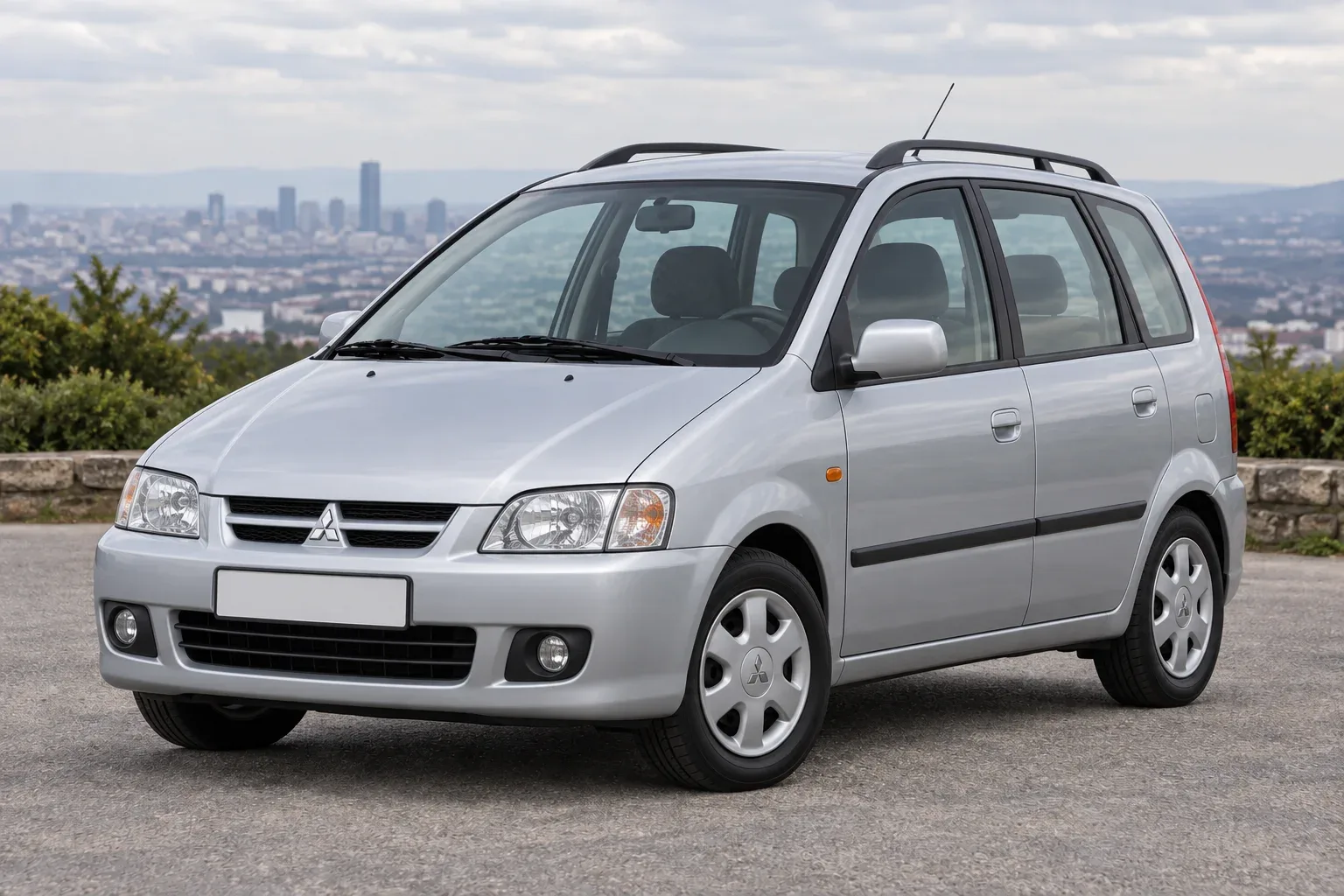
Many years ago, Mitsubishi’s core priorities looked different than they do today. Instead of the now fashionable SUVs and crossovers, vans were preferred at the time, including the Space Wagon and Space Runner. In 1998, Space Star was introduced.
2What buyers check
Review
Many years ago, Mitsubishi’s core priorities looked different than they do today. Instead of the now fashionable SUVs and crossovers, vans were preferred at the time, including the Space Wagon and Space Runner. In 1998, Space Star was introduced. The family car was built on the platform of Carisma, a fully European Mitsubishi. The European models were produced at the Dutch company NedCar, which was jointly built with Volvo, where twins Volvo S40 and V40 were assembled. The creators of Mitsubishi Space Star decided to offer maximum space in a minimum area. Although the car seems to be significant, it is actually only four meters long. But the height of the Space Star is more than 1.5 meters. In 2002, Space Star was updated. Mitsubishi refreshed the body, in particular the front part, which received small headlights with a darkened background, a black grille and a bumper with otherwise located air intakes. There were more attractive lights behind. The aesthetics inside Stara have also been improved and the set of equipment has been expanded. It is worth emphasizing the fact that the equipment of the car is quite decent. Air conditioning is already included in the list of basic equipment. Also, it was not necessary to pay extra for the onboard computer, central lock, electric windows and mirrors. It is a pity that ESP and adjustment of the steering column on departure were not provided. It would be safer and more comfortable. The interior is made of solid grades of plastic. The front panel, as in other models of Mitsubishi, is designed in the spirit of minimalism, without frills.
Engines
Under the hood hit the Mitsubishi gasoline engines with a working volume of 1.3 liters (82 and 86 hp), 1.6 liters (98 hp) and 1.8 liters (112 and 122 hp) and the Renault 1.9 DI-D turbodiesel (102 and 115 hp).
The greatest caution should be exercised on the 122-horsepower 1.8 GDI. This is the first engine with direct fuel injection. The innovative design allows you to save fuel well, but only during very gentle driving. The method of supplying gasoline contributes to the deposition of coke in the intake manifold. The nozzles are expensive and very sensitive to fuel quality. The engine design makes it difficult to install gas equipment, since the injectors are cooled with fuel and, therefore, a complete shutdown of the fuel supply is impossible. In the updated Space Star, the complex 1.8 GDI gave way to the classic 1.8 MPI.
The 1.3-liter engine for a 1.2-ton van is too weak. The 1.6 liter engine is more dynamic, but better than all the 1.8 MPI (2003-2005) French turbodiesel 1.9 DI-D is quite reliable, but with increasing mileage, the likelihood of failure of the turbine, nozzles or double flywheel increases.
Walking
The Mitsubishi Space Star suspension is a combination of McPherson in the front and the "multi-lever" in the rear. The suspension settings do not have to be fast driving. The Space Star is showing insufficient rotation. However, it should be noted that Mitsubishi is doing better on the road than its French competitors. The load capacity is only 460 kg. This should not be forgotten, loading the car to the end before traveling to the country. Excessively overloaded chassis unpleasantly breaks through on irregularities.
Other problems and malfunctions
Old Mitsubishi models are famous for their reliability. However, the European version, unified with separate components of Renault and Volvo and assembled at the Dutch plant NedCar, did not perform well.
Unfortunately, many drivers complain of a complex scheme of gear selection and difficulty with turning on the reverse, accompanied by grinding. Diesel engines often lose oil. A big problem for owners of Space Star are equipment failures: control unit electric windows, light switch, display onboard computer, electric motor headlight corrector. The average service life has stabilizer racks, suspension sleeves, front bearings and hand brake. Corrosion primarily attacks the trunk lid, hood and rear wings.
German car club DEKRA has strongly criticized Mitsubishi Space Star for the high number of malfunctions in the van segment. Worse yet, all major components were producing their life ahead of expected time. The weakest point was the brake system. After 100-150 thousand km of repair required about 40% of the Space Star. DEKRA specialists most often identified wear of brake pads and defects of brake hoses. Often there were cases of breakage of the suspension springs and the SRUS - due to moisture getting under the anther.
Spare parts are not cheap and the range of substitutes is small. But the basic parts and consumables can be purchased without difficulty for reasonable money.
3Pre-purchase checklist
Engines
- The greatest caution should be exercised on the 122-horsepower 1.8 GDI.
Walking
- However, it should be noted that Mitsubishi is doing better on the road than its French competitors.
Other problems and malfunctions
- A big problem for owners of Space Star are equipment failures: control unit electric windows, light switch, display onboard computer, electric motor headlight corrector.
- Corrosion primarily attacks the trunk lid, hood and rear wings.
- German car club DEKRA has strongly criticized Mitsubishi Space Star for the high number of malfunctions in the van segment.
- The repairs required about 40% of the Space Star.
- DEKRA specialists most often identified wear of brake pads and defects of brake hoses.
4Challenges of selling privately
The Mitsubishi Space Star is not a classic minivan. Because of its size and design, it is rather a cross between a classic wagon and a compact van. The car is not without drawbacks, but the advantageous combination of price and functionality allows you to close your eyes to this.
- good equipment for most of the copies
- less functional space than in other vans
- relatively high operating costs
- Many years ago, Mitsubishi’s core priorities looked different than they do today.
- Engines: Under the hood hit the Mitsubishi gasoline engines with a working volume of 1.3 liters (82 and 86 hp), 1.6 liters (98 hp) and 1.8 liters (112 and 122 hp) and the Renault 1.9 DI-D turbodiesel (102 and 115 hp).
- Driving: The Mitsubishi Space Star suspension is a combination of McPherson in the front and the "multi-lever" in the rear.
- Other problems and malfunctions: A big problem for owners of Space Star are equipment failures: the control unit of the electric windows, the light switch, the display of the onboard computer, the electric motor of the headlight corrector.
Shows, bargaining and re-registration take time: buyers look, promise to think and disappear. Fair price after inspection closes the auction on the spot. If money is needed urgently, the purchase takes away waiting and repeat displays.
5How selling to us works
Leave a request with the car data. We will discuss the preliminary assessment and inspection. After checking the status and documents, we agree on the final price and terms of the transaction.