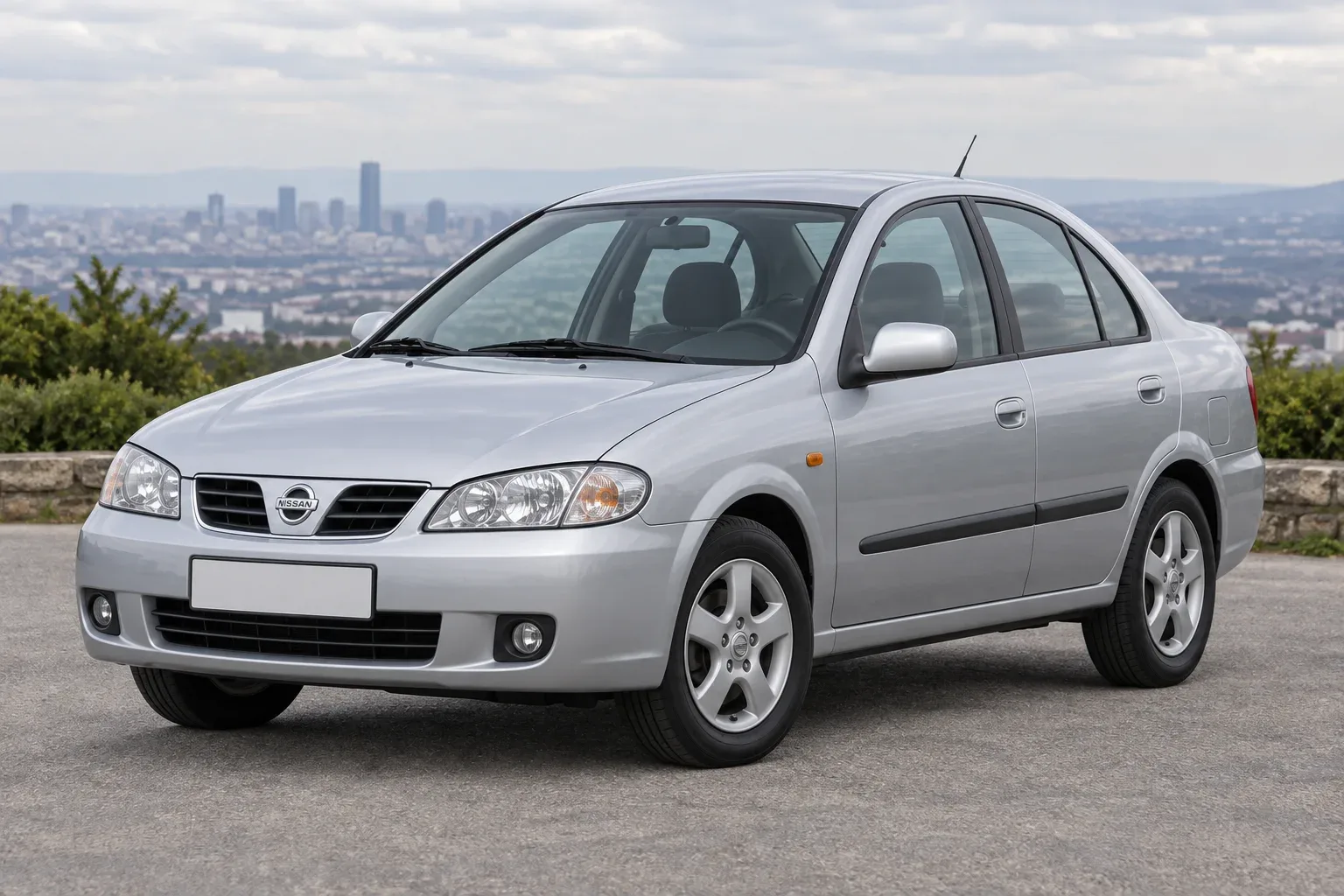
Nissan Almera N16
Valuation of the Nissan Almera N16 (2000–2006): condition, paperwork, inspection and terms of sale.
Indicative purchase price
Below market value
Final price agreed after inspection.
Value my car1Why buyers choose this model
In 1999, Nissan introduced a new version of its successful but little-adorable Almera N15. The successor to the N16 was a pleasant surprise – the appearance of the car has improved significantly. Unfortunately, Nissan’s partnership with Renault has undoubtedly affected the quality of the new Almera. It later emerged that Japanese reliability was only a vague memory, and daily communication with Almera is not as serene as before. Nissan Almera N16 debuted in two body options: 3-door and 5-door hatchback. In 2001, a version appeared - a sedan. The second-generation Almera offers a large amount of space in both the front and rear seats. Both hatchbacks have an identical boot capacity - 328 liters. Although the sedan has a larger trunk of 393 liters, but against the background of classmates – this is a modest result. For comparison, the capacity of the luggage compartment of the Opel Astra I is 460 liters, and the Ford Focus I is 490 liters. The front panel looks quite modern. After restyling in 2002, the quality of finishing materials has significantly improved. Satellite navigation and a large display in the center of the panel were available as an option. The watch received a silver edge, and the steering wheel - a new shape, as well as the gear lever. The changes also affected the control panel of the audio system and climate control. European organization EuroNCAP, engaged in research in the field of vehicle safety, rated the safety of Nissan Almer at four stars out of five possible.
2What buyers check
Gasoline
The line of gasoline units is represented by 16-valve engines with a working volume of 1.5 l / 90 hp (QG15DE) and 1.8 l / 114 hp (QG18DE).
After modernization in 2002, the engines received the NVCS (Nissan Valve Timing Control System) phase change system, and their power increased to 98 hp and 116 hp, respectively.
The main problem of both engines is the growth of oil carbon monoxide (up to 1 liter per 1000 km) after 200-300 thousand km. Replacement of the sturdy rings and sulphurized oil caps. Repair of the engine will cost 30-50 thousand rubles.
In addition, both units have a valve timing drive chain. It tends to stretch after 200-300 thousand km. At the same time, there is a characteristic rattling, power drops, and errors appear on the position of the camshaft and crankshaft. To replace the chain drive valve timing will need 25-30 thousand rubles.
Other typical malfunctions affect the ignition coils (1-3 thousand rubles), the lambda probe (3-6 thousand rubles), the sensor of the position of the crankshaft and camshaft (1-2 thousand rubles).
The valve clearance is adjusted by selecting pushers or adjusting washers (both options were used).
After 300,000 km, the starter brushes wear out (500-3000 rubles for a new brush assembly).
With age, the radiator is also handed over (5-19 thousand rubles).
Diesel
Some problems have also affected diesel engines, in particular the 110-horsepower 2.2 Di (YD22DDT) with direct injection of fuel of Nissan's own production. The biggest drawback of this engine is the VP44 TNVD, which rarely exceeds 200,000 km. Its cost is about 30 000 rubles. By today’s standards, the Japanese diesel engine lacks dynamics.
2.2 dCi (YD22DDTi) – created in cooperation with Renault. In fact, it is a modernized Nissan engine: the turbodiesel is equipped with a Common Rail type injection system and a turbocharger with variable geometry. The power unit has a capacity of 136 hp and demonstrates good performance. However, diesel is more sensitive to fuel quality, which determines the durability of injectors. The increase in power was achieved, including due to the turbocharger with variable geometry, which is much more expensive to repair.
Connoisseurs of economical driving will enjoy the 1.5 dCi produced by Renault. Its maximum power is 82 hp, and a sprint to hundreds takes 14.5 seconds. The average fuel consumption is about 4.5 l/100 km.
The 1.5-liter diesel is sensitive to fuel quality. After 100-150 thousand km, the probability of needing to replace Denso fuel injectors increases. Unfortunately, the manufacturer did not provide for the possibility of restorative repair.
After 150-200 thousand km, the turn of the turbocharger can come.
In addition, there are cases of turning the liners and failure of the fuel pump. However, this engine is usually praised by owners.
Transmissions
In standard equipment, all engines work in tandem with a 5-speed manual transmission, except for the 136-horsepower 2.2 dCi, which is combined only with a 6-speed. Fans of the “automatic” will find it in versions with gasoline engines with a working volume of 1.8 liters.
The clutch of a manual transmission usually serves over 200,000 km. The new set can be purchased for 5-8 thousand rubles, and for the work on replacement in the service will ask 5-6 thousand rubles.
The next step may be to fail the manual transmission, paired with the atmospheric 1.5 / QG15DE. The bearings and shafts wear out prematurely.
The machine is much more durable and less often sent for repairs. The first serious malfunctions of automatic transmission occur after 250-300 thousand km.
Walking
It is worth noting that the Almera is not too rigid and absorbs irregularities well. On the rear axle applied a non-standard solution – the so-called “Scott-Russell mechanism”. Thanks to the system of levers applied to the torsion beam, the behavior of the car at high speed improves, including during cornering with poor surface.
Silent blocks of rear suspension reach up to 300,000 km.
Ball supports and Silent blocks of the front axle are less tenacious. Factory lived up to 150-200 thousand km, analogues go about 50-100 thousand km.
A similar weight in the service life have and hub bearings. The rear ones change in collection with a hub (3-13 thousand rubles), and the front ones are separately (1500 rubles plus 1000 rubles for work).
At the interval of 200-300 thousand km, external and internal SRUS (2-7 thousand rubles) are updated.
After 200-250 thousand km can knock or leak the steering rack. The cost of the repair kit is about 2000 rubles. The new rack is available for 18 000 rubles, the original is more expensive - more than 40 000 rubles.
Attention may require and the lower cross of the steering shaft (2000 rubles with work).
In versions with 1.5dCi, there is a probability of failure of the electrohydraulic pump of the power steering.
Other problems and malfunctions
All body modifications are connected by one big problem - corrosion. However, thanks to the efforts of the manufacturer, compared to the previous generation, the defect took a smaller scale, but it was not possible to completely get rid of the disease.
Despite the fact that the body is galvanized, rust affects many of its elements: the rear wings, rapids, bottom and even the supporting glasses of the front shock absorbers.
Corrosion is merciless to the exhaust system (8,000 rubles for an analog or 40,000 rubles for the original).
3Pre-purchase checklist
Gasoline
- The main problem of both engines is the growth of oil carbon monoxide (up to 1 liter per 1000 km) after 200-300 thousand km.
- Replacement of the sturdy rings and sulphurized oil caps. Repair of the engine will cost 30-50 thousand rubles.
- Other typical malfunctions affect the ignition coils (1-3 thousand rubles), the lambda probe (3-6 thousand).
Diesel
- Some problems also affected diesel engines, in particular the 110-horsepower 2.
- The increase in power was achieved, including due to the turbocharger with variable geometry, which is much more expensive to repair.
- The probability of needing to replace Denso fuel injectors increases.
- Unfortunately, the manufacturer did not provide for the possibility of restorative repair.
Transmissions
- The machine is much more durable and less often sent for repairs.
- The first serious malfunctions of automatic transmission occur after 250-300 thousand km.
Walking
- A steering rack can be knocked or leaked.
- The cost of the repair kit is about 2000 rubles.
Other problems and malfunctions
- All body modifications are connected by one big problem - corrosion.
- Despite the fact that the body is galvanized, rust affects many of its elements: the rear wings, rapids, bottom and even the supporting glasses of the front shock absorbers.
- Corrosion is merciless to the exhaust system (8,000 rubles for an analog or 40,000 rubles for the original).
4Challenges of selling privately
Serious malfunctions, requiring high costs to fix, have undermined the confidence of many fans of Japanese brands in the Nissan Almera N16 series. Attempts to attract new customers through modern stylistic solutions were unsuccessful. Nissan engineers have never been able to create a model that is more reliable than its predecessor. The Almera body is prone to corrosion and petrol engines consume too much oil. But on the other hand, a well-kept specimen gives a chance for long and trouble-free operation. Among the advantages are reasonable price and good equipment.
- Transmissions: The machine is much more durable and less often sent for repairs.
- Driving: a km can be knocked or leaked by a steering rack.
- Other problems and malfunctions: All body modifications are connected by one big problem - corrosion.
Shows, bargaining and re-registration take time: buyers look, promise to think and disappear. Fair price after inspection closes the auction on the spot. If money is needed urgently, the purchase takes away waiting and repeat displays.
5How selling to us works
Leave a request with the car data. We will discuss the preliminary assessment and inspection. After checking the status and documents, we agree on the final price and terms of the transaction.