
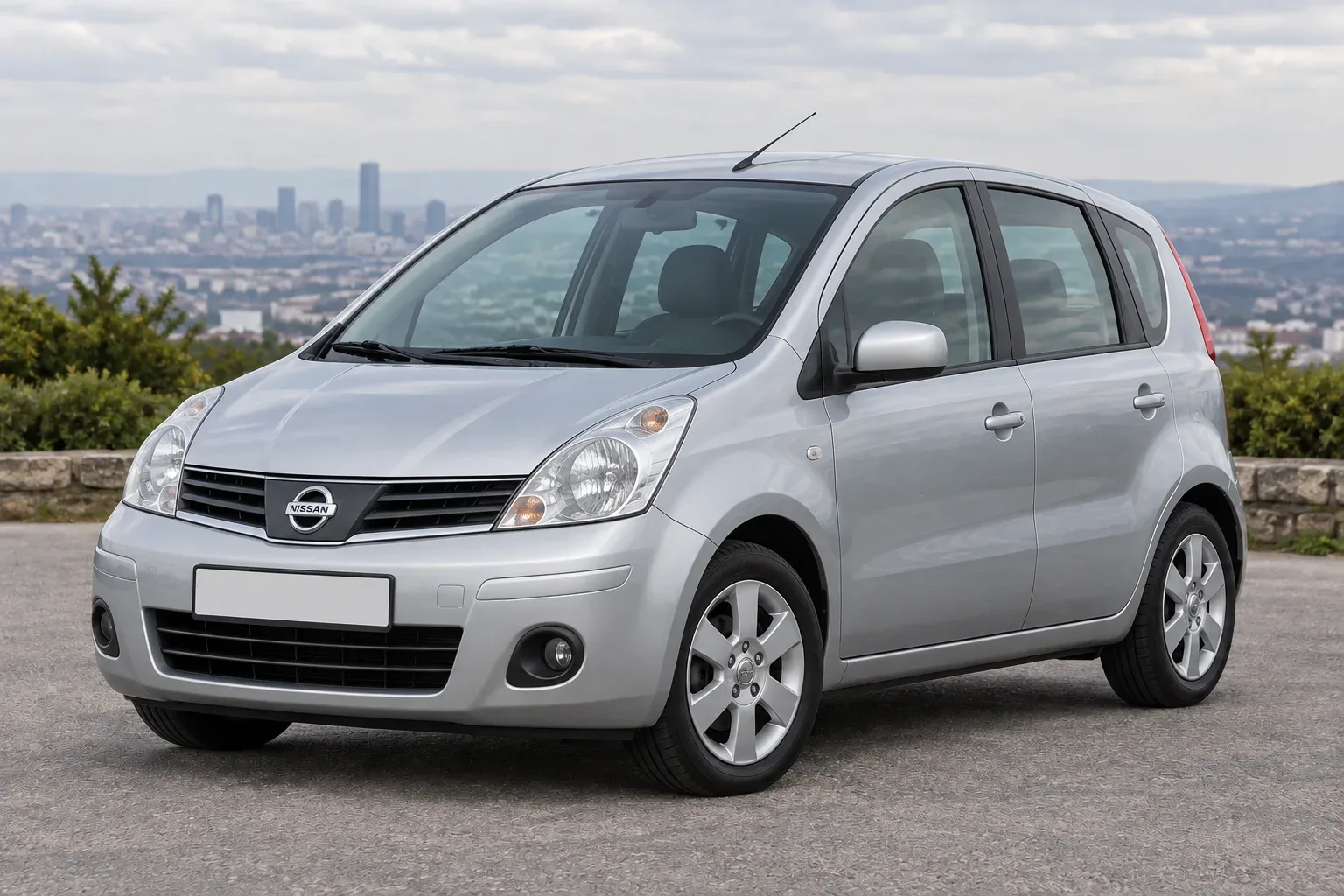
Nissan Note 1 / E11
Valuation of the Nissan Note 1 / E11 (2004–2013): condition, paperwork, inspection and terms of sale.
Indicative purchase price
Below market value
Final price agreed after inspection.
Value my car1Why buyers choose this model
Nissan Note is not a typical compact car, but a subcompact van, which means a subcompact minivan. Therefore, it has a modest size (body length is only 409 cm). In terms of sales, the subcompact van did not break records, but, nevertheless, it lasted on the conveyor for nine years. The last instance left the factory in 2013. Until then, the model managed to update in 2009. The Nissan Note began assembly in 2004, and only two years later the subcompact van reached the European continent. The car was manufactured at Nissan’s Sunderland, UK plant. The car was created in close cooperation with Renault and built on the platform of the Renault Grund Moduse. In addition, the diesel engine received the French pedigree. The laptop has a properly planned interior that fascinates with a significant space inside. The large wheelbase provides space for passengers on the back sofa. In addition, the second row seats can move in the longitudinal direction, increasing or decreasing the volume of the trunk. The trunk itself has a double bottom. If necessary, you can fold the back of the rear seat, while forming an almost flat surface. The equipment by class standards is rich. The car was available in three trim levels: Visia, Acenta and Tekna. All the copies were equipped with at least air conditioning, and the top version - automatic climate control.
2What buyers check
Engines
The powertrain line includes two petrol (1.4 and 1.6 liters) and one diesel (1.5 dCi in various power options) engine. Among gasoline engines, the most preferred 1.6-liter HR16DE. 88-horsepower 1.4 l CR14DE is too weak - overtaking is protracted and unsafe. 110-horsepower 1.6 l is much better cope with the weight of the car due to higher torque (25 Nm). It consumes a little more fuel, but the difference is insignificant. Petrol 1.4 and 1.6 have a chain drive of valve timing. But the chain of atmospheric 1.4 is less durable. Its replacement may be needed after 150-200 thousand km. In addition, the 1.4-liter unit suffers from oil leaks through the laying of the valve cover, the glands of candle wells or from under the bolts of the phaser valve flanges. Gasoline 1.6 liters this ailment is not familiar. The supports of both power units are in disrepair closer to 200,000 km. But the most unpleasant feature of the 1.4 gasoline is the increase in oil consumption after 160-200 thousand km. At best, the oily jelly can be defeated by replacing oil caps. Sometimes you have to update the oil rings. In the worst case, owners are forced to change the engine to a contract. The French diesel is the well-known 1.5 dCi, which debuted in 2001. Unfortunately, this turbodiesel can not boast of an impeccable reputation. The thing is that this unit has not got rid of the congenital disadvantage - the twisting of rod liners. Not all mechanics willingly take up repairs, preferring to change worn parts entirely.
Transmission
Gasoline 1.4 and 1.6 were combined with a 5-speed manual transmission. 4-speed automatic was offered only with 110-horsepower 1.6.
The clutch of the manual transmission usually travels over 150-200 thousand km (about 15 000 rubles with work). Often resort to replacement of clutch forced worn-out squeezing bearing (5000 rubles). Difficulties with switching are sometimes caused by biting the cable of the gear selection mechanism.
One of the common defects of mechanics working in pair with 1.4 is noise (rattling) at idling speeds, which disappears when pressing the clutch pedal. The disease manifests itself after 50-100 thousand km, and the probable sources are bearings of shafts or axial backlash of the input shaft. Some managed to get rid of extraneous noise after changing the type of transmission fluid. The presence of a flaw does not affect the resource of the manual transmission.
The Jatco machine shows good reliability. Rare cases of repairs occur after 250-300 thousand km (about 100 thousand rubles). But there are boxes that reached without intervention up to 400-480 thousand km.
However, after 140-180 thousand km from time to time there is a box hovering when switching from the first to the second gear. The culprit is a rotten lowering resistor (2500 rubles), which is installed on the left spangeron.
Walking
On the front axle of Nissan installed Macpherson struts, and on the rear - elastic beam.
Silent blocks of front levers and ball supports are surrendered closer to 80-120 thousand km. The Silen blocks of the rear beam and the front subframe usually live up to 150-200 thousand km. Weared elements can be replaced separately (600-800 rubles for a ball or Silentblock).
Front shock absorbers (from 1500 rubles) with bearings (from 500 rubles) reach 100-150 thousand km. Rear shock absorbers usually live longer.
After 150-200 thousand km can burst one of the front springs (from 2000 rubles).
After 100-150 thousand km, you may have to replace the hub bearings (500-900 rubles). They change separately from the hubs.
In cars with automatic transmission after 50-100 thousand km, sometimes a foreign knock was found. This is the result of a constructive miscalculation - the upper node of the mounting of the left thrust of the subframe collapsed on the spangeron. The cost of repair is about 6000 rubles.
In Nissan Note, the start of production quickly surrendered the steering rack, which was changed at the expense of the manufacturer during the warranty service period. In other cars, its repair or replacement may be necessary after 200-250 thousand km. (from 7000 rubles for an analogue and 40 000 rubles for the original).
External SRUS can make noise in 100-200 thousand km (from 2000 rubles). And after 150-200 thousand km, the left semi-axis can break. Destruction occurs in the area of balance (stabilizing gum). The original semi-axis is available for 33 000 rubles, and the analogue - for 12 000 rubles.
Other problems and malfunctions
In chairs with combined upholstery after 1-4 years, cracks on the inserts from the leather substitute could appear. When contacting the service, the upholstery was changed under warranty. Sometimes water gets on the driver or front passenger during maneuvers. It's condensation that accumulates under the ceiling. In the salon, water seeps through the fastening of the solar visor. After 150-200 thousand km often soured the mechanism of drive of the front or rear windshield wiper. Usually, it is possible to restore the wiper's operability after disassembly, cleaning and lubrication of the mechanism. The windscreen washer with age ceases to work due to burnt contacts on the steering switch. Many note the inefficient work of the heater - in winter it is cold in the cabin. Most often, complaints are heard from owners of cars with a base 1. 4. Some help washing or replacing the radiator heater, others cost a replacement of the radiator cover. But more often the problem remains unresolved, going to the list of features of the model. One of the reasons for the penetration of cold air into the cabin is a shrivelled seal at the entrance point of the air conditioning tubes into the motor shield. After 150-200 thousand km, the backlight of the climate control handles begins to periodically fade. The reason is a poor soldering of resistors that must be soldered again. Soon, the fan of the heater is also handed over (5000 rubles) or its resistor (700 rubles). Sometimes the failure of the heater engine is to blame for the melted connector. A little later, the wiring in the protective corrugated between the body and the trunk lid is interrupted, because of which the rear wiper, trunk lock or glass heating ceases to work.
3Pre-purchase checklist
Engines
- Its replacement may be needed after 150-200 thousand km.
- Not all mechanics willingly take up repairs, preferring to change worn parts entirely.
- What further aggravates the situation is the failure of auxiliary equipment: wear of the turbocharger, nozzles, problems with camshafts and oil leaks.
- The cost of fixing any of these malfunctions starts at a few hundred dollars.
- It is definitely necessary to change the oil more often and regularly - at least once every 8-10 thousand km.
- But it happens that they are given up earlier, and repairs are not always effective. A necessary condition for longevity 1.
Transmission
- km, and the probable sources are bearings of shafts or axial backlash of the input shaft.
- Rare cases of repairs occur after 250-300 thousand km (about 100 thousand rubles).
- The culprit is a rotten lowering resistor (2500 rubles), which is installed on the left spangeron.
Walking
- Sometimes a foreign knock was found.
- This is the result of a constructive miscalculation - the upper node of the mounting of the left thrust of the subframe collapsed on the spangeron. The cost of repair is about 6000 rubles.
- In other vehicles, repair or replacement may be necessary after 200-250 thousand km.
Other problems and malfunctions
- In chairs with combined upholstery after 1-4 years, cracks on the inserts from the leather substitute could appear.
- Some help washing or replacing the radiator heater, others cost a replacement of the radiator cover.
- But more often the problem remains unresolved, going to the list of features of the model.
- The reason is a poor soldering of resistors that must be soldered again.
- Sometimes the failure of the heater engine is to blame for the melted connector.
- Over time, the steering train wears out (from 1000 rubles), which leads to the failure of the buttons on the steering wheel, and the indicator of the malfunction of the airbags burns.
4Challenges of selling privately
On the secondary market there are copies sold by official dealers, as well as imported from Japan and Europe. European models, as a rule, have the most powerful engines and very good equipment. At the same time, imported Notes in the past often had body repairs - the consequences of an accident. Should I buy a Nissan Note of the first generation?
If the car is sold through a dealer network in Russia, has a 1.6-liter gasoline engine, and at least some confirmation of the reality of mileage, then yes – it is worth it. The imported cars have a dubious past, and the real mileage is a terrible secret covered in darkness. Buying such a copy may soon turn into an unexpected repair.
As for repairs, the prices for original spare parts are not overstated, and most of them are made in Europe. There are plenty of cheap substitutes on the market.
- Engines: It may need to be replaced after 150,000 to 200,000 km.
- Transmission: km, and the probable sources are bearings of shafts or axial backlash of the input shaft.
- Walking: sometimes a foreign knock was detected.
- Other problems and malfunctions: In chairs with combined upholstery, after 1-4 years, cracks in the inserts of the leather substitute could appear.
Shows, bargaining and re-registration take time: buyers look, promise to think and disappear. Fair price after inspection closes the auction on the spot. If money is needed urgently, the purchase takes away waiting and repeat displays.
5How selling to us works
Leave a request with the car data. We will discuss the preliminary assessment and inspection. After checking the status and documents, we agree on the final price and terms of the transaction.