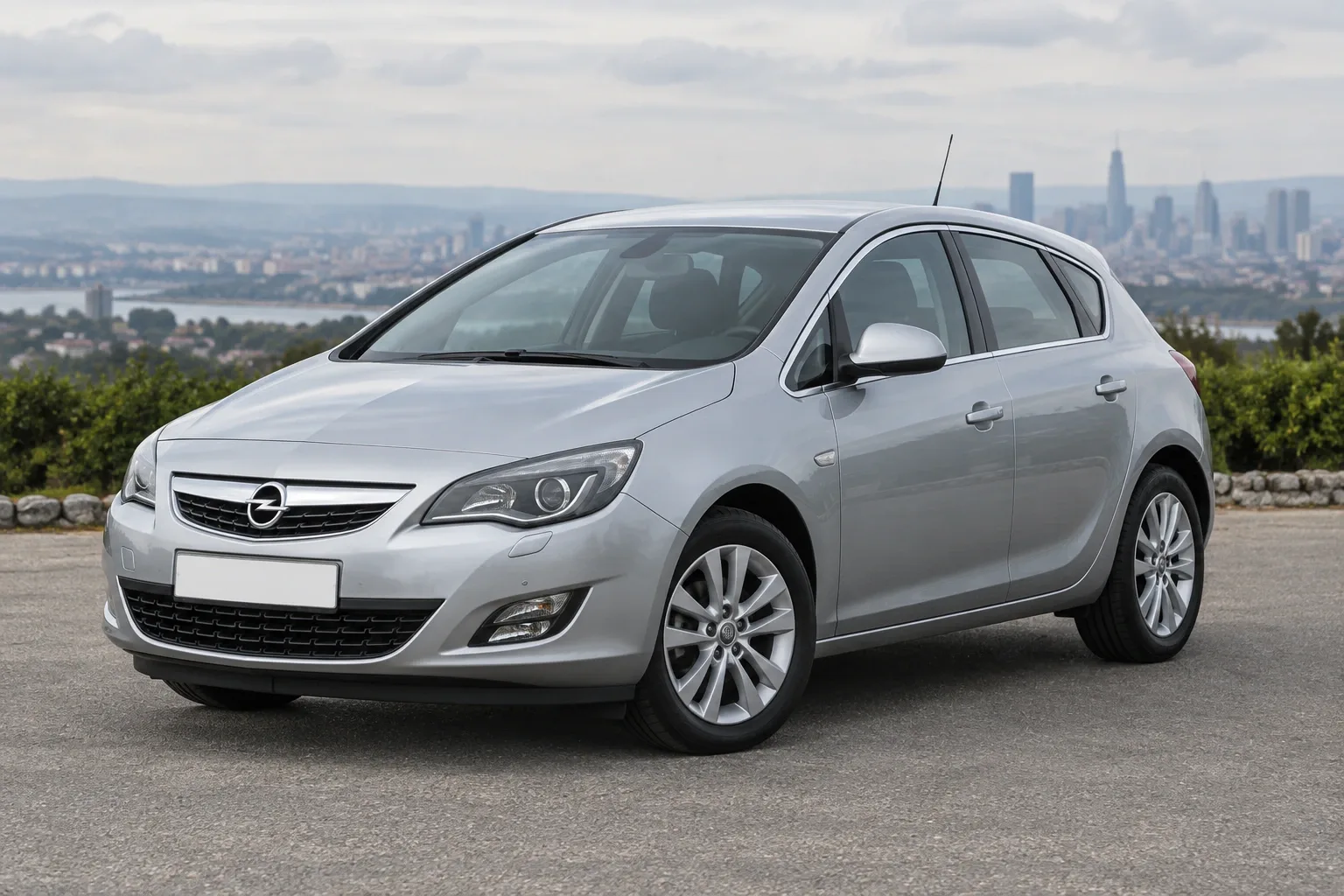
Opel Astra J
Opel Astra J (2009–2018): Status, documents, inspection and conditions of sale of the car.
Indicative purchase price
Below market value
Final price agreed after inspection.
Value my car1Why buyers choose this model
Opel cars have a large circle of fans, but nowadays it is increasingly difficult to count on customer loyalty. They go where the cheaper, more beautiful, more reliable and longer warranty. What does the Opel Astra IV offer? One look is enough to understand that one of the strengths of the model is appearance. The car does not look colorful, but it causes some sympathy. The salon also makes a good impression. The front panel has interesting lines, and good materials are used in the design (by class standards). Despite the rather large size inside the Opel Astra is not too spacious. Especially acutely this disadvantage is experienced by passengers on the back sofa - the knees touch the backs of the front seats. It should be recognized that the front seats are in abundance, and the chairs provide a high level of comfort. Two people in the back will also feel great if they are short. But narrow doors make it difficult to get into the car. Another disadvantage is that there are too many buttons on the center console. Some of them do not allow you to understand the purpose at an intuitive level - to understand the functionality will help the manual. This is a typical problem of Opel cars of this period. Stylish design and good quality. In the photo, the Opel Astra salon with a mileage of 230,000 km.
2What buyers check
Engines
The range of Opel Astra engines has about 20 units. But not all of them are worth the recommendations. The list of gasoline engines open representatives of 1.4 and 1.6 liters. Even very calm drivers will find them too boring. So the 1.4-liter version with a capacity of 100 hp accelerates to 100 km / h in 14.1 seconds (according to tests), and to reduce the interval between 80 and 120 km / h it will take as much as 30 seconds! For example, the 100-horsepower Ford Focus takes only 15.3 seconds to do this. The consolation will be acceptable fuel consumption. 1.4-liter engine is enough 6.7 liters per 100 km. What is the reason for the "sluggishness"? The secret is the huge mass of the car. The lightest 1.4-liter version weighs 1.4 tons. That's too much. Some modifications with more powerful engines have a weight of almost 1.7 tons! This result is comparable to small crossovers. One popular source of traction is the turbocharged 1.4-liter engine. For the same reason as the atmospheric, it is not capable of demonstrating the wonders of dynamics. However, this modification is much more pleasant in management. Acceleration to 100 km / h takes about 10.4 seconds. With a reasonable rhythm of movement Opel Astra 1. 4T consumes, on average, about 7 l / 100 km. Those who are counting on really good dynamics, you should look for cars with a 1.6-liter turbo engine. This is a very good model, but is extremely rare. 2-liter turbo engine was designed for a sports version of the ORS. 4th Astra, traditionally for Opel, had a wide range of diesel units, which are not officially offered in Russia.
Common faults
While atmospheric gasoline engines pose almost no problems, stronger turbocharged modifications have a number of weaknesses. For example, the intake manifold is an early instance of 1.4 T. There are also frightening incidents - the destruction of one of the pistons and, as a result, bullies in the cylinder. The cost of repair, depending on the scale of damage, ranges from 30 to 60 thousand rubles. In rare cases, mechanical breakdowns of the turbocharger cost 40-60 thousand rubles occur.
It should be noted that serious malfunctions of turbo engines and automatic machines are not mass in nature, and among them there are centenarians who have passed 300,000 km without notice.
Among the common problems, we can highlight the low durability of a number of components. In the first 100,000 km owners have to change the thermostat, expansion tank, coolant pump, cooling tubes of automatic transmission oil. After 100,000 km, the throttle assembly and ignition module wear out. At the same time, fogging or leaking from under the gasket of the valve cover, the gasket of the heat exchanger (oil cooler), engine glands and boxes (in the area of the drive shafts) is detected.
In 1.7 CDTI, the piston can form a soak, which leads to damage to the cylinder walls.
All Opel Astra diesel engines were equipped with a particulate filter. If you notice that the process of burning began to start too often (every 100-200 km), then most likely the nozzles failed. Fortunately, they are repairable. Turbines and fuel pumps have a decent lifespan.
Transmissions
Only the basic petrol versions (1.4/87 and 100 hp; 1.6/115-116 hp) were equipped with a 5-speed manual transmission. All the others used Fiat 6-speed mechanics (code M32). Its main problem is premature wear of bearings and differential. For comprehensive repairs in the walls of the "official service" will require about 50 000 rubles, in the usual - no more than 30 000 rubles. Remek Opel offers a full set of bearings, Fiatovskiy - allows you to purchase bearings separately.
The machine asks for the attention of its owner a little more often. The first signs he begins to give after 60-100 thousand km: there are kicks. The most common cause is premature wear of solenoids (electromagnetic valves) in the hydroblock. There is also a destruction of the wavy pressing disc. The cost of bulkheads - from 50 to 80 thousand rubles. To avoid trouble will allow regular change of oil in the box - every 60,000 km.
Walking
One of the advantages of Opel Astra is the chassis settings. The base version with classic shock absorbers offers a good compromise between comfort and stability. Optional adaptive suspension FlexRide with shock absorbers variable stiffness allows you to choose the optimal driving mode for the situation: sports or comfortable. However, repairing such a running machine will be very expensive.
The components of the chassis are quite strong. Many elements, such as ball, Silent blocks and steering thrusts, are capable of traveling 150,000 km. But the front shock absorbers and bearings sometimes do not reach up to 100,000 km. One of the common problems of the Astra J is knocking in the front of the car when passing irregularities. Official services, first of all, check the brake calipers. But often the source of noise is depreciation racks.
Sometimes the back springs are destroyed - the ends break. Often, this defect is not noticed by either the owners or the mechanics of service stations.
Typical problems and malfunctions
Modern buyers are more important parameter as the cost of operation, and comfort fades into the background. In this respect, Opel Astra is a kind of middle peasant. But let's start with merit. The body is well protected from corrosion, and the interior shows no signs of wear even after 100,000 km. Unless you can crack the patch on the automatic transmission selector.
The back is slightly larger than the Corsa. Tall people will be uncomfortable.
Electronics are moderately stable. But owners of used Opel Astra should periodically visit the official services to check whether it is time to update any software for free. Among the harmless comments can be noted burnout mat of heating the front seats and sometimes revived "crimes" in the cabin.
3Pre-purchase checklist
Engines
- For example, the 100-horsepower Ford Focus takes only 15.3 seconds to do this.
- Those who are counting on really good dynamics, you should look for cars with a 1.6-liter turbo engine.
Common faults
- While atmospheric gasoline engines pose almost no problems, stronger turbocharged modifications have a number of weaknesses.
- The cost of repair, depending on the scale of damage, ranges from 30 to 60 thousand rubles.
- It should be noted that serious malfunctions of turbo engines and automatic machines are not mass in nature, and among them there are centenarians who have passed 300,000 km without notice.
- Among the common problems, we can highlight the low durability of a number of components.
- At the same time, fogging or leaking from under the gasket of the valve cover, the gasket of the heat exchanger (oil cooler), engine glands and boxes (in the area of the drive shafts) is detected.
- If you notice that the process of burning began to start too often (every 100-200 km), then most likely the nozzles failed. Fortunately, they are repairable.
Transmissions
- Its main problem is premature wear of bearings and differential.
- For comprehensive repairs in the walls of the "official service" will require about 50 000 rubles, in the usual - no more than 30 000 rubles.
- The most common cause is premature wear of solenoids (electromagnetic valves) in the hydroblock.
- To avoid trouble will allow regular change of oil in the box - every 60,000 km.
Walking
- However, repairing such a running machine will be very expensive.
- One of the common problems of the Astra J is knocking in the front of the car when passing irregularities.
- Official services, first of all, check the brake calipers.
- Sometimes the back springs are destroyed - the ends break.
Typical problems and malfunctions
- The body is well protected from corrosion, and the interior shows no signs of wear even after 100,000 km.
- But owners of used Opel Astra should periodically visit the official services to check whether it is time to update any software for free.
4Challenges of selling privately
The pleasant appearance and wide choice of versions are important advantages of a compact car. But in the case of Opel Astra J, there are some defects that may be unplanned or annoying.
- Engines: The range of engines Opel Astra has about 20 units. But not all of them are worth the recommendations.
- Transmissions: Its main problem is premature wear of bearings and differentials.
- The repair of this car will be very expensive. The components of the chassis are quite strong.
- Typical problems and malfunctions: The body is well protected against corrosion, and the interior shows no signs of wear even after 100,000 km.
Shows, bargaining and re-registration take time: buyers look, promise to think and disappear. Fair price after inspection closes the auction on the spot. If money is needed urgently, the purchase takes away waiting and repeat displays.
5How selling to us works
Leave a request with the car data. We will discuss the preliminary assessment and inspection. After checking the status and documents, we agree on the final price and terms of the transaction.