Opel Corsa C
Opel Corsa C rating (2000–2006): condition, documents, inspection and conditions of sale of the car.
Indicative purchase price
Below market value
Final price agreed after inspection.
Value my car1Why buyers choose this model
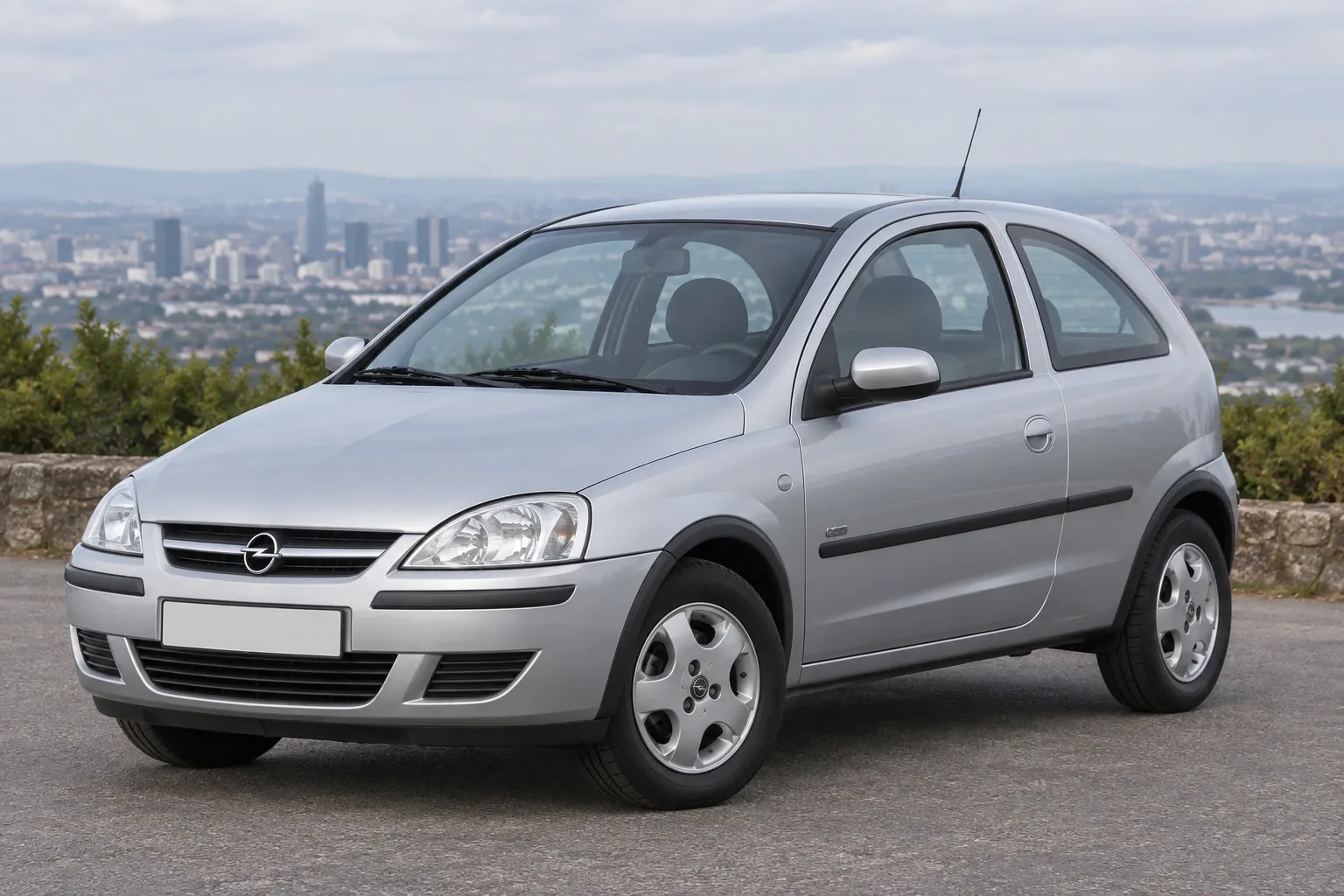
In Russia, reviews about Opel Korsa are not the best. So what is a Corsa bad car? Let's try to figure it out. The Opel Corsa C replaced the B series in 2000. Funny, it hasn’t changed much compared to its predecessor. Visually, at least. However, it is based on a fundamentally new platform, the wheelbase has increased by 45 mm, the interior has been updated, the equipment list has been expanded. However, the trunk lost 20 liters of volume - its capacity of 260 liters. Unfortunately, new does not mean attractive. The interior is painfully boring. Even in the lavishly equipped instances, the center console is just an old-fashioned pileup. The big steering wheel is not too beautiful either. The design of the body was not much different from the competitors of the time, although today it still looks quite attractive. However, the car is not without advantages. For example, a good space on the back of the sofa.
2What buyers check
Walking
Another plus of the Opel Corsa C is the comfortable suspension settings, which, on the other hand, are poorly suited for high-speed driving. The design of the running gear is not much different from its predecessor. On the front axle are Macpherson struts with a stabilizer and triangular levers. On the rear axle - torsion beam with spaced springs and shock absorbers.
The suspension is durable, unlike the steering rack - one of the sore points of the model. She's starting to knock. Fortunately, repairing it is neither expensive nor complicated.
With the suspension, almost nothing happens except the natural wear of the components. Front often have to deal with the bushings and racks of the stabilizer, and behind shock absorbers. In addition, with age, drives and wheel bearings make themselves felt.
Engines
Opel Corsa C has a wide range of power units. They all know each other well from their predecessor. The 1.0-1.4 litre petrol units were carried over unchanged, while the 1.7 DI and 1.7 DTI diesel units are the deeply upgraded Isuzu units - already with direct injection.
The engine palette was completely updated in 2003-2004. Gasoline engines with a capacity of 1.0 and 1.2 liters acquired Twinport technology, 1.4 liters belongs to the new series, and 1.7-liter DI and DTI gave way to 1.3 CDTI and 1.7 CDTI - with the Common Rail injection system.
The smallest of the engines is not very successful. This is a three-cylinder gasoline engine with a working volume of 1.0 liters. The engine is not distinguished by comfortable work, and its return is only 58 hp (60 hp). A much better choice is a 1.2-liter engine with a capacity of 75 hp, and even better – 1.4 l / 90 hp.
Opel can offer more powerful engines, such as 1.8 liters with 125 hp and 1.6 Turbo with 175 hp - for the ORS version.
Gasoline
The basic "litre", in addition to the relatively high fuel consumption, has not a sufficiently reliable chain drive of the timing. In addition, the 1-liter engine is noisy and very weak. the 1.2-liter unit is almost trouble-free, like a 1.4-liter engine. Engines 1.4 liters and 1.8 liters eventually begin to take oil.
Interestingly, the same set of GRMs is suitable for all versions 1.0, 1.2 and 1.4 Twinport. The problem of chain stretching concerns all these engines. Rapid wear contributes to aggressive driving style and delaying the timing of oil change. The old 1.4 has a slightly different timing system drive.
Among the common problems can be noted leakage of the oil sensor and the coolant pump. The latter was later refined, and leaks began to appear much less often.
Diesel
It is no secret that under the Opel index 1. 3 CDTI hides the technology Fiat called Multijet. This diesel debuted on the market in 2003, and fell under the hood only a year later - just after the restyling in 2003. 1.3-liter turbodiesel was created to reduce the size of the unit and increase the return due to the Common Rail injection system and a turbocharger with variable geometry. However, the Corsa received a simple version of the diesel with a capacity of 70 hp. and 170 Nm of torque, which was valuable in the entire range of engines, except for the sports ORS. 1.3 CDTI average consumption of 4.5-5 l / 100 km. It is noteworthy that at that time, a particulate filter was provided for this engine, but not for the Opel Corsa C. Theoretically, turbodiesel should not cause serious problems, since its design is generally successful. But only if operated under normal conditions and there is no torture. 1. 3 CDTI is a good alternative for a gasoline engine in the city, but operating a turbocharger requires complex maintenance and, above all, regular oil change. The manufacturer recommends changing it every 20,000 km, which is too much. It is no wonder that most engines are worn out and absorb a huge amount of oil. The oil level must be constantly monitored, as the lubrication system volume is only 3.2 liters. Even a small loss of oil has devastating effects on the engine. That is why many 1.3 CDTIs to 200,000 km are already severely worn out.
Transmission
All Opel Korsa front-wheel drive. In a pair of power units were installed 5-speed mechanics, 4-speed automatic or automated transmission Easytronic. The ICV clutch is quite gentle. It wears out relatively quickly, especially with a dynamic driving style. This element is relatively expensive and can not cope with the large flow of power of Italian turbodiesel. The vulnerable place in the manual transmission is a gentle fork of switching on gears.
It is not recommended to buy the Opel Corsa C with an automated transmission Easytronic, which almost always has problems with the software. Much safer 4-speed classic "automatic".
Typical problems and malfunctions
Of the minor diseases, it is worth noting the wear of the front windshield wiper mechanism. Another typical problem is a broken plastic lining at the bottom of the windshield. Owners are damaging it while trying to remove the battery. They're bending the plastic. You can't do that. First, you need to unscrew the wipers and remove all the plastic. Then on the left side you can check the flow of water. If it is clogged, the water will rush into the salon.
The electrician’s refusals are non-systemic, so there are no specific complaints. However, sometimes the actuator responsible for the level of passing beam of headlights fails, or the central lock begins to capricious: not all doors open.
The corrosion of the body is not as large as that of its predecessor. Usually, rust appears only on age cars. In addition, corrosion attacks elements of the exhaust system.
Petrol engines
*M – manual transmission, ET – Easytronic robot, A – machine gun
GSi and diesel engines
*M – manual transmission, ET – Easytronic robot, A – machine gun
3Pre-purchase checklist
Walking
- Fortunately, repairing it is neither expensive nor complicated.
- With the suspension, almost nothing happens except the natural wear of the components.
Gasoline
- The 1.2-liter unit is almost fault-free, like a 1.4-liter engine.
- The problem of chain stretching concerns all these engines.
- Rapid wear contributes to aggressive driving style and delaying the timing of oil change. The old 1.4 has a slightly different timing system drive.
- Among the common problems can be noted leakage of the oil sensor and the coolant pump.
Diesel
- Theoretically, turbodiesel should not cause serious problems, since its design is generally successful.
- The manufacturer recommends changing it every 20,000 km, which is too much.
- The oil level must be constantly monitored, as the lubrication system volume is only 3.2 liters.
- Even a small loss of oil has devastating effects on the engine. That's why many 1s.
- Problems can be caused by the EGR valve, which can be silenced without negative consequences for the engine. But for that, you need to reconfigure the ECU.
- And because of the incandescent candles and flowmeter, problems arise with starting a cold engine and power failures.
- Among the serious malfunctions should be noted damage to the head of the block, after the turbine began to throw oil.
Transmission
- It is not recommended to buy the Opel Corsa C with an automated transmission Easytronic, which almost always has problems with the software.
Typical problems and malfunctions
- Of the minor diseases, it is worth noting the wear of the front windshield wiper mechanism.
- Another typical problem is a broken plastic lining at the bottom of the windshield.
- First, you need to unscrew the wipers and remove all the plastic.
- Then on the left side you can check the flow of water.
- The electrician’s refusals are non-systemic, so there are no specific complaints.
- However, sometimes the actuator responsible for the level of passing beam of headlights fails, or the central lock begins to capricious: not all doors open.
- The corrosion of the body is not as large as that of its predecessor.
- Usually, rust appears only on age cars.
4Challenges of selling privately
The Opel Korsa in the third incarnation is a standing car for people who need an inexpensive vehicle. Operation will not require significant financial costs. It’s true that the Opel Corsa C isn’t flawless, but most faults can be fixed for ridiculous money.
- Walker: Fortunately, its repairs are not expensive or complicated.
- Engines: Opel Corsa C has a wide range of powertrains.
- Transmission: It is not recommended to purchase the Opel Corsa C with the Easytronic automatic transmission, which almost always has software problems.
- Typical problems and malfunctions: Of the minor diseases, it is worth noting the wear of the front windshield wiper mechanism.
Shows, bargaining and re-registration take time: buyers look, promise to think and disappear. Fair price after inspection closes the auction on the spot. If money is needed urgently, the purchase takes away waiting and repeat displays.
5How selling to us works
Leave a request with the car data. We will discuss the preliminary assessment and inspection. After checking the status and documents, we agree on the final price and terms of the transaction.