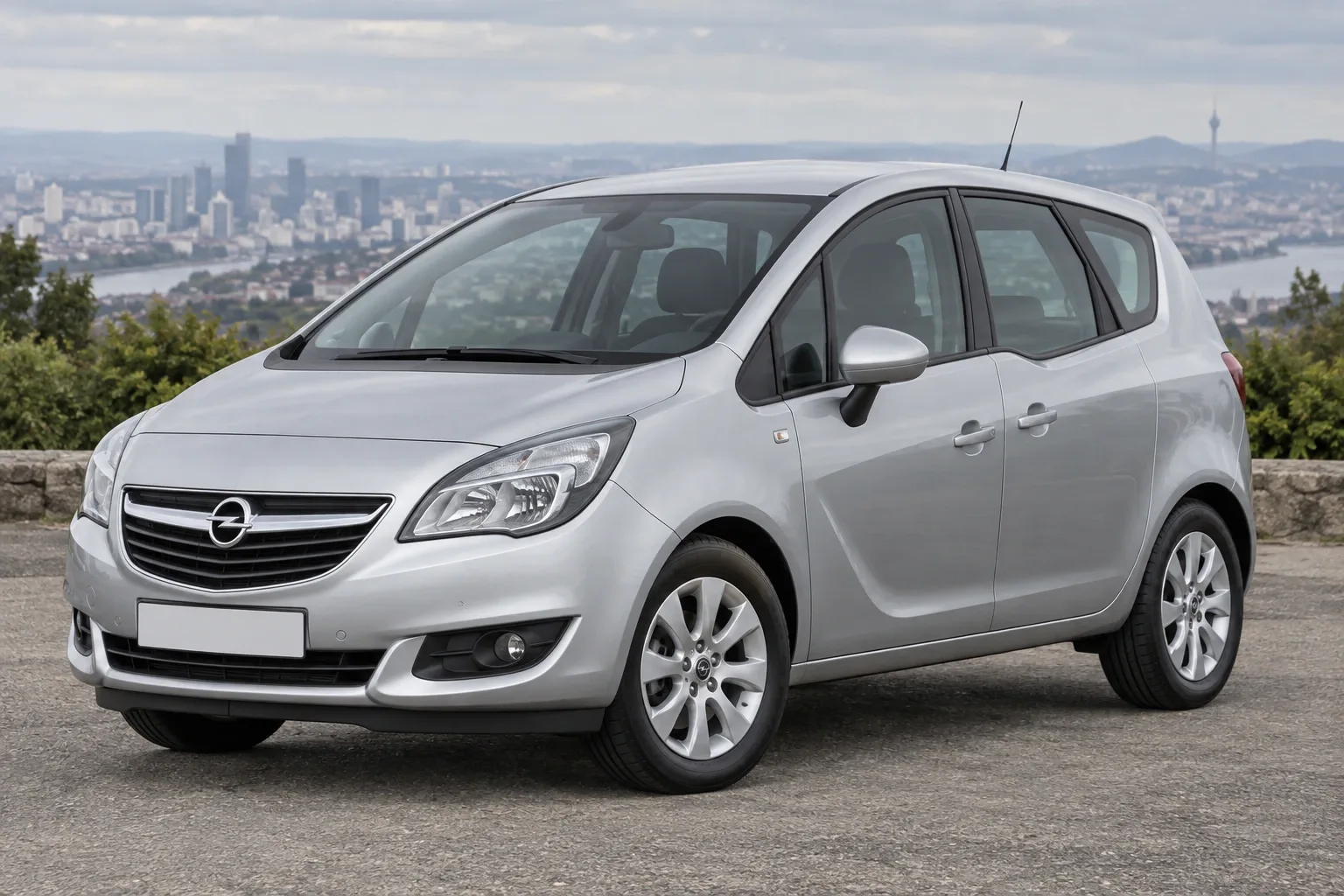
Opel Meriva B
Opel Meriva B (2010–2018): condition, documents, inspection and conditions of sale of the car.
Indicative purchase price
Below market value
Final price agreed after inspection.
Value my car1Why buyers choose this model
The second-generation Meriva Opel debuted at the Geneva Motor Show in 2010. The model came to Russia in the spring of 2011.
2What buyers check
Review
The second-generation Meriva Opel debuted at the Geneva Motor Show in 2010. The model came to Russia in the spring of 2011. Compact van was assembled in Kaliningrad by the method of large-assembly. The painted body and motor with a box were brought from Spain. Opel Meriva is the key model of the European small MPV segment. It was based on the redesigned Zafira B platform. One of the main features of Meriva is the FlexDoors swing doors. The back pair of doors opens against the direction of travel. Large doors attached to the rear pillars open to an angle close to 90 degrees. This facilitates access to the salon. The designers had to leave the middle racks to maintain the strength of the body. Other ways to increase the rigidity of the body would lead to an increase in the weight and cost of the car. The onboard electronics do not allow you to move with open or poorly closed doors. When the movement begins, the rear door locks are automatically locked (when reaching 4 km / h). If the door opens while driving or is not perfectly closed, the driver receives an audible warning. Maximum ergonomics of the interior space allowed to implement the system of transformation FlexSpace. It provides folding of the rear seats in one stage, as well as longitudinal movement (by 190 mm) of the outer seats independently of each other. In addition, a five-seater cabin can be turned into a four-seater, folding the middle section. Side seats can be moved back and to the center at the same time. This gives the rear passengers more freedom in their elbows. Basic luggage capacity of 400 liters.
Engines
The line of engines is represented exclusively by small units.
All gasoline engines have a volume of 1.4 liters, cast iron block, aluminum block head, timing system chain drive and adjustable phases of intake and exhaust valves.
The base 1.4 Twinport developed 100 hp (14XER).
The turbocharged 1.4 was offered in two power options – 120 hp (14NEL) and 140 hp (14NET).
The diesel lineup includes 1.3 CDTI/75-95 hp (A13DT) and 1.7 CDTI/100-130 hp (A17DT).
Both turbo diesels have a 16-valve aluminum block head with a 1800 bar Common Rail injection system.
In 2014, 1.3 CDTI recoil 95 hp gave way to the 110-horsepower 1.6 CDTI, which debuted earlier in the Opel Zafira Tourer. The all-aluminum turbodiesel B16DT is part of the GM Medium family of engines and meets Euro 6 emission standards.
Of the diesel variants in Russia, only the version with 1.7 CDTI was officially offered.
Petrol engines
Gasoline engines are relatively hot. The operating temperature of the coolant is 105 degrees. This is one of the many measures that allow you to fit into strict environmental regulations.
However, high temperatures significantly reduce the service life of seals, gaskets and plastic elements of engine attachments. As a result, owners periodically have to eliminate leakage of working fluids.
Among the consumables is a plastic fitting for the removal of coolant gases (1-2 thousand rubles), an expansion tank (2-3 thousand rubles), a heat exchanger gasket (11-12 thousand rubles with work), a valve cover laying (500-2000 rubles) and a thermostat body (2-5 thousand rubles).
The ignition module (7-10 thousand rubles per analogue) can fail after 100-150 thousand km.
Soon the absorber valve (2-4 thousand rubles) begins to fail - the turns float, and an error appears on the "poor mixture".
Disruptions in the operation of the gasoline engine may occur due to a faulty membrane of the valve ventilation of crankcase gases. The membrane is built into the valve cover (from 7000 rubles for an analogue plus 2-4 thousand rubles for work).
It does not differ in durability and pump (3-10 thousand rubles). It is also updated after 100-150 thousand km.
And after 80-120 thousand km can alert traces of oil in the area of the front crankshaft.
The gas distribution mechanism chain usually lasts a long time (about 6000 rubles per set). Nevertheless, after 150-200 thousand km of run there are isolated cases of its replacement, primarily in turbo engines.
1.4 Turbo
Owners of turbo versions sometimes faced major engine repairs due to the destruction of piston rings and partitions between the rings on the piston. If the walls of the cylinders are not affected, then about 40-50 thousand rubles will be needed for repair. If bullies are found, then the restoration of the engine will have to spend about 100-150 thousand rubles.
The main cause of the malfunction is detonation. It is provoked by poor-quality fuel, as well as engine oil that got into the cylinders. Opel later limited the range of oils allowed to the Dexos 1 Gen 2 specification. This type of oil contains special additives that prevent the oil from self-ignition when compressed under high temperatures.
Sometimes the turbine could also be of interest. Usually cracked hot part, which is combined with the exhaust manifold. The new turbocharger can be purchased for 50-90 thousand rubles.
Diesel engines
timing system 1.3 CDTI chain type. The chain is usually not bothered (about 5000 rubles), unless you lose control of the oil level. Lack of oil affects the performance of the chain tensioner.
The smallest diesel is quite weak, which is why it often works with heavy loads, which accelerates its wear. Vulnerable places include the valve of the exhaust gas recirculation system (9-11 thousand rubles).
1.7 CDTI is noticeably stronger and more enduring. It is based on the Isuzu turbodiesel.
A belt shall be used to drive the 1.7 CDTI gas distribution mechanism. The first replacement is recommended after 160,000 km or after 6 years. The cost of a new set: 6-7 thousand rubles for an analog or 17 000 rubles for the original.
In the long term, we should expect problems with the particulate filter, the exhaust gas recirculation valve (9-16 thousand rubles) and fuel injectors (10,000 rubles for repairs or 35,000 rubles for the original injector).
Transmission
Initially, all Opel Meriva B came with a 6-speed manual transmission. Only the gasoline atmospheric was satisfied with a 5-speed manual transmission. Later versions with a turbodiesel 1.7 CDTI return of 100 and 110 hp, and since 2013, versions with a gasoline turbo engine have been able to combine with a 6-band automatic. The clutch of the manual transmission usually serves more than 150-200 thousand km. The new set can be purchased for 13-22 thousand rubles. For work on the replacement will be asked in the range of 5-9 thousand rubles. The Opel manual transmission could make noise after 100-150 thousand km. The reason is premature wear of bearings. The problem is well known to many owners of Opel. The defect is typical for the M32 and F13 boxes. The cost of repairs is over 20 000 rubles. The automatic transmission is much more reliable. The AF40 is a Japanese Aisin TF-80SC machine gun. It has been used by many car manufacturers and has proven itself on the positive side. Only sometimes owners of cars with ACKP complain about the tremors (kicks) when switching. Some manage to beat the ailment after changing the oil, others are helped by a software update, and still others install an additional cooler for the box's oil. In extreme cases, you will need to replace the sealing rings of the shaft of friction packets (over 60,000 rubles). But in fact, it usually does not come to repair. The glands of the drives (200-600 rubles), regardless of the type of gearbox, can soot after 50-100 thousand km. Vibrations during movement sometimes occur due to wear of the internal SRUS (3-4 thousand rubles).
Walking
On the front axle are installed Macpherson struts, and on the back - an elastic beam.
Silent blocks of the front levers usually reach 100-150 thousand km. The first to surrender the rear silentblocks (1-2 thousand rubles per piece).
Ball supports often go over 100-150 thousand km. Originals are only assembled with a lever (11,000 rubles). But, if you cut the rivets, then instead you can install a ball from the assortment of third-party manufacturers (600-1300 rubles).
Silent blocks of the rear beam are still more durable (2-3 thousand rubles per piece plus 3-5 thousand rubles for work).
Sometimes after 100-150 thousand km of run it is brought to update the Silent blocks of the front subframe (6 pieces for 400 rubles).
After 100,000 km, the front step bearings can make noise. They change separately from the hub (3-4 thousand rubles).
An electrohydraulic amplifier is used in steering. It can fail after 150-200 thousand km. The new amplifier is prohibitively expensive - almost 200,000 rubles. A used knot can be purchased for 25 000 rubles. The amplifier can be repaired, for which you will have to pay about 20,000 rubles.
A little later, you may ask for repairs of the steering rack. There's a knock or a leak. For bulkheads will ask in the area of 15-18 thousand rubles, the new rail costs more than 20 000 rubles.
The parking brake is controlled by a button that drives the electric motors. After 7-9 years, the parking brake cables can lose their tightness, and moisture gets inside. As a result, the cables sour or freeze in winter. New cables are available for 5-6 thousand rubles.
Other problems and malfunctions
After 8-10 years of operation, there are traces of corrosion in the lower part of the interior of the doors (under the drainage holes).
Due to moisture, often false signals or locks of the rear doors begin to be blocked. Usually helps drying and preventive lubrication of locks. In the end, the locks have to be changed. There are no substitutes, the locks are only in the original - 14-16 thousand rubles.
With age, the boot opening button (500-2000 rubles) begins to fail.
The generator may require attention after 100-150 thousand km. The new node is available for 12-15 thousand rubles. Often the generator can be repaired for a small amount - about 3000 rubles.
After 100-150 thousand km, the gear selector handle often acquires a shabby appearance, and sometimes breaks. A new handle can be ordered on the Internet for 600-700 rubles.
3Pre-purchase checklist
1.4 Turbo
- Owners of turbo versions sometimes faced major engine repairs due to the destruction of piston rings and partitions between the rings on the piston.
- If the walls of the cylinders are not affected, then about 40-50 thousand rubles will be needed for repair.
- The main cause of the malfunction is detonation.
Diesel engines
- The smallest diesel is quite weak, which is why it often works with heavy loads, which accelerates its wear.
- The first replacement is recommended after 160,000 km or after 6 years. The cost of the new set: 6-7 thousand.
- In the long term, we should expect problems with the particulate filter, the exhaust gas recirculation valve (9-16 thousand).
- RUB) and fuel injectors (10,000 rubles for repairs or 35,000 rubles for the original nozzle).
Transmission
- The reason is premature wear of bearings.
- The problem is well known to many owners of Opel.
- The defect is typical for the M32 and F13 boxes. The cost of repairs is over 20 000 rubles.
- In extreme cases, you will need to replace the sealing rings of the shaft of friction packets (over 60,000 rubles).
- But in fact, it usually does not come to repair.
- Vibrations during movement sometimes occur due to wear of the internal SRUS (3-4 thousand rubles).
- In addition, corrosion can eat the slits in the connection of the intermediate shaft and the right semi-axle (23,000 rubles for the original axis assembled with an intermediate shaft).
Walking
- The amplifier can be repaired, for which you will have to pay about 20,000 rubles.
- A little later, you may ask for repairs of the steering rack. There's a knock or a leak.
- After 7-9 years, the parking brake cables can lose their tightness, and moisture gets inside.
- As a result, the cables sour or freeze in winter. New cables are available for 5-6 thousand rubles.
Other problems and malfunctions
- After 8-10 years of operation, there are traces of corrosion in the lower part of the interior of the doors (under the drainage holes).
- Often the generator can be repaired for a small amount - about 3000 rubles.
- km the gear selector handle often acquires a shabby appearance, and sometimes breaks.
4Challenges of selling privately
Opel Meriva B attracts practicality, functionality, a good level of comfort and a relatively low cost. However, a number of minor miscalculations and malfunctions do not allow you to enjoy carefree operation. First of all, this applies to gasoline versions, especially with turbocharging. Against their background, the most preferred modifications with automatic and turbodiesel 1.7 CDTI.
- The second-generation Meriva Opel debuted at the Geneva Motor Show in 2010.
- Engines: The line of engines is represented exclusively by small units.
- Transmission: The reason is premature wear of bearings.
- Chasing: The amplifier can be repaired, for which you will have to pay about 20,000 rubles.
- Other problems and malfunctions: After 8-10 years of operation, there are traces of corrosion in the lower part of the interior of the doors (under the drainage holes).
Shows, bargaining and re-registration take time: buyers look, promise to think and disappear. Fair price after inspection closes the auction on the spot. If money is needed urgently, the purchase takes away waiting and repeat displays.
5How selling to us works
Leave a request with the car data. We will discuss the preliminary assessment and inspection. After checking the status and documents, we agree on the final price and terms of the transaction.