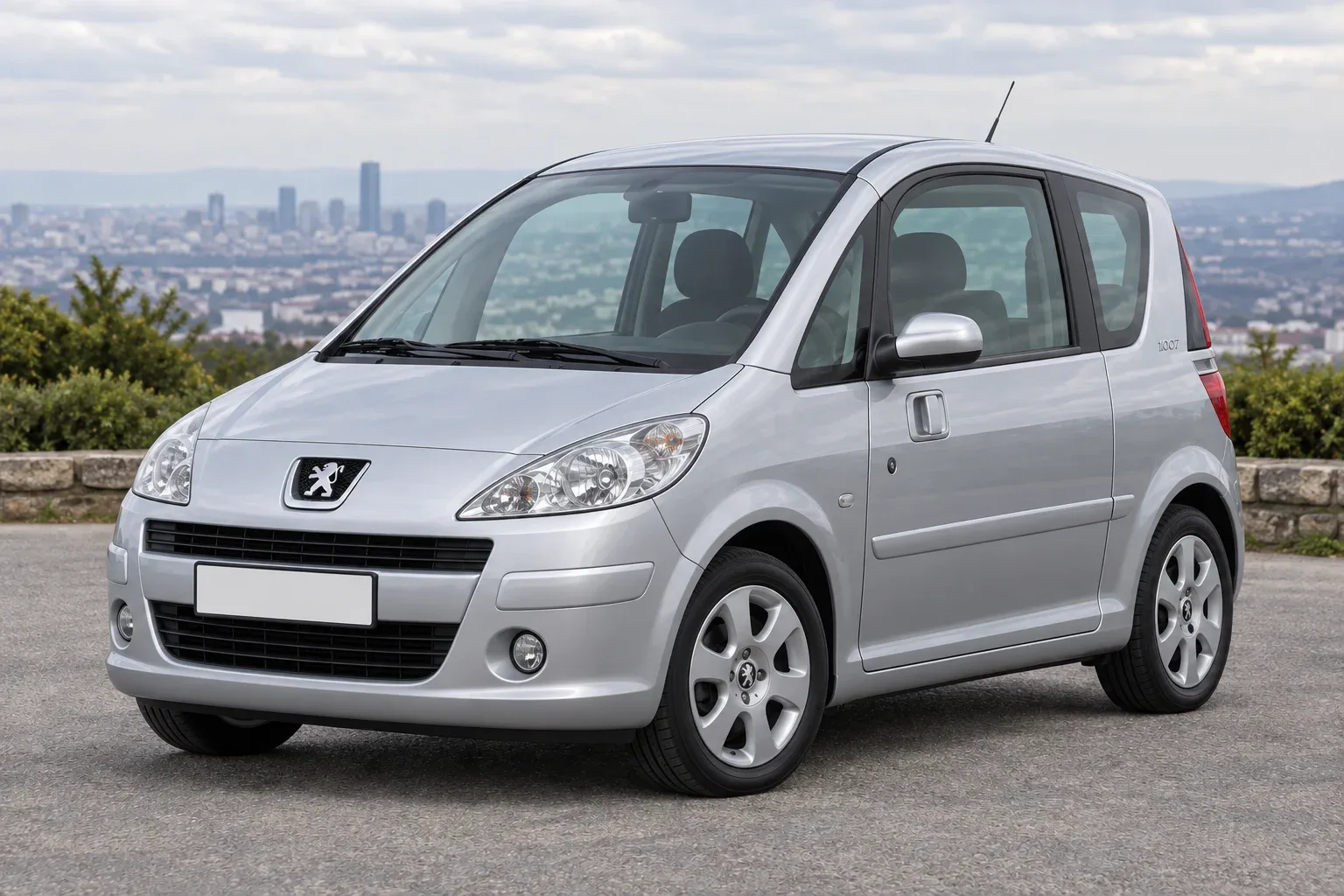
Peugeot 1007
Valuation of the Peugeot 1007 (2005–2009): condition, paperwork, inspection and terms of sale.
Indicative purchase price
Below market value
Final price agreed after inspection.
Value my car1Why buyers choose this model
The Peugeot 1007 has not the usual classic doors, but sliding, as in the MPV. It may be a good idea, but it didn’t get the owners’ attention.
2What buyers check
Design features
Technically, the Peugeot 1007 is based on small Citroen C2 and the first C3. They have almost identical platform, transmission and chassis.
Perhaps to emphasize the exclusivity of the model, the French decided to equip the sliding doors with an electric drive. It was a reckless move. During the production period, 122,000 cars were sold. If there were an alternative with conventional swing doors, the 1007 would sell much better. The fact is that the complex and expensive mechanism of the sliding door significantly affected the cost of the compact. It was beyond the purchasing power of most car enthusiasts. Those who were willing to pay such money, preferred cars in the class above.
The Peugeot 1007 is one of the smallest cars in the segment. Its length is only 3.73 m. However, this did not prevent the Frenchman in 2005 to earn 5 stars in crash tests according to EuroNCAP. The compact in the maximum configuration is equipped with front and side airbags, curtains and a knee airbag for the driver.
Sliding doors
It is worth noting that for urban conditions, sliding doors are a great idea. Close parking allows you to fully reveal all the advantages of an unusual scheme. And after opening the door in the body there was an impressive opening - 92 cm. At the same time, it was the sliding doors that most often caused concern among owners of the Peugeot 1007. Sometimes they start to live their own lives, even in new cars. They opened spontaneously after closing. Other shortcomings were manifested in bad weather. The process of closing/opening the door takes more than 5 seconds. Thus, a full cycle takes at least 10 seconds. This is enough to make the seats soaked in water during rain or snow. Two control units are used in the door control system. One of them is installed in the central rack, the second - directly in the door. Both are connected to a multiplex network and communicate via a data bus with the multifunctional COM2002 module (located under the steering wheel), ABS/ESP, airbag module, as well as with the BSI intelligent unit, which is actually the main center of the entire multiplex network of the machine. The airbag module reports a collision, which is a signal to unlock the door locks. From ABS, the system receives information about the beginning of movement, and if you exceed the speed of 5 km / h, a command is received to lock the door locks. But if the door was open, then after 5 km / h it is not closed. As for safety, the servo is turned off if the door suddenly began to experience resistance, for example, not removed the hand.
Typical problems and malfunctions
Technical problems with doors can be divided into two groups. Problems that can be solved relatively cheaply and easily, and problems that require a deeper diagnosis. Replacing some components will be very expensive. The first group includes cases when the doors do not remain open, or vice versa refuse to close completely. One of the reasons is dirty guides (the creak will be heard). If the door is not fixed in the open position, then most likely the fault of the plastic micro-switch located in the rear of the lower rail. Incomplete door closure, in turn, is responsible for the contacts in the front pillar. There are several contacts here. Some of them give a signal to the control unit to activate the servo motor pressing the back side of the door to the body. Other contacts power the servo-driven glass - when the doors are open, the windows are turned off. Sometimes get rid of the disease is possible banal cleaning of contacts from dirt. The second group of problems includes failures in the door management system. Experience shows that the probability of ailment is directly proportional to the age of the car. The door ceases to respond to commands from the button on the front panel and, accordingly, on the remote control of the central lock. In this case, the door can be opened by simply pulling the handle, which will require more effort. Most often, the lock servo drive fails. It has a fragile plastic lever with a movable contact. It is impossible to buy a lever separately. Change the servo drive in the collection - about 3 800 rubles.
Engines
Initially, the Peugeot 1007 was equipped with two gasoline and one diesel engine: 1. 4 8V, 1. 6 16V and 1. 4 HDi. Later, a 1.4 16V was proposed, and in 2007 - 1.6 HDi. 1.4-liter 8-valve 4-cylinder gasoline unit is a representative of the popular TU series. This engine is reliable and durable. Perhaps the only thing that can happen is a breakdown of the gasket under the head of the block. As a result, oil leaks appear, which penetrates into the cooling system. By modernization of the 8-valve was obtained 1.4-liter 16-valve, which received the designation ET3. In terms of performance, it is the best engine for the 1007. It differs in compression degree (was reduced from 10.5 to 10.2), the presence of two upper camshafts with a valve timing system on the intake shaft and hydraulic valve gap compensators. 16-valve 1.6-liter TU5JP4 engine as well as 1. 4 16V uses a block head with two shafts. In 8-valve motors have to put up with mechanical adjustment of the gap valves. In 16-valves used hydraulic compensators, the service life of which directly depends on the quality and frequency of oil renewal. Over time, they “clog”, and the engine after a cold start begins to rattle like a sewing machine. At high mileage, cracks may occur in the exhaust manifold of the TU engines (1. 4 8V and 1. 6 16V). Diesel versions are best avoided. Fortunately, they are almost never seen, as the new diesel car was too expensive. With large runs, loss of tightness of sealing washers under nozzles is possible.
Engine maintenance
The gas distribution mechanism of all motors without exception is driven by a gear belt. Experienced mechanics recommend changing it every 60,000 km.
The 1.4-liter petrol atmosphere is sufficient for the SAE 10W-40 class oil, others require 5W-40. In the case of gasoline units, the oil must comply with the API standard SH/SJ, and in the case of diesel units, the ACEA B3-96.
The 8-valve 1.4-liter engine requires control and adjustment of the valve gap no later than 150,000 km.
Transmission
The compact was equipped with a 5-speed manual transmission. 1.6 16V was standardly offered with an automated 2-Tronic transmission. The 1.4 8V robot was provided as an option. In 2006, even the most powerful version of the game appeared. This is the merit of the sports version of RC.
A robotic transmission is by far the cheapest way to attract customers who prefer the machine. Classic automatic transmission with a hydraulic transformer for this segment is too expensive.
2-Tronic is the same robot as Citroen Sensodrive. It is designated as MA5/S. From this it is clear that the node is based on the manual transmission MA5. The difference between them is noticeable on the outside, where a block with three step servo motors is installed. Two of them are responsible for changing speeds, and the third controls the clutch.
During operation, the adhesion mechanism wears out, the functionality and accuracy of the system decreases. All servo motors are combined into a single control unit. If one of them fails, the block changes completely - about 60 000 rubles.
Since the 2-Tronic uses a conventional clutch, the control unit must know the clutch threshold values, i.e. it must be adapted. Otherwise, the box will not work smoothly. In addition, premature wear of the clutch occurs (from 5 000 rubles per set).
It is worth noting that the clutch in manual transmissions lasts much longer.
Walking
Peugeot’s handling merits average marks. But the level of comfort when driving on bumps is truly French. Through the dips on the roadway 1007 passes gently, and passengers do not experience excessive shocks.
The front uses classic McPherson racks, and the rear - a torsion beam with spaced springs and shock absorbers. Despite the simplicity of the design, the strength of the suspension is not impressive. Shock absorbers sometimes require replacement after 30,000 km, and later and bearings.
In some cases, clicks are observed when turning the steering wheel - you will need to repair or replace the steering column.
Model history
2002 – Peugeot Sesame Concept is introduced.
2005 – The Peugeot 1007 was launched in April.
2006 – A sports version of the RC is offered in autumn.
Sporty version of RC
It is very rare, and is recognized by a slightly different front and rear parts of the body. Inside are anatomical seats, upholstered with very high-quality leather.
Engines
A reliable and durable TU3 engine, which is too weak for the 1007. You should avoid the 2-Tronic robot.
The ET3 engine is an evolution of the 8-valve 1.4 TU3. It is much better luck: surprisingly elastic and ready to work from the lowest rpm. The engine is reliable and durable.
The engine, compared to the 1.4-liter 16-valve, reveals its potential at higher revs. It was combined exclusively with the 2-Tronic, which means that it will be useful only if the car purchased has a low mileage.
The turbodiesel is equipped with Siemens’ Common Rail power system. The engine is quiet and gently operated and has a very low fuel consumption. Unlike the larger 1.6 HDi, it has no problems caused by a drop in pressure in the lubrication system. This is all the more surprising when you consider that the oil pallet and the oil pump suction basket are identical on both engines.
The turbodiesel is also equipped with a Common Rail power system, but it is already developed by Bosch. When using low-quality oils and delaying the replacement, pressure in the lubrication system may drop due to the formation of carbon deposits.
3Pre-purchase checklist
Typical problems and malfunctions
- Technical problems with doors can be divided into two groups.
- Problems that can be solved relatively cheaply and easily, and problems that require a deeper diagnosis.
- Replacing some components will be very expensive.
- The first group includes cases when the doors do not remain open, or vice versa refuse to close completely.
- The second group of problems includes failures in the door management system.
- Most often, the lock servo drive fails.
Engines
- At high mileage, cracks may occur in the exhaust manifold of the TU engines (1. 4 8V and 1. 6 16V).
- With large runs, loss of tightness of sealing washers under nozzles is possible.
- This leads to rapid degradation of oil, the formation of carbon deposits and wear of the engine and turbocharger.
Engine maintenance
- Experienced mechanics recommend changing it every 60,000 km.
Transmission
- In addition, premature wear of the clutch occurs (from 5 000 rubles per set).
Walking
- In some cases, clicks are observed when turning the steering wheel - you will need to repair or replace the steering column.
Engines
- You should avoid the 2-Tronic robot.
- The engine, compared to the 1.4-liter 16-valve, reveals its potential at higher revs.
- 6 HDi it has no problems caused by a pressure drop in the lubrication system.
4Challenges of selling privately
In addition to the short-lived electric drive of the sliding doors, the Peugeot 1007 was criticized for its high weight. 1215 kg negatively affected fuel consumption. If you want a small city car and you’re going to drive alone or alone, the 1007 is an interesting choice. However, his merits hardly compensate for all the shortcomings. In this segment, it is better to look at the competitors.
- Technically, the Peugeot 1007 is based on small Citroen C2 and the first C3.
- Sliding doors: It is worth noting that for urban conditions, sliding doors are a great idea.
- Typical problems and malfunctions: Technical problems with doors can be divided into two groups.
- Engines: At high mileages, cracks may occur in the exhaust manifold of the TU series engines (1. 4 8V and 1. 6 16V). Diesel versions are best avoided.
- Engine maintenance: The gas distribution mechanism of all motors without exception is driven by a gear belt.
- Transmission: In addition, premature wear of the clutch occurs (from 5 000 rubles per set).
- Driving: In some cases, there are clicks when turning the steering wheel - you will need to repair or replace the steering column.
- Model history: 2002 – Peugeot Sesame concept is presented.
Shows, bargaining and re-registration take time: buyers look, promise to think and disappear. Fair price after inspection closes the auction on the spot. If money is needed urgently, the purchase takes away waiting and repeat displays.
5How selling to us works
Leave a request with the car data. We will discuss the preliminary assessment and inspection. After checking the status and documents, we agree on the final price and terms of the transaction.