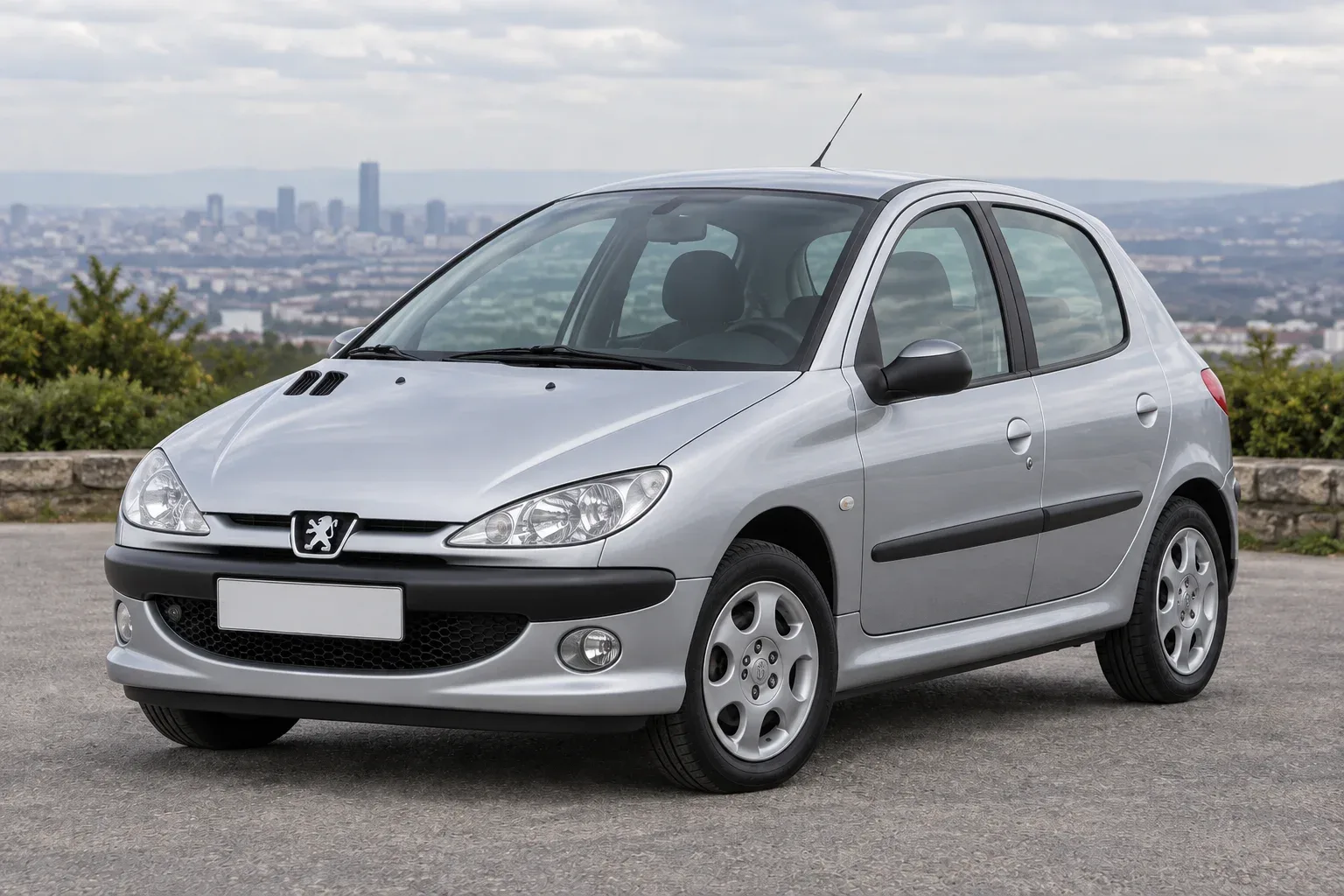
Peugeot 206
Valuation of the Peugeot 206 (1998–2010): condition, paperwork, inspection and terms of sale.
Indicative purchase price
Below market value
Final price agreed after inspection.
Value my car1Why buyers choose this model
The Peugeot 206 is one of the most popular models of the Peugeot brand. In 2010, the Peugeot 206, with a twelve-year history, became the best-selling Peugeot car of all time. The representative of the supermini was produced from September 1998 to 2010. The car was offered in the back of a 3 or 5-door hatchback. In 2001, a station wagon and coupe-convertible appeared. In March 2003, the 206-series underwent restyling: changes touched the interior, front optics and taillights, grille, bumper began to fully color the body. The sedan was developed by Iran’s Khodro and launched in 2005. The sedan entered the Russian market in 2006. Peugeot assembly was carried out in all corners of the world: France, Great Britain, Madrid, Brazil, Argentina, China, Indonesia, Iran, Malaysia, Chile and Uruguay.
2What buyers check
Engines
The first Peugeot 206 were equipped with gasoline engines of 1.1 liters (60 hp), 1.4 liters (75 hp) and 1.6 liters (89 hp). In 2000, the 1.6-liter engine was replaced by a 16-valve analogue with a capacity of 109 hp. In 2003, a 16-valve version of 1.4 liters with a capacity of 88 hp appeared. In addition, in Europe were available 2-liter gasoline engines with a capacity of 135 hp. Diesel versions were also offered. Initially, a diesel 1.9D (70 hp) was available, which in 2001 was replaced by 1.4 HDi (68 hp) and 2.0HDi (90 hp), and in 2004 1.6 HDi (109 hp) was added. In Russia officially supplied Peugeot 206 only with gasoline engines 1.1 liters, 1.4 liters and 1.6 liters. All three engines have a belt-driven valve timing with a recommended replacement interval of 80 thousand km. The cost of a new set of valve timing is about 2-3 thousand rubles. In a pair with the valve timing, it is recommended to change the pump: about 2.5-3 thousand rubles - the original and 1-1.5 thousand rubles - the analogue. The most massive in the three was the engine of 1.4 liters. One of the common problems with which many owners have been unsuccessfully fighting for a long time is floating idling turns. Less common is a triple and stalled engine. Many people tend to believe that floating turns are a Peugeot feature that you just have to put up with. But sometimes motor vagaries can be overcome by replacing candles, ignition coils, oxygen sensor or absolute air pressure sensor at the intake - MAP sensor. Some owners even resorted to a successful replacement of the ECU. Similar problems are found on engines with a working volume of 1.1 and 1.6 liters. After 80,000 to 100,000.
Transmission
The main transmission is a 5-speed “mechanics” BVM5. The clutch disc is at least 150-200 thousand km, but, as a rule, owners are forced to change it when running more than 80-120 thousand km. The reason is the premature failure of the squeeze bearing and breaking the petals of the basket. The cost of the original clutch set is about 10-12 thousand rubles, the analogue is about 4-5 thousand rubles, and replacement work is about 4-6 thousand rubles. Leakage of the glands of drives and curtains is a common problem that occurs after 100-150 thousand km. At the same time, the clutch pedal can begin to jam or fall through - wear of the clutch cable. the 4-speed AL-4 "automatic" could be installed in a pair of gasoline engines with a volume of 1.4 liters and 1.6 liters. The box is generally reliable and easily survives up to 250-300 thousand km. Only “mockery” can reduce its resource to 150-200 thousand km – frictions burn. In this case, for the restoration of automatic transmission will have to pay about 30-50 thousand rubles. Achilles heel "automatic" - electromagnetic valves that fail after 80-120 thousand km, which causes twitching during switching, delayed switching time, lights up the signalizers "snowflake" and "S", the box "goes" into emergency mode, and pop up pressure errors. The cost of two new electromagnetic valves is about 6-8 thousand rubles, and the full cost of replacement will be about 10-15 thousand rubles. Internal and external SRUS often require replacement after 100-150 thousand km. ShRUS are only assembled with drives: 15-20 thousand rubles - original, 8-10 thousand rubles - analog.
Walking
The rear suspension of the torsion type, as a rule, requires intervention after 60-90 thousand km: the rear wheels become a house, backlash wheels and knocks appear in the suspension. The reason is the wear of needle bearings and “fingers” of the rear beam. In addition, the back often begins to knock the stabilizer located inside the beam, due to wear of the bushings. The new original beam costs about 50 thousand rubles, the analogue - about 20-25 thousand rubles. To improve the health of the beams can be in the service for 15-20 thousand rubles, of which about 7-8 thousand rubles - for a full set of bearings, fingers and anthers. Front shock absorbers are often given after 100,000 km, rear - after 150 000 km. The cost of the original shock absorber is about 3-4 thousand rubles, analogue - about 1-2 thousand rubles. After 100-150 thousand km wear the silenth blocks of the rear suspension levers of the sedan - jet thrusts. The cost of a new lever in the collection is about 5 thousand rubles, Silent blocks - about 500-600 rubles. In the same period, ball supports in the front suspension are sometimes handed over. The replacement is provided only in the lever collection - for 3 thousand rubles, but some services cope with the replacement of only one ball for 1-1.5 thousand rubles. Front stage bearings serve more than 80-100 thousand km: 2-3 thousand rubles - original and 1-2 thousand rubles - analog. Resource of rear hub bearings more than 100-150 thousand km: about 1000 rubles. After 100-150 thousand km, owners of Peugeot 206 often face the appearance of knocks in the steering rack or its leakage. For repair of the rake will have to pay about 6-8 thousand rubles. After that, after 150-200 thousand.
Other problems and malfunctions
Problems with corrosion resistance of body iron do not occur, provided that the car is washed in a timely manner after traveling on the "salt" roads. Occasionally, there are cases of leakage through the seal of the antenna on the roof - the ceiling plafond begins to flow. Crickets appear in the salon in places. And after 100-150 thousand km, many found antifreeze under the front passenger mat. These were leaking heater tube seals. For the elimination of leaks in the car service will take about 3-5 thousand rubles. After 150-200 thousand km due to the burned-out resistor of the stove may not turn on the heater motor or vice versa will always blow at the maximum 4th speed. The bearing of the air conditioner compressor clutch can make noise or jam after 100-150 thousand km. For the replacement will ask about 5-6 thousand rubles: 1000 rubles for the bearing and 4-5 thousand rubles for work. A common reason for depressurization of the air conditioner line is the tubes broken off from the fittings (weak construction). The situation is uncritical and easily rectified. After 150-200 thousand km, problems with charging the battery due to failure of the generator are encountered. The cost of the new original generator is about 14 thousand rubles, analogue - 7-10 thousand rubles. Repair of the generator is much cheaper - 2-4 thousand rubles. Due to the fallen off or worn contact tracks on the steering switch appear "glitch" with electrical appliances controlled by switches - external lighting, direction indicators, sound signal and wipers. The problem is found on cars older than 8-10 years.
3Pre-purchase checklist
Engines
- All three engines have a belt-driven valve timing with a recommended replacement interval of 80 thousand km.
- In a pair with the valve timing, it is recommended to change the pump: about 2.5-3 thousand rubles - the original and 1-1.5 thousand rubles - the analogue.
- One of the common problems with which many owners have been unsuccessfully fighting for a long time is floating idling turns.
- Similar problems are found on engines with a working volume of 1.1 and 1.6 liters.
- km per 1.4 liters often leaks the gasket of the cylinder head.
- For the elimination of the problem will have to pay about 10 thousand rubles.
- On the Iranian Peugeot 206, collected in 2008-2009 during the autopsy to replace the gasket HBC, “corrosion” was often found in the channels of the coolant of the cylinder block.
- Its failure can be caused by burning of the retractable contacts, failure of the retracting agent itself or wear of brushes.
Transmission
- Leakage of the glands of drives and curtains is a common problem that occurs after 100-150 thousand km.
- At the same time, the clutch pedal can begin to catch or fall off - wear of the clutch cable.
- Achilles heel "automatic" - electromagnetic valves that fail after 80-120 thousand.
- The cost of two new electromagnetic valves is about 6-8 thousand.
Walking
- km: rear wheels become a house, there are backlash wheels and knocks in the suspension.
- The reason is the wear of needle bearings and “fingers” of the rear beam.
- In addition, the back often begins to knock the stabilizer located inside the beam, due to wear of the bushings.
- The replacement is provided only in the lever collection - for 3 thousand.
- Often owners of Peugeot 206 face the appearance of knocks in the steering rack or its leakage.
- For repair of the rake will have to pay about 6-8 thousand rubles. After that, after 150-200 thousand.
- Sometimes the pump is handed over to the GUR: there is noise and flow. The new pump will cost 4-6 thousand rubles.
Other problems and malfunctions
- Problems with corrosion resistance of body iron do not occur, provided that the car is washed in a timely manner after traveling on the "salt" roads.
- Occasionally, there are cases of leakage through the seal of the antenna on the roof - the ceiling plafond begins to flow.
- km there are problems with charging the battery due to failure of the generator.
- Repair of the generator is much cheaper - 2-4 thousand rubles.
- The problem is found on cars older than 8-10 years.
- On age cars, there are also episodic problems with electrical equipment caused by the oxidation of contacts in electric connectors.
4Challenges of selling privately
The Peugeot 206 is a good car overall, though not without its drawbacks. Weaknesses of the 206th - gasket of the 1.4-liter engine, rear torsion beam, electromagnetic valves in the automatic transmission, a squeeze bearing in the manual transmission and contacts of electric connectors on older cars.
- Engines: One of the common problems that many owners have been unsuccessfully fighting for a long time is floating idling speeds.
- Transmission: The flow of the coils of the drives and the curtains is a common problem that occurs after 100-150 thousand km.
- Chasing: km: rear wheels become a house, there are backlash wheels and knocks in the suspension.
- Other problems and malfunctions: Problems with corrosion resistance of body iron do not occur, provided that the car is washed in a timely manner after traveling on “salt” roads.
Shows, bargaining and re-registration take time: buyers look, promise to think and disappear. Fair price after inspection closes the auction on the spot. If money is needed urgently, the purchase takes away waiting and repeat displays.
5How selling to us works
Leave a request with the car data. We will discuss the preliminary assessment and inspection. After checking the status and documents, we agree on the final price and terms of the transaction.