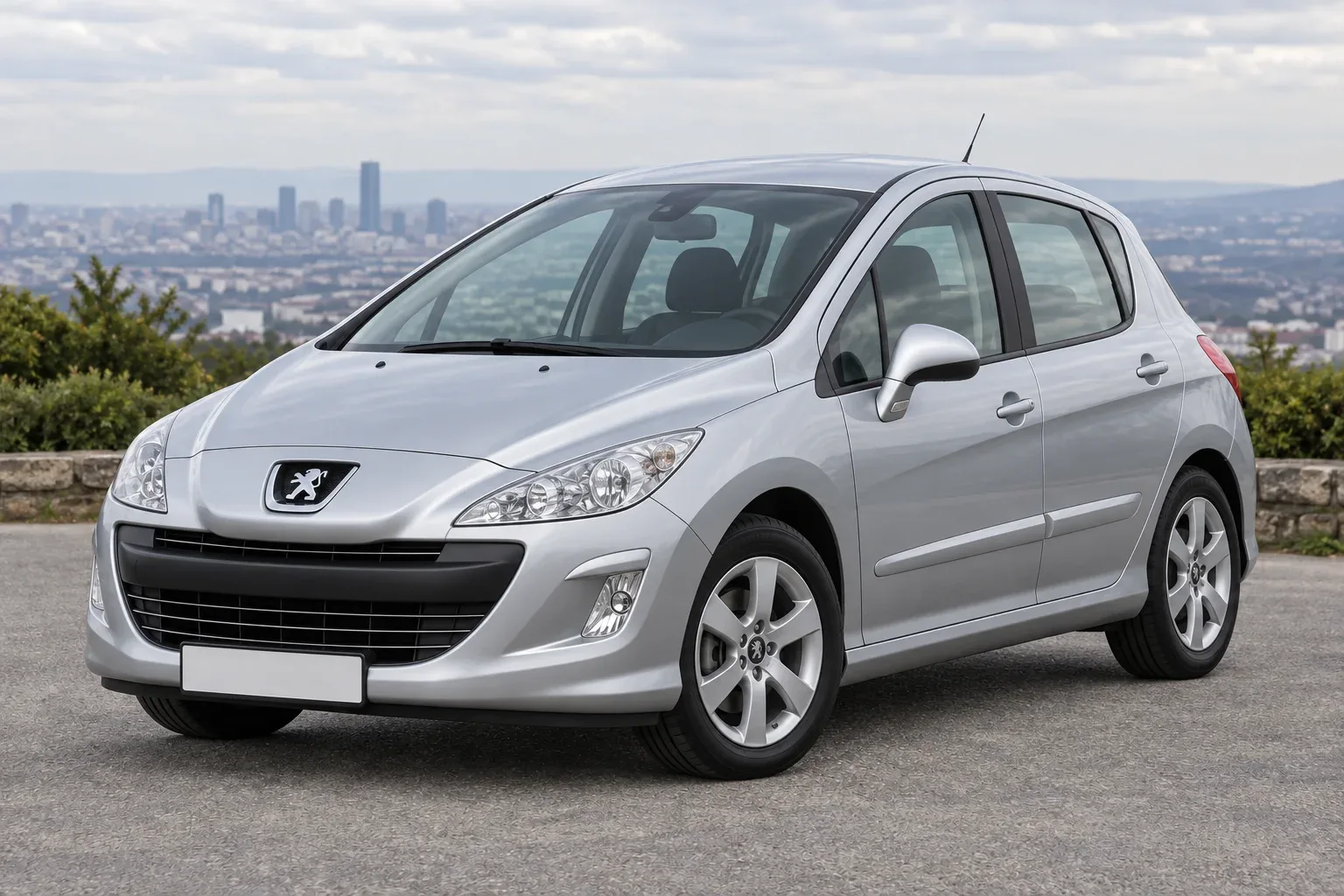
Peugeot 308 I
Valuation of the Peugeot 308 I (2007–2015): condition, paperwork, inspection and terms of sale.
Indicative purchase price
Below market value
Final price agreed after inspection.
Value my car1Why buyers choose this model
The Peugeot 308 first rolled off the assembly line in September 2007, and sales of the model in Russia began in March 2008. The car was offered in the back of a 3- and 5-door hatchback, as well as a station wagon SW. There were three types of equipment available: Confort-Pak, Premium and Premium-Pak. Later, the Sportium configuration, close to the Premium configuration, with its unique trim elements, appeared. In 2010, Peugeot 308 began to be assembled in Russia at the PSA plant in Kaluga. All cars of the Russian assembly were equipped with only 120-strong gasoline engine and option package "Rushen-Pak", which includes additional protection of the engine compartment from below, a battery of increased capacity and suspension for heavy conditions. Versions with a turbo engine were assembled in France. A few years later, the assembly of the 308th near Kaluga was curtailed, and all cars again went from France. In May 2011, the car was redesigned. Changes affected the front bumper, wings, hood, lighting and individual external decorative elements. At the same time, the names of the complete sets were renamed into Access, Asset and Allure. The Sportium has been preserved. As for safety, it is in order and all five stars according to EuroNCAP. For the entire period of official sales, the Peugeot 308 in Russia became the most bought car of the brand, entering the top ten best-selling golf class cars.
2What buyers check
Engines
Peugeot 308 for the Russian market was equipped with engines with a working volume of 1.6 liters, developed in conjunction with BMW. The atmospheric version with the EP6 index developed 120 hp, and the turbocharged EP6DT - 140/150 hp. The EP6 series engine is generally not bad in terms of performance, but it has a number of technical shortcomings. For example, the wear of seats camshafts after 60-100 thousand km of run. With axial displacement, the camshaft of fluoroplastic seals was squeezed outward, and the oil-producing channel on the phase regulator became untight. This led to a shortage of oil in the circuit of the phase regulator, and the impossibility of correcting the gas distribution phases, which contributed to the appearance of an error in the composition of the mixture. In such cases, it was necessary to fork out for a costly replacement of the cylinder head in the amount of about 100-120 thousand rubles. Fortunately, the incidents with camshafts are few. But the loss of valve seats (most often intake) is a phenomenon that is gaining momentum after 150-200 thousand km. The cost of repairs is about 30-40 thousand rubles. On the engines of 2008 often broke down the tensioner chain of the HRM, which could thunder after 80-100 thousand km. However, usually the chain of the drive of the gas-engines on atmospheric engines serves more than 150-200 thousand km. After 100,000 km, some engines begin to “eat up” oil, and to 150-200 thousand km have to update the oil caps (10-20 thousand rubles without replacing the chain of the fuel. Ignoring high oil consumption is not worth it.
Transmission
Peugeot 308 was equipped with a 5-speed manual or 4-speed automatic transmission. The manual transmission is the PSA concern’s own development, known from the previous Peugeot 307 model. Mechanics usually do not give surprises. Clutch on the atmospheric engine will serve at least 120 – 150 thousand km, on the “supercharged” its resource is slightly less than about 100 – 120 thousand km. The new clutch set is available for 11-17 thousand rubles, and the work on its replacement will take about 7000 rubles. The automatic transmission is developed by PSA in collaboration with Renault - AT8 (AL4). All problems with the box, arising when running more than 50 – 60 thousand km, are associated with failure of the valves of pressure distribution. The first signs of the disease are pushes during gear shifts and highlighting the error. Valves, there are two, will cost 7-8 thousand rubles, work on their replacement will require about 10-14,000 rubles. It is necessary to wash the hydroblock and replace the oil, so as not to repeat the procedure again after 20 – 30 thousand km, and forget about the problem for another 50 – 60 thousand km. The glands of the box begin to “sweat” after 150 – 180 thousand km. After restyling in a pair of turbocharged 1. 6 began to install a 6-speed Japanese automatic Aisin TF-70SC. There are usually no serious problems with him. The diesel 1.6 was combined with 5-speed mechanics (6-speed after the update) or with the 6-band robot EGS6 (after restyling). Contrary to expectations, the French robot is not known as capricious. Expenses can require only the developed its resource clutch - about 16 000 rubles after 150 000 km.
Walking
The suspension of French Golf is comfortable, but its work raises a number of questions.
When running more than 20 – 30 thousand km ahead, knocks appeared, caused by the formation of a gap between the upper rubber and metal support of the rack and the “glass” of the body. The pendant was knocked and with the arrival of frosts.
Rear shock absorbers (3-5 thousand rubles) had to be changed after 60 - 80 thousand km, the front (4-6 thousand rubles) - after 100 - 120 thousand km.
Ball supports are surrendered after 60-100 thousand km (900-1200 rubles). Silent blocks of the front suspension reach 100-150 thousand km (300-500 rubles).
Silent blocks of the rear beam come into disrepair after 150 000 km (600 rubles analogue plus 2000 rubles for work).
Front hub bearings are updated after 80-120 thousand km. They change separately from the hub (3-4 thousand rubles).
Brake booster (11,000 rubles) could throw problems after 60 – 80 thousand km – brakes failed. In addition, the amplifier wedged, which caused the chain to vomite, and cut off the stars, and the valves could meet the pistons. Subsequently, the internal amplifier was made of plastic, which allowed to avoid unpleasant consequences for the engine.
The front brake pads end after 30 – 50 thousand km, the rear walk longer – 50 – 70 thousand km. The front brake discs have to be updated every 40 – 70 thousand km (1 – 2.5 thousand rubles per set), the rear – 60 – 90 thousand km.
The steering rack can knock after 150-200 thousand km. The cost of the new rake is 33-47 thousand rubles, and the restored one is 20-30 thousand rubles.
Other problems and malfunctions
Peugeot body iron is not prone to corrosion.
In winter, folding mirrors may not fold or decompose. The reason is moisture and freezing of the mechanism.
The salon may eventually start to creak. The sources of annoying sounds are usually in the rack separating the small and large glass of the front door, in the lock of the trunk door or in the area of the rear felt shelf.
Beautiful white scales of instruments over time are covered with incomprehensible spots. The reason for their appearance is a layer of dust on the back of the plastic insert. When lighting devices there is an effect of spots. To clean the insert, it is necessary to remove the instrument panel and disassemble it.
Dorestyling Peugeot 308 2008 release suffered from excessive tenderness of the armrest of the central tunnel, more precisely, plastic guides on the frame of the mechanism. They were easily broken by a little pressure. The armrest was later reworked and the problem disappeared.
After 150-200 thousand km of mileage owners sometimes have to deal with poor heating up of the cabin. The culprit is a clogged stove radiator. Washing the radiator saves the indecency. The radiator is better to replace (9-10 thousand rubles).
Soon attention may require and generator - wear brushes, current-removing rings and bearings.
Price
What can you count on having 1 million rubles: a restyled version of 2014 with an automatic (1.6AT) and a declared mileage of 100,000 - 150,000 km.
3Pre-purchase checklist
Engines
- For example, the wear of seats camshafts after 60-100 thousand km of run.
- But the loss of valve seats (most often intake) is a phenomenon that is gaining momentum after 150-200 thousand km. The cost of repairs is about 30-40 thousand rubles.
- There are cases of burnout and destruction of the valve, which led to damage to the cylinder-piston group and subsequent overhaul.
- Often the blame for this lay on the intake and exhaust of electromagnetic valves (2-3 thousand rubles). After 150,000 to 200,000.
- km of run often requires replacement of the right support of the engine (3-6 thousand rubles).
- In the list of vulnerable elements is listed and TNVD (8000 rubles for repair).
- The temperature sensor built into the thermostat caused a lot of problems after 40 – 60 thousand km on pre-restyling engines.
- The ignition coils fail after 100-150 thousand km (2000 rubles per piece).
Transmission
- All problems with the box that occur when running more than 50 – 60 thousand.
- It is necessary to wash the hydroblock and replace the oil, so as not to repeat the procedure again after 20 – 30 thousand.
- Forget about the problem for another 50 – 60 thousand km.
- The glands of the box begin to “sweat” after 150 – 180 thousand km.
- There are usually no serious problems with him.
- In diesel versions with MT and AMT, in addition to the clutch, a two-mass flywheel can also wear.
Walking
- Knocks appeared in front of the front, caused by the formation of a gap between the upper rubber-metal support of the rack and the "glass" of the body.
- The pendant was knocked and with the arrival of frosts.
- Brake booster (11,000 rubles) could throw problems after 60 – 80 thousand km – brakes failed.
Other problems and malfunctions
- Peugeot body iron is not prone to corrosion.
- The reason is moisture and freezing of the mechanism.
- To clean the insert, it is necessary to remove the instrument panel and disassemble it.
- The armrest was later reworked and the problem disappeared.
4Challenges of selling privately
The age-old Peugeot 308 has a number of chronic diseases that will have to be eliminated periodically. The least problematic can be considered diesel versions, but such offers in the secondary market are very few.
- Engines: For example, wear of seats camshafts after 60-100 thousand km of run.
- Transmission: All problems with the box that occur when running more than 50 - 60 thousand.
- Walking: a kilometer in front there were knocks caused by the formation of a gap between the upper rubber-metal support of the rack and the "glass" of the body.
- Other problems and malfunctions: Peugeot body iron is not prone to corrosion.
- Price: What you can count on having 1 million rubles: on the restyled version of 2014 with a machine gun (1).
Shows, bargaining and re-registration take time: buyers look, promise to think and disappear. Fair price after inspection closes the auction on the spot. If money is needed urgently, the purchase takes away waiting and repeat displays.
5How selling to us works
Leave a request with the car data. We will discuss the preliminary assessment and inspection. After checking the status and documents, we agree on the final price and terms of the transaction.