
Peugeot 407
Valuation of the Peugeot 407 (2004–2010): condition, paperwork, inspection and terms of sale.
Indicative purchase price
Below market value
Final price agreed after inspection.
Value my car1Why buyers choose this model
The Peugeot 407 debuted at the 2003 Frankfurt Motor Show as a concept car called the 407 Elixir. The production version was presented on May 27, 2004.
2What buyers check
Review
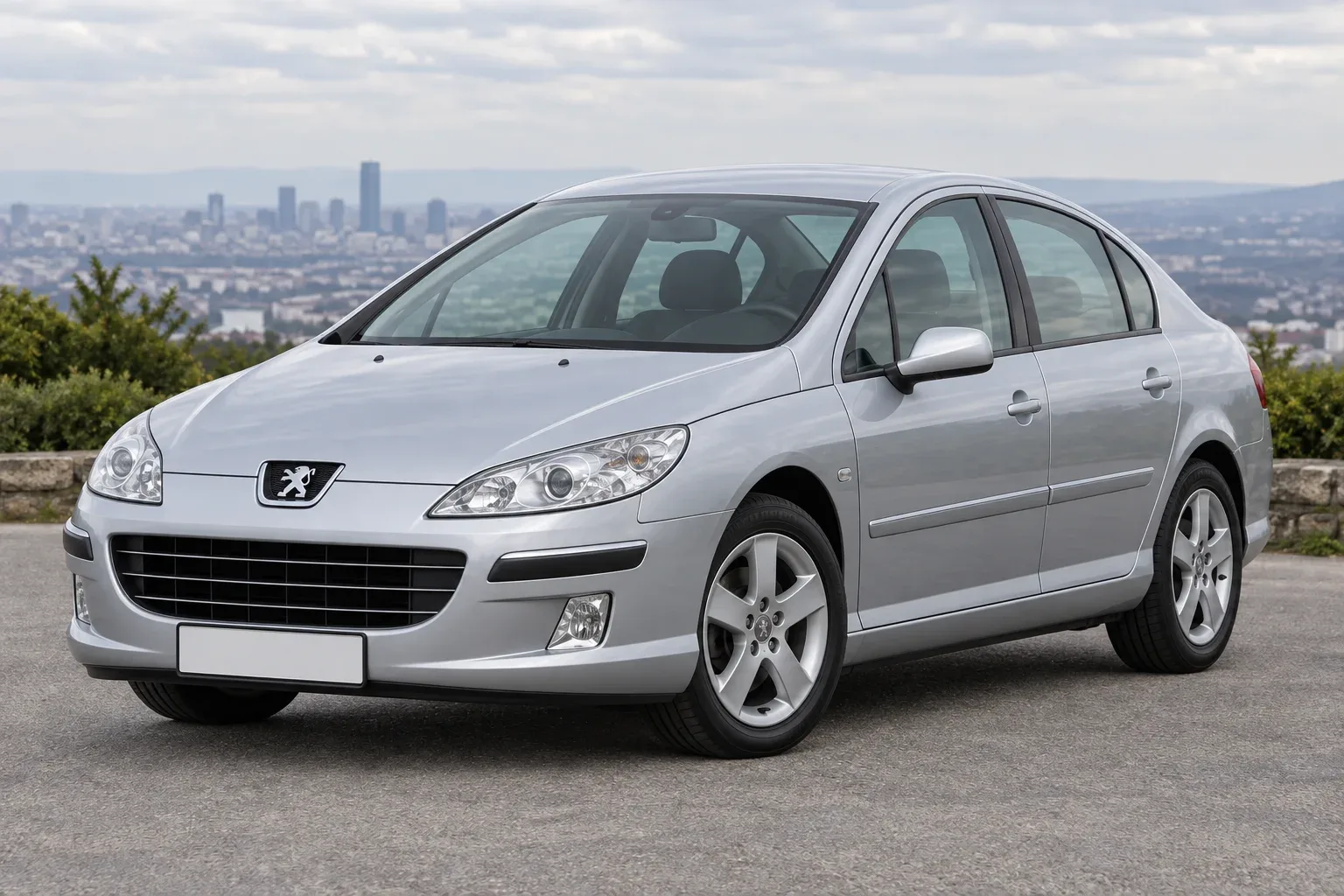
The Peugeot 407 debuted at the 2003 Frankfurt Motor Show as a concept car called the 407 Elixir. The production version was presented on May 27, 2004. The richly equipped Frenchman enjoyed huge commercial success for the first two years, but interest in the car fell later.
In 2008, the model underwent a facelift, and in 2010 it was time to say goodbye - the Peugeot 508 appeared on the market.
Exterior and interior
The design of the 407 has caused a lot of controversy. The characteristic strongly tilted windshield, together with a long hood, had a positive effect on aerodynamics. But the trunk was very short, and it could hold only 407 liters. Compared to the competitors, this is a very weak result. The cabin was more spacious, especially in the front seats. The seats are comfortable, and in the best trim levels they were finished with a very pleasant touch with velour or leather. It's not so much fun in the back. Lack of free space is most noticeable at the height of the knees. If you need more space, then do not particularly hope for a wagon (designation SW). Unfortunately, there is not as much space as the competitors. The long body (4765 mm) did not allow the French to use its full potential. The trunk capacity is only 448 liters. Fortunately, it is of the correct shape, and when folding the backs of the rear seat, its volume can be increased to 1365 liters. However, the lack of space is compensated by the interior design. The French were a bit short of ideas for the center console, but otherwise they did very well. The armrest is exactly where it is located, the pointers on the instrument panel are easy to read, the gear lever is pleasant to the touch and conveniently lies in the hand. The basic equipment included 6 airbags, ABS, ESP and air conditioning. In the Platinum configuration, the car was equipped with xenon headlights, side airbags and dual-zone climate control. In matters of security, the Peugeot 407 does not give rise to complaints.
Construction
The suspension of all wheels is independent. But that's not the point. The most interesting thing is the front axle. Instead of the banal McPherson racks, the French manufacturer has demolished the racks and levers. Due to this, the front wheels, regardless of the angle of rotation, always retain a right angle in relation to the carriageway. As a result, tires in any situation have the greatest contact area with the road surface, providing the maximum possible grip. The design of the front suspension resembles the scheme used in cars "Formula -1".
The Peugeot back has a lot to boast about, too. Here is a compact axis, for each wheel of which there are four levers. Small dimensions of the entire structure are achieved due to the strong inclination of shock absorbers.
Petrol engines
The Peugeot 407 had a wide range of engines, some of which were inherited from its predecessor. The line of gasoline engines began with a 1.8-liter unit with a capacity of 116 hp and ended with a 2.9-liter V6. Among them, the most reliable were recognized as 2- and 2.2-liter. Basic 1.8 loses to atmospheric 2.0 in dynamics, consumes almost the same amount of fuel and is prone to high oil consumption (up to 1 l / 1000 km). It is worth noting that in gasoline engines of 1.8 and 2.0 liters, the engine software had to be updated due to malfunctions in the electronic throttle. Gasoline 2.2 is rare, and atmospheric V6 is expensive to maintain. The cost of purchasing a new set of drive for the 3-liter V6 will be 37-55 thousand rubles. For comparison, the set of drive for four-cylinder 1.8 and 2.0 is much more affordable - 8-12 thousand rubles. However, any of the petrol units will require less maintenance and repair costs than diesel engines. Among the tangible costs can be noted periodically burnout ignition coils (5-6 thousand rubles per module). In addition, with age, there are engine failures caused by wear of the sealing rings of fuel injectors. Sometimes you have to change the faulty nozzles. From time to time it is brought to deal with oil leaks through the glands or from under the valve lid (2 pcs of 3-6 thousand rubles). In addition, the oil begins to poison the electromagnetic valves of phase regulators.
Diesel engines
Diesels of HDI series were presented by units with a capacity of 1.6 liters to 3.0 liters. The weak 1.6 HDi, with a 109 hp capacity, was the most popular in Europe. The versions with 2.0 and 2.2 HDi were also in demand. The most powerful of the diesels had 6 cylinders and provided excellent performance – 241 hp. and 440 Nm of torque. 2. 0 HDi offers the most acceptable ratio of performance to fuel consumption, but due to the complex design is quite expensive to operate. Access to incandescent candles and EGR is difficult. Leaks from the TNVD are one of the common problems. Due to the low popularity, problems with spare parts can arise. It is worth admitting that in general, 2-liter turbodiesel breaks quite rarely. In 2006, the range appeared 2. 2 HDi Biturbo capacity of 170 hp. It has two turbochargers. The first works with a maximum return of up to 2700 rpm, after the second begins to work. This avoids the phenomenon called “turbolag” but increases maintenance costs. 2.7 HDi V6 was also used in the Jaguar S-Type and Citroen C6. This unit, like the 3.0 HDi, has two turbochargers ($1,000 each), but due to astronomical maintenance costs, only suits real connoisseurs. Both engines are a time bomb. The worst thing that can happen is the collapse of the crankshaft. Diesel V6 is not recommended for use in urban areas. They don’t like frequent launches and short-distance trips. Most owners consider them capricious. 1. 6 HDi was used not only by Peugeot, but also by Citroën, Ford, Mazda, Mini, Suzuki and Volvo.
Transmissions
The manual transmission was offered with all engine options, except for the 3-liter petrol V6.
The adhesion of mechanics usually serves more than 150-200 thousand km. The new set can be purchased for 6-30 thousand rubles. In diesel cars, the two-mass flywheel will also require an update, which increases the cost of the set to 40-50 thousand rubles.
The ICS rarely causes serious problems. And the difficulties with the inclusion of gears are usually caused by the wear of the gear selection mechanism.
The 4-speed AL4 is considered the most controversial. However, in most cases, interruptions in operation disappear after the replacement of electromagnetic valves (solenoids - 30-50 thousand rubles). Before major repairs, it usually comes less often (100-120 thousand rubles).
The German automatic transmission ZF 4HP20 was paired with engines of 2.2 liters. Cases of repairs are observed after 250-300 thousand km of run.
The 3-liter V6 was combined with a reliable Japanese Aisin TF80 machine.
Walking
Despite the complexity of the design, things with its operation are not so bad. It seems that the manufacturer has taken care of possible repairs. On the front axle, there is a replacement of Silent blocks and ball blocks without replacing levers. The cost of the new Silentblock is about 1-3 thousand rubles. Two balls - the upper and lower (2-7 thousand rubles per piece).
The situation is a little worse on the back axle. The compact design makes it difficult to replace. It does not spoil the choice and range of spare parts. There are owners who complain that something is constantly knocking in the suspension behind. Only here there are more than a dozen Silent blocks and it is not so easy to find the culprit. A set of all Silentblocks will pull from the wallet about 15 000 rubles.
The bearings can make noise after 150-200 thousand km. The rear ones change in collection with a hub (4-12 thousand rubles), and the front ones separately (6-10 thousand rubles plus 2000 rubles for work).
After passing 200-250 thousand km, the steering rack knocked or leaked draws attention. The cost of repairs is 16,000 rubles. A new rake can be found for 28 000 rubles.
In individual instances, there are malfunctions of the electrohydraulic pump of the power steering.
Other problems and malfunctions
Protection against corrosion is commendable. The hood is made of aluminum. Unfortunately, every year the well-groomed body is less and less common. Rust attacks the rapids and the junction of the wing with the bumper. Sometimes redheads are found on the edge of the trunk lid and above the windshield. The biggest problem of the owners of Peugeot 407 - failures in the electrician. There are errors and false messages. The worst part is that not every master can fight it. Special equipment is often needed. The electric components of the car are controlled by the BSI unit. Its minor failures are sometimes difficult to repair. For used block will have to pay at least 5 000 rubles. Delivers trouble and a block of BSM fuses installed under the hood. Usually the relay of the gas pump fails, which makes it difficult to start the engine. The new block can be purchased for 16 000 rubles. After 200-300 thousand km, the radiator fan ceases to work due to a faulty board installed on the body (9-23 thousand rubles for a fan). In addition, there are problems with the central lock, and the lamps burn out due to circuits in the electrical wiring harness. Sometimes the steering switch fails. And the taillights stop burning due to the melting of contacts in the connector. After 200-300 thousand km of run during heating, the image begins to float on the monochrome display of the central panel. The cost of a used display is about 2000 rubles. The same fate sometimes befalls the display on the instrument panel. After 200-250 thousand km, attention must be paid to the generator. The unit in the collection can be purchased for the amount of 11 to 63 thousand rubles.
3Pre-purchase checklist
Exterior and interior
- The long body (4765 mm) did not allow the French to use its full potential. The trunk capacity is only 448 liters.
Petrol engines
- However, any of the petrol units will require less maintenance and repair costs than diesel engines.
- In addition, with age, there are engine failures caused by wear of the sealing rings of fuel injectors.
- In addition, the oil begins to poison the electromagnetic valves of phase regulators.
- Replacing the sealing rings does not always help - you have to change the valve. In the case of 1. 8-2. 0 EHR is available for 3-8 thousand rubles.
- km of run occasionally there are cases of major repairs of 4-cylinder engines.
Diesel engines
- Leaks from the TNVD are one of the common problems.
- Due to the low popularity, problems with spare parts can arise.
- It is worth admitting that in general, 2-liter turbodiesel breaks quite rarely.
- Diesel V6 is not recommended for use in urban areas.
- He suffers from a number of minor but annoying malfunctions.
- However, the replacement period should be reduced from the manufacturer's recommended 240,000 km to 100-120 thousand km.
- If you regularly (every 100,000 km) change the above components, then no other problems with the engine will occur.
- Preventive replacement or at least cleaning every 50,000 km, using high-quality oil and replacing it every 10,000 to 15,000 km solves the problem.
Transmissions
- The ICS rarely causes serious problems.
- And the difficulties with the inclusion of gears are usually caused by the wear of the gear selection mechanism.
- However, in most cases, interruptions in operation disappear after the replacement of electromagnetic valves (solenoids - 30-50 thousand rubles).
- Before major repairs, it usually comes less often (100-120 thousand rubles).
- Cases of repairs are observed after 250-300 thousand km of run.
Walking
- It seems that the manufacturer has taken care of possible repairs.
- On the front axle, there is a replacement of Silent blocks and ball blocks without replacing levers.
- km, draws attention to the knocked or leaked steering rack. The cost of repairs is 16,000 rubles.
- In individual instances, there are malfunctions of the electrohydraulic pump of the power steering.
Other problems and malfunctions
- Protection against corrosion is commendable. The hood is made of aluminum.
- Rust attacks the rapids and the junction of the wing with the bumper.
- The biggest problem of the owners of Peugeot 407 - failures in the electrician. There are errors and false messages.
- Special equipment is often needed.
- Usually the relay of the gas pump fails, which makes it difficult to start the engine.
- In addition, there are problems with the central lock, and the lamps burn out due to circuits in the electrical wiring harness.
- Sometimes the steering switch fails.
- For repairs, you will need to remove the front panel, which is very expensive.
4Challenges of selling privately
And yet the Peugeot 407 is a car without the serious problems that diesel modifications deliver the most. The most reliable versions with a 2-liter gasoline unit. Some spoil the image of Peugeot such trifles as wear suspension and problems with electricity.
If you want a mid-range car, the 407 isn’t for you. The best option is the Citroen C5. But Peugeot conquers good handling, comfort, outstanding design and low price.
- The Peugeot 407 debuted at the 2003 Frankfurt Motor Show as a concept car called the 407 Elixir.
- Exterior and interior: The fairly long body (4765 mm) did not allow the French to use its full potential. The trunk capacity is only 448 liters.
- Design: All wheels are independent. But that's not the point. The most interesting thing is the front axle.
- Transmissions: The transmission rarely causes serious problems.
- Driving: It feels like the manufacturer has taken care of a possible repair.
- Other problems and malfunctions: Corrosion protection is commendable. The hood is made of aluminum.
Shows, bargaining and re-registration take time: buyers look, promise to think and disappear. Fair price after inspection closes the auction on the spot. If money is needed urgently, the purchase takes away waiting and repeat displays.
5How selling to us works
Leave a request with the car data. We will discuss the preliminary assessment and inspection. After checking the status and documents, we agree on the final price and terms of the transaction.