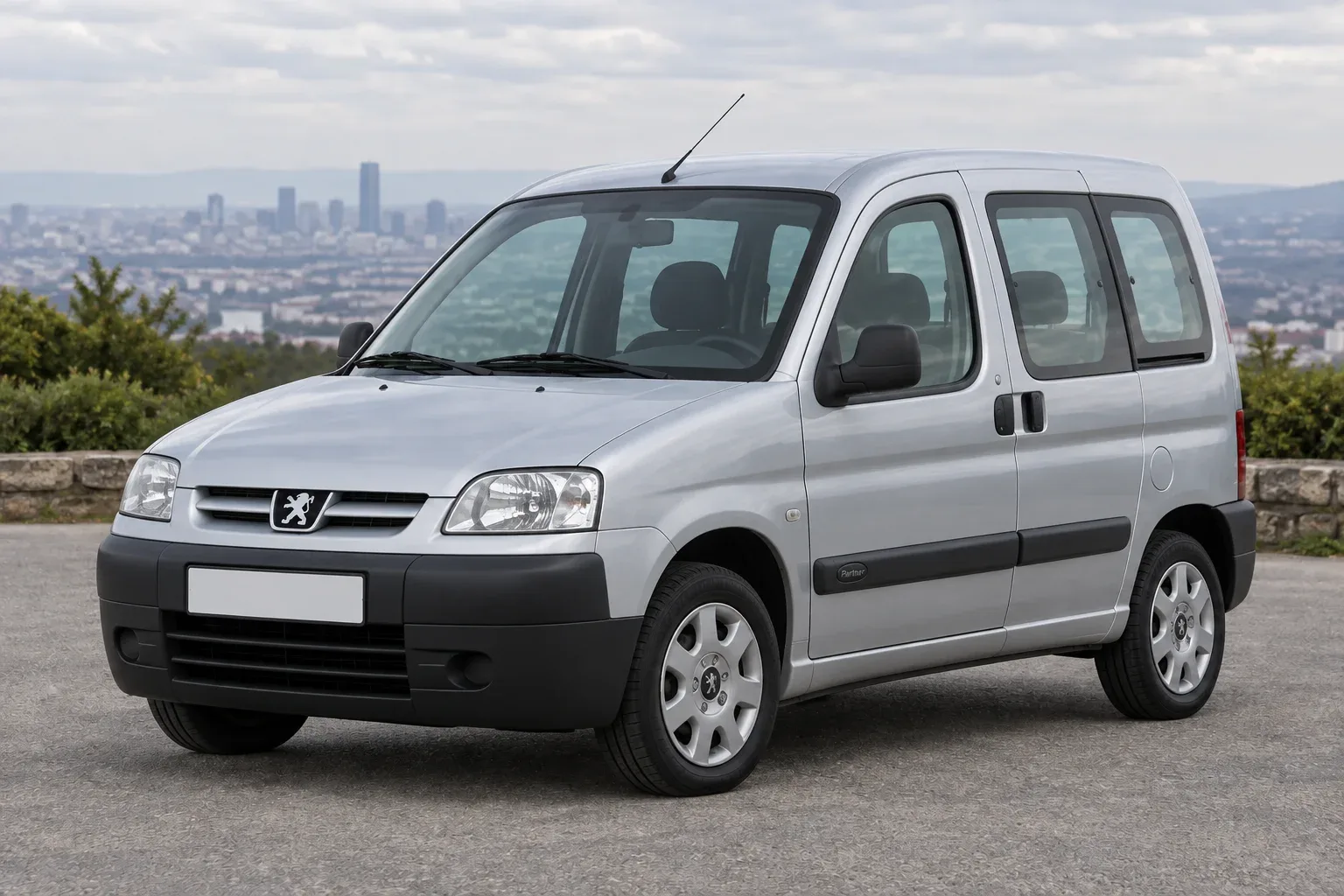
Peugeot Partner 1
Valuation of the Peugeot Partner 1 (1997–2012): condition, paperwork, inspection and terms of sale.
Indicative purchase price
Below market value
Final price agreed after inspection.
Value my car1Why buyers choose this model
The predecessor of Peugeot Partner clearly emphasized its “cargo” purpose. It offered a modest cabin for two people and a huge space for transportation. Peugeot Partner has proven that a car like this could be completely different. Moreover, it was positioned as a versatile van for young and active people who need a car that can carry a bunch of friends and sports equipment.
2What buyers check
Model history
Peugeot Partner was introduced in 1996, at the same time as its sister company, Citroen Berlingo 1. Technically speaking, the cars are almost identical. In 1997, mass deliveries to the market began with atmospheric engines: gasoline 1.1 l / 60 hp, 1.4 l / 75 hp, 1.8 / 90 hp and diesel 1.8 D / 60 hp and 1.9 D / 68-69 hp. In 2000, a new 2.0 HDi 90 hp turbodiesel with Common Rail injection system appeared in the range. In 2001, the gasoline 1.8 was replaced by a new 16-valve engine 1.6 l / 109 hp.
In 2003, a restyle was carried out. Shortly before the change of generations, in 2006, a new turbodiesel 1.6 HDi/75 and 90 hp, which worked on Peugeot, Citroen and Ford. In 2008, the production of the first generation model was completed. However, the first Partner continued to be assembled in Turkey, from where the machines were delivered to other markets.
Design features
Peugeot Partner immediately became a great success. There are a lot of offers in the secondary market today. Among them are passenger, universal, cargo and even off-road versions. The first one is made with an emphasis on comfort. The universal modification is able to serve for business and work on working days, and on weekends act as a car for personal and family needs. The cargo model offers only a 2-seat interior and a cargo compartment of 3 m3. The remaining modifications have a trunk capacity of 624-664 liters.
The interior of the car will please passengers with a large number of various compartments for small things and space. Even passengers in the rear seats, access to which is through large side sliding doors, will not feel damaged. They can be on either side of the car or on either side of the car. Many instances do not have a sliding side door on the left.
However, in the samples of the first years of production, sliding doors were not offered. The back row could only be reached through the reclined back of the front seat, which caused serious inconvenience.
An important stage in the life of Peugeot Partner of the first generation - 2003, when the market came a restyled version of the model. Rejuvenation affected not only the appearance (increased in the size of the headlight), but the interior decoration. The new front panel is more comfortable. The range of equipment has also expanded.
Access to the cargo compartment is either through the rear cover, which folds upwards, or through swing doors. The second option is most often found.
Engines
Basic gasoline engines of 1.1 and 1.4 liters suffer from a lack of power. The ideal choice would be the 1.6-liter 16-valve 4-cylinder atmospheric, but it was only available until 2001. Those who want to buy an older partner with a gasoline engine will have to agree to a 1.4-liter unit or an 8-valve 1.8 liter. The petrol engines are reliable. Possible interruptions in operation at large mileages can be caused by a failure of attachments (for example, sensors). Some customers, especially in Europe, prefer diesel. The best reputation is an outdated atmospheric diesel. In 2000, the 2.0 HDi appeared, which is almost equal in reliability and at the same time much more economical. However, with significant runs, you can not avoid problems with nozzles (from 30,000 rubles per piece). Fortunately, in the 2.0 HDi, it has a higher life than in the high-powered 1.6 HDi. However, with age, both suffer from problems with the EGR valve, turbocharger and throttle. There is no exception to oil leaks. In case of a turbocharger failure in 1. 6 HDi (from 22 000 rubles for an analogue, 80 000 rubles for the original), a simple replacement cannot be avoided. The primary cause of premature wear is a sludge-filled oil supply channel (3,000 rubles). If the problem is not fixed, the new turbine will not last long. Due to the large drag of Peugeot, all engines consume a significant amount of fuel. If you do not have to travel a lot, you can decide to buy a gasoline version.
Typical problems and malfunctions
When buying Peugeot Partner, you should pay attention to the condition of the rear axle - most often, hub bearings are handed over (from 2000 rubles, assembled with a hub). If the rear wheels are a house (A), then the rear beam needs investment. This usually happens after 200,000 km.
On the front axle, the rack and the sleeve of the transverse stability stabilizer are periodically required to be replaced (about 1000 and 800 rubles per pair - respectively). Over time, the bearings of the front pillars begin to knock (about 600 rubles for one). Less often, you have to deal with the wear of ball supports. The design provides for their replacement - 600 rubles per piece.
It is necessary to check the operation of the power steering, which sometimes fails. For a new pump will have to pay at least 20 000 rubles. There are failures in the operation of electrical equipment, especially in restyled versions. For example, the switches stop functioning. Removal of the defect will require a large investment – from 20 000 rubles for a new block.
Problems can also arise with sliding doors. Sand gets into the guides, the sliding mechanism wears out and the doors wedge. Problems with doors arise after elimination of damages to the body, received as a result of an accident.
Intensive operation on most of the copies leaves an indelible mark.
3Pre-purchase checklist
Engines
- Possible interruptions in operation at large mileages can be caused by a failure of attachments (for example, sensors).
- However, with significant runs, you can not avoid problems with nozzles (from 30,000 rubles per piece). Thankfully, at 2.
- However, with age, both suffer from problems with the EGR valve, turbocharger and throttle. There is no exception to oil leaks.
- In case of failure of the turbocharger in 1.
- The primary cause of premature wear is a sludge-filled oil supply channel (3,000 rubles).
- If the problem is not fixed, the new turbine will not last long.
Typical problems and malfunctions
- When buying Peugeot Partner, you should pay attention to the condition of the rear axle - most often, hub bearings are handed over (from 2000 rubles, assembled with a hub).
- Less often, you have to deal with the wear of ball supports.
- The design provides for their replacement - 600 rubles per piece.
- It is necessary to check the operation of the power steering, which sometimes fails.
- Problems can also arise with sliding doors.
- Problems with doors arise after elimination of damages to the body, received as a result of an accident.
4Challenges of selling privately
Peugeot Partner is a very successful car that combines the features of a passenger car and a practical van. At the same time, it is quite spacious. Before buying, it is necessary to check the condition of the rear beam and power unit.
- The Peugeot Partner was introduced in 1996, at the same time as the sister model Citroen Berlingo 1.
- Design features: Peugeot Partner immediately became a great success.
- Engines: Possible disruptions to high mileage may be caused by attachment failure (e.g. sensors).
- Typical problems and malfunctions: Less often you have to face the wear of ball supports.
Shows, bargaining and re-registration take time: buyers look, promise to think and disappear. Fair price after inspection closes the auction on the spot. If money is needed urgently, the purchase takes away waiting and repeat displays.
5How selling to us works
Leave a request with the car data. We will discuss the preliminary assessment and inspection. After checking the status and documents, we agree on the final price and terms of the transaction.