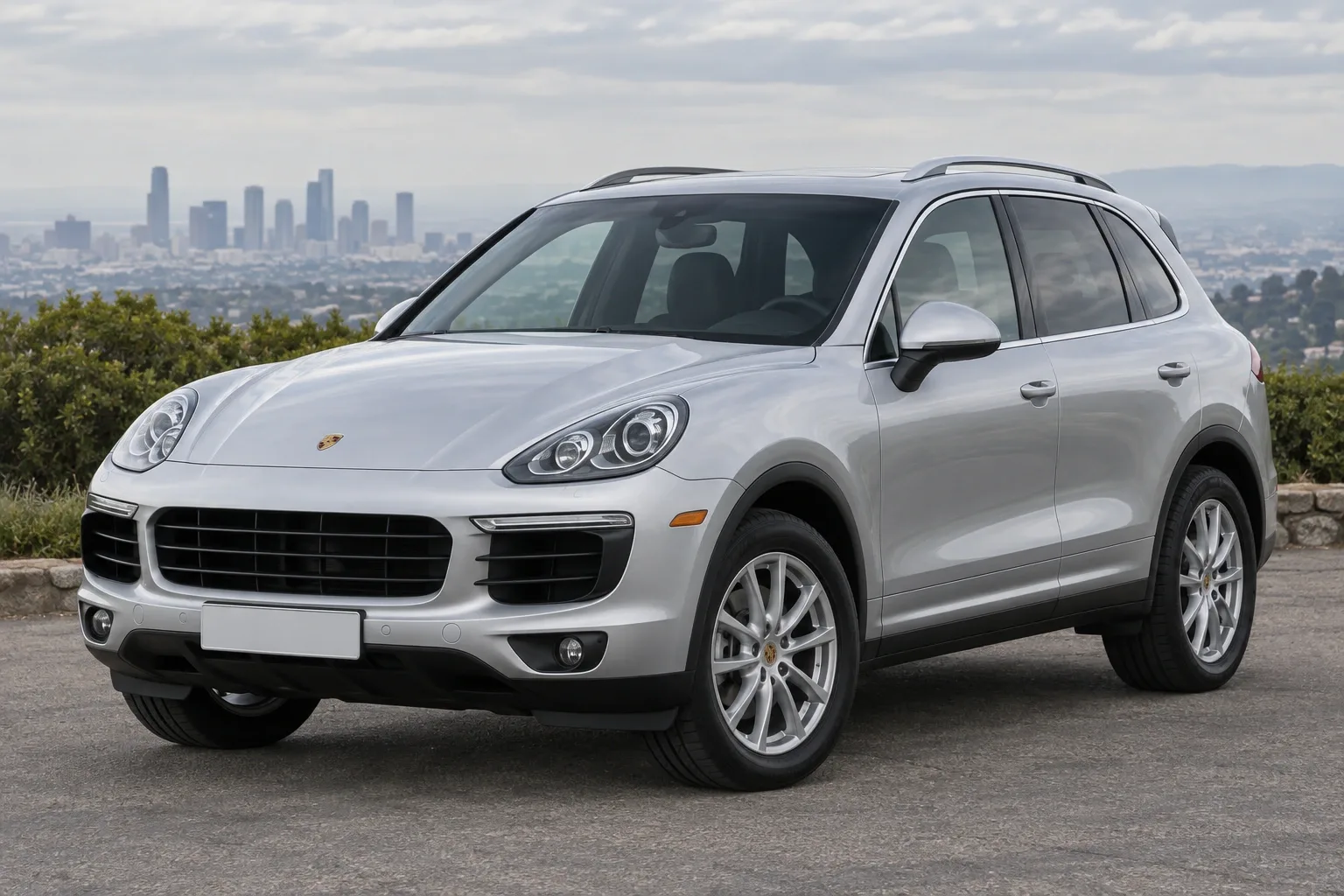
Porsche Cayenne 958 / 92A
Porsche Cayenne 958/92A (2010–2017): condition, documents, inspection and conditions of sale of the car.
Indicative purchase price
Below market value
Final price agreed after inspection.
Value my car1Why buyers choose this model
The second generation Porsche Cayenne entered the market in May 2010. It is built on the optimized platform of the predecessor.
2What buyers check
Review
The second generation Porsche Cayenne entered the market in May 2010. It is built on the optimized platform of the predecessor. In comparison, the weight decreased by 185 kg, and the wheelbase increased by 40 mm.
Technically, the second Cayenne is close to the second generation Volkswagen Tuareg. Both cars were even assembled in the same factory in Bratislava, Slovakia. At the same time, in Leipzig, Germany, Cayenne shared a conveyor line with Porsche Panamer and Makan. The growing demand for the model forced Porsche to open an additional assembly in 2015 at the VW plant in Osnabrück (Germany).
In 2014, the SUV underwent an update. The changes are noticeable when looking at the front bumper, headlights and taillights.
Engines
The basic versions received a 300-horsepower atmospheric gasoline V6 with a volume of 3.6 liters.
Cayenne S and GTS got an eight-cylinder atmospheric tank with a capacity of 4.8 liters, developing 400 and 420 hp, respectively.
After restyling, the place of the 8-cylinder atmospheric car was taken by a turbocharged V6 3.6 – 420 hp (S) and 440 hp (GTS).
The top versions of the Turbo and Turbo S were equipped with a V8 4.8 with turbocharging. Before restyling, they developed respectively 500 and 550 hp, and after - 520 and 570 hp.
The weakest was the diesel Cayenne with the designation Diesel - 245 hp. It was powered by a V6 3.0 TDI from Volkswagen.
In early 2013, the diesel lineup was diluted by S Diesel with an eight-cylinder 4.1 TDI / 382 hp.
3.6 V6
Basic V6 - analogue of the atmospheric "six" Tuareg. This engine is one of the most reliable in the engine palette.
Periodic attention requires a valve ventilation crankcase gases, built into the oil separator (3-6 thousand rubles).
Sometimes it is necessary to eliminate leakage of working fluids through the valve cover gaskets, intake manifold or cooling system valve.
A number of owners complain of noticeable vibration when the engine is in the range of 1000-1500 rpm. Recommendations for replacing the supports of the power unit and digesting the exhaust resonator do not always help.
3.6 turbocharged V6
The basis of biturbo 3.6 was a block of a 3-liter unit from Panama of Porsche's own design. The working volume was increased due to the stroke of the piston, which increased from 69 to 83 mm.
Unlike the atmospheric 3.6, the turbo engine is completely aluminum, without cast iron sleeves. Therefore, it is not immune from the appearance of bullies on the walls of cylinders. But in fact, such cases are still rare.
When bullies are detected, it is necessary to change the cylinder block, since its sleeve is impossible.
4.8 V8
The V8 with direct fuel injection is made entirely of aluminum. The engine is Porsche’s own design.
Atmospheric and biturbo variants of the V8 4.8, like its predecessor in the 957th, are prone to the appearance of bullies on the walls of the cylinders (250-300 thousand rubles for repairs). However, the actual cases of defect detection are not so large.
Some of the samples have rolled over 250,000 km without any problems. To avoid expensive repairs will help regular washing of radiators (10-15 thousand rubles), timely replacement of engine oil and gentle loads until full warming up.
Before restyling, phase rotators became the subject of attention - aluminum bolts broke off. The new original phase rotator is available for 43 000 rubles, and the analogue for 22 000 rubles.
Among the repeated flaws can be noted failure of the ignition coils (2-5 thousand rubles) after 100-150 thousand km of run.
And after 150 000 km, the plastic horn-shaped tube of the cooling system dries up and collapses (3-4 thousand rubles).
V6 3.0 TDI
3-liter turbodiesel from VAG-and quite reliable. However, after 100,000 km of running (and sometimes before) large costs can not be avoided. The engine is starting to leak nicely. Leaks occur through the valve covers, pallet, timing system chain cover, front and rear crankshaft oal. A heat exchanger can also flow - antifreeze is found in the collapse of the block.
To eliminate most leaks, engine recompacting is required. For this, it must be dismantled. Official services take for work 200-300 thousand rubles. In the profile service will ask about 80 000 rubles. Not all owners are ready to shell out such amounts, so they often skate, delaying repairs to the last.
Sometimes the chain tensioner failed - crumbled. The timing system drive circuit is located on the side of the gearbox. For updating the set of the timing system had to pay about 90 000 rubles.
Fuel injectors (20-25 thousand rubles) usually serve more than 200 000 km.
V8 4.1 TDI
The V8 is familiar to many in the Audi A8, Q7 and Touaregu. For all models, it was assembled at the Audi factory in Hungary.
In the Porsche 4.1 TDI features a higher boost pressure and a more productive intercooler.
Unlike the 3-liter turbodiesel, it does not force to deal with numerous leaks of working fluids.
Only occasionally there are interruptions in the work of turbocharging. The reason is the wear of the actuator plastic gears. The actuator can be replaced separately (10,000 rubles), despite the fact that in the original it is assembled with a turbine (200,000 rubles).
Hybrid version
As a power plant in the S Hybrid, a combination of a six-cylinder 3.0 TFSI petrol (333 hp) with a mechanical compressor and a three-phase synchronous electric motor (34 kW or 46 hp) is used.
The energy storage device (nickel-metal hydride battery) is located at the rear of the car. The electric power reserve is about 2 km, and the maximum speed of electric power is 60 km / h.
The letter S in the Cayenne S Hybrid name means that the dynamic performance must match the eight-cylinder Cayenne S.
The hybrid version received electrified auxiliary units: air conditioner compressor, GUR pump and vacuum pump. This allows you to maintain the efficiency of the systems when the engine is turned off.
After restyling, the S E-Hybrid came with the Plug-In concept, i.e. with the ability to charge the battery from the outlet. The electric motor began to develop 70 kW (95 hp), and as a drive used a more powerful lithium-ion battery. The power reserve on electricity is up to 36 km, and the maximum speed is up to 125 km / h.
The cost of a new battery is about 900 000 rubles.
The 3.0 TFSI suffered from bullies on cylinder walls until the end of 2013. At the end of 3013, the sputtering intensified, but incidents still occurred. In 2015, the disease was completely eliminated with the help of cast-iron shells.
Transmissions
The manual transmission could be installed only in the basic versions with a gasoline 3.6. But you can't find these cars on sale.
The remaining crossovers, except for hybrid, were paired with an 8-speed automatic development Aisin. The TR-80SD version is very lively. Repairs are quite rare. The main thing is to regularly update the oil in the box - every 60,000 km. Many owners are baffled by Porsche’s recommendation to make the first 240,000 km replacement of the transmission fluid. It's too late.
In hybrid modifications, a robotic PDK transmission is used. Its weak point is the clutch block (about 180 000 rubles).
All-wheel drive system
Only diesel and hybrid Cayens were equipped with permanent all-wheel drive with a self-locking Torsen center differential (as in Tuareg). In this combination, the torque between the axes is distributed in a ratio of 40:60.
In gasoline versions, the front axle is connected using a multi-plate clutch with electronic control (as in the Panamera). Under normal conditions, the front wheels only get 10% of the thrust. If necessary, the clutch is blocked completely. Nevertheless, the petrol Porsche feels confident both on the difficult terrain and on the snowy virgin land.
For a surcharge, the SUV could be equipped with a rear differential PTVP with electronically controlled locking. The system brakes the inner wheel in corners and increases the torque on the outer wheel.
The front gearbox could make noise after 100-150 thousand km. The defect is characteristic, first of all, for pre-restyling samples. A new gearbox can be found for 100,000 rubles, and for repairs will ask 30-50 thousand rubles.
In gasoline versions, sometimes the handout failed - tremors appeared. Sometimes the jerks disappeared after the update of the transmission fluid. The new node is available for 200-300 thousand rubles, and for the restoration of the old will take 40-50 thousand rubles. The distribution was modernized after 2016.
Walking
On the front axle, each wheel has a pair of transverse levers. A multi-element circuit is used on the rear axle.
The suspension could be both conventional - on steel springs, and pneumatic (standard for turbo versions). Optionally, electronically controlled shock absorbers PASM and the PDCC roll suppression system were available.
Silent blocks of the front and rear levers can become unusable after 80-120 thousand km. To update all rubber and metal elements will have to spend about 30 000 rubles.
The ball supports of the front levers are much more tenacious. They change in the collection with levers (4-22 thousand rubles for the top).
The pneumosystem is generally considered reliable and durable. Although there were some shortcomings. For example, over time, the pneumonoids began to knock.
Sometimes the defect was eliminated by replacing the supports of shock absorbers (2-3 thousand rubles per piece). In other cases, the bulkhead helped (20 000 rubles per rack) or the replacement of pneumatic resistant (50-70 thousand rubles).
Pneumoballoons usually last a long time. The front reaches 200,000 km, but the rear could start to tamper a little earlier.
In winter, there are sometimes interruptions in the system. Usually, this is the fault of freezing moisture.
Long-term ignoring of problems with the pneumosystem accelerates the wear of the compressor (30-50 thousand rubles).
Brakes
The flagship versions of the Turbo S were equipped with PCCB carbon ceramic brakes with 10-piston front calipers and four-piston rear.
Carbon brakes have a large endurance reserve and do not lose effectiveness with frequent braking from high speeds on the race track. However, in case of wear or damage for a new set will have to pay a tidy sum - about 1,300,000 rubles!
For everyday habitat, there are enough conventional brakes (55,000 rubles for the original set or 30,000 rubles for analogues).
Other problems and malfunctions
The body iron of the Porsche Cayenne is not yet plagued by corrosion problems. The hood, front wings and trunk door are made of aluminum.
Many owners complain about the mist of the headlights.
Light removable headlights are a tasty piece for negligent citizens who are hungry for easy profit. The damage from the loss of xenon block headlights will be 63 000 rubles, and LED – 140 000 rubles. The second headlight can be bought for 30 000 rubles.
It is noteworthy that in hybrid versions due to the lack of headlights stops working power steering.
Some firms offer kits for protection against theft of optics with screws or cables. However, in this case, an attempt to take possession of the headlight often ends in damage to the hood, wing or bumper.
After 100-150 thousand km, shock absorbers of the trunk lid with electric drive are handed over. They change in a pair - 2 pieces for 20-25 thousand rubles.
After 150-200 thousand km, there may be failures in the operation of door locks. The servo drive fails - 400 rubles for a Chinese motor. The castle in the collection will cost 4-14 thousand rubles.
With age, chrome flies off from the windows, and sometimes the buttons break off altogether. The new block of driver’s door buttons is available for 3-5 thousand rubles, and the original one for 10 thousand rubles.
Over time, drainage holes are clogged in the area of rubber plugs located behind the lockers (plates). This is the main reason for the sudden appearance of water in the legs of the driver or front passenger. In the neglected case, water can get to the ECU of the engine, the fuse block or the engine of the stove (8-13 thousand rubles for an analog).
3Pre-purchase checklist
4.8 V8
- 8, like its predecessor in the 957th, are prone to the appearance of bullies on the walls of cylinders (250-300 thousand rubles for repairs).
- Some of the samples have rolled over 250,000 km without any problems.
- To avoid expensive repairs will help regular washing of radiators (10-15 thousand).
- RUB), timely replacement of motor oil and gentle loads until full warming up.
- And after 150 000 km, the plastic horn-shaped tube of the cooling system dries up and collapses (3-4 thousand rubles).
V6 3.0 TDI
- A heat exchanger can also flow - antifreeze is found in the collapse of the block.
- To eliminate most leaks, engine recompacting is required. For this, it must be dismantled.
- Not all owners are ready to shell out such amounts, so they often skate, delaying repairs to the last.
V8 4.1 TDI
- The reason is the wear of the actuator plastic gears.
Transmissions
- Repairs are quite rare.
All-wheel drive system
- If necessary, the clutch is blocked completely.
- A new gearbox can be found for 100,000 rubles, and for repairs will ask 30-50 thousand rubles.
Walking
- In other cases, the bulkhead helped (20 000 rubles per rack) or the replacement of pneumatic resistant (50-70 thousand rubles).
- Usually, this is the fault of freezing moisture.
- Long-term ignoring of problems with the pneumosystem accelerates the wear of the compressor (30-50 thousand rubles).
Brakes
- However, in case of wear or damage for a new set will have to pay a tidy sum - about 1,300,000 rubles!
Other problems and malfunctions
- The body iron of the Porsche Cayenne is not yet plagued by corrosion problems.
- Many owners complain about the mist of the headlights.
- The servo drive fails - 400 rubles for a Chinese motor. The castle in the collection will cost 4-14 thousand rubles.
4Challenges of selling privately
The second Cayenne became roomier, faster and more economical. Unfortunately, maintenance costs have not become less, and not every service is able to repair or maintain an SUV. Only specialized PIWIS equipment is required to perform diagnostics, adjustments and adaptation.
Of the whole set, the most reliable diesel versions and the basic version with an atmospheric gasoline V6 3.6 proved themselves.
- The second generation Porsche Cayenne entered the market in May 2010.
- Engines: Basic versions received a 300-horsepower atmospheric gasoline V6 with a volume of 3.6 liters.
- Hybrid version: As a power plant in the S Hybrid, a combination of six-cylinder gasoline 3.0 TFSI (333 hp) is used.
- Transmissions: Repairs are rare.
- All-wheel drive system: A new gearbox can be found for 100,000 rubles, and for repairs they will ask 30-50 thousand rubles.
- Chasing: In other cases, the bulkhead (20,000 rubles per rack) or the replacement of pneumatic sticks (50-70 thousand rubles) helped. Pneumoballoons usually last a long time.
- Other problems and malfunctions: The body iron of the Porsche Cayenne is not plagued by corrosion problems yet.
Shows, bargaining and re-registration take time: buyers look, promise to think and disappear. Fair price after inspection closes the auction on the spot. If money is needed urgently, the purchase takes away waiting and repeat displays.
5How selling to us works
Leave a request with the car data. We will discuss the preliminary assessment and inspection. After checking the status and documents, we agree on the final price and terms of the transaction.