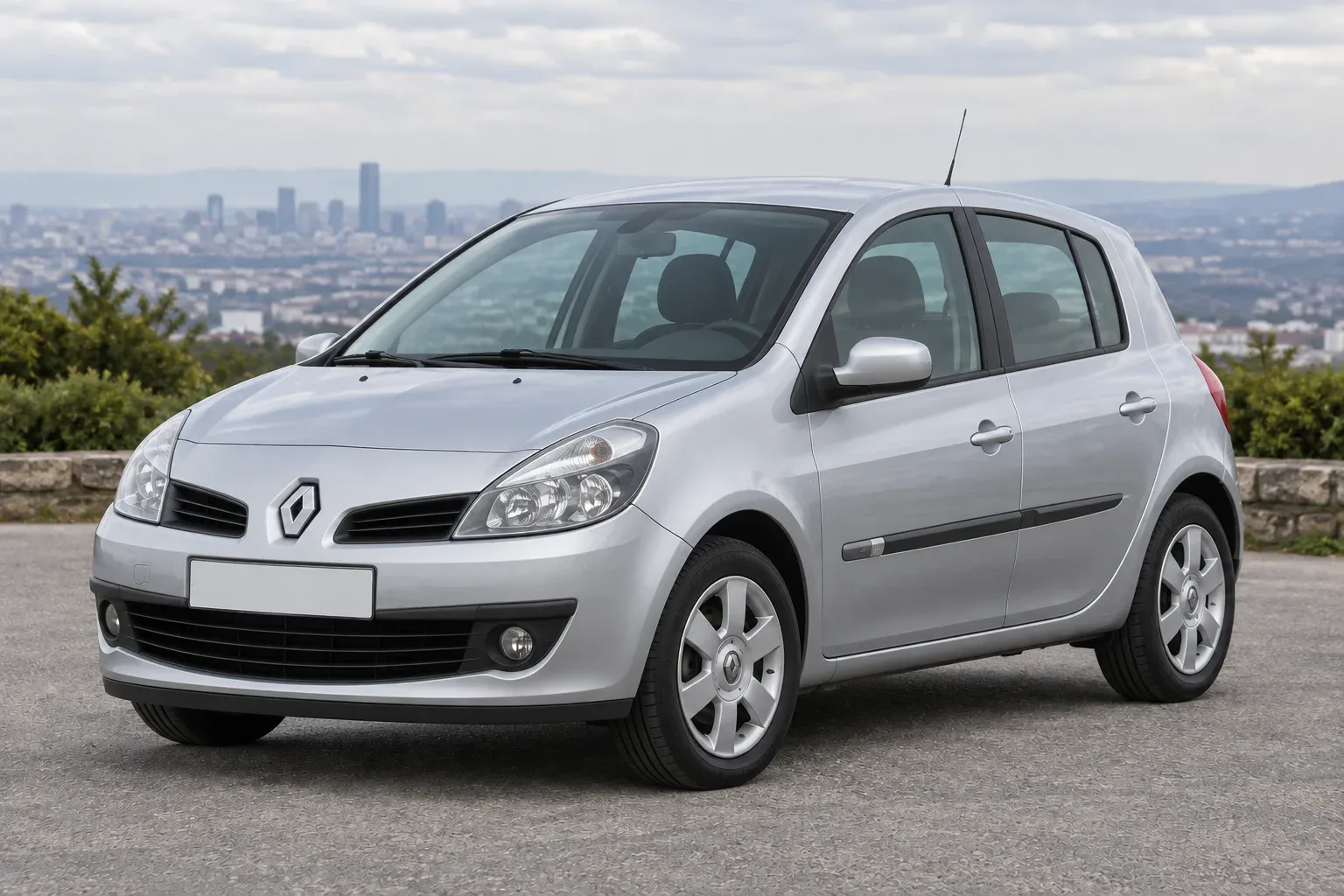
Renault Clio 3
Valuation of the Renault Clio 3 (2005–2014): condition, paperwork, inspection and terms of sale.
Indicative purchase price
Below market value
Final price agreed after inspection.
Value my car1Why buyers choose this model
The creators of Renault Clio did not have to make a technical revolution. The second generation Clio has done very well. All that remained to be done was to modernize and refine the source material. The third edition appeared in 2005. It was a brand new car built on the B platform, developed as part of an alliance with Nissan. The designers of the new Clio, first of all, took care of safety. As a result, the maximum 5 stars according to the results of the crash tests EuroNCAP. The predecessor scored only 4 stars. Reliability issues were not left out either. Work in this direction has yielded tangible results. Every year the quality of the assembly has improved, and the number of problems has decreased. Clio is also attractive in terms of practicality. The relatively spacious interior is decorated with good materials. The spacious trunk of the hatchback has a volume of 288 to 1028 liters. If this is not enough, then you can consider the 22 cm version of the wagon with a cargo compartment of 439-1277 liters. For fans of thrills, a sports modification of the RS is provided. The third generation Clio is primarily a small and elegant, but at the same time comfortable and functional city car, which can easily go on a long journey. It has good smoothness and acceptable sound insulation. Clio is easily controlled and completely predictable in all road conditions. In favor of the compact speaks and the title of “Car of the Year”, which he was awarded in 2006. Maintenance costs can be very low if you choose the right engine. The simple design of the car and the availability of spare parts allow it to be serviced in almost any workshop. It does not cause difficulties and everyday operation.
2What buyers check
Engines
The least problematic unit is an atmospheric gasoline engine with a volume of 1.2 liters. This is a 4-cylinder unit with the index D4F. Its technical feature is 16 valves controlled by one camshaft. This technology was widely used by Japanese manufacturers in the 90s. Valves are controlled by means of skewers and mechanical gap limiters. Superior engine reliability is violated only by the control electronics. It was supplied by the French Sagem and the Italian Magneti Marelli. And just the latter showed itself unimportant - it could not withstand increased heat load. However, the engine is worthy of recommendations, as it is free of any fatal defects. Gasoline atmospherics with a working volume of 1.4 liters have also proven themselves well. However, sometimes you have to resort to replacing the engine cushions and repairing the throttle. 1. 4 is marked with the code K4J. Its head contains two camshafts, and the gaps of the valves are controlled by hydraulics. Petrol 1. 6 K4M - derivative of atmospheric 1.4 liters. The expansion of the working volume was achieved by increasing the stroke of the piston from 70 to 80 mm while maintaining the cylinder diameter of 79.5 mm. Atmospheric 1.4 and 1.6 are equipped with a phase control system on the intake shaft. For this purpose, a hydraulic switch is used, which is assembled with the gears of the camshaft. Over time, the phase rotator is surrendered, which is manifested by grinding when the engine is started. Ignition coil failure is another common problem with K4J and K4M engines. There are four coils here, one for each cylinder.
1.5 dCi
The diesel is available in the K9K series and is available in several versions. They are distinguished by performance, environmental class, compression degree and Common Rail nozzles.
Euro-4 versions offer 68 and 86 hp. The fuel system was developed by Delphi. Its nozzles and TNVD are easily repairable.
A more advanced modification of the 106 hp recoil has a reduced compression ratio - from 17.9:1 to 15.6:1. The engine is still quieter and softer. Instead of electromagnetic Delphi nozzles, piezoelectric Siemens are used. But they also fail sometimes. Siemens injectors are more expensive and more difficult to repair.
Owners of the most powerful version may be concerned about the likelihood of rolling rod liners. Sometimes this happens after 120-150 thousand km. The only way to prevent the problem is to reduce the interval of oil change to 7-8 thousand km.
In 2010, Euro-4 was replaced by Euro-5 turbodiesels, developing 75 and 88 hp. However, 1.5 dCi return 106 hp was offered until the end of production of the model.
For large runs, attention should be paid to the EGR valve. It usually gets clogged due to wear on the turbocharger bearings, which start to let a lot of oil into the intake system.
Not characterized by durability and two-mass flywheel. The problem with the two-mass flywheel disappears in versions with the weakest diesel. But this car is not happy with the dynamics. The EGR valve should also be considered.
Transmission
Gasoline engines with a volume of 1.6 and 2.0 liters were the only ones combined with an automatic transmission DP0. Unfortunately, she offered only 4 assists and not too long a lifespan. To extend the life of the machine will help regular oil change - every 60 000 km. The upcoming repair will prompt jerks during the movement. The machine later goes into emergency mode. Sometimes it is possible to revive the box after turning off the ignition. But it won't last long. Experts believe that the service life of the box is 150-170 thousand km.
The 1.2 16V and 1.5 dCi engines could be powered by the Quickshift robotic box. Two completely different boxes were hidden under the same name - the JA3 and the more powerful JA5. The reason is the mechanics of JH3 and JR5, respectively. The switching is controlled by an electrohydraulic. The robot is not reliable.
Over time, the mechanism for selecting transmissions in the ICAT wears out. The backstage has a large free ride, which makes it difficult to turn on gears.
Walking
Clio's soft suspension provides a good level of comfort. However, it is not considered hardy. Quickly develop their resource bearings front pillars, Silent blocks of front levers and stabilizer racks.
Short-lived and hub bearings. But if the replacement of the front is cheap, then the rear has to pay more - they change in the collection. However, the chassis is considered inexpensive and easy to repair, which can be handled by any mechanic.
Electromechanical amplifier is used in steering. Knocks in the steering wheel can be caused by a gap in the steering column. The disease affected TRW powered cars (mostly from summer 2008 to January 2009).
Body and salon
Corrosion of the body is very rare, and even then after unprofessional repair of the element damaged in an accident. The front wings are made of plastic. Therefore, they should be inspected for cracks.
The spare wheel is located in an inconvenient and inaccessible place - outside under the trunk floor. Besides, it's always dirty.
Clio disease is a noise made by the trunk door. Adjusting the cover helps for a short time and not always.
The Renault Clio 3 is one of the few cars to have two levels of equipment. It is not about equipment, but materials. Buyers of cheaper versions have to settle for a front panel made of hard plastic. In more expensive configurations, it is made of foamed plastic.
Electrician.
Electrical and electronic components are a regular source of trouble in Clio. First of all, the key card and switches on the steering wheel refuse to obey. Also depressing is the control unit of the instrument panel, electric windows and the electric motor of windshield wipers. Problems with the air conditioning system are usually associated with malfunctions in the control electronics or compressor components.
Key card
The electronic card instead of the classic ignition key was first proposed in Laguna 2. A year later, the card received a futuristic Megan 2, well, and then other models of the brand.
The basic versions of Clio 3 were content with the usual ignition key. It was in two versions - classic and with a folding blade. The remaining variations could have an electronic card, and also in two versions.
The simplest card allowed you to unlock the locks by pressing the appropriate button. This is called a remote control map.
A more advanced version of the key gave the right to unlock the locks, and then open the car door without removing it from your pocket. Just pulling a pen. The movement of the handle recorded a sensor of its movement, which was hidden behind a dark plate and visible on the handle. There are also two transmitters involved. One is located in the front of the car and the other in the back. They detect the presence of the card and register its answering machine (transponder).
To block the car, you need to press a small button on the handle. Clio does not use a version of the control system that automatically closes the locks once the card is removed.
Renault electronic key cards are still being discussed extensively not on the topic of reliability. This is true for Laguna and Meghan. In Clio, this technology has become better. More often, the buttons on the door handle itself fail. In this case, to close the locks you have to use the buttons on the map.
Service promotions
The third generation Clio has experienced two service promotions. The first one was in the spring of 2007 and concerned a defective stop light switch. The launch of the second campaign for owners of versions with a gasoline engine of 1.2 liters was announced at the end of summer 2011. There was a risk of getting a splint of valves into the engine.
Model history
2005 – premiere of the model in the back of the 3 and 5-door hatchback with gasoline engines with a working volume of 1.2 liters (65 and 75 hp), 1.6 liters (88 and 112 hp) and a turbodiesel 1.5 dCi (68, 86 and 106 hp)
2006 – expanded the range of engines: gasoline engines with a working volume of 1.2 liters (78 hp), 2.0 l (140 hp) and turbodiesel 1.5 dCi (103 hp) appeared. Presented sports version of the Sport F1 Team R27 with a 2-liter gasoline engine with a capacity of 197 hp.
2007 – petrol turbo engine 1.2 Tce (100 hp). The model range was replenished with a wagon (Grandtour).
2009 – a small restyling – changes touched the front. There was a gasoline engine of 1.6 liters (128 hp). Presented sports version of Gordini RS with a 2-liter engine with a capacity of 201 hp.
2010 – 1.5 dCi turbodiesel (75 and 88 hp)
2011 – gasoline engines with a working volume of 1.6 liters (112 hp) and TC 100 (100 hp)
Deficiencies
- squirrel-like electronics and electrical equipment
Recommendations
The lowest operating costs require petrol versions of the Clio with atmospheric engines of 1.2, 1.4 and 1.6 liters. The smallest of them is too weak, but less troublesome. The other two provide quite good dynamics, but consume more fuel and have minor ailments. The turbo engine and 2-liter unit are much more expensive to operate due to higher fuel consumption, greater maintenance requirements and expensive spare parts. Turbodiesel is not recommended for problems, especially after 100,000 km. The least risks of them guarantee a weak 1.5 dCi with a capacity of 68 hp.
3Pre-purchase checklist
Engines
- The least problematic unit is an atmospheric gasoline engine with a volume of 1.2 liters.
- And just the latter showed itself unimportant - it could not withstand increased heat load.
- However, sometimes you have to resort to replacing engine cushions and repairing the throttle.
- Ignition coil failure is another common problem with K4J and K4M engines.
- Interestingly, this defect has been haunting these engines since the second half of the 90s, since they appeared in the first Megan.
- Due to a large number of malfunctions, Renault turned to another supplier - Denso - for help.
- 2-liter atmospheric engine and turbo engine 1. 2 TC road in maintenance and repair.
- D4Ft, like D4F, needs to be checked for valve clearance from time to time (usually when noise appears).
1.5 dCi
- Its nozzles and TNVD are easily repairable.
- Instead of electromagnetic Delphi nozzles, piezoelectric Siemens are used. But they also fail sometimes.
- Siemens injectors are more expensive and more difficult to repair.
- The only way to prevent the problem is to reduce the interval of oil change to 7-8 thousand km.
- For large runs, attention should be paid to the EGR valve.
- It usually gets clogged due to wear on the turbocharger bearings, which start to let a lot of oil into the intake system.
- The problem with the two-mass flywheel disappears in versions with the weakest diesel.
- The EGR valve should also be considered.
Transmission
- To extend the life of the machine will help regular oil change - every 60 000 km.
- The upcoming repair will prompt jerks during the movement.
Walking
- But if the replacement of the front is cheap, then the rear has to pay more - they change in the collection.
- However, the chassis is considered inexpensive and easy to repair, which can be handled by any mechanic.
- Knocks in the steering wheel can be caused by a gap in the steering column.
Body and salon
- Corrosion of the body is very rare, and even then after unprofessional repair of the element damaged in an accident.
- Therefore, they should be inspected for cracks.
Electrician.
- Electrical and electronic components are a regular source of trouble in Clio.
- First of all, the key card and switches on the steering wheel refuse to obey.
- Problems with the air conditioning system are usually associated with malfunctions in the control electronics or compressor components.
Key card
- To block the car, you need to press a small button on the handle.
- More often, the buttons on the door handle itself fail.
Recommendations
- Turbodiesel is not recommended for problems, especially after 100,000 km.
4Challenges of selling privately
The third-generation Clio is technically much more mature than its predecessor. He's become more comfortable and practical. Driving this car is fun, and the sports version is delightful. It is a pity that the level of reliability of Clio is still not too high, which spoils the image of a really good model.
- Engines: The least problematic unit is an atmospheric 1.2-liter gasoline engine.
- 1.5 dCi: Its nozzles and CNVDs are easily repairable.
- Transmission: To extend the life of the machine will help regular oil change - every 60,000 km.
- But if the replacement of the front is cheap, then the rear has to pay more - they change in the collection.
- Body and salon: Body corrosion is very rare, and even then after unprofessional repair of the element damaged in an accident.
- Electricity: The components of electrical and electronics are a regular source of problems in Clio.
- Key card: More often, the buttons on the door handle itself fail.
- Service promotions: The third-generation Clio has survived two service promotions.
Shows, bargaining and re-registration take time: buyers look, promise to think and disappear. Fair price after inspection closes the auction on the spot. If money is needed urgently, the purchase takes away waiting and repeat displays.
5How selling to us works
Leave a request with the car data. We will discuss the preliminary assessment and inspection. After checking the status and documents, we agree on the final price and terms of the transaction.