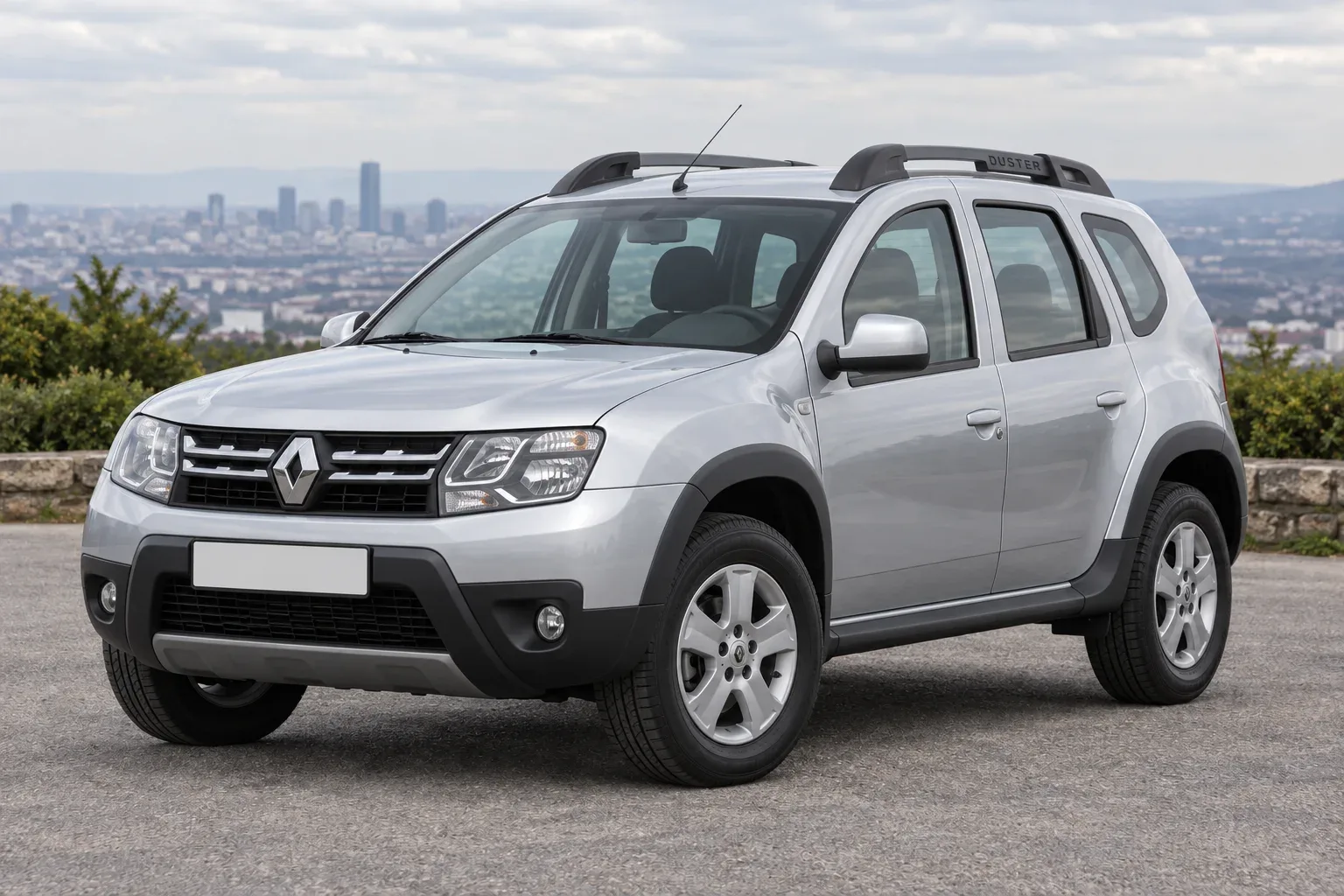
Renault Duster
Valuation of the Renault Duster (2010–2021): condition, paperwork, inspection and terms of sale.
Indicative purchase price
Below market value
Final price agreed after inspection.
Value my car1Why buyers choose this model
Renault Duster is based on Renault’s old and time-tested technology. In addition, a number of Nissan components are used. The most obvious proof is the running and transmission.
2What buyers check
Walking
The engine and transmission are placed on a large subframe. This solution was first used in 1980 on the small Renault 9 sedan, and then moved to more modern models of the French brand. The subframe also holds the front struts of McPherson - using transverse levers. Their design and shape resemble those that were installed on the old Renault, for example, Megane I or Clio II. The configuration of the lever is an equilateral triangle.
The durability of the front suspension largely depends on the operating conditions. Updating the stratified silentblocks may be necessary after 60-100 thousand km, and worn ball supports - after 100,000 km. The cost of the new original lever is 12,000 rubles, and the analogue is from 2,000 rubles.
The rear suspension comes in two types. In front-wheel drive modifications, a torsion beam is used, and in all-wheel drive - an independent circuit with two parallel transverse arms and one longitudinal one. This configuration has been widely used by Japanese, Korean and Italian manufacturers for many years.
The components of the rear suspension are more durable - almost do not require attention to 150-200 thousand km. But shock absorbers on the front or rear axle can fill after 50-100 thousand km. After 60-100 thousand km can sound one of the rear hub bearings. The new element costs about 2 000 rubles.
Transmission
In Renault Duster with all-wheel drive, a 6-speed manual transmission TL8 is installed. The lack of traction was compensated by short gear ratios. 4.45:1 of the first gear means that at 1000 rpm the speed of the car will be only 5.79 km / h. The first two gears and the rear speed (4.86:1) are completely identical for both petrol and diesel versions. The gear ratios of the other speeds are different. Front-wheel drive modifications Duster were equipped with 5-speed mechanics JR5
The clutch of the ICS serves more than 150,000 km. The cost of the new set is 6-9 thousand rubles. Alternatively, the 2-liter petrol version could get a 4-band automatic: DP8 with all-wheel drive or DP2 with front. Part of the Dusters with automatic transmission entered the service action to replace the distribution unit and three sealing rings. However, there are no serious problems with the machine. In the case of all-wheel drive car boxes, an angle drive is built, which is connected to the rear axle with a drive shaft. The distribution of traction is taken care of by a multi-plate clutch placed in the block in front of the rear axle differential. The system is similar to the 4x4 All Mode used by Nissan. The traction between the front and rear axles is distributed in a ratio of 100:0 to 50:50 - depending on the driving conditions and parameters taken from the sensors, including the lateral acceleration sensor. The driver has three modes of operation of the transmission. 2WD - the coupling is completely disconnected, and the Renault Duster remains front-wheel drive.
Petrol engines
The most common gasoline units with a volume of 1.6 liters. Before restyling, the K4M engine was offered, which has been widely used by Renault since 1998. In Duster, he develops 102 hp. You will not have to stock up on additional funds to replace phase regulators, because they are not here. In Europe, the K4M engine had two additional modifications. The first was designed to work on gas, and the second - on bioethanol E85.
The more powerful H4M unit replaced the K4M after restyling in 2015. At the same time, the return of the 2-liter F4R increased from 135 to 143 hp.
All Duster engines have a temporary type of valve timing drive, which is recommended to be changed every 90,000 km. 114-horsepower H4M uses a chain drive valve timing.
In the process of operation of K4M, you can encounter failed ignition coils (from 1500 rubles per unit). If the engine is not working uniformly, and the engine malfunction control lamp lights up, then it is not recommended to continue further movement. The K4M control unit is not able to disable the nozzle with a faulty coil, such as the TSI controller in VW engines. As a result, the fuel, burning in the exhaust, increases the heat load on the catalyst.
After 60-100 thousand km, fogging is sometimes found in the area of the valve cover. The oil squeezes out from under the lid bolts. The engine has no other weaknesses, as does the 2-liter F4R.
In both units after 70-100 thousand km can fail the thermostat. Characteristic symptom - jumps in the temperature readings of the cooling liquid. The cost of a new thermostat is around 500 rubles.
Diesel engines
At first, the 1.5 dCi K9K turbodiesel was offered in two versions, slightly different in power and torque. The weakest variant of the 86 hp recoil has a compression ratio of 17.6:1 and a Common Rail injection system. Delphi fuel equipment is quite complex, but quite reliable and repairable. The cost of a new nozzle is about 22 000 rubles. This unit was intended only for front-wheel drive modifications, and, therefore, was combined with the manual transmission JR5. The reliability of the ligament increases the absence of a two-mass flywheel. Later, a 90-horsepower version of the 1.5 dCi was proposed. The compression ratio was reduced to 15.7:1, but the fuel system remained the same. The engines met Euro 4 toxicity standards and were therefore not equipped with particulate filters. The most powerful 1.5-liter turbodiesel with a recoil of 109 hp also works with a reduced compression ratio of 15.7: 1. However, there is installed fuel equipment Siemens and a turbocharger variable geometry. The weaker versions use a constant geometry turbine, where performance is regulated by by a bypass. the 109-horsepower turbodiesel is designed only for all-wheel drive modifications. This is combined with the TL8 mechanical box. In addition, this version received a two-mass flywheel costing from 35 000 rubles and a particulate filter. The resource of the latter is more than 150-200 thousand km. The fuel system of French turbodiesel is sensitive to the quality of fuel. Therefore, you should only refuel at proven gas stations and not save on replacing the fuel filter. Fortunately, the K9K does not cause any serious problems. At the same time, after 60-100 thousand.
Inlays
Many people have heard about problems with the rod liners of the K9K engine. This defect is inherent in all versions of the 1.5 dCi turbodiesel, since the design of the crank-shaking mechanism is almost identical. The disease is especially common in Europe, where the service interval of oil replacement is 20-30 thousand km. However, the manufacturer says that in 2013 the liners were strengthened.
The best prevention is more frequent oil change: once in 7-10 thousand km. Before restyling, owners of diesel Dusters were ordered to update the oil once every 10,000km. After restyling, the service interval was increased to 15,000 km.
So far, cases of premature wear of inserts on Duster have not been identified. However, experts recommend preventively changing the liners after 100-150 thousand km. A set of inserts costs from 1500 rubles. For the work will have to pay almost 10 000 rubles. The dismantling and reverse installation of the oil pallet, as well as actions to prepare for replacement in the official service, is given almost 4.5 hours. Another 4 hours is taken by the replacement of the liners. Experienced mechanics recommend installing new bolts, although the manufacturer does not require this.
Body and interior
The strength of Duster’s paintwork is no different from its competitors. Soon chips and scratches form.
A number of owners of cars from 2012-2013, after 1-3 years, found cracking of the LCP on the roof - in the groove of the drain, closer to the trunk door. The manufacturer acknowledged the defect and increased the length of the weld in the problem area. In copies collected after 2013, this ailment does not occur.
Sometimes there is water in the engine compartment. It flows down a fluid supply tube to the washer. The washer nozzles are installed on the hood without sealing rubber bands. In addition, the body of the nozzle may be defective or cracked. Unpleasant consequences occur when liquid hits the ignition coil - it fails.
In summer, from time to time, a puddle forms under the front passenger mat. It's condensation from the air conditioner vaporizer. It gets into the cabin due to undocking of the drainage elements or careless assembly on the conveyor. After restyling, the problem is less common.
Disadvantages:
The average level of safety is 3 stars according to EuroNCAP.
3Pre-purchase checklist
Walking
- km, and worn ball supports - after 100,000 km.
Transmission
- However, there are no serious problems with the machine.
- In terms of operation, the electromagnetic multi-plate clutch is a more practical solution than the electro-hydraulic Haldex clutch, widely used in European cars.
- A back cross of the driveshaft may appear.
- According to the regulations, the replacement of the node is made in the collection with a cardan - 35,000 rubles.
Petrol engines
- All Duster engines have a temporary type of HRM drive, which is recommended to be changed every 90,000 km.
- In the process of operation of K4M, you can encounter failed ignition coils (from 1500 rubles per unit).
- If the engine is not working uniformly, and the engine malfunction control lamp lights up, then it is not recommended to continue further movement.
- km sometimes detect fogging in the area of the valve cover. The oil squeezes out from under the lid bolts.
- In both units after 70-100 thousand km can fail the thermostat.
Diesel engines
- Delphi fuel equipment is quite complex, but quite reliable and repairable.
- Therefore, you should only refuel at proven gas stations and not save on replacing the fuel filter.
- Fortunately, the K9K does not cause any serious problems. At the same time, after 60-100 thousand.
- km may be difficult to start due to wear of the reverse valve fuel injectors. The cost of the full set is 5-10 thousand rubles. After 100,000 to 150,000.
- The EGR (exhaust gas recirculation) system may fail.
- The reason is the wear of plastic parts of the drive of the UGR valve. The new node will cost 10-15 thousand.
Inlays
- Many people have heard about problems with the rod liners of the K9K engine.
- The best prevention is more frequent oil change: once in 7-10 thousand km.
- So far, cases of premature wear of inserts on Duster have not been identified.
- However, experts recommend preventively changing the liners after 100-150 thousand km.
- Another 4 hours is taken by the replacement of the liners.
- Experienced mechanics recommend installing new bolts, although the manufacturer does not require this.
Body and interior
- The manufacturer acknowledged the defect and increased the length of the weld in the problem area.
- The washer nozzles are installed on the hood without sealing rubber bands.
- Unpleasant consequences occur when liquid hits the ignition coil - it fails.
- After restyling, the problem is less common.
4Challenges of selling privately
- Chasing: km, and worn ball supports - after 100,000 km.
- Transmission: However, there are no serious problems with the machine.
- Gasoline engines: During operation of K4M, you can encounter failed ignition coils (from 1500 rubles per unit).
- Diesel engines: Delphi fuel equipment is quite complex, but quite reliable and maintainable.
- About the problems with the rod liners of the engine K9K heard many.
- Body and interior: The manufacturer has acknowledged the defect and increased the length of the weld in the problem area.
- Disadvantages: 3-star average safety level according to EuroNCAP
Shows, bargaining and re-registration take time: buyers look, promise to think and disappear. Fair price after inspection closes the auction on the spot. If money is needed urgently, the purchase takes away waiting and repeat displays.
5How selling to us works
Leave a request with the car data. We will discuss the preliminary assessment and inspection. After checking the status and documents, we agree on the final price and terms of the transaction.