
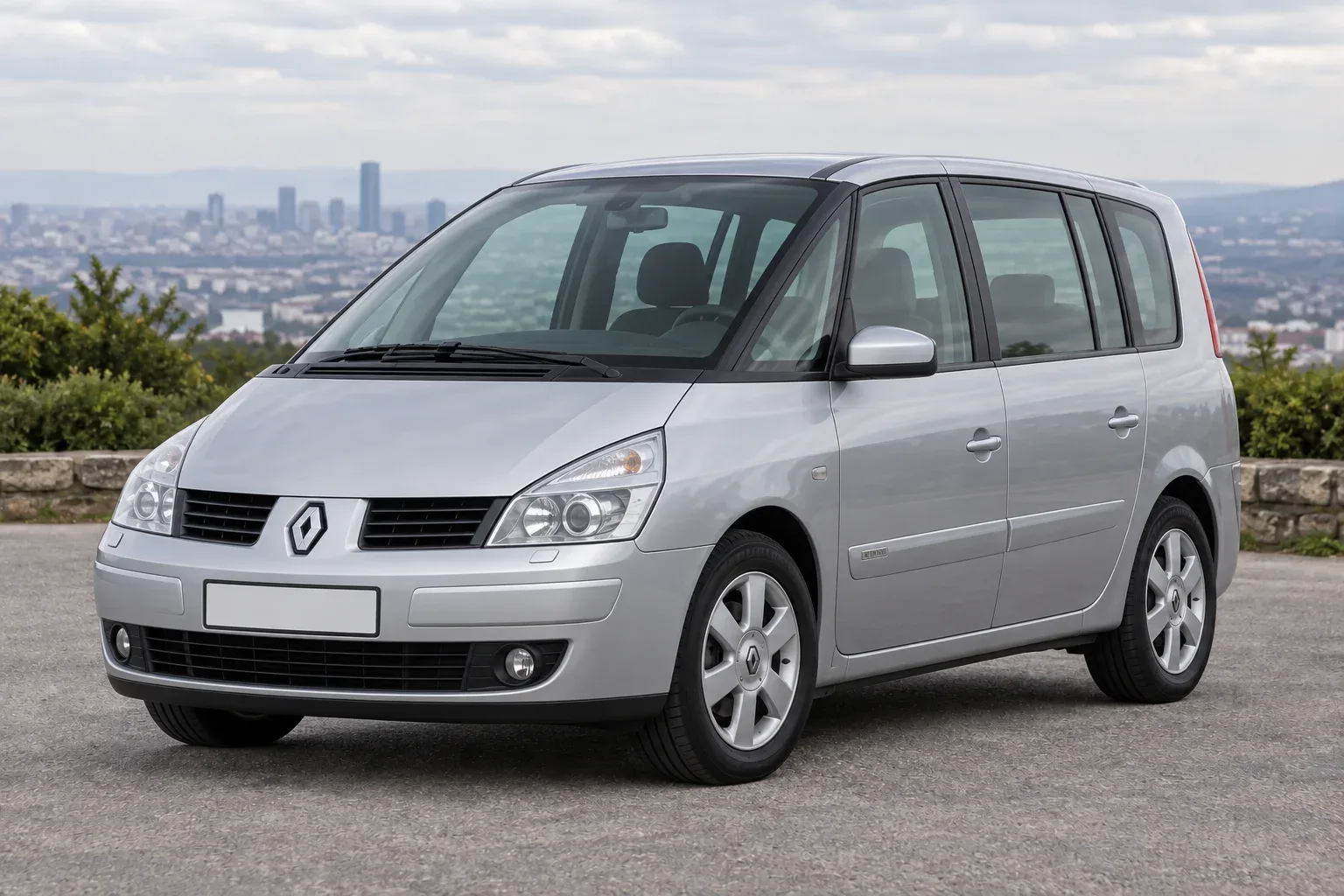
Renault Espace 4
Valuation of the Renault Espace 4 (2002–2014): condition, paperwork, inspection and terms of sale.
Indicative purchase price
Below market value
Final price agreed after inspection.
Value my car1Why buyers choose this model
The first Renault Espace debuted back in the 80s.The 4th Espace went into production in 2002. Four years later, the Frenchman underwent a minor modernization.
2What buyers check
Model history
The first Renault Espace debuted back in the 80s.The 4th Espace went into production in 2002. Four years later, the Frenchman underwent a minor modernization. The changes are quite modest, which are difficult to notice: a new front bumper, brighter headlights, modernized taillights and several new details in the interior.
In 2012, Renault decided on another facelift. This time the changes were more obvious, but without revelation. The most noticeable transformation of the front part: the air intake in the bumper is expanded, a chrome edging of fog lamps is added, the grille and the body of the side mirrors are changed. In addition, there was a new navigation kit, a rear-view camera and leather upholstery with the addition of Teflon. At the end of 2014, the next fifth generation van replaced it.
In the crash tests of EuroNCAP, the French minivan earned 5 stars.
Engines
R4 2.0 Turbo (163-170 hp) / 2002-2013 The range of power units is really rich, but some engines are pursuing serious malfunctions. Unfortunately, we are talking about all turbo diesels without exception. In the base 1.9 dCi, failures in the injection system (from 16,000 rubles per injector), the valve of the EGR exhaust gas recirculation system and the turbocharger are noted. In addition to everything, there is premature wear of rod liners. The reason is known: too long service interval of oil change - 30 000 km. Not reliable and control electronics, and with large runs appear oil leaks. Owners of 2.2 dCi cars point to the same problems. You should not be tempted by the 3-liter turbodiesel design Isuzu. It is one of the most unsuccessful engines ever installed in Renault. Over time, its sleeves are displaced, which is why a “gap” is formed between the head and the block, through which gases rush into the cooling system and squeeze out antifreeze. In addition, faulty nozzles often lead to burnout of pistons. There are also problems with the plastic intake manifold. After 2006, the engine was upgraded and changed its designation from the P9X 701 to the P9X 715. According to the mechanics, the improved diesel is not free from defects, but they occur much less often. Among diesel engines, the best reputation is enjoyed by the 2.0 dCi, which appeared in 2006. There are two versions of this motor.
Transmission
All versions of the Renault Espace 4 have front-wheel drive only. The engine traction is transmitted through a 6-speed manual transmission, as well as through a 5 or 6-speed automatic (from 3.0 dCi after 2006 and from 2.0 dCi after 2010).
Both automatic transmissions were developed by Japanese engineers Aisin. Repair automatic transmission may be required after 200-250 thousand km, which will require 60-100 thousand rubles. Sometimes the mechanics fails (up to 50-80 thousand rubles for bulkheading).
Walking
In the front suspension, classic Macpherson struts are used, and in the back - a twisting beam.
The most common malfunctions concern such elements as ball supports of levers (from 500 rubles per ball) and stabilizer racks. They are not particularly strong and the tips of the steering rods. However, repair costs are not high, and many components are suitable for the Renault Laguna II, for which the market is full of cheap substitutes.
The bearings must be changed after 200-250 thousand km. Soon there is a turn of shock absorbers (from 2000 rubles), front springs (from 3000 rubles) and external shRUS (5-7 thousand rubles).
With large runs, the thrust of the transverse stability of the rear beam can rot. New traction costs 25 000 rubles, however, the old traction can often be brewed.
The steering will not be ignored either. It may be necessary to repair the steering rack (18 000 rubles) or the pump GUR (from 6 000 rubles), or replace the cross of the steering shaft.
The Grand Espace (top) differs from the Espace (bottom) in its increased wheelbase (2868 mm instead of 2803 mm) and length (4861 mm instead of 4661 mm).
Typical problems and malfunctions
The previous generation of the model in terms of reliability showed itself not from the best side. Unfortunately, his successor was not much better. There's a lot of defects.
The Espace body has no problems with corrosion. The doors and hood are made of aluminum, the front wings are made of plastic, and the trunk door is made of fiberglass. Only some owners note the appearance of “bubbles” on the paint coating around the door handles.
Traces of wear on the upholstery of the seats and door panels can become noticeable after 150-200 thousand km.
Owners of Renault Espace complain about the failure of cards and card receivers of the Hands Free keyless access system, as well as tire pressure sensors. The air conditioning control panel, instrument panel and various displays have their quirks. A lot of trouble brings lighting, generator, central lock, tuner and amplifier of the audio system.
Onboard electronics can fail, for example, immediately after turning off the engine to remove the mass from the battery. To avoid this, you can turn off the car no earlier than half an hour after turning off the ignition.
The fan of the heater may fail due to wear of the electric motor, faulty resistor or speed controller. Sometimes the air conditioner compressor passes. Problems in the work of ABS arise due to dirt and oxides in the hydroblock. From time to time, a vacuum brake booster also fails.
Over time, the mechanism of lowering the spare wheel “sours”.
Specifications of Renault Espace IV (2002-2014)
Dynamic characteristics (producer)
3Pre-purchase checklist
Engines
- The range of power units is really rich, but some engines are pursuing serious malfunctions.
- In addition to everything, there is premature wear of rod liners.
- 2 dCi indicate the same problems.
- You should not be tempted by the 3-liter turbodiesel design Isuzu.
- There are also problems with the plastic intake manifold.
- The second, 150-horsepower has a more reliable chain of the fuel, the replacement of which is made only if necessary, and even then, after 300,000 km. Both engines are indistinguishable from the outside.
- At too large intervals of oil renewal, the problem of turning the liners is not alien to him either.
- The basic atmospheric unit does not create problems in operation, but, of course, it does not cope with a car of such dimensions.
Transmission
- Automatic transmission repair may be required after 200-250 thousand.
Walking
- The most common malfunctions concern such elements as ball supports of levers (from 500 rubles per ball) and stabilizer racks.
- However, repair costs are not high, and many components are suitable for the Renault Laguna II, for which the market is full of cheap substitutes.
- With large runs, the thrust of the transverse stability of the rear beam can rot.
- It may be necessary to repair the steering rack (18 000 rubles) or the pump GUR (from 6 000 rubles), or replace the cross of the steering shaft.
Typical problems and malfunctions
- The Espace body has no problems with corrosion.
- Traces of wear on the upholstery of the seats and door panels can become noticeable after 150-200 thousand km.
- The fan of the heater may fail due to wear of the electric motor, faulty resistor or speed controller. Sometimes the air conditioner compressor passes.
4Challenges of selling privately
All that can be blamed on Renault Espas is a large number of minor malfunctions and low quality finishing materials. But inside the place so much that a large family with luggage can fit. In addition to everything, the rear seats can be arranged to your liking: unfold, rotate or just take out. Praise is also deserved by a huge number of different compartments for small things. Another important advantage is a comfortable suspension, which is invaluable in long voyages. The most preferred young specimens after restyling, preferably with diesel 2.0 dCi, gasoline 2.0 Turbo or atmospheric 2.0.
1. Premature wear of liners was most commonly found in diesel 1.9 and 2.2 dCi.
2. A faulty central display is a common occurrence.
3. Exhaust gas recirculation system valve EGR.
4. Individual suspension elements are quite cheap and easily accessible. Regular replacement requires bearings, ball and stabilizer racks.
- Model history: The first Renault Espace debuted back in the 80s. the 4th Espace went into production in 2002.
- Engines: The range of powertrains is really rich, but some engines are chasing serious malfunctions.
- Transmission: Automatic transmission repair may be required after 200-250 thousand.
- Driving: The most common malfunctions concern such elements as ball supports of levers (from 500 rubles per ball) and stabilizer racks.
- Typical problems and malfunctions: The Espace body has no corrosion problems.
- Specifications of Renault Espace IV (2002-2014): Dynamic characteristics (manufacturer)
Shows, bargaining and re-registration take time: buyers look, promise to think and disappear. Fair price after inspection closes the auction on the spot. If money is needed urgently, the purchase takes away waiting and repeat displays.
5How selling to us works
Leave a request with the car data. We will discuss the preliminary assessment and inspection. After checking the status and documents, we agree on the final price and terms of the transaction.