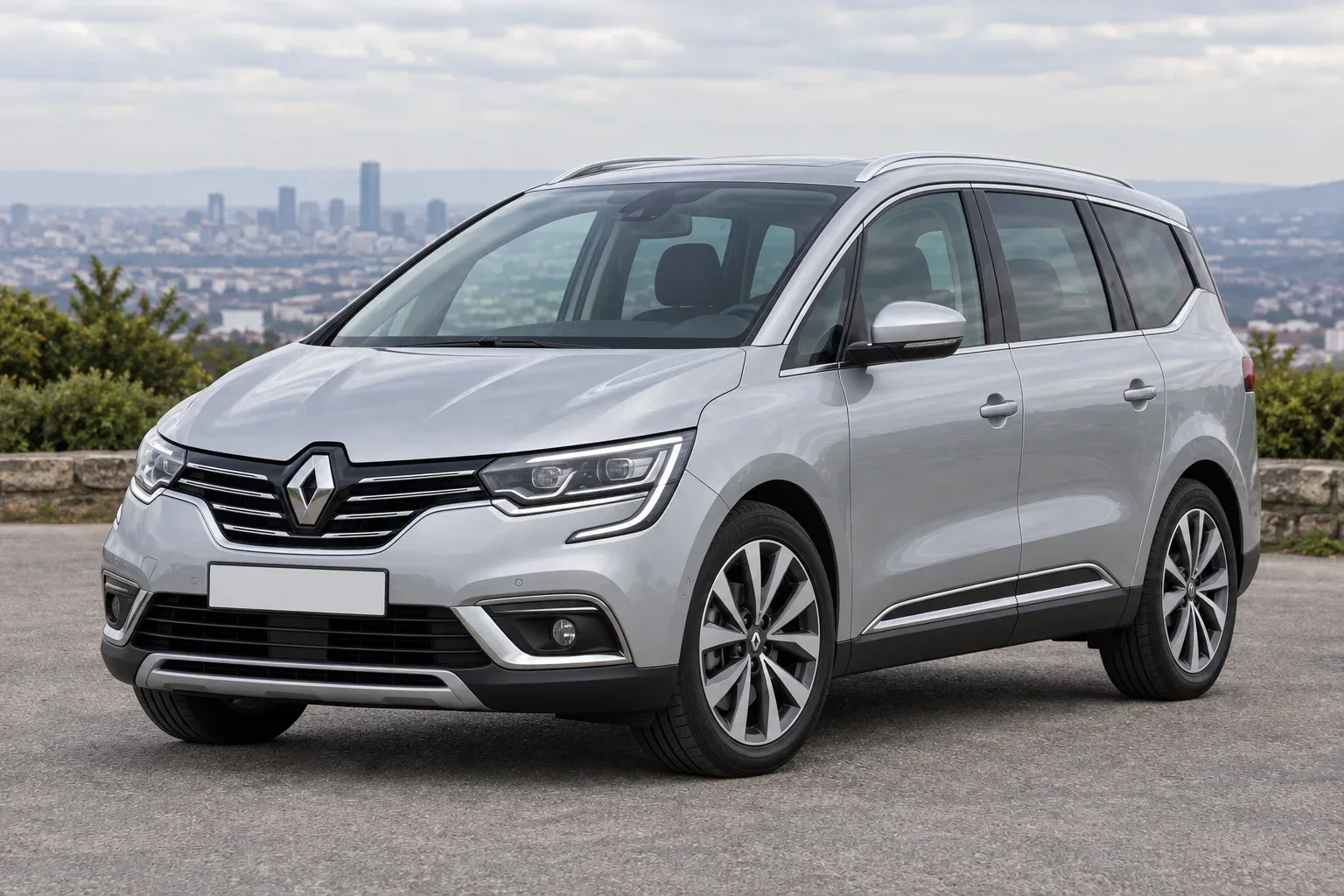
Renault Espace 5
Valuation of the Renault Espace 5 (2015–2023): condition, paperwork, inspection and terms of sale.
Indicative purchase price
Below market value
Final price agreed after inspection.
Value my car1Why buyers choose this model
Renault speaks of the Espace 5 as a crossover, but apart from the large wheels that contributed to the 16-centimeter ground clearance, and the avant-garde 4Control rear wheel steering system for this segment, it is quite a regular MPV. And still only with front-wheel drive. Renault Espace has actually risen to flagship status. He was sometimes criticized for moving away from practicality in favor of style and modern technology, which is understandable, but in any case it was not a big problem. The fact that the space overhead has become less than in its predecessor worries the target audience less than journalists. But still remain clean sills, protected from dirt well-designed door design. Everyone will appreciate how easy the seats fold at the touch of a button. The rear seats have become smaller and adjust the slope, as in the predecessor, is no longer possible. But you can fold them in a second by pressing the button - individually or all at once.
2What buyers check
Deficiencies
The Espace 5 came at a bad time, when Renault temporarily did not offer more than 1.6-liter engines. That he squeezed decent performance out of them didn't matter. Small engines are hard to sell to dealers, and by the time more powerful engines came along, they were already gripped by childhood illnesses. The engines were refined along the way, technical changes followed each other, until it sometimes seemed that this was a repeat of the story with the Laguna II. Problems with the new infotainment system R-Link2 were combined with production shortcomings throughout the car, plus various misaligned comfort functions, mandatory reprogramming of diesel control units, reworking of brake hydraulics due to possible sawdust contamination, reviewing glued hood and hatch joints, replacing steering bolts, addressing complaints of creaking in the running room, leaking taillights, creaking front seats and so on. Since it was a flagship car that cost a lot of money and Renault wasn’t going to risk losing trust a second time around, there were dances around customers and as many confessions as possible under warranty. That’s why even older models today pose little risk – even imported ones. In this case, no one could do without branded service, and this is often evidenced by the condition of used cars. However, checking the technical condition and service history still makes sense. It's not a simple car with cheap parts. #EDC
In the Renault Espace 5 with the EDC dual-clutch automatic transmission, it is important to keep an eye on regular oil change - no later than 60,000 km. the 6-speed EDC is identical to the Ford 6DCT450. TCe petrol turbo engines were equipped with a more agile and conceptually more modern 7-speed 7DCT300. Coincidentally, this robot had some flaws in its early years. For example, he creaked when changing gears, or prematurely refused to clutch. An electronic selector, similar to a golf club, switches modes in an unusual way - by tilting the lever. An interesting feature of the Getrag 7DCT300 (also with so-called "wet" clutches) is a significant simplification of the hydraulic circuit, which safely dispenses with a replaceable filter. Hydraulics here only controls the clutch, and the pressure is not constant - it is created "on demand" by an electric pump. Another feature is the five interchangeable electric motors. Two drive the gear plugs, two drive the gear oil pump that controls the clutch, and the last drives the coolant pump (if necessary). In the case of both EDC variants, long maneuvers in the parking lot with millimeter accuracy drive the robot crazy. In motion, it works very nicely, switching smoothly, quickly and, unlike the competing DSG, not too overloading the engine even in eco-mode. ## 4Control
Most buyers chose the top version of Intiale Paris, the equipment of which is usually rich. As a mandatory equipment, the 4Control wheel control system was installed. Package 4Control, always present in the top configuration, optionally - in the middle. Despite the fact that at high speeds, the minivan with the rear wheel turnaround system behaves as predictable as possible, the hinges of the steering levers still make undesirable backlash into the kinematics of the rear wheels, and the car has to be constantly steered a little. The system has no functional flaws, but the rear electric steering mechanism Aisin on a number of cars was replaced under warranty due to noise. You can’t afford it after the guarantee is over. A minivan with a standard chassis without full steering is not as agile in cornering, but provides better stability on the straight. It is more appreciated on a cruise ship. 4Control machines sometimes lack electronically controlled shock absorbers. Ordinary is much softer (especially the rear, located at a large angle), the body on them strongly swings when you are in a hurry to drive along a bumpy road. Long trips on freeways are a different matter! The front seats are like a bridge, panoramic views from above, a quiet engine, always running at the right speeds. In such a car you can go to the end of the world. Smarter adaptive cruise control with Stop & Go and cup holders on hand is now available in the Espace 5 Phase II. But with a tight budget, you don't have to think about it. #1.6 TCe EDC (R4/16V, 200 hp, 2015-2017)
The engine was developed in collaboration with Nissan. Reliable, economical (with a lighter body consumes up to 8 liters), but works more like an old atmospheric - at the top. It doesn't match up well with the weight and cruise nature of Espace. Weak pulls from the bottom, and with frequent switches to a reduced gear, the ride becomes unnecessarily tense. The other 7-speed EDC robot switches great, but it just came out and crashes from time to time. Turnover at 130 km/h 2600 min-1, acceleration 80-120 km/h in 6.7 s (kickdown). # 1. 8 TCe EDC(R4/16V, 225 hp, 2017-2023)
A younger unit, similar to the 1.6 TCe, but almost new. It's faster, quieter, warms up faster in the morning. Compared to the senior 1.6 TCe, it is less economical in city traffic, but on the autobahns its performance has not changed. At 130 km / h - 2550 rpm, from 80-120 km / h - in 6.0 seconds (kickdown). Since autumn 2018, a particulate filter has been added that is usually not cause for concern. #1.6 dCi 130 hp (R4/16V, 2015-2018)
Turbodiesel is known for the more popular models of Megan and Scenic. It comes only with a manual transmission, usually in basic equipment. Incredibly low fuel consumption (with a light foot five liters). It is able to tow a two-ton trailer, as well as the more powerful versions. Thanks to the well-chosen shorter gears, the speaker is only slightly inferior to biturbo, the weak point of which is slightly below the mark of 1600 rpm. At 130 km / h - 2600 rpm, the elasticity of 80-120 km / h on the 5th/6th gear - 8.9 / 11.9 s. # # 1. 6 dCi biturbo 160 hp. EDC (R4/16V, 2015-2018)
The increase in power looks significant, but with a heavy body it is not so noticeable. Rather, we can note a more even thrust in the limit ranges. Periodically there are problems, but they are not related to engine load. A conventional FAP filter in practice serves up to 300,000 km. The first versions consumed less than 5.5 liters. If 7 liters are missing, you can be sure that the software eliminates the excess nitrogen oxides, increasing the volume of gas recirculation and shifting gear points to higher speeds. At 130 km/h - 2250 rpm, 80-120 km/h - in 7.9 seconds (kickdown). # 2. 0 BluedCi 160/200 hp EDC (R4/16V, from 2018)
After a long break, a reincarnated 2.0 L can no longer do without AdBlue. The tank with a volume of 22.2 liters is enough for the entire service interval - however, for BluedCi it is reduced to 20,000 km / 1 year. Even more powerful version is content with one turbocharger. 6-band EDC surprisingly works more smoothly than with 1. 6 dCi biturbo, and combined with greater thrust from below pleases the response to the pressing of the gas pedal. The more powerful version rushes like the wind, but the dynamics is inferior to the quieter 1. 6 dCi biturbo. The engine is too young to assess its reliability, except for a couple of NOx sensors, nothing has broken yet. Consumption from 6.5 to 7.5 l / 100 km depending on the style of driving. Turnovers at 130 km/h 2340 min-1 (both versions), acceleration of 80-120 km/h in 8.4 s (BluedCi 160 version) or 7.4 s (BluedCi 200). # 1. 6 dCi - both versions
Failure of the EGR valve or loss of leakage of the EGR heat exchanger (gas leakage in the area of the regulating valve). Analogue - from 16 000 rubles, the original - 26 000 rubles, a more complex replacement in biturbo. A faulty lambda sensor is usually the one behind the catalytic converter. The engine is working normally, but the control lamp is on. Oil leak through the valve timing cover - for resealing, the engine is dismantled due to lack of space, so in practice no one eliminates. Damage to engine mechanics after suction of condensate from the intake manifold. There have been isolated cases in colder countries. ##1.6 dCi 160 EDC
Cracked engine block with crankcase destruction. Dozens of cases have been reported, primarily in Germany and France. Presumably a material defect of cast iron block in some series. # #1. 6 TCe 200 EDC
Wear of clutch or noisy operation of the 7EDC dual-clutch transmission (episodic in the first series). ## Electrical wiring and body equipment
Various quirks of the R-Link2 multimedia system (hang-ups, radio and communication failures, etc., especially in the early years). Sometimes the battery had to be changed after two years. Accelerated battery discharge was sometimes caused by sticking one of the relay contacts. Electric parking brake failure - not unlocked. Rarely in the early years, the replacement of the handbrake control module helped. Scream of front seats. Usually, only the replacement of guides helps. Leaky taillights; cracked hatch (not sliding). ## Driving part
Luft in the Silentblocks of the front levers (after 100-120 thousand km), the knock of the stabilizer racks (original aluminum usually change to more durable steel). Noise/squeak from rear wheel control motor (rarely, early-release 4Control). ## Maintenance recommendations
All engines are equipped with a chain drive valve timing. The belts of auxiliary power units, including pulleys, should be changed after 150,000 km/6 years, the brake fluid - after 3 years, the air filter - after 60,000 km/4 years (but it will be useful to change it with each oil change). Service intervals (small A, large B) - each year, the upper interval of engine oil replacement is 30,000 km/2 years (TCe, dCi) or 20,000 km/1 year (Blue dCi). Of course, an earlier replacement would only benefit the engine - ideally after 10,000km. Recommended oil standards are RN0720 (for 1.6 dCi), RN0710 (TCe), RN17 (TCe with FAP, BluedCi). Oil replacement in the EDC gearbox: for 6-speed diesel engines - after 80,000 or 90.00 km/6 years (depending on the year of production and VIN), for 7-speed gasoline versions after 90,000/4 years. It is better to reduce the interval of update of the transmission fluid to 60 000 km. #
Equipment of older versions (especially the top-end Intiale Paris)
Size and shape of the front seats, always clean sills
Quiet driving, well-tuned gearboxes
Small Turn Diameter with 4Control System
Seat inclination adjustment system, seven-seat version
Cons
Small range of adaptive cruise control (phase 1)
Adjustable shock absorbers only for versions with rear thruster wheels
Lower quality and reliability of first year models
At the beginning of production, only small engines
Only with a glass roof (fixed or sliding hatch)
Model history
2015: Sales start in February. Engine options 1. 6 TCe 200 (Gearbox 7EDC), 1. 6 dCi 130 (6MT), 1. 6 dCi 160 (6EDC). All Euro 6 diesels are still without AdBlue. 2017: end of release 1. 6 TCe, which was replaced by 1. 8 TCe 225 (7EDC). 2018: changes at the end of summer due to the emission standard Euro 6d-Temp. 1. 8 TCe now with a particulate filter (without changing characteristics), 1. 6 dCi ceases to exist and is replaced by a new 2. 0 Blue dCi (already with AdBlue) in versions 160 and 200 hp (both with 6EDC). Ventilated front seats for Initiale Paris. 2020: A restyled version, the so-called Phase 2, has been on sale. Matrix LED headlights, new multimedia system (EasyLink), redesigned interior, improved climate control. ## Competitors of the used Renault Espace
Ford S-Max 2 (since 2015): The second generation S-max is much more comfortable.
3Pre-purchase checklist
Deficiencies
- Since it was a flagship car that cost a lot of money and Renault wasn’t going to risk losing trust a second time around, there were dances around customers and as many confessions as possible under warranty.
- However, checking the technical condition and service history still makes sense.
- If something fails, the repair can hit the pocket hard.
EDC
- In the Renault Espace 5 with the EDC dual-clutch automatic transmission, it is important to keep an eye on regular oil change - no later than 60,000 km.
- For example, he creaked when changing gears, or prematurely refused to clutch.
- Two drive the gear plugs, two drive the gear oil pump that controls the clutch, and the last drives the coolant pump (if necessary).
4Control
- Despite the fact that at high speeds, the minivan with the rear wheel turnaround system behaves as predictable as possible, the hinges of the steering levers still make undesirable backlash into the kinematics of the rear wheels, and the car has to be constantly steered a little.
1.6 dCi biturbo 160 hp EDC (R4/16V, 2015-2018)
- Periodically there are problems, but they are not related to engine load.
1.6 dCi - both versions
- Failure of the EGR valve or loss of leakage of the EGR heat exchanger (gas leakage in the area of the regulating valve).
- Analogue - from 16 000 rubles, the original - 26 000 rubles, a more complex replacement in biturbo.
1.6 TCe 200 EDC
- Wear of clutch or noisy operation of the 7EDC dual-clutch transmission (episodic in the first series).
Electrical wiring and bodywork
- Electric parking brake failure - not unlocked.
- Rarely in the early years, the replacement of the handbrake control module helped.
- Usually, only the replacement of guides helps.
Chassis
- Luft in the silent blocks of the front levers (after 100-120 thousand).
- Km), the knock of the stabilizer racks (original aluminum usually change to stronger steel ones).
Service recommendations
- The belts of auxiliary power units, including pulleys, should be changed after 150,000 km/6 years, the brake fluid - after 3 years, the air filter - after 60,000 km/4 years (but it will be useful to change it with each oil change).
- Of course, an earlier replacement would only benefit the engine - ideally after 10,000km.
- Recommended oil standards are RN0720 (for 1.6 dCi), RN0710 (TCe), RN17 (TCe with FAP, BluedCi).
- Oil change in EDC gearbox: for 6-speed diesel engines - after 80,000 or 90.
Competitors of the second-hand Renault Espace
- With the chassis here there are no problems, unlike the large Bavarians, maximum - rust the eccentricities of the rear levers.
4Challenges of selling privately
The fifth generation of Espace has caught on to crossovers and probably caused tears in the eyes of fans of previous boxed versions. The only thing that remains the same is the name.
Espace 5 became more of a luxury item than a family transport, and the price tag often matched that. Sales because of this were not very cheerful, so the choice on the secondary is not too diverse.
The most affordable can be bought a little cheaper than 1 700 000 rubles, and the machines themselves to choose from only a few dozen. Most of them are diesel engines with automatic transmission. It's not the most popular item on the secondary. At this price level, buyers are more inclined to crossovers.
- Disadvantages: Problems with the new R-Link2 infotainment system were combined with production deficiencies throughout the car, plus various uncoordinated comfort functions, mandatory reprogramming of diesel control units, reworking of brake hydraulics due to possible sawdust contamination, reviewing glued hood and hatch connections, replacing steering bolts, addressing complaints of creaking in the running room, leaking taillights, creaking front seats and so on.
- EDC: For example, he creaked when changing gears, or prematurely failed to clutch.
- 4Control: Despite the fact that at high speeds, the minivan with the rear wheel turnaround system behaves as predictable as possible, the steering gears still bring unwanted backlash to the kinematics of the rear wheels, and the car has to be constantly steered a little.
- Service recommendations: Of course, an earlier replacement would only benefit the engine - ideally after 10,000km.
- Pros: Equipment of older versions (especially the top Intiale Paris) Dimensions and shape of the front seats, always clean sills Quiet driving, well-tuned gearboxes Small diameter turn with 4Control System Adjustment of the seat inclination, seven-seat version
- Cons: Small range of adaptive cruise control function (phase 1) Adjustable shock absorbers only for rear thruster versions Lower quality and reliability of first-year models In the beginning of production only small-size engines with glass roof only (fixed or sliding hatch)
- Model history: 2015: start of sales in February. Engine options 1. 6 TCe 200 (Gearbox 7EDC), 1. 6 dCi 130 (6MT), 1. 6 dCi 160 (6EDC).
- Rivals of the used Renault Espace: With the chassis there are no problems, unlike the big Bavarians, maximum - rusting eccentricities of the rear levers.
Shows, bargaining and re-registration take time: buyers look, promise to think and disappear. Fair price after inspection closes the auction on the spot. If money is needed urgently, the purchase takes away waiting and repeat displays.
5How selling to us works
Leave a request with the car data. We will discuss the preliminary assessment and inspection. After checking the status and documents, we agree on the final price and terms of the transaction.