
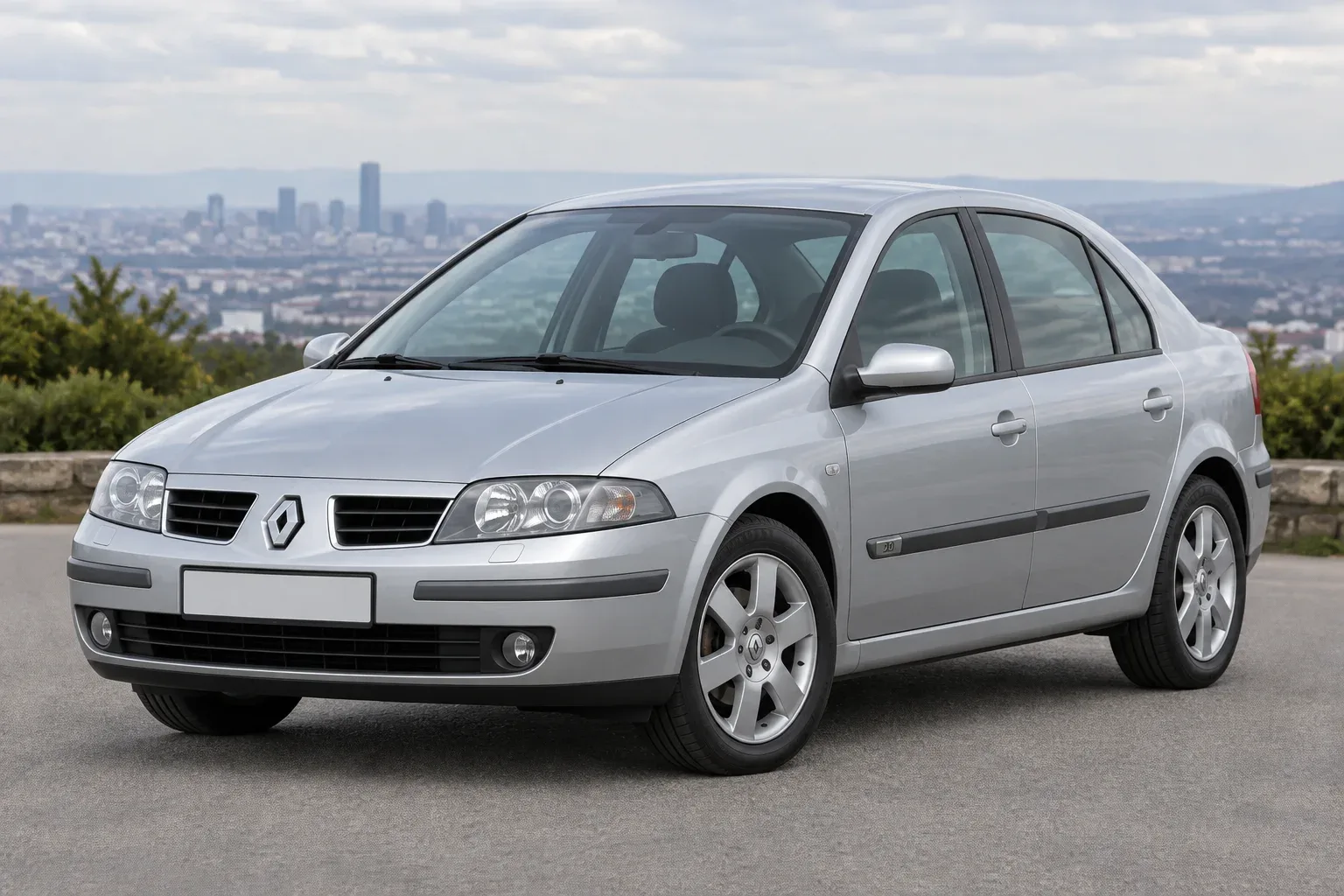
Renault Laguna 2
Valuation of the Renault Laguna 2 (2001–2008): condition, paperwork, inspection and terms of sale.
Indicative purchase price
Below market value
Final price agreed after inspection.
Value my car1Why buyers choose this model
They say that French cars are very fragile. The aesthetics of the manufacturers, whose capital city Paris, are much more sophisticated. Peugeot, Citroen and Renault are visually very attractive. Unfortunately, this is not combined with reliability.
2What buyers check
Model history
In 2001, the second generation of the highly successful Laguna was introduced. Renault has added another argument to the list of advantages of the model – safety. The Renault Laguna 2 is the first European car to earn a maximum of 5 stars in EuroNCAP crash tests.
In 2005, Laguna experienced a light restyling. The most noticeable changes occurred in the front of the car. The headlights took on a slightly different shape, and the chrome insert over the grille disappeared. The engine line was slightly adjusted. In 2007, the model gave way to the next generation.
Bodywork
After a rather quiet first-generation design, the successor began to look very bold. The car received a hatchback body, despite the opinion that this is the least interesting version.
Unfortunately, the Laguna II trunk can hold just 430 litres, which is not a good result. If someone needs more, then you should pay attention to the Grantour version. Its trunk has a capacity of 475 liters, and with the back of the sofa folded, the volume increases to 1500 liters. Interestingly, in both versions, the trunks are smaller than in the previous generation model.
There is no need to complain about the lack of space in the interior. Only tall passengers in the back seat of the hatchback can lament the low ceiling touching the hair. The interior of the car is decorated with plastic of decent quality, and the level of comfort increases additional equipment. It is almost impossible to find a version that is not equipped with electric glass drive, air conditioning or CD player.
Owners of Renault have repeatedly noted the appearance of creaking plastic front panel. In addition, the upholstery on the doors and chairs is not sufficiently wear-resistant. The body is not prone to corrosion, unless it was repaired after an accident.
Engines
Renault Laguna 2 was equipped with a fairly large number of engines. Taking into account the dynamic characteristics, the most optimal gasoline unit is a 1.8-liter 120-horsepower engine. It provides acceleration from 0 to 100 km / h in just over 10 seconds, a maximum speed of over 200 km / h and fuel consumption at the level of 7-10 l / 100 km. In matters of reliability, the engine is not bad, but not ideal. the 3-liter unit is not only more voracious, but also more expensive to maintain. All gasoline engines, both 4 and 6-cylinder, well tolerate work on liquefied gas. Unfortunately, the Laguna II is a car with an increased risk of malfunctions. In gasoline 1.6 and 1.8 liters, problems with cold start and ECU engine control unit were noted. Often defects were eliminated after updating the firmware of the block. In some motors there is a malfunction of the electronic throttle. Corrosion occurs on the elements of the exhaust gas system. The gasoline 2.0 IDE should be avoided. It is equipped with direct fuel injection, and after 100-120 thousand km often makes you face ailments difficult to eliminate. Fortunately, Renault abandoned this unit in 2004, in favor of 2.0 liters with a capacity of 135 hp. The 2-liter turbo engine also collects good reviews, especially the return of 170 hp (since 2005). It provides satisfactory dynamic performance (about 8.4 s to 100 km / h), does not require too much fuel, and is quite hardy. Among diesel engines, the greatest interest is 1. 9 dCi with a capacity of 120 hp. Difference in consumption with baseline 1.
Electrician.
Electronics failures are one of the biggest drawbacks of the Renault Laguna II.
In earlier versions of the Laguna, a map was used to open the car and start the engine. Over time, it was replaced by a system such as “hands free”, thanks to which it is enough that the driver has a card in his pocket. The central lock opens automatically after the owner takes the handle, and the engine starts with a button. This system is a very interesting gadget, but it was he who caused a lot of problems to the owners of Renault. Sometimes the car simply could not detect the presence of the card, which excluded the possibility of free access. Repairs usually came down to replacing the card (about $120) and prescribing it (plus $30).
In addition to the map, the faults of the air pressure control system in the tires, the windshield wiper, electric windows and the central lock were tired. Quite often the display of the Climatronic climate unit refused.
Problems with the tire pressure sensors were caused by too tight tolerances. The shortcoming was finally eliminated only at the end of 2003. But there are cases of loss of radio signal from the sensors of the wheels.
Sometimes for no apparent reason, the alarms on the dashboard begin to go crazy. And then after a while, everything comes back to normal. Many small electronics “glitch” by themselves, only sometimes requiring the intervention of a diagnostician to remove “false” errors.
Chassis.
Owners periodically complain about the insufficiently durable elements of the suspension. In particular, on the front axle ball supports and steering rods wear relatively quickly, and on the back - pillows beams, racks and sleeves of the stabilizer, hub bearings. The first copies of a serious repair suspension was required after 50-60 thousand km. Over time, the chassis components were reinforced.
Transmission
Remove the slingshot was not the worst thing that could happen. The manual transmission was also too delicate. It had a number of problems: poor third gear inclusion, leaks, noise and wear of bearings. After a lot of trouble, the manufacturer successfully upgraded the box.
Maintenance and repair
Original spare parts are not cheap compared to other manufacturers. The problem is especially acute when repairing electronics - there are no cheap substitutes. The list of analogues covers only the most demanded consumables. Does this mean that you should abandon the idea of buying Laguna 2? If you are afraid of unplanned expenses, then yes.
However, it should be recognized that constant improvements have led to the fact that later copies have become more reliable. This is clearly shown by statistics. In 2001 and 2002, about 70% of cars were required for warranty repair, while in 2006 only 10% of such cars became warranty repairs. The only problem is that the market is dominated by old pre-restyling copies.
Often, the anthers of the SRUS break, which contributes to dirt and premature wear of the hinges.
Approximate cost of spare parts:
- brake pads front / rear - $ 30/20;
- Front/rear shock absorbers – $50/40.
3Pre-purchase checklist
Bodywork
- If someone needs more, then you should pay attention to the Grantour version.
- In addition, the upholstery on the doors and chairs is not sufficiently wear-resistant.
- The body is not prone to corrosion, unless it was repaired after an accident.
Engines
- Unfortunately, the Laguna II is a car with an increased risk of malfunctions.
- In gasoline 1.6 and 1.8 liters, problems with cold start and ECU engine control unit were noted.
- In some motors there is a malfunction of the electronic throttle.
- Corrosion occurs on the elements of the exhaust gas system.
- The gasoline 2.0 IDE should be avoided.
- Fortunately, Renault abandoned this unit in 2004, in favor of 2.0 liters with a capacity of 135 hp.
- 9 dCi in operation causes fewer problems than 2. 2 dCi.
- The 1.9 dCi electromagnetic injectors are quite cheap to repair.
- 9 dCi - the twisted liners of the crankshaft.
Electrician.
- This system is a very interesting gadget, but it was he who caused a lot of problems to the owners of Renault.
- Repairs usually came down to replacing the card (about $120) and prescribing it (plus $30).
- In addition to the map, the faults of the air pressure control system in the tires, the windshield wiper, electric windows and the central lock were tired.
- Quite often the display of the Climatronic climate unit refused.
- Problems with the tire pressure sensors were caused by too tight tolerances.
- But there are cases of loss of radio signal from the sensors of the wheels.
Chassis.
- The first copies of a serious repair suspension was required after 50-60 thousand km.
Transmission
- Remove the slingshot was not the worst thing that could happen.
- It had a number of problems: poor third gear inclusion, leaks, noise and wear of bearings.
Maintenance and repair
- The problem is especially acute when repairing electronics - there are no cheap substitutes.
- Does this mean that you should abandon the idea of buying Laguna 2?
- However, it should be recognized that constant improvements have led to the fact that later copies have become more reliable.
- In 2001 and 2002, about 70% of cars were required for warranty repair, while in 2006 only 10% of such cars became warranty repairs.
- Often, the anthers of the SRUS break, which contributes to dirt and premature wear of the hinges.
4Challenges of selling privately
Renault Laguna II is a car with an interesting design, innovative solutions, comfortable suspension, a rich engine palette and a very competitive price. Unfortunately, operating the Laguna, you have to put up with a high risk of malfunctions. However, restyled instances are considered more reliable. Over time, the French manufacturer got rid of a number of problems. This applies to both electronics and mechanics. The main thing is to find a “young” copy with a small mileage.
- In 2001, the second generation of the very successful Laguna came to market.
- Body: In addition, upholstery on doors and chairs is not sufficiently wear-resistant.
- Engines: Unfortunately, the Laguna II is a vehicle with an increased risk of malfunction.
- Electric: This system is a very interesting gadget, but it was the one that caused a lot of problems for Renault owners.
- The first copies of a serious repair suspension was required after 50-60 thousand km.
- Transmission: Repair suspension is not the worst thing that could happen.
- Maintenance and repair: The problem is especially acute when repairing electronics – there are no cheap substitutes.
- Approximate cost of spare parts: - brake pads front / rear - $ 30/20; - shock absorbers front / rear - $ 50/40.
Shows, bargaining and re-registration take time: buyers look, promise to think and disappear. Fair price after inspection closes the auction on the spot. If money is needed urgently, the purchase takes away waiting and repeat displays.
5How selling to us works
Leave a request with the car data. We will discuss the preliminary assessment and inspection. After checking the status and documents, we agree on the final price and terms of the transaction.