
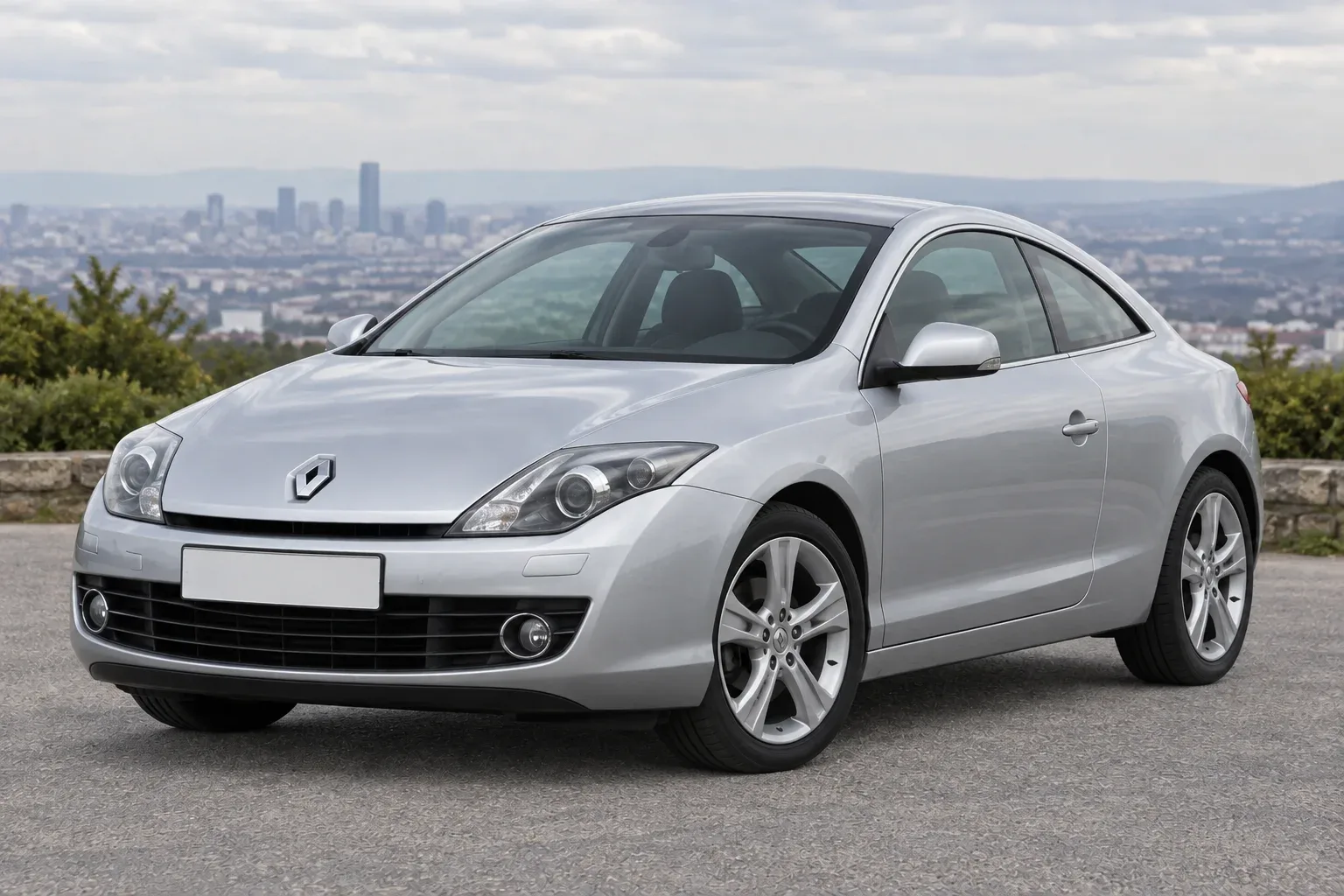
Renault Laguna Coupe
Valuation of the Renault Laguna Coupe (2007–2012): condition, paperwork, inspection and terms of sale.
Indicative purchase price
Below market value
Final price agreed after inspection.
Value my car1Why buyers choose this model
The third generation Renault Laguna was not easy. The previous model significantly spoiled the reputation of the Frenchman: regular electronics glitches, poor build quality and massive engine failures, especially 2.2 dCi diesels.
2What buyers check
Review
The third generation Renault Laguna was not easy. The previous model significantly spoiled the reputation of the Frenchman: regular electronics glitches, poor build quality and massive engine failures, especially 2.2 dCi diesels. The third Lagoon, which came in September 2007, had a difficult task to get rid of the bad reputation. But as it turned out later, all efforts were in vain. Renault sold 250,000 Lagunas in Europe in 2002, 90,000 in 2008, 50,000 in the next three years, and just under 30,000 in 2012. The hero of our story is Laguna Coupe. She was given the role of a stylish sports car. The model was distinguished by rich equipment, and under the hood were installed engines with a supercharged volume of at least 2 liters. In the arsenal there were even 6-cylinder units with a volume of 3 liters. The Renault Laguna Coupe is said to have originally been designed as an open model with a rigid folding roof. This is hinted at by the strong inclination of the windshield and the characteristic design of the medium racks. Probably, the cost and retail price of the coupe-convertible was too large, so only the closed version went into the series. However, the Coupe did not come out cheap. The high cost was compensated by rich equipment. The owner received a dual-zone climate control unit, an audio system with navigation, leather seats with electric adjustments and so on and so on. The problem is that despite the interesting interior design, some elements look really cheap. Yes, in general, the finishing materials are of good quality and soft to the touch.
Running
You should not expect sports habits from the Laguna. The 4Control system, which is active in rear wheel control, only makes the car feel too nervous. Coupe does not like sudden changes in direction. Moreover, each time Renault behaves quite differently and somewhat unpredictable. Understeering is a natural manifestation of the Laguna Coupe when cornering fast with a large radius, but the reactions to steering commands are too sharp. The element of the coupe is high-quality highways.
The machine, by modern standards, is a little lazy, but if necessary, it can be helped in manual mode. Perhaps the biggest disappointment will come from the suspension. In corners, the car wobbles a little, and at the same time does not filter irregularities well enough - the joints are clearly transmitted to the body. On rough roads, something knocks, something creaks - there is an insufficient rigidity of the body to the torsion.
Engines
The delicate and weak 1.5 dCi diesel, luckily, was not delivered. The diesel lineup starts with a 2.0 dCi with a capacity of 150 hp and a torque of 340 Nm. Later, a more powerful version of the recoil 173 and at the end of 178 hp 2. 0 dCi with the designation M9R has a number of interesting solutions, for example, liquid cooling turbines. This increases its reliability, but does not mean that the oil can be changed less often. Although the engine no longer has the fatal problems it once had, Renault’s recommended oil change intervals (15-20 thousand km) have a negative impact on the condition of the liners and turbines. The valve timing chain lasts a long time. But heavy loads on the not yet heated engine lead to cracking of the cylinder head. Almost 400 Nm of torque quite quickly finish 6-speed manual transmission and even semi-axle. At the very least, nozzles can be replaced easily and inexpensively, and the DPF filter only causes problems for those who move around the city. The service life of the particulate filter is 250-300 thousand km. The valve of the EGR system is controlled by a reliable servo drive, but over time may require replacement of the UGR cooler. 2-liter turbodiesel can only be recommended if the car has a transparent service history, and you are not afraid of preventive investments in repairs. 3-liter 6-cylinder turbodiesel provides good dynamics. It is a pity that it is because of the “flawless” machine that the engine torque was reduced from 550 to 450 Nm. The difference between 3.0 dCi and the most powerful 2.0 dCi is only noticeable at very high speeds and protracted climbs.
Typical problems and malfunctions
Before buying it is very important to check the transmission. Unfortunately, neither the mechanics nor the machine differs in reliability. If there are problems, changing the oil will only help in part. The owner should always be ready to repair the box.
In the process of operation, minor malfunctions also appear. For example, in the headlights there is moisture, or begin to leak door seals. However, the latter may indicate poor repair after the accident. The trouble can be caused by the electric chairs. From time to time, the air conditioner strikes, or the onboard systems do not respond to commands from the central remote in front of the armrest. Quite often, cruise control fails due to a faulty switch. Heated seats may also be denied.
Problems with the keyless access system occur, as a rule, with a weak battery in the smart key. And if the key card accidentally happens to be in the trunk, then the car can lock the locks on its own after closing the lid. The owners have faced a stalemate more than once.
3Pre-purchase checklist
Review
- The previous model significantly spoiled the reputation of the Frenchman: regular electronics glitches, poor build quality and massive engine failures, especially 2.2 dCi diesels.
- The problem is that despite the interesting interior design, some elements look really cheap.
Running
- The machine, by modern standards, is a little lazy, but if necessary, it can be helped in manual mode.
Engines
- Although the engine no longer has the fatal problems it once had, Renault’s recommended oil change intervals (15-20 thousand) are not enough.
- At the very least, nozzles can be replaced easily and inexpensively, and the DPF filter only causes problems for those who move around the city.
- A 2-litre turbo diesel is recommended only if the car has a transparent service history and you are not afraid of proactive investment in repairs.
- Therefore, checking the state of the machine is very important here.
- A six-cylinder diesel engine is not bad, but due to its large size and limited access in the engine compartment, repairs will be very expensive.
- The mechanical part is reliable, but much depends on the past: how often the potential of the engine was used, and whether the oil was changed on time.
- In the process of operation, there are problems with the cooling system, and a tired engine begins to “eat” oil.
Typical problems and malfunctions
- Before buying it is very important to check the transmission.
- If there are problems, changing the oil will only help in part.
- The owner should always be ready to repair the box.
- In the process of operation, minor malfunctions also appear.
- However, the latter may indicate poor repair after the accident.
- Quite often, cruise control fails due to a faulty switch. Heated seats may also be denied.
- Problems with the keyless access system occur, as a rule, with a weak battery in the smart key.
4Challenges of selling privately
The Renault Laguna Coupe is a car that you should like. Buying such a car is often prompted by the desire to stand out for a little money. You won’t find a car like this every day. The choice in the market is very narrow, so there is not much to choose from. Usually, the Coupe has a small mileage and gets good service. The most reasonable choice is the version with a 2-liter turbo engine, which combines reliability, dynamics and a reasonable cost of operation.
- The previous model significantly spoiled the reputation of the Frenchman: regular electronics glitches, poor build quality and massive engine failures, especially diesel 2. 2 dCi.
- On the go: Do not expect sports habits from the Laguna.
- Engines: Although the engine no longer has the fatal problems it once had, Renault's recommended oil change intervals (15-20 thousand) are not enough.
- Typical problems and malfunctions: If there are “problems,” changing the oil will only help in part.
Shows, bargaining and re-registration take time: buyers look, promise to think and disappear. Fair price after inspection closes the auction on the spot. If money is needed urgently, the purchase takes away waiting and repeat displays.
5How selling to us works
Leave a request with the car data. We will discuss the preliminary assessment and inspection. After checking the status and documents, we agree on the final price and terms of the transaction.