
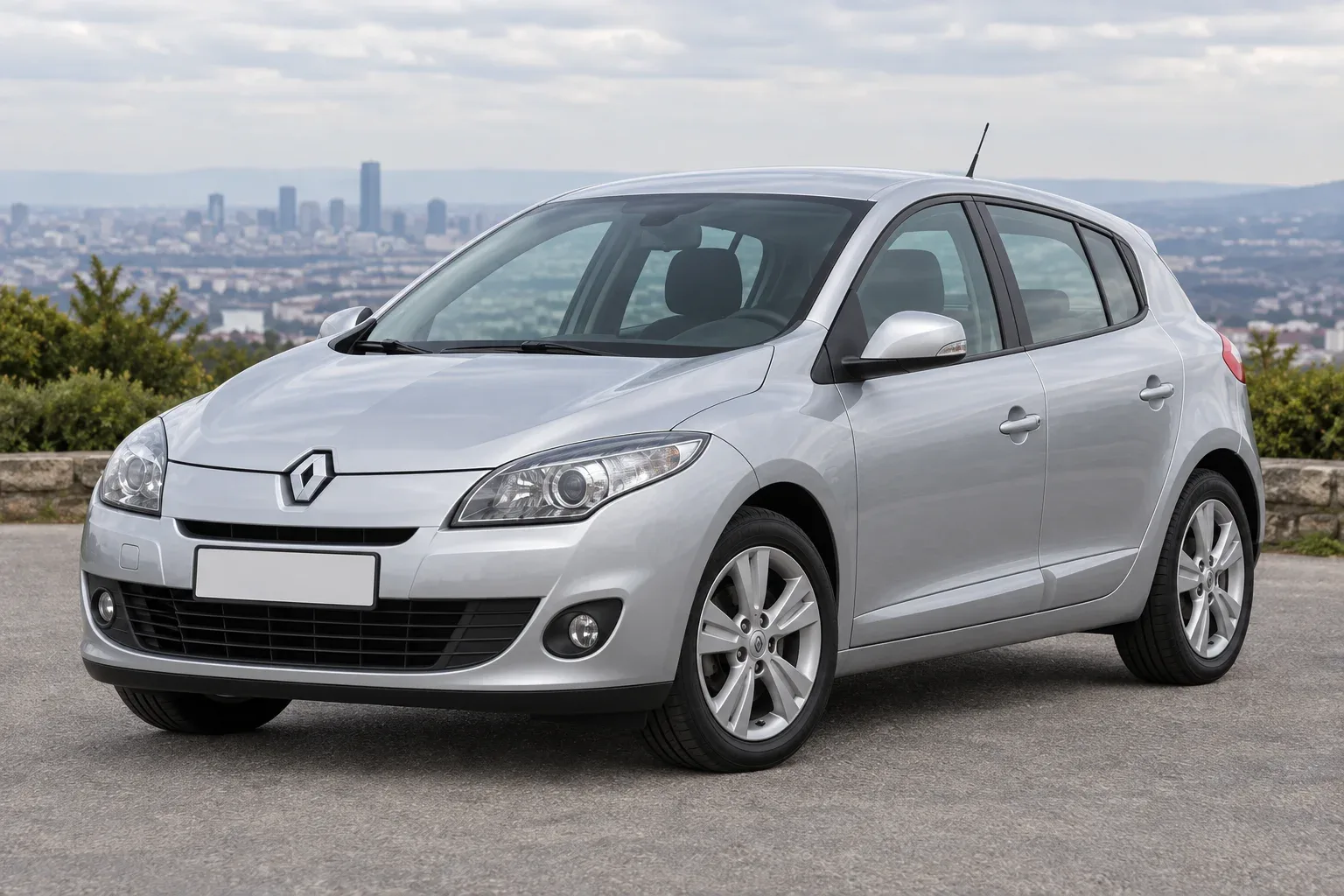
Renault Megane 3
Valuation of the Renault Megane 3 (2008–2016): condition, paperwork, inspection and terms of sale.
Indicative purchase price
Below market value
Final price agreed after inspection.
Value my car1Why buyers choose this model
Meghan’s Renault is a car full of change. While the first generation of the R19 was only round, the second generation was shattered by its shape. The third Megane is less avant-garde. Renault has been successfully maintaining the image of all its models since the late nineties as reliable and well protected from corrosion. Meghan 3 is perfect in this respect, but not perfect. Opinions about him are quite contradictory. However, more often complaints can be heard only from those who bought a car without a service book or with twisted mileage. Among the advantages is the highest score for crash tests. Experts were concerned only about the consequences of hitting a pedestrian. The latter had severe injuries to his legs and head. Due to the tightening of the rules for conducting crash tests EuroNCAP Renault Megan in 2014 earned only three stars out of five possible.
2What buyers check
Equipment
The vast majority of the Renault Megane 3 is well equipped. All cars are equipped with air conditioning and electric windows of the front doors. There are five trim levels in Europe: Generation, Authentique, Expression, Dynamique and Privilege. The first version was created specifically for corporate garages. Unlike other versions, it uses a speed pointer and a traditional key instead of a chip card. This variation is easily recognized by black unpainted handles and exterior mirrors. In Authentique, the mirrors are already painted in body color. Buying a car in the secondary market, it is better to pay attention to the Privilege trim levels (more comfortable, with consecutive keyless access, often with leather upholstery of seats, there are also fog lights), Dynamique (sports version, external door handles made of aluminum) and Bose Edition (with Bose audio system). Limited editions are also worth considering, including Tech Run (with TomTom navigation) and Robert Kubitz’s GT sports model. It is worth noting that the maximum possible equipment was truly royal. It is comparable to the level of premium German competitors. For example, for an additional fee, a rotary bi-xenon was installed. At the time, it was a real peak in lighting, as LED technology was just beginning to develop. Among the options available were a panoramic roof and navigation system. If you can choose a machine with navigation, it is better to prefer the one equipped with TomTom system. It is recognized by the SD slot for cards next to the display. ## Gasoline engines
Among the engines, the most reliable is the old and time-tested 1.6-liter 16-valve gasoline engine K4M. It has two versions - 106 and 114 hp. The principal difference is the absence of a phase regulator of the gas distribution mechanism in a less strong modification. A characteristic disadvantage of a more powerful unit is the premature wear of this very phase regulator. Its resource is about 100,000 km, and the cost is 6000 rubles. Mechanics recommend changing the phase regulator along with the HRM belt for prevention. Sometimes you have to face and failed ignition coils (1500 rubles). The rest of the engine is reliable and inexpensive to operate. It consumes no more than 11 l / 100 km. 2-liter atmospheric design Nissan collects good reviews. In Europe, the modification with 1. 4 CU was popular. This is a turbocharged H4J unit. It appeared under the hood of the Renault Meghan 3 in 2009. The engine has distributed fuel injection and chain-type valve timing drive. 1.4 TCe doesn't deliver too many problems. It is surprisingly elastic, but when driving actively consumes more than 11 liters per 100 km. During movement in a calm rhythm, the appetite drops to 7-8 liters. In 2012, the 1.4 TCe was replaced by another turbo engine, the 1.2 TCe (H5F). This unit received direct fuel injection and variable phases on the exhaust shafts. In the early years of production, the engine suffered from excessively high oil consumption. If there was a problem, the manufacturer changed the engine under warranty. Another drawback is the complexity of starting and unstable revolutions during engine heating at an air temperature of about zero. # # Diesel engines
Diesel modifications are very popular in Europe. The most common is equipped with a 1.5-liter turbodiesel 1. 5 dCi. Only 9 versions. All of them differ in performance (from 86 to 110 hp) and injection system. A huge plus is a fairly reliable particulate filter with a “fifth” fuel injector in the exhaust pipe. Therefore, the risk of dilution of oil by diesel fuel is excluded. The engine stands out very low fuel consumption and good performance. There are many owners who have traveled more than 200,000 km without any comment. However, there are those who were forced to face repair of the engine after 150,000 km due to premature wear of the liners. First of all, cars equipped with a particulate filter are affected by the defect. If you change the oil every 8-10 thousand km, then such problems should not be. However, after 200-250 thousand km, many motorists resorted to preventive replacement of liners. Mechanics recommend simultaneously updating the oil pump. The total costs will be about 15-20 thousand rubles. Fuel injectors travel over 200,000 km (12,000 rubles), and the turbine is capable of serving more than 250-300 thousand km 1. 6 dCi (R9M) replaced 1. 9 dCi in 2012. Instead of a belt, a chain is used. A number of new technologies are also used here. From diamond-like surface treatment DLC (Diamond Like Carbon) to a solution that allows you to get rid of vortex valves. This is done due to the combined gas distribution mechanism, when both camshafts control the intake and exhaust valves. The scheme is implemented in the same way as in 2.0 dCi. ## Service
Engines 1. 2 TCe, 1. 4 TCe, 2. 0 16V, 1. 6 dCi and 2. 0 dCi have chain-type valve timing drive. The remaining engines are equipped with a belt with a replacement interval of 120,000 km or 5 years. The cost of the set of valve timing - 3-5 thousand rubles, pumps - 1-3 thousand rubles. For work in the service will ask about 5000 rubles. It is recommended to change the oil once every 10,000 km. It should be used oils SAE 5W-30, ACEA A3 / B3, and diesels with a particulate filter - exclusively C3.
114-horsepower version of the 1.6-liter gasoline atmospheric relied 6-speed manual transmission TL4. Unlike the 5-mortgage JH3 (for 106 hp), the TL4 offers a more accurate operation of the gear selection mechanism. She's really not much use on the highway. The sixth gear has almost the same gear ratio as the fifth. As a result, what is there, that the engine at high speed develops quite high speeds. The TL4 was also available for the 1. 2 and 1. 4 TCe turbo engines. As an alternative, a pair of 1. 6/106 hp was offered 4-speed automatic DP2/DP0, created on the basis of AL4. Contrary to fears, it usually does not come to a thorough repair of the box. And tremors during switching usually disappear after changing the oil and two electromagnetic valves (1,600 rubles each). Sometimes it was necessary to wash and hydroblock. 1. 6/114 hp and 2-liter modification were completed exclusively with a continuously variable transmission CVT (FK0 / JF011E). The variator does not add to driving pleasure, and after 200,000 km may require repair. 1. 9 dCi was aggregated with a new 6-speed ND4 transmission. 150-horsepower 2. 0 dCi could alternatively be combined with an AJ0 automatic machine native to Jatco. Other versions - recoil 160 hp - came with a manual box RK4. RK4 was also relied on a 2-liter gasoline turbo engine. The three-shaft 6-speed mechanics are very reliable. It was developed to replace the capricious RK6 from Laguna II with 2. 0dCi (M9R). Clutch of manual transmissions runs over 200-250 thousand km. The cost of the new set is 8-12 thousand rubles. # #
The chassis of the third Renault Megan is distinguished by decent endurance and cheap to repair. On the front axle, the manufacturer used the McPherson system, on the rear - a twistable beam. Typical malfunctions are the wear of the Silent blocks of levers, bushings and stabilizer racks. Ball supports and Silentblocks of the front levers (3-6 thousand rubles per lever) usually needed to be replaced no earlier than 80-120 thousand km. Problems with bearings (1000-1500 rubles) were more common in the previous generation model. It's much less common here. The rear suspension is quite strong. The only surprise is the cost of rear brake discs with integrated wheel bearings. To replace you will have to prepare about 14 000 rubles for two original discs. Analogues start with the mark of 2000 rubles (per disk). # # Booth
The body usually does not rust, but aesthetic defects may appear on the paint coating. Small bubbles are found near rapids - mostly under the back doors. Imperfection of paint coating is revealed on the hood. In addition, the owners note that the polish is very susceptible to scratches. Before buying, you should carefully inspect the windshield. In some instances, it spontaneously cracked, but this was not common. For the replacement of the windshield with a rain sensor in the official service had to lay out about 19 000 rubles, in the informal – only 8000 rubles. With age, the plastic bushings of the wiper mechanism wear out. The new trapezoid is available for 6-12 thousand rubles. However, there is an option and cheaper - sleeves from Kalina for 150 rubles. Among minor defects, it is possible to note fogging of the taillights and water entering the trunk through a leaky seal of the third stop light or rear windshield wiper. After a while, you have to update the door opening limiters (rollers wear out). And when you replace no, no, and cracks are found on the middle pillar of the body - in the area of the mounting of the limiter. ## Interior
The interior of the Renault Megan 3 is assembled qualitatively, but the materials used are gentle and sensitive to rough contacts. Owners complain of rapid wear of plastic and leather on the steering wheel after 80,000-100,000 km. Sometimes it's annoying and creaking panels. Electrical problems occur (such as with a chip card reader), but are much less common than in the previous generation model. Sometimes the climate control panel (lights and buttons) is glitched, or the heater fan resistor fails. The air conditioner may refuse due to a leaky condenser (7-8 thousand rubles). Problems with the work of the taillights arise due to poor contacts. The fault can be caused by damage to the wiring in the protective corrugated between the trunk lid and the body. The lock of the trunk door will also stop functioning. #Renault Megane Generation
In 2010, Megane Generation was born. It was assembled in Bursa, Turkey and was intended exclusively for the Eastern markets. In Western Europe, this car was never sold. The model was positioned as a cheaper modification of Renault Megan, and therefore poorer. The Megane Generation is a completely different car. There are really many differences. This is the other rear bumper and the spare wheel under the car, not in the depression under the trunk floor. In addition, the Generation is 20 mm taller and 7 mm shorter. It is a completely different and the technology of the production of the body. Here, the usual point welding was used, and less high-strength steel was used. As a result, the car was heavier than the original 15-50 kg (depending on the installed engine). In service practice, the Megane Generation is considered as a standalone model, as is the Renault Fluence. Technical differences are also present in the running. On the front axle there are no auxiliary aluminum stiffness elements that absorb some of the energy in a frontal collision. A slightly modified twisting beam is used behind, differing, for example, by the points of attachment of the shock absorber. Since it was necessary to do without laser welding, and the proportion of high-strength steel was reduced, Renault was forced to refine the power structure of the body. As a result, 2 times thicker than the crossbar connecting the middle pillars of the body from above, and increased the rigidity of the pillars and partitions of the engine compartment. The same features were received and copies of the Russian assembly. # # # 3d (coupe)
Dimensions: length: 431 cm, width 181 cm, height 142 cm, wheelbase 264 cm, luggage volume 375-1025 l
5d
Dimensions: length 430 cm, width 181 cm, height 147 cm, wheelbase 264 cm, luggage volume 405-1160 l
4d (Fluence)
Dimensions: length 462 cm, width 181 cm, height 148 cm, wheelbase 270 cm, luggage volume 530 l
Comby (Grandtour, Estate wagon)
Dimensions: length: 456 cm, width 181 cm, height 153 cm, wheelbase 270 cm, luggage volume 486-1600 l
SS (convertible)
Dimensions: length: 449 cm, width 181 cm, height 143 cm, wheelbase 264 cm, luggage volume 210-415 liters
GT
The GT is a special sports version.
3Pre-purchase checklist
Petrol engines
- Among the engines, the most reliable is the old and time-tested 1.6-liter 16-valve gasoline engine K4M.
- A characteristic disadvantage of a more powerful unit is the premature wear of this very phase regulator.
- Mechanics recommend changing the phase regulator along with the HRM belt for prevention.
- Sometimes you have to face and failed ignition coils (1500 rubles).
- 4 TCe doesn't cause too many problems.
- If there was a problem, the manufacturer changed the engine under warranty.
- At least in Western Europe, this problem does not exist.
Diesel engines
- However, there are those who were forced to face repair of the engine after 150,000 km due to premature wear of the liners.
- If you change the oil every 8-10 thousand km, then such problems should not be. After 200-250 thousand.
- Mechanics recommend simultaneously updating the oil pump.
- There is also premature wear of the liners.
- To avoid problems, it is possible to reduce the interval of oil change.
- However, sometimes the exhaust gas cleaning system delivers problems.
- The differential pressure sensor fails, or the flexible hose connecting to the sensor loses its tightness.
Service
- It is recommended to change the oil once every 10,000 km.
- It is necessary to use oils SAE 5W-30, ACEA A3 / B3, and in diesel engines with a particulate filter - exclusively C3.
Transmission
- Contrary to fears, it usually does not come to a thorough repair of the box.
- And tremors during switching usually disappear after changing the oil and two electromagnetic valves (1,600 rubles each).
- The variator does not add to driving pleasure, and after 200,000 km may require repairs.
Walking
- The chassis of the third Renault Megan is distinguished by decent endurance and cheap to repair.
- Typical malfunctions are the wear of the Silent blocks of levers, bushings and stabilizer racks.
- Problems with bearings (1000-1500 rubles) were more common in the previous generation model. It's much less common here.
Bodywork
- Imperfection of paint coating is revealed on the hood.
- Before buying, you should carefully inspect the windshield.
- Among minor defects, it is possible to note fogging of the taillights and water entering the trunk through a leaky seal of the third stop light or rear windshield wiper.
- And when replacing no-no and cracks are found on the middle rack of the body - in the area of the mounting of the limiter.
Interior
- Owners complain of rapid wear of plastic and leather on the steering wheel after 80,000-100,000 km. Sometimes it's annoying and creaking panels.
- Electrical problems occur (such as with a chip card reader), but are much less common than in the previous generation model.
- Sometimes the climate control panel (lights and buttons) is glitched, or the heater fan resistor fails.
- The air conditioner may refuse due to a leaky condenser (7-8 thousand rubles).
- Problems with the work of the taillights arise due to poor contacts.
- The fault can be caused by damage to the wiring in the protective corrugated between the trunk lid and the body.
History of Renault Megane 3
- The new front bumper, and in later versions - running LED lights. 116-horsepower 1. 2 TCe replaced 1. 4 TCe.
Characteristic problems and malfunctions
- Sometimes there are problems with electricity;
- The first diesel versions had problems with the particulate filter.
- failure of pressure sensors in tires - cars of 2008-2010;
- Failure of electrical locking of the steering wheel.
4Challenges of selling privately
The Renault Megane 3 is worth the recommendation. If someone cites the flaws in the finish, keep in mind that the car is quite cheap and costs less than, for example, the Honda Civic.
- The vast majority of Renault Megane 3 is well equipped.
- Gasoline engines: The characteristic disadvantage of a more powerful unit is the premature wear of this very phase regulator.
- Diesel engines: True, there are those who have been forced to face engine repairs after 150,000km due to premature wear of the liners.
- Maintenance: Engines 1. 2 TCe, 1. 4 TCe, 2. 0 16V, 1. 6 dCi and 2. 0 dCi have chain-type valve timing drive.
- Transmission: Contrary to concerns, it usually doesn’t get to a thorough repair of the box.
- Chassis third Renault Megan is distinguished by decent endurance and cheap to repair.
- Body: Imperfection of paint coating is revealed on the hood.
- Owners complain of rapid wear of plastic and leather on the steering wheel after 80,000-100,000 km. Sometimes it's annoying and creaking panels.
Shows, bargaining and re-registration take time: buyers look, promise to think and disappear. Fair price after inspection closes the auction on the spot. If money is needed urgently, the purchase takes away waiting and repeat displays.
5How selling to us works
Leave a request with the car data. We will discuss the preliminary assessment and inspection. After checking the status and documents, we agree on the final price and terms of the transaction.