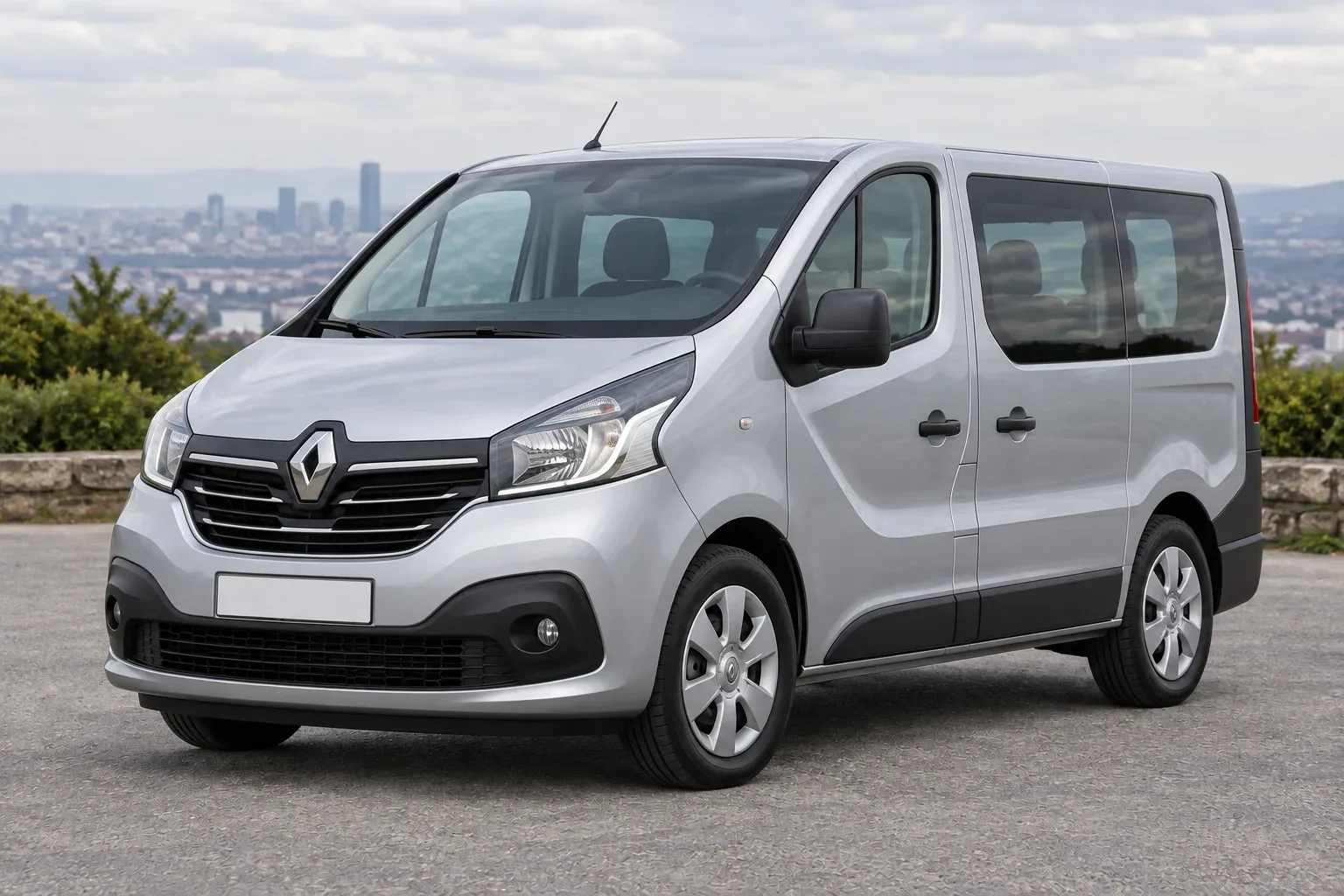
Renault Trafic 3/X82
Valuation of the Renault Trafic 3 / X82 (2014–2024): condition, paperwork, inspection and terms of sale.
Indicative purchase price
Below market value
Final price agreed after inspection.
Value my car1Why buyers choose this model
Who would have given up the Volkswagen Multivan? It has an ageless design, and however old it is, it looks decent, especially if it is kept in good condition. The list of options was 30 pages long, and the buyer had what to choose: double glazing, seats covered with two-tone leather, side doors with electric or full control, two types of autonomous heating. And, of course, all-wheel drive, useful in winter when snow falls. A multivan capable of towing a 2.5-ton trailer is an undisputed ideal for any practical guy. One of the more affordable alternatives is the Renault Trafic 3, produced since 2014, with an elastic beam on the springs at the back, like a passenger car. It can hardly be called comfortable, especially since in recent versions the multivan has become much tougher and no longer so gracefully smooths potholes. The main advantages of Traffic 3 are reliable engines, excellent corrosion resistance and, of course, the price. A used car costs about half as much as a German Multiven. If you want a car that is close to a multi-seat van, with sliding seats in guides, folding tables and sleeping places, look for the Space Class version, where the rear seats are taken directly from the Mercedes V-Class. Renault currently delivers Trafic only in the N1 “cargo” version, that is, a maximum of six-seat version.
2What buyers check
Equipment
The Renault Trafic equipment list is only two pages long and lacks some pretty much sought-after items. For example, only the most expensive passenger versions of the Space Class can be equipped with automatic climate control, and even then, only in the front. The rear is a manual air conditioner (although it could have been automatic on the second generation until 2014), and the driver cannot interfere with its operation from his seat. And if women and children don't know how to handle these things, they can freeze or sweat. Only in 2017, the image from the camera reversed began to be transmitted to a large display. Before that, there was only a small screen built into the rear-view mirror. Traffic has never had xenon, only when updated in 2018, it received LED headlights. The automatic transmission (six-speed with a pair of clutches in the oil bath produced by Getrag, the maximum torque of 400 Nm) also appeared only in 2018. A little alarming is the fact that the AKP reduces the permissible weight of the towed trailer from 2000 to 1630 kg. It’s amazing why other automakers leave the VW Group such a huge advantage in towing capacity. Unfortunately, the electric drive control side sliding doors and did not appear in any of the versions. If you think that this is a surplus for spoiled people, you are mistaken. For example, if you stop at the front of school, the kids won’t slam the heavy doors behind them, or even move them.
The best news is reliability.
Renaults built after 2000 are virtually free from corrosion. Traffic's wings and rapids, stoned to bare metal, simply don't rust. The real surprise was the 1.6 dCi, which was seen as a temporary solution between 2014 and 2018, unable to offer a more powerful unit after the 2.0 and 2.5 dCi. It actually turned out the opposite. Drivers who travel the mountains in fully loaded cars agree that the twin-turbo variants 1. 6 dCi (125, 140 or 145 hp) are surprisingly much more willing to ride than the older two-liter, and even better than the 2.5 liter. And in the 1. 6 dCi unusually low fuel consumption - economical drivers usually fit into seven liters, ordinary - eight. There is no problem with the engine. In exceptional cases, the EGR valve fails. Sometimes we had to face oil leaks in the area of the lid of the HRM chain, even on fairly young cars. It was probably some kind of system manufacturing defect that affected a certain series. There is no problem with replacing the candles in 1. 6 dCi. Unlike older engines, there is a 0.5 mm gap between the candle and the head, so it does not cling and can be twisted normally if necessary. The attachment of thin and long steel incandescent candles to aluminum cylinder heads is a serious problem of all modern diesel engines, turning a seemingly banal operation into a drama.
Reputation
Renault Trafic is often overlooked due to doubts about its reliability. The negative view developed between 2001 and 2006, when the second generation of Traffic was equipped with a 1.9 dCi engine paired with a complex PK6 transmission. That’s where the turbochargers really let down (sometimes they drove the oil so that the engine wedged or spontaneously spinning the revs), and the gearbox hummed. The updated Trafic 2 is much better, having received in addition to the 2.0 dCi engine, which is still used today, the PF6 gearbox, familiar from the larger Master.
Some series were used poor-quality control hydraulic cylinders, after which the pedal failed and transmissions were impossible to switch. A technically ignorant person interpreted the symptoms as a failure of the transmission. Fortunately, it was only a faulty component, replaced by an hour's warranty at a maintenance station. There was even a service bulletin that ordered the repair shop to replace the hydraulic cylinder as a preventive measure.
Engines
1.6 dCi (R4/16V, 95, 115 or 120 hp, 260 or 300 Nm, 2014-2018).
The manufacturer focused it on various school minibuses and other purely urban purposes. The more powerful 115- or 120-horsepower turbodiesel was already decent, but was offered only for utilitarian commercial versions.
1.6 dCi Twin Turbo (R4/16V, 125, 140 or 145 hp, 320 or 340 Nm, 2014-2018).
An amazingly powerful, economical and reliable engine.
It is noteworthy that the high specific load was reflected not in the reduction of durability, but in very high emissions of nitrogen oxides. In 2017, in response to the scandal with “Dieselgate” manufacturer released a patched software that was downloaded the first time you visited the official service. It significantly increased the dosage of urea. Fortunately, the car has a decent 20-liter tank, which is enough for 15,000 km. The increase in fuel consumption after the modification was quite small, and fortunately reliability was not affected.
2.0 Blue dCi (R4/16V, 120, 145 or 170 hp, 320, 350 or 380 Nm, as of 2018).
Due to stricter emissions measurements in the WLTP cycle, the manufacturer has returned to two-liter volume. However, this is not the original 2.0 dCi, but a brand new engine based on the 2.3-liter Master unit, an incredibly reliable unit. Let’s hope the 2.0 Blue dCi will follow in his footsteps. The compressed air water intercooler also contributes to lower NOx emissions and faster response.
Characteristic problems and malfunctions
Failure of hydraulic clutch control (1.6 dCi): leaky hydraulic cylinder causes system emptying, pedal falls into the floor, clutch remains on. The problem arose until 2017, then was corrected.
Oil leak through the lid of the chain of the valve timing (1.6 dCi): some cars apparently had incorrectly sealed sealant in the factory.
Bad image from the reversing camera: fogging the lens from the inside.
Daytime running lights failure: Fortunately, double filament lamps of 21/5W are very easy to replace.
Scream side sliding doors: will help adjustment. Sometimes it has to be repeated every year.
Wear of front ball supports: you can inexpensively replace yourself.
The engine goes into emergency mode (1.6 dCi): most often faulty EGR valve.
It is impossible to put the seats in place after dismantling (Space Class): if you carelessly remove the sliders are displaced relative to each other. You have to adjust with a special handle.
Service recommendations
The service interval is 40,000 km and the engines carry it surprisingly well. However, the owner will not be mistaken if he updates the oil more often.
After 6 years or 160,000 km, the belt of the drive of auxiliary units, including pulleys, is prescribed.
For the HRM chain, regular maintenance is not provided, and no one has had problems with it so far. Experts believe that its resource is not less than 500,000 km.
Diesel testing
An experienced diagnostician can determine the condition of the engine by measuring the amount of corrective fuel. The amount of diesel fuel that the control unit must add or subtract in each cylinder to keep the engine running evenly.
A higher number means worse condition of the nozzles or a decrease in compression in the cylinder. The correct way to measure is to measure on a warmed-up engine. But freezing to the cold is a secret trick. A car that has low adjustments even in a cold state is guaranteed to be flawless.
Pluses
Comparatively favorable prices for used cars
Remarkably elastic and economical 1.6 dCi Twin Turbo engine
Not of interest to thieves and scammers
It is easy to replace light bulbs by yourself until 2018 (including daytime running lights)
Cons
Problematic availability of comfortable versions of Space Class
Lack of electrical control of side sliding doors
No additional heater is provided for the factory
Automatic transmission not available until 2018
Limited supply in the used car market
Weight of 2,000 kg (even less with automatic EDC)
Model history
2014: The appearance of the model. The body options are Van, Combi Van and Passenger. Two lengths: L1 - 4999 mm (wheelbase 3098 mm) and L2 - 5399 mm (wheelbase 3498 mm). Engines 1.6 dCi (95 or 115 hp) and 1.6 dCi Twin Turbo (125 or 140 hp).
2015: Passenger versions are converted to Euro 6 standard. Urea injection, power 1.6 dCi Twin Turbo increased to 145 hp
2016: Urea injection also for commercial versions. Power 1.6 dCi increased to 120 hp
2017: there was a luxury configuration Space Class with sliding seats.
2018: model update, LED headlights as standard. The new 2.0 Blue dCi engine in versions with 120, 145 and 170 hp. The weakest 120-horsepower version came only with a manual transmission, a stronger 145 hp optionally could be combined with an automated transmission EDC, the strongest 170 hp - exclusively with EDC.
2021: Presented the second facelift model.
Competitors of Renault Trafic III
The Opel Vivaro and Fiat Talento (since 2014) are Renault Trafic’s biggest competitors, and hail from its own stable.
The Opel Vivaro was a nasty rival to Renault dealers, as it often had a better price. It was shipped from the British factory in Luton, where the last specimen rolled off the assembly line in September 2019. Since then, Opel has been redesigning PSA vans. Some Renaults were also supplied from Luton, but the quality was no different than those assembled in Sanduville, France.
The Fiat Talento was usually more expensive, but often better equipped in the base. It also offered a handy personal configuration (Panorama) in the six-seat version of the N1.
Other rivals are Citroen Spacetourer and its co-platforms (since 2016): Peugeot Traveller and Toyota (Proace). The design is strongly inspired by the Volkswagen Multivan.
The advantage of the trio is a reliable and powerful 2.0 BlueHDI engine combined with an excellent eight-speed Aisin automatic.
Weaknesses are Dangel’s complex, heavy and expensive optional all-wheel drive, and especially the under-stiff front axle. Enough minimal distortion or deviation of the shape of the tires, so that the steering wheel shakes in the hands. The manufacturer used tires of the highest quality, which cannot be bought in the conventional market.
3Pre-purchase checklist
Equipment
- And if women and children don't know how to handle these things, they can freeze or sweat.
The best news is reliability.
- Renaults built after 2000 are virtually free from corrosion.
- There is no problem with the engine.
- In exceptional cases, the EGR valve fails.
- There is no problem with replacing the candles in 1. 6 dCi.
- Unlike older engines, there is a 0.5 mm gap between the candle and the head, so it does not cling and can be twisted normally if necessary.
- The attachment of thin and long steel incandescent candles to aluminum cylinder heads is a serious problem of all modern diesel engines, turning a seemingly banal operation into a drama.
Reputation
- There was even a service bulletin that ordered the repair shop to replace the hydraulic cylinder as a preventive measure.
Characteristic problems and malfunctions
- Failure of hydraulic clutch control (1).
- The problem arose until 2017, then was corrected.
- Bad image from the reversing camera: fogging the lens from the inside.
- Sometimes it has to be repeated every year.
- Wear of front ball supports: you can inexpensively replace yourself.
Service recommendations
- After 6 years or 160,000 km, the belt of the drive of auxiliary units, including pulleys, is prescribed.
- For the HRM chain, regular maintenance is not provided, and no one has had problems with it so far.
Diesel testing
- But freezing to the cold is a secret trick.
Pluses
- It is easy to replace light bulbs by yourself until 2018 (including daytime running lights)
Cons
- Problematic availability of comfortable versions of Space Class
4Challenges of selling privately
Today, large families are used to the fact that if they want to comfortably accommodate three or more children in the car, they have to turn to passenger versions of vans. The choice in the market is not too diverse, finding a good car is quite difficult. There are few passenger versions among the vans, and of course even fewer options with more luxurious configurations, such as the Trafic Space Class. It could compete with the iconic Multivan, which costs twice as much as the Mercedes V-Class.
If you’re looking for an affordable family car, you just can’t do without the Trafic, its sister Opel Vivara, or even the rival Ford Tourneo Custom.
- Equipment: And if women and children are not good at handling these things, they can freeze or sweat.
- The best news is reliability: Renaults built after 2000 are virtually free from corrosion.
- Reputation: There was even a service bulletin that ordered the repair shop to replace the hydraulic cylinder as a preventive measure.
- Engines: 1.6 dCi (R4/16V, 95, 115 or 120 hp, 260 or 300 Nm, 2014-2018).
- Characteristic problems and malfunctions: Failure of hydraulic clutch control (1).
- Service recommendations: After 6 years or 160,000 km, the belt of the drive of auxiliary units, including pulleys, is prescribed.
- Diesel testing: An experienced diagnostician can determine the condition of the engine by measuring the amount of corrective fuel. Ie.
- Pros: Comparatively favorable prices for used cars Amazingly elastic and economical engine 1.
Shows, bargaining and re-registration take time: buyers look, promise to think and disappear. Fair price after inspection closes the auction on the spot. If money is needed urgently, the purchase takes away waiting and repeat displays.
5How selling to us works
Leave a request with the car data. We will discuss the preliminary assessment and inspection. After checking the status and documents, we agree on the final price and terms of the transaction.