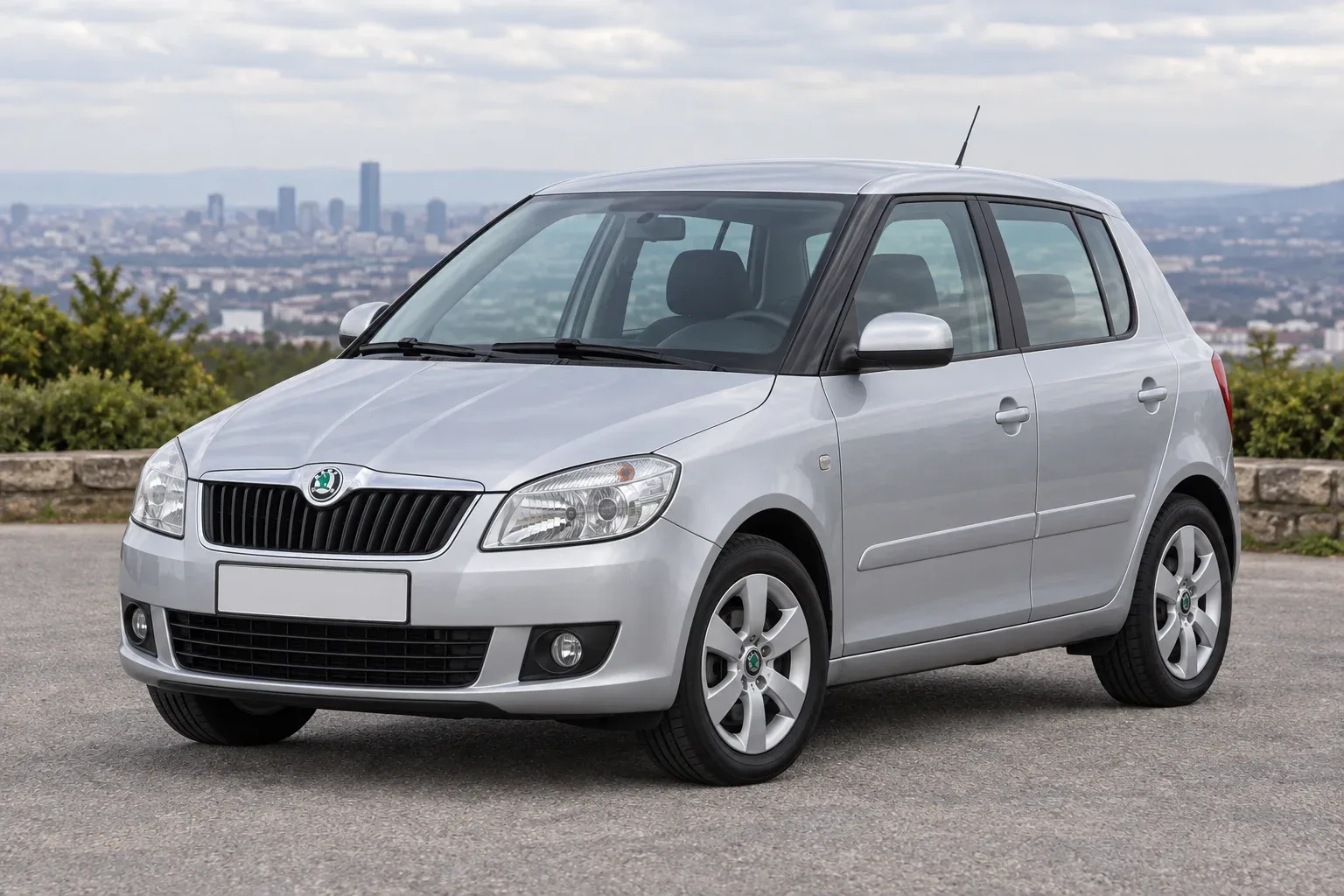
Škoda Fabia 2 / 5J
Valuation of the Škoda Fabia 2 / 5J (2007–2014): condition, paperwork, inspection and terms of sale.
Indicative purchase price
Below market value
Final price agreed after inspection.
Value my car1Why buyers choose this model
The ŠKODA Fabia 2 was unveiled at the Geneva Motor Show in the spring of 2007. The reaction of the general public was mixed. Fabia is technically identical to the VW Polo and Seat Ibiza. But in this trio, it takes on the role of the most pragmatic car. Fabia has five doors, large vertical side windows and a roomy interior, in which four adults will sit quietly. If someone has little space, then you should pay attention to the wagon. Regardless of the modification in comfort of accommodation and suspension, it is one of the best cars in the class.
2What buyers check
Design features
Compared to the predecessor of Škoda, Fabia was already 4 mm. But the remaining dimensions increased - length by 22 mm, and height by 47 mm.
From the beginning, Fabia 2 offered three versions of headlights, but there were no xenon lights even for a surcharge. The first one is the usual one with an H4 lamp. More advanced used a lens with a H7 lamp. Top versions were offered with a lens that can illuminate the turn. They were in conjunction with the assistance function by switching on the fog lamp corresponding to the direction of turning.
The air conditioning system is also presented in three versions. The basic was conventional air conditioning. Climate control is able to automatically maintain the set temperature in the cabin. Climatronic not only monitored the temperature, but also controlled the flow of air and its speed.
Engines
The engine line is quite uncomplicated. Those who need something simpler, can safely choose between gasoline engines with a working volume of 1.4 liters (85 hp) and 1.6 liters (105 hp). Both engines are quite reliable.
Among diesels should not fail 1.6 TDI (75 hp, 90 hp and 105 hp), which appeared in the range in March 2010. The Common Rail power system replaced the more vulnerable injector pumps that often caused problems, up to the point of disabling the cylinder head.
1.2 HTP
The three-cylinder 1. 2 HTP until 2010 met the Euro-4 standard and existed in two versions - a 6-valve with one camshaft and a 12-valve with two shafts. The first was BBM-marked and developed 60 hp, and the second was BZG/70 hp. Three-cylinder engines are familiar to the owners of the Fabia Mk1, where they have not earned the best fame. Several problems with the launch of the second generation model have been fixed. For example, high oil consumption due to the catalyst located too close to the engine block. In ŠKODA Fabia 2, additional protection is installed in the form of a shield made of heat-resistant steel. Another problem is the EGR exhaust gas recirculation system. It was clogged, as a result of which the engine malfunction indicator lit, dynamics dropped, and fuel consumption increased. The fault was the engine control unit Siemense SIMOS 3. The second generation of the Skoda Fabia uses the more advanced SIMOS 9.1 system and the disease is no longer found. It was not possible to cope with the loss of compression in one of the cylinders. This is the result of hitting the cylinders of small particles of the collapsed catalyst core (at the time of rapid closure of the throttle, which causes a sharp change in pressure). The catalytic converter crumbles due to poor-quality gasoline. Sawdust damages the guide valves, piston rings, and sometimes cylinders. As a result, the consumption of oil increases. The problem is mainly affected by 6-valve versions 1. 2. Regular operation at high speeds (over 3,500 rpm) leads to overheating of the oil, and, as a result, blocking of hydraulic valve pushers.
1.4
A good alternative to the three-cylinder gasoline engine will be a 4-cylinder 1.4 liter volume. It left the range of engines for a short period of time - from 2010 to 2011.
1.4 has an aluminum block and a head with 16 valves. The gas distribution mechanism is driven by two gear belts - a long one connects the crankshaft and the camshaft, and a short one connects camshafts. To update the drive valve timing will need about 13 000 rubles.
Euro 4 was designated BXW and Euro 5 was designated CGGB. Both engine variations are great. The engine is quiet and reacts vigorously to the gas. However, the engine does not have enough strength at low speeds. Part of the situation is corrected by the manual gearbox 02T.
1.6
The 16-valve 1.6 (BTS) remained in production until 2010. It is based on the 1.6 FSI used in the Golf Mk5 and Skoda Octavia 2. The Fabia version, due to distributed fuel injection, has a different block head and pistons with a different bottom shape. The drive of the camshaft remained chain. If you change the oil in time, then there are no problems with the chain drive of the valve timing.
In 2010, the BTS was replaced by an aggregate with the CFNA index. He later went to Volkswagen Polo Sedan and Škoda Rapid. Its disadvantages are the knock of pistons and cracking of the exhaust manifold (over 6000 rubles).
Both versions of the engine are reliable. They are the only ones combined with the 6-speed Japanese Aisin 096.
1.2 TSI
Since March 2010, the turbocharged 1.2 TSI has been used. It has an aluminum block, one camshaft and 8 valves. The weaker version of the 86 hp was labeled CBZA, and the stronger version was labeled 105 hp - CBZB. In addition to the manual transmission, the turbo engine could be combined with a 7-speed automatic transmission with dual clutch DSG DQ200. It is a really strong engine, but unfortunately it often disappointed with the problems with the HRM circuit and its tensioner. A characteristic symptom is noise after starting a cold engine. The chain could have jumped several links due to a stretch or faulty chain tensioner. This phenomenon is not so rare. In the worst case, the engine could go for major repairs (after the valves meet with the pistons). Since June 2011, the valve timing drive has been modified. The changes affected the chain, both stars and guides with a tensioner. Initially, replacing the lower star of the valve timing was a big problem. Later, Škoda equipped the workshops with a device that allows you to remove the gear from the crankshaft directly on the car. Unfortunately, as it turned out later, even modified chains stretch (7-9 thousand rubles per set). Another problem of 1.2 TSI is related to the turbocharger. Skoda changed suppliers twice. The defect was associated with the stepper motor of the regulating valve (Westgate). He suffered from a high fever and began to live his life. Fortunately, the stepper motor can be ordered separately. Skoda tried to fix the glitch with software and a 2mm substrate.
1.4 TDI PD
The most affordable among diesel units is a three-cylinder 1.4 TDI with pump injectors. Fabia relied on versions - BMN capacity of 69 hp and BNV recoil 80 hp. The more powerful BNV was combined with the reliable 5-speed 02R mechanics, designed to transfer torque up to 250 Nm. The weaker BMN was equipped with the 02T manual transmission.
There was another version - BMS performance of 80 hp. She used ceramic candles and a particulate filter. This version is best avoided, as engines with pump injector technology have problems with the regeneration of the particulate filter.
The combined type of valve timing drive is a gear belt plus a chain connecting the balance shafts. The belt is updated every 60,000 km (10,000 rubles for a set with a pump). The chain is recommended to be changed after 200,000 km (12,000 rubles per set).
1.9 TDI PD
Very dynamic is the modification of Shkoda with 1.9 TDI PD. The turbodiesel offers 105bhp. Motors with BSW code do not have a particulate filter, unlike BLS.
Getting diesel fuel into oil
The problem affected diesel engines 1.4 and 1.9 TDI. Over time, a gap appeared in the landing sites of the nozzles, and the fuel fell into the cylinder head, which diluted the oil and accelerated the wear of the moving elements. The new head of the block costs about 35 000 rubles.
1.6 TD CR
Diesel 1.6 with the Common Rail injection system is characterized by quiet and soft operation. Until 2011, he suffered from oil leaks from under the valve lid. The cover was changed along with the gasket.
The engine is reliable, but requires high-quality fuel. Otherwise, there will be problems with nozzles (cold nozzles work noisily).
Sometimes there are faults of the valve of the exhaust gas system. They can be caused by a failed valve valve control electronics due to jamming of the so-called snoring mechanism.
After 150 000 km, the cooling system pump can flow, so it is better to change it together with the timing belt (14-16 thousand rubles).
Transmission
All gearboxes show good endurance. Only periodically detected leakage of transmission fluid through seals of drive shafts.
The clutch of the manual transmission usually runs over 150-200 thousand km. The new set is available for 9-12 thousand rubles, and for work in the service will ask about 5000 rubles.
The same will last the clutch of the robotic box DSG7. But the replacement will cost more - about 30 000 rubles. If the flywheel gets tired, then you will have to give about 40 thousand rubles.
The machine, subject to regular oil updates, will pass without repair at least 300,000 km. For its complete bulkhead will need more than 100,000 rubles.
Walking
The rear axle inherited a supple beam from the first Fabia. Her Silentblocks are practically eternal.
On the front axle are equipped with modified McPherson racks. Initially, the front levers repeated the design of the first generation model. Its feature is the back support of the lever. It was a Silentblock in an aluminum case fixed on a subframe. A lever finger was inserted into this support.
The rear Silent block was changed along with the bracket, and the front Silent block - along with the lever. Ball support (2-3 thousand rubles) can be replaced separately - it is fixed on three screws.
Since March 2008, the front suspension has been reminiscent of the one used in the ŠKODA Octavia. Both Silentblocks (200-1000 rubles) have already become part of the lever, and they can be replaced separately. The service life has increased by about three times.
Cylent blocks of the front suspension and ball supports usually run over 100,000 km.
Front and rear hub bearings up to 150,000 km rarely attract attention. They change in the collection with the hub - 3-7 thousand rubles plus 1.5-2 thousand rubles for work.
Since the Skoda Fabia is mainly used in urban traffic with frequent stops, brake discs and pads wear out relatively quickly. Fortunately, replacing them will be inexpensive.
Many owners note a rather early operation of the ABS system, which sometimes in critical situations turns into a lack of braking distance and collision with an obstacle.
Corrosion and LCP
With age, there are complaints about the appearance of foci of corrosion in the area of the trunk lid, rapids, doors and wheel arches.
Noise from wind and moisture penetrating through the front door is caused by improper installation, damage or displacement of the door seal. In addition, over time, seals wipe the paint coating in the doorways.
Water in the trunk.
Water gets through the ventilation grilles. They are located under the rear lights and do not fit well to the body.
Wiring of the front doors
Wiring in corrugated with age is damaged, which leads to interruptions in the work of the central lock, windows, as well as the drive and heating of mirrors.
Cleaners
After 100-150 thousand km, faulty wipers may require attention. If the rear mechanism is usually enough to disassemble and clean, then the front one has to be changed (thrust flies). The cost of a new trapezoid is 7-10 thousand rubles.
Engine supports
When the supports wear (3-4 thousand rubles) vibrations appear (usually after 120-160 thousand km).
Faulty ignition coils
The engine is starting to turn. The cost of the ignition coil is 2-4 thousand rubles.
Radiator fan
After 150-200 thousand km, the radiator fan may stop working. There are several reasons - damage to the power harness or failure of the resistor of the fan. In the latter case, the fan is better to replace - from 4000 rubles for an analogue or 16 000 rubles for the original.
The engine of the stove
After 150-200 thousand km can make noise or completely refuse the engine of the stove (from 3000 rubles for an analog or 17 000 rubles for the original).
3Pre-purchase checklist
Engines
- The Common Rail power system replaced the more vulnerable injector pumps that often caused problems, up to the point of disabling the cylinder head.
1.2 HTP
- Several problems with the launch of the second generation model have been fixed.
- Another problem is the EGR exhaust gas recirculation system.
- It was clogged, as a result of which the engine malfunction indicator lit, dynamics dropped, and fuel consumption increased.
- It was not possible to cope with the loss of compression in one of the cylinders.
- The problem is mainly affected by 6-valve versions 1. 2.
- This problem is again more typical of the 6-valve version 1.
- The common problem of 3-cylinder 1. 2 is the valve timing drive chain. It's pulling out relatively quickly.
- The regulation provides for the replacement of the chain when the mileage of 150 000 km is reached.
1.6
- If you change the oil in time, then there are no problems with the chain drive of the valve timing.
- Its disadvantages are the knock of pistons and cracking of the exhaust manifold (over 6000 rubles).
1.2 TSI
- It is a really strong engine, but unfortunately it often disappointed with the problems with the HRM circuit and its tensioner.
- In the worst case, the engine could go for major repairs (after the valves meet with the pistons).
- Initially, replacing the lower star of the valve timing was a big problem.
- Another problem of 1.2 TSI is related to the turbocharger. Skoda changed suppliers twice.
1.4 TDI PD
- This version is best avoided, as engines with pump injector technology have problems with the regeneration of the particulate filter.
- The chain is recommended to be changed after 200,000 km (12,000 rubles per set).
Getting diesel fuel into oil
- The problem affected diesel engines 1.4 and 1.9 TDI.
- Over time, a gap appeared in the landing sites of the nozzles, and the fuel fell into the cylinder head, which diluted the oil and accelerated the wear of the moving elements.
1.6 TD CR
- Otherwise, there will be problems with nozzles (cold nozzles work noisily).
- Sometimes there are faults of the valve of the exhaust gas system.
- They can be caused by a failed valve valve control electronics due to jamming of the so-called snoring mechanism.
- After 150 000 km, the cooling system pump can flow, so it is better to change it together with the timing belt (14-16 thousand rubles).
Transmission
- But the replacement will cost more - about 30 000 rubles.
- The machine, subject to regular oil updates, will pass without repair at least 300,000 km.
Walking
- Fortunately, replacing them will be inexpensive.
Corrosion and LCP
- With age, there are complaints about the appearance of foci of corrosion in the area of the trunk lid, rapids, doors and wheel arches.
The engine of the stove
- km can make noise or completely refuse the engine of the stove (from 3000 rubles for an analog or 17 000 rubles for the original).
4Challenges of selling privately
The comfort level in the ŠKODA Fabia is comparable to higher-end cars. Problems with the 1.2 TSI HRM chain and the block head in turbo diesels with pump injectors make it easier to choose engines. The most preferred gasoline atmospherics volume of 1.4 and 1.6 liters, as well as a strong turbodiesel 1.6 TDI.
- Design features: Compared to the predecessor of Škoda, Fabia was already 4 mm.
- Engines: The Common Rail power system replaced the more vulnerable injector pumps that often caused problems, up to the point of disabling the cylinder head.
- Transmission: But the replacement will cost more - about 30 000 rubles.
- Thankfully, replacing them will be inexpensive.
Shows, bargaining and re-registration take time: buyers look, promise to think and disappear. Fair price after inspection closes the auction on the spot. If money is needed urgently, the purchase takes away waiting and repeat displays.
5How selling to us works
Leave a request with the car data. We will discuss the preliminary assessment and inspection. After checking the status and documents, we agree on the final price and terms of the transaction.