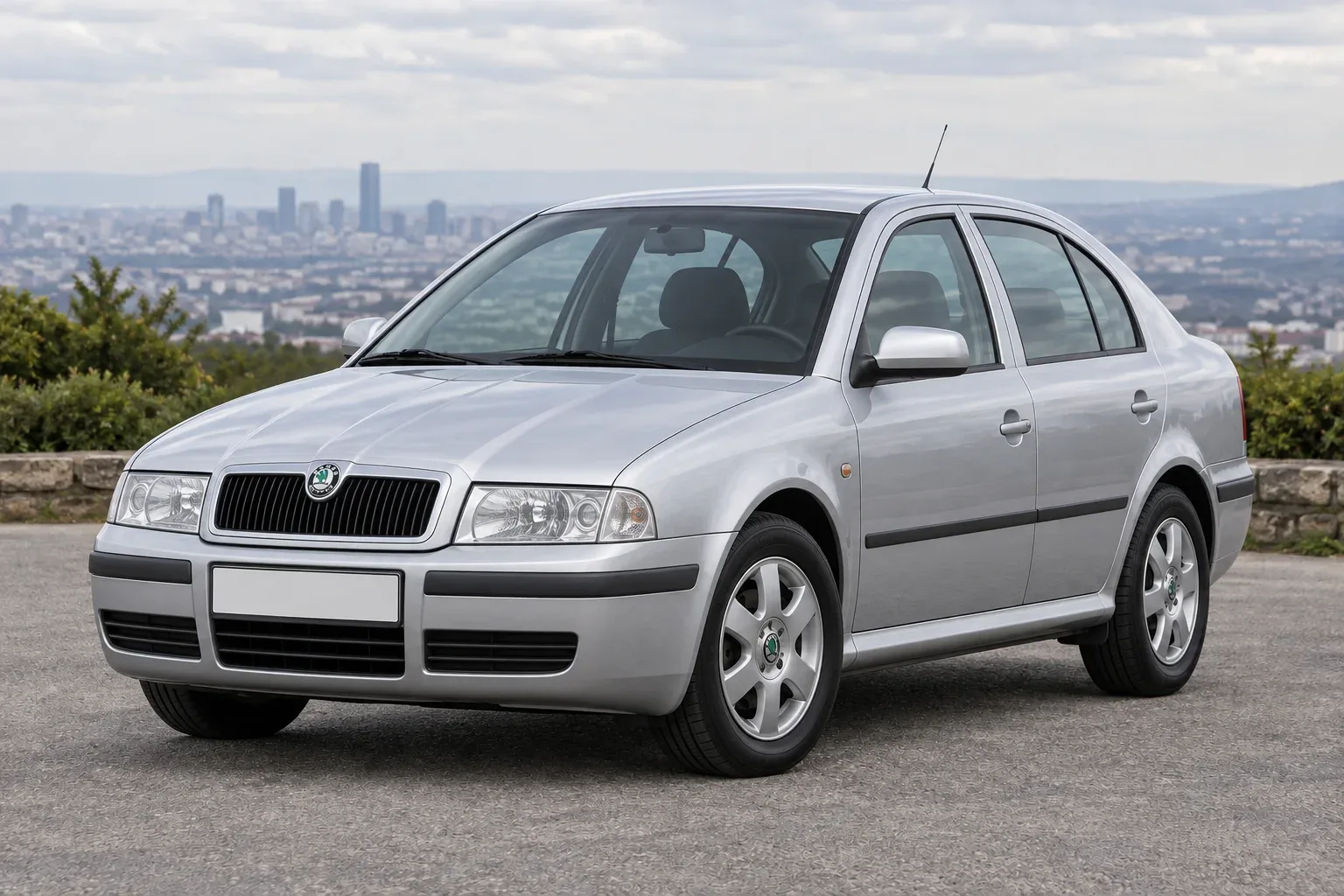
Škoda Octavia A4 / Tour
Valuation of the Škoda Octavia A4 / Tour (1996–2011): condition, paperwork, inspection and terms of sale.
Indicative purchase price
Below market value
Final price agreed after inspection.
Value my car1Why buyers choose this model
The first-generation Octavia (PQ34) is essentially a simplified version of the Golf IV. The model was produced from 1996 to 2010, and since 2004 it was sold only as the Octavia Tour. In the Russian secondary market, the car has earned a reputation as an “unkillable workhorse”. However, it is worth admitting that the solid age and large mileage of most specimens revealed a number of specific defects of VAG.
2What buyers check
Confusion A4 and A5: Be careful
When examining reviews, there is often confusion between the first and second generation Octavia (A4 and A5). On the forums, you can see complaints about the Octavia Tour due to "1.8 TSI oilslozher", "DSG kicks" or "FSI's cost." It is important to remember that the Octavia A4 (1U) for all 14 years of production did not install TSI / FSI engines and DSG boxes.
If the seller says that the 2008 car is “wet diesel DSG” or 1.8 TSI, you are either swap or Octavia A5 (PQ35), which is not structurally linked to the A4. By the way, this confusion gives rise to many myths about the “reliability” or “problem” of the model.
Body: where to look for corrosion
The body of the A4 is galvanized by the method of full hot immersion and resists through corrosion well. However, age makes itself felt in places of accumulation of hidden moisture - this is perhaps the main weakness of the model.
Drainage under the toad
Under the plastic lining of the windshield are drainage holes. Because of the leaves and dirt, they are clogged in 3-4 years. The water rises to the level of the salon filter and pours the salon on the front right pillar.
At the bottom of the floor is an electronic comfort unit. Oxidation of its contacts causes electrical failures: spontaneous opening of windows, locking doors, battery discharge.
When inspecting, lift the carpet - if it is damp under the feet of the driver or passenger, the block is threatened. The problem is worse if the car has been under the trees for a long time.
Wings and rapids
The second problem is the lower part of the front wings in the junction zone with the threshold. Under the regular plastic locker for years stuffed with wet sand, the metal rots from the inside, outside appear bubbles of paint.
In addition, due to the shape of the rib stiffness of the threshold, unqualified masters on tire mounts sometimes put the legs of lifts or jacks incorrectly. The rib crumples, the anticores collapse, and the threshold rots from the front.
Engines: What you need to know
The range of engines includes proven VAG units, but each has its own characteristics - some of them are critical when buying.
Atmospheric 1.6
The eight-valve 1.6 is the most popular engine. On older versions before restyling, the throttle drive is mechanical, the aluminum intake manifold. They are tenacious, but after 200 thousand km, the "maslozhor" often begins due to the occurrence of piston rings. It is treated by replacing rings and oil caps.
On the versions of the Tour after 2000, a motor with an electronically controlled thermostat in a plastic case was installed. The body eventually dries up and lets it flow through microcracks. The electronic part of the thermostat fails, causing the cooling fans to constantly rotate at maximum. The cost of such a thermostat is 4-5 times higher than a conventional mechanical one – this is perhaps one of the most unpleasant hidden costs.
1.8 Turbo
Engines with 5 valves per cylinder (20V) provide excellent dynamics. On the more recent modifications is an expensive hydraulic tensioner chain (GNC) with an electromagnetic valve of the phase rotator. With age, due to oil starvation or rare oil change, the intercamval chain stretches, the tensioner shoes wear out.
Symptom - a characteristic diesel roar or crackling at the back of the head of the block when starting on a cold one. Ignoring leads to chain jumping and all 20 valves bend.
When buying 1.8T be sure to measure the pressure of oil in the area of the oil filter with a mechanical pressure gauge: hot should be at least 1.2-1.4 bar on idles.
1.9 TDI: TNVD vs pump injectors
When buying a diesel Octavia, it is important to determine the type of fuel system by the engine code. Versions with a distribution TNVD (AGR, ALH on 90 and 110 hp) are the most reliable diesel engines in history. The nozzles are simple, mechanical, easily tolerate Russian low-quality diesel fuel. The camshaft is practically eternal.
Versions with pump injectors (AXR, ASZ on 100 and 130 hp) are more demanding on fuel quality. The main problem is that the pump injector is held in the landing place with only one bolt. Over time, from cyclic loads, the nozzle begins to luft, breaking the aluminum landing socket in the cylinder head, which leads to the entry of diesel fuel into the engine oil. These engines require strict use of expensive oil with a tolerance of 505.01 VW, otherwise the cams of the camshaft will be instantly worn.
Transmissions: What to pay attention to
When choosing a box on the Octavia A4, buyers traditionally look for the mechanics, considering it to be eternal. It is, however, a mistake.
02K ISL (1.4 and 1.6)
This box was installed on all atmospheric engines 1.4 and 1.6. VAG designers have put a vulnerability in it: the planetary gear of the differential is attached to the body using factory rivets with a diameter of 9 mm. With increasing mileage and frequent sharp starts, these rivets are cut under load. Free metal finger or rivet residue begins to rotate inside the crankcase and breaks through the silimine body of the gearbox. The transmission oil leaks out in seconds, the box jamms on the go.
Boxes on the powerful versions of the 1.8 Turbo (type 02J) are free of this problem - there the differential is assembled on bolts from the factory.
If you buy an Octavia 1.6 from your native manual transmission, check the history of the rivets replaced by a reinforced original set of VAG bolts (Art. 02K 498 088 A). When test drive, turn on the first gear and smoothly ride along the blank wall - the box should not emit cyclic clicks or a thunderous roar.
01M automatic transmission
The four-stage 01M is Volkswagen’s own development from the 90s. It is devoid of complex electronics and with regular oil change once every 60,000 km is able to survive the car itself. The main enemy is overheating due to a clogged heat exchanger. If the machine switches gears without strong blows to hot - it can be taken.
The chassis: nuances of the PPD
Almost all Octavia Tours, officially sold in Russia or assembled in Kaluga, were equipped with a Bad Road Package (BPD), which increased the clearance to 170 mm.
Parts conflict
Owners often make the mistake of replacing the racks. Trying to save money, they buy standard shock absorbers from the European VW Golf IV. With European short shock absorbers, the rigid springs of the PPD are stretched to the limit, and on the first pile or “lying policeman”, the rack is triggered to break with a metal knock. Selection of suspension elements for Kaluga cars should be carried out strictly according to PR codes in the VIN card.
Rear axle.
The rear suspension on front-wheel drive cars is a regular P-shaped beam. It is eternal, but to run 200-250 thousand km completely peel off its massive Silent blocks. Because of this, the rear axle begins to "steer" in the track, and the tread of the rear tires wears out unevenly (spots).
The front silent blocks and the sleeves of the McPherson stabilizer serve for 80-100 thousand km, their replacement costs a penny.
Electricity: Two chronic problems
The wiring is simple, but has two chronic problems – they are easy to check on examination.
The ends of the locks
Inside each door lock is a microswitch responsible for indicating the opening of the door. Over the years, its plastic rod is washed against the fist of the castle. You open the driver’s door, but the car doesn’t see it. The light does not turn on in the cabin, the buzzer of forgotten headlights does not work, and most importantly - if you opened the car from the key fob, put the keys on the seat and closed the door, the regular security system will automatically lock all the locks after 30 seconds, leaving the keys inside.
Trapezia janitors
Due to the ingress of water through the drainage of the toad, the steel fingers of the leashes of the wipers are dead-soaked inside the aluminum bushes of the trapezoid. The wipers start moving slowly, then stop in the middle, burning the electric motor. Trapezia requires regular (once every 2-3 years) dismantling, cleaning and lubrication.
Checklist of inspection on the lift
• Carpet: Press the floor covering in the legs of the driver and front passenger. Traces of moisture are a sign of clogged drainage toads and threats to the comfort block. • Carter ICPP 02K: inspect the joint of the halves of the box body. Traces of argon welding or fresh sealant indicate that the rivets of the differential have already pierced the body. • Silent blocks of the rear beam: assess the condition of the rubber in the beam mounts. Separations and cracks mean that a complex press replacement is needed. • End test: open each of the four doors alternately with the ignition on. On the panel or in the form of salon light should display the opening of each lock without delay.
What oil to pour in 1.6 BFQ to reduce consumption?
Pouring thicker oil (10W-60) in the hope of curing oil is a mistake. The narrow oil drain channels in BFQ pistons will clog up with coke even more. The only valid tolerance is the VW 502.00 / 505.00 with a 5W-40 viscosity. If the flow rate exceeds 500 ml per 1000 km, only mechanical replacement of piston rings will help.
How to distinguish a problem-free ICS from a problem one?
Visually, the 02K type boxes (problem) have a lower stamped green tin cover of the fifth gear from the end of the gearbox and a lever switching mechanism under the hood.
The 02J reliable boxes (on 1.8T engines) have a fully cast aluminum body and a cable switching drive.
How to check the Haldex coupling of the 1st generation?
All-wheel drive versions of the Octavia A4 (4x4) are equipped with a Haldex clutch with electro-hydraulic control. Put the car with the front wheels on a slippery surface (sand, ice) and sharply move from place. The rear axle should be connected almost without delay - within 1/4 of the turn of the towing front wheel. If there is no connection, the problem is the burnt-out electric pump of the coupling or ignoring the regulations for changing the oil and the Haldex filter (every 30,000 km).
3Pre-purchase checklist
Confusion A4 and A5: Be careful
- It is important to remember that the Octavia A4 (1U) for all 14 years of production did not install TSI / FSI engines and DSG boxes.
- By the way, this confusion gives rise to many myths about the “reliability” or “problem” of the model.
Body: where to look for corrosion
- The body of the A4 is galvanized by the method of full hot immersion and resists through corrosion well.
Drainage under the toad
- When inspecting, lift the carpet - if it is damp under the feet of the driver or passenger, the block is threatened.
- The problem is worse if the car has been under the trees for a long time.
Wings and rapids
- The second problem is the lower part of the front wings in the junction zone with the threshold.
- Under the regular plastic locker for years stuffed with wet sand, the metal rots from the inside, outside appear bubbles of paint.
- The rib crumples, the anticores collapse, and the threshold rots from the front.
Engines: What you need to know
- The range of engines includes proven VAG units, but each has its own characteristics - some of them are critical when buying.
Atmospheric 1.6
- The body eventually dries up and lets it flow through microcracks.
- The electronic part of the thermostat fails, causing the cooling fans to constantly rotate at maximum.
1.8 Turbo
- On more recent modifications is an expensive hydraulic tensioner chain (GNC) with an electromagnetic valve of the phase rotator.
- 8T be sure to measure the pressure of oil in the area of the oil filter with a mechanical pressure gauge: hot should be at least 1. 2-1. 4 bar on idles.
1.9 TDI: TNVD vs pump injectors
- When buying a diesel Octavia, it is important to determine the type of fuel system by the engine code.
- The main problem is that the pump injector is held in the landing place with only one bolt.
- Over time, from cyclic loads, the nozzle begins to luft, breaking the aluminum landing socket in the cylinder head, which leads to the entry of diesel fuel into the engine oil.
02K ISL (1.4 and 1.6)
- 8 Turbo (type 02J) this problem is free - there the differential is assembled on bolts from the factory.
- 6 from the native manual transmission, check by history whether the rivets were replaced by a reinforced original set of VAG bolts (Art. 02K 498 088 A).
Parts conflict
- With European short shock absorbers, the rigid springs of the PPD are stretched to the limit, and on the first pile or “lying policeman”, the rack is triggered to break with a metal knock.
Rear axle.
- The front silent blocks and the sleeves of the McPherson stabilizer serve for 80-100 thousand km, their replacement costs a penny.
Electricity: Two chronic problems
- The wiring is simple, but has two chronic problems – they are easy to check on examination.
Checklist of inspection on the lift
- Carter ICS 02K: inspect the joint of the halves of the box body.
- Separations and cracks mean that a complex press replacement is needed.
What oil to pour in 1.6 BFQ to reduce consumption?
- If the flow rate exceeds 500 ml per 1000 km, only mechanical replacement of piston rings will help.
How to distinguish a problem-free ICS from a problem one?
- Visually, the 02K type boxes (problem) have a lower stamped green tin cover of the fifth gear from the end of the gearbox and a lever switching mechanism under the hood.
How to check the Haldex coupling of the 1st generation?
- If there is no connection, the problem is the burnt-out electric pump of the coupling or ignoring the regulations for changing the oil and the Haldex filter (every 30,000 km).
4Challenges of selling privately
- Confusion of the A4 and A5: Beware: By the way, it is this confusion that has generated many myths about the model’s “reliability” or “problem.”
- Body: where to look for corrosion: The body of the A4 is galvanized by the method of full hot immersion and resists through corrosion well.
- Engines: What to know: The range of engines includes proven VAG units, but each has its own characteristics - some of them are critical when buying.
- Transmissions: What to look out for: When choosing a box on the Octavia A4, buyers traditionally look for the mechanics, considering it to be eternal. It is, however, a mistake.
- Almost all Octavia Tour, officially sold in Russia or assembled in Kaluga, were equipped with a Bad Road Package (PPD), which increased the clearance to 170 mm.
- Electrical: Two chronic problems: Wiring is simple, but has two chronic problems – they are easy to check on inspection.
- Checklist of inspection on the lift: Detachments and cracks mean the need for a complex press replacement.
Shows, bargaining and re-registration take time: buyers look, promise to think and disappear. Fair price after inspection closes the auction on the spot. If money is needed urgently, the purchase takes away waiting and repeat displays.
5How selling to us works
Leave a request with the car data. We will discuss the preliminary assessment and inspection. After checking the status and documents, we agree on the final price and terms of the transaction.