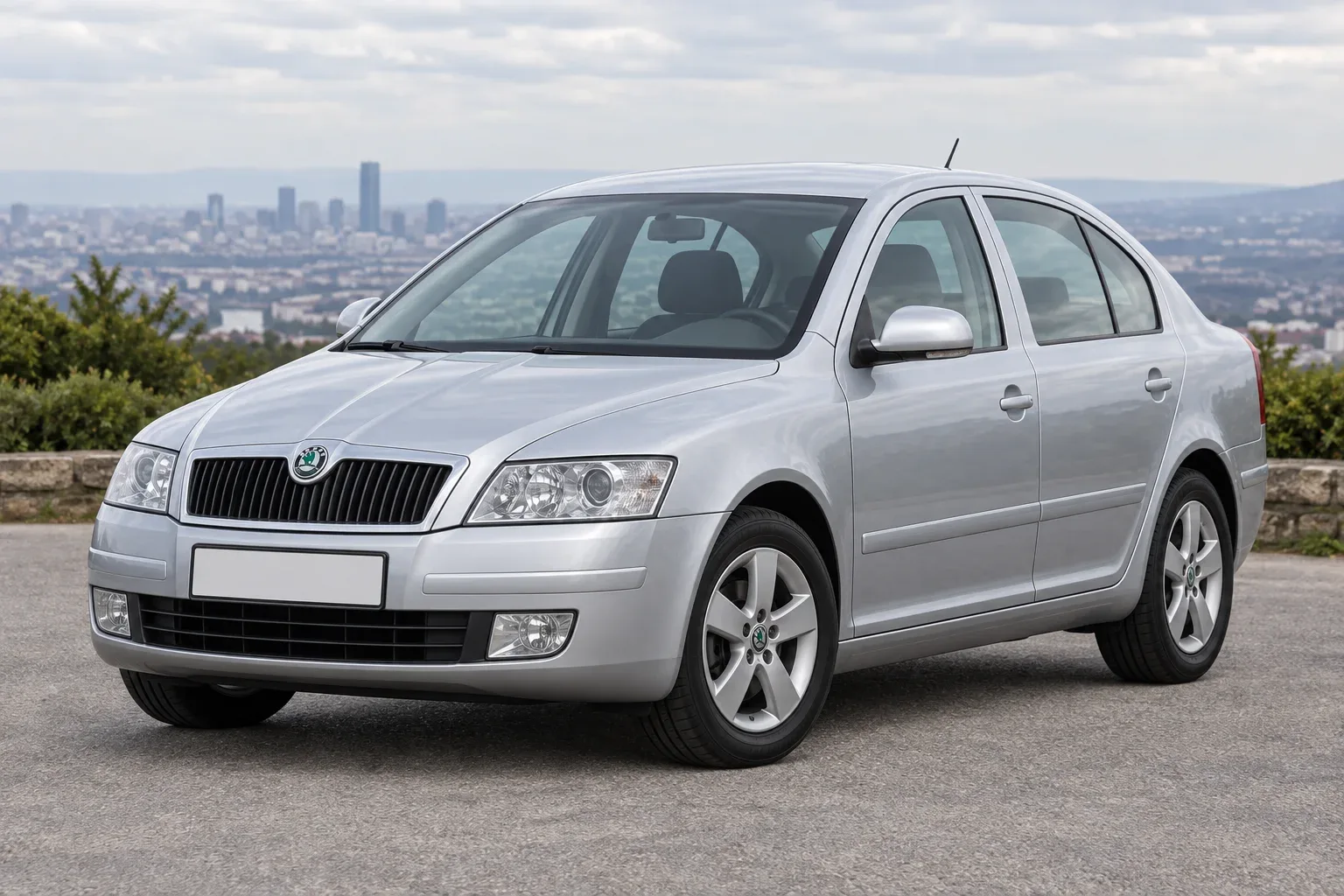
Škoda Octavia A5
Valuation of the Škoda Octavia A5 (2004–2013): condition, paperwork, inspection and terms of sale.
Indicative purchase price
Below market value
Final price agreed after inspection.
Value my car1Why buyers choose this model
The Czech manufacturer offers more than the typical compact car buyer expects. And that is the secret of Octavia’s undeniable success. The term “more” in this case means unusually roomy trunk, plenty of space for rear passengers and a wide range of engines. The point above the “and” is the fact that the ŠKODA Octavia A5 uses most of the components from the Volkswagen Golf V, which is considered quite reliable and has a decent selection of easily available spare parts.
2What buyers check
The price of popularity
The good reputation of Škoda was reflected in the cost of used copies. The Czech car is 15% more expensive than its direct competitors – the Ford Focus II and Opel Astra III. The aforementioned large trunk makes the Octavia more useful in the family than the slightly less functional Golf. At least when comparing the 5-door versions. As a rule, the cheapest copies are not from first hand. In addition, the model was very popular in corporate garages. For this reason, most young specimens have large runs, and subsequent owners often twist it. A well-groomed car from the first hand will cost 100-150 thousand rubles more than the average market price. But finding a good copy is not easy, as it “goes away” very quickly. The cost of the car is also affected by the level of equipment. The cheapest versions do not even have a standard head unit, let alone air conditioning. And the plastic on the steering wheel and door handles resembles the one used twenty years ago in Felicia. In expensive trim levels, you will find luxurious leather upholstery and an advanced multimedia system controlled via a touch screen. Buying an empty car is not worth it, as it is very difficult to resell. To the maximum-equipped copies must be approached carefully. Often, owners change equipment on their own, using components available on the secondary market for this purpose. There is nothing wrong with this, provided that the customers know what they are dealing with. However, do not forget that the car configured in the factory is more reliable. ## A little history
The second generation of the Skoda Octavia debuted in 2004, initially in the back of a hatchback. The wagon appeared in the model range a year later. In 2007, Škoda offered an all-terrain version of the Scout with increased ground clearance, four-wheel drive and external decorative elements made of plastic. The Octavia II FL was introduced in 2008. Technically, it was the same car. Visually updated model is distinguished by new headlights, taillights, hood and several details in the interior, such as the instrument panel. The Octavia II FL was replaced by the Octavia II. But at the same time, the first generation model, the Octavia Tour, remained available in some markets. In 2010, Skoda held a small castling: officially ended sales of the Octavia I Tour, instead of which offered a re-imitated Octavia II Tour. In 2012, the Octavia 2 Tour was officially completed, and in 2013, and FL, which gave way to the Octavia III.
The second generation octavia is very well protected from corrosion. Only the quality of the paintwork deserves reservations. On the hood soon appear chipped, and the surfaces to which the door seal adjoins, quickly abrade. This model is typical of strong aerodynamic noise that appears in the rear of the car after 60 km / h. This is due to the small windows in the back doors. At first glance, it seems that they fit tightly into the glass. It is enough to glue the film to check. If the noise has subsided, it means the sealers are to blame. In addition, there are frequent cases of leaks through the glazing seals of the rear doors. On the lift, corrosion is sometimes found on the elements of the suspension and exhaust system. Unfortunately, this is a typical disease, but it should not cause you anxiety. It is quite common for the car mistting headlights, and clouded glazing in old copies indicates a trouble-free past. The interior retains good shape for a long time. The exceptions are the steering wheel and the gear lever. After 150,000 km, both elements take on a rather worn look. The front panel is made of soft materials. In the highest trim levels, for example, Elegance, the quality of interior decoration Octavia can even compete without complexes with his blood brother Golf V. It is a pity that over time when driving on uneven roads, the cabin begins to creak. #
Burning lamps in front headlights and taillights are common. The procedure for replacing light bulbs in the front headlights is troublesome and may entail cracking of the fasteners. In addition, often capricious head device audio system, central lock and electric windows. Sometimes the stop-signal switch fails. Some electrical failures are caused by corrosion of electrical connections. Sometimes the ABS block fails - its electronic part fails. Subsequently, the block was upgraded. The cost of the used block is 10-12 thousand rubles. # #
The common platform includes the same chassis with the VW Golf V, Seat Leon, Seat Altea and Audi A3 II. The suspension has a modern design, providing effective absorption of irregularities, a good understanding of the car and stable behavior on the road. The front is used independent suspension type Macpherson. There is also an independent suspension in the back. On the one hand, this means potentially higher maintenance costs, and on the other hand, better handling. The whole structure is attached to the subframe. For each rear wheel there is one solid load-bearing transverse lever, one additional transverse lever and one longitudinal lever. To reduce maintenance costs, instead of the traditional scheme, the depreciation rack combined with the spring, the shock absorber and the spring are installed separately. At the back, at least once every two years, it is necessary to adjust the convergence with the help of eccentric washers under the fastening bolts of the transverse suspension levers. Russian cars suffered from broken rear springs at a mileage of 50,000-150 thousand km. If the torsion beam is installed behind (on some European versions), then it can be left unattended for 200,000 km. But then you will need to replace rubber silent blocks and bushings - about 100-150 dollars. In the front suspension, you often have to face wear of the bushings and stabilizer racks. And after 80-120 thousand km, the levers' Silentblocks are surrendered. Ball supports can be replaced separately: they are fastened with bolts, which makes it easier to repair. # # Gasoline engines
The base engine of Octavia of the second generation is 1.4 liters. Due to the low power – only 75 or 80 hp and low popularity in the market, we may not consider it. This engine was used in the initial stage of production. Much more interesting is the 8-valve 1.6-liter engine. It’s not very powerful either – 102 hp – but it has a number of other important advantages. First of all, it's pretty reliable. Secondly, it is very cheap to repair. Third, it works well with LPG (liquefied gas) systems. With some caution should be treated to the engines 1. 6 FSI, 1. 8 TFSI, 2. 0 FSI and 2. 0 TFSI. All of them have direct fuel injection, which increases maintenance costs and is a major obstacle to installing LPG gas equipment. To prevent the appearance of deposits on the valves, it is necessary to keep the ventilation system of crankcase gases clean. This requires regular cleaning. Among the common problems of gasoline engines, we can distinguish a short-lived pump and a gasoline pump (from 5 000 rubles), which are often given after 100-150 thousand km. Turbo engines often required the replacement of a prematurely stretched chain and a faulty tensioner in the area of 60-150 thousand km. The cost of updating the set of valve timing - 25-30 thousand rubles. The turbine runs over 250,000 km. ## Diesel engines
The diesel line is represented by three units. First, an old acquaintance 1. 9 TDI. It can be recommended with a clear conscience. The engine lasts a long time, but after 150-200 thousand km may require replacement of the clutch with a double flywheel (about 30 000 rubles), air flowmeter, and sometimes turbocharger (about 15 000 rubles). Active driving prevents the turbine blade drive from jamming, as the drive constantly changes its position. Temporary type valve timing drive. Among other common problems can be distinguished: malfunction of the valve of correction of boost (valve N57), failure of the flowmeter and wear of the regulator of the fuel pump, which leads to difficulty starting the warm engine. Much more trouble delivers 2.0 TDI PD with pump-nozzles with a capacity of 140 and 170 hp. It guarantees an excellent ratio of dynamic performance and fuel consumption, but is widely known for problems with nozzles and cracking of the head of the block. Also, there are frequent cases of destruction of the oil pump drive. Fortunately, the manufacturer after restyling eliminated almost all the shortcomings and installed a Common Rail injection system. The design of the 2.0 TDI engine has not changed much. With large runs, there is a need to replace the two-mass flywheel and nozzles. The main way to diagnose diesel engines is a trial ride with a connected diagnostic device VAG-com, which reads the necessary operating parameters from the engine controller. Based on the information received, a conclusion is made about the serviceability of the turbodiesel. ##
People who appreciate low operating costs are recommended a manual transmission. However, there are problems with it - the rear double bearing is destroyed. The clutch of mechanics serves more than 150-200 thousand km. The DSG’s automated transmission can severely empti out the wallet due to the need for control electronics repair and expensive oil change after 100,000km. Most often, owners had to deal with the replacement of the clutch (about 25 000 rubles) or mechatronics even when running 50-100 thousand km. At the end of 2013, the problem nodes were finalized, and troubles began to occur less often. It is worth noting that recently some specialized services have learned to repair mechatronics. 6-speed automatic 09G (Aisin TF-60SN) is very reliable. Provided that the oil is regularly updated and carefully handled, it easily passes more than 250-300 thousand km. Otherwise, the first visit to the service is guaranteed after 150,000 km. The cost of repair will be from 40 to 100 thousand rubles. # This can be done independently.
Owners of poorly equipped versions can retrofit the car to their liking. The most popular modification is the installation of a “large” head unit. The used device can be found in good condition on the Internet, for about 6000 rubles. Thanks to the CAN bus, you can replace the instrument panel with a small display with a more expensive one, the so-called “MAXI DOT”. But after installing a new "device" it must be adapted, i.e. programmed on-board computer, so that he saw and began to use the new device. The same principle can be used for cruise control. #
In Europe, the A5 model was offered in 5 trim levels: Classic, Mint, Ambiente, Elegance and Laurin & Klement. In the last two specifications you can find almost everything: Laurin & Klement even has leather upholstery. Equipping poorer versions is difficult to predict in advance. Many of the units were equipped with a number of equipment for an additional fee. A classic example is air conditioning in the Classic version. Other most commonly found elements of the equipment are audio system with CD and MP3 player, navigation system, fog lights and hatch. ## Skoda Octavia RS
The RS is the fastest modification of Octavia. The car was offered in the body hatchback and station wagon. It is distinguished by an understated sports suspension, a restrained package of external styling, a beautifully designed interior and, of course, powerful engines. The power unit is two: gasoline 2.0 TFSI with a capacity of 200 hp and since 2006 2.0 TDI 170 hp. Both engines are quite energetic, although the latter is much more economical. The power deficit of the diesel engine is compensated by the large torque. ## 4x4, Scout
In fact, the Octavia 4x4 is a conventional station wagon equipped with rear-wheel drive. For the distribution of torque is responsible multi-disc clutch Haldex with electronic control.
3Pre-purchase checklist
The price of popularity
- To the maximum-equipped copies must be approached carefully.
Body and salon
- The second generation octavia is very well protected from corrosion.
- On the hood soon appear chipped, and the surfaces to which the door seal adjoins, quickly abrade.
- It is enough to glue the film to check.
- In addition, there are frequent cases of leaks through the glazing seals of the rear doors.
- On the lift, corrosion is sometimes found on the elements of the suspension and exhaust system.
- It is quite common for the car mistting headlights, and clouded glazing in old copies indicates a trouble-free past.
- After 150,000 km, both elements take on a rather worn look.
Electrician.
- Sometimes the stop-signal switch fails.
- Some electrical failures are caused by corrosion of electrical connections.
- Sometimes the ABS block fails - its electronic part fails. Subsequently, the block was upgraded. The cost of the used block is 10-12 thousand rubles.
Walking
- On the one hand, this means potentially higher maintenance costs, and on the other hand, better handling. The whole structure is attached to the subframe.
- At the back, at least once every two years, it is necessary to adjust the convergence with the help of eccentric washers under the fastening bolts of the transverse suspension arms.
- But then you will need to replace rubber silent blocks and bushings - about 100-150 dollars.
- In the front suspension, you often have to face wear of the bushings and stabilizer racks. And after 80-120 thousand km, the levers' Silentblocks are surrendered.
- Ball supports can be replaced separately: they are fastened by bolts, which facilitates repair.
Petrol engines
- But it has a number of other important advantages. First of all, it's pretty reliable. Secondly, it is very cheap to repair.
- With some caution should be treated to the engines 1. 6 FSI, 1. 8 TFSI, 2. 0 FSI and 2. 0 TFSI.
- To prevent the appearance of deposits on the valves, it is necessary to keep the ventilation system of crankcase gases clean.
- Among the common problems of gasoline engines, we can distinguish a short-lived pump and a gasoline pump (from 5 000 rubles), which are often given after 100-150 thousand km.
Diesel engines
- km may require replacement of the clutch with a double flywheel (about 30 000 rubles), air flowmeter, and sometimes turbocharger (about 15 000 rubles).
- Among other common problems can be distinguished: malfunction of the valve of correction of boost (valve N57), failure of the flowmeter and wear of the regulator of the fuel pump, which leads to difficulty starting the warm engine.
- It guarantees an excellent ratio of dynamic performance and fuel consumption, but is widely known for problems with nozzles and cracking of the head of the block.
- With large runs, there is a need to replace the two-mass flywheel and nozzles.
- The main way to diagnose diesel engines is a trial ride with a connected diagnostic device VAG-com, which reads the necessary operating parameters from the engine controller.
- Owners of some Skoda Octavia were again invited to the service in late 2009 to check the clutch.
Transmission
- People who appreciate low operating costs are recommended a manual transmission.
- However, there are problems with it - the rear double bearing is destroyed.
- The DSG’s automated transmission can severely empti out the wallet due to the need for control electronics repair and expensive oil change after 100,000km.
- At the end of 2013, the problem nodes were finalized, and troubles began to occur less often.
- It is worth noting that recently some specialized services have learned to repair mechatronics.
- The cost of repair will be from 40 to 100 thousand rubles.
You can do it yourself.
- But after installing a new "device" it must be adapted, i.e., adapted.
4x4, Scout
- It is noteworthy that the system is almost faultless.
Skoda Octavia II – typical problems and malfunctions
- - the old 16-valve engine with a working volume of 1.4 liters had problems with the lubrication system - in winter the crankcase gas drainage channel was frozen;
- 4 TSI problems with the tensioner of the chain of the HRM, it is possible to jump the chain or even break it.
- Dual-clutch DSG boxes after 100,000 km often required expensive repairs.
Gasoline versions
- Among the disadvantages are the problems with the lubrication and ventilation system of crankcase gases.
- Very economical and surprisingly elastic unit. However, he has problems with the chain of the GRW.
- The engine has direct injection, turbocharging and problems with the chain drive of the valve timing.
- The cost of the official remake is from 30 000 rubles, but many services have learned to repair a faulty node.
- km (replacement of oil caps and rings is required).
- They are not durable and after 150,000 km often begin to cause problems. 1.
4Challenges of selling privately
The body is well made, but not perfect. There is nothing bad to say about the cabin capacity and equipment. It is one of the best cars on the market.
The front is a simple Macpherson. Rear - multi-link or torsion beam (European versions). The suspension is fortunately resistant and can withstand more than 100,000 km without intervention of mechanics.
Depending on the modifications, they provide sufficient or excellent performance, but unfortunately most of them have a sophisticated modern design that requires high operating costs.
The car is relatively expensive. At first glance, spare parts seem cheap, but owners of diesel versions, sometimes, are forced to spend up to 30,000 rubles a year on maintaining the working condition of the engine.
The second generation ŠKODA Octavia is the perfect family car. It is based on the VW Golf V, but is more practical thanks to the large trunk. Unfortunately, time has shown that this is not the cheapest car to operate. Technically, the Octavia is quite modern.
- Price of popularity: The good reputation of Škoda has affected the cost of used copies.
- A bit of history: The second generation of the Skoda Octavia debuted in 2004, initially in the back of a hatchback.
- Body and salon: The second generation Octavia is very well protected from corrosion.
- Electrical: Sometimes the stop light switch fails.
- Driving: On the one hand, this means potentially higher maintenance costs, and on the other hand, better handling. The whole structure is attached to the subframe.
- Gasoline engines: but it has a number of other important advantages. First of all, it's pretty reliable. Secondly, it is very cheap to repair.
- Diesel engines: km may require replacement of the clutch with a double flywheel (about 30,000 rubles), air flowmeter, and sometimes a turbocharger (about 15,000 rubles).
- Transmission: However, there are problems with it - the rear dual bearing is destroyed.
Shows, bargaining and re-registration take time: buyers look, promise to think and disappear. Fair price after inspection closes the auction on the spot. If money is needed urgently, the purchase takes away waiting and repeat displays.
5How selling to us works
Leave a request with the car data. We will discuss the preliminary assessment and inspection. After checking the status and documents, we agree on the final price and terms of the transaction.