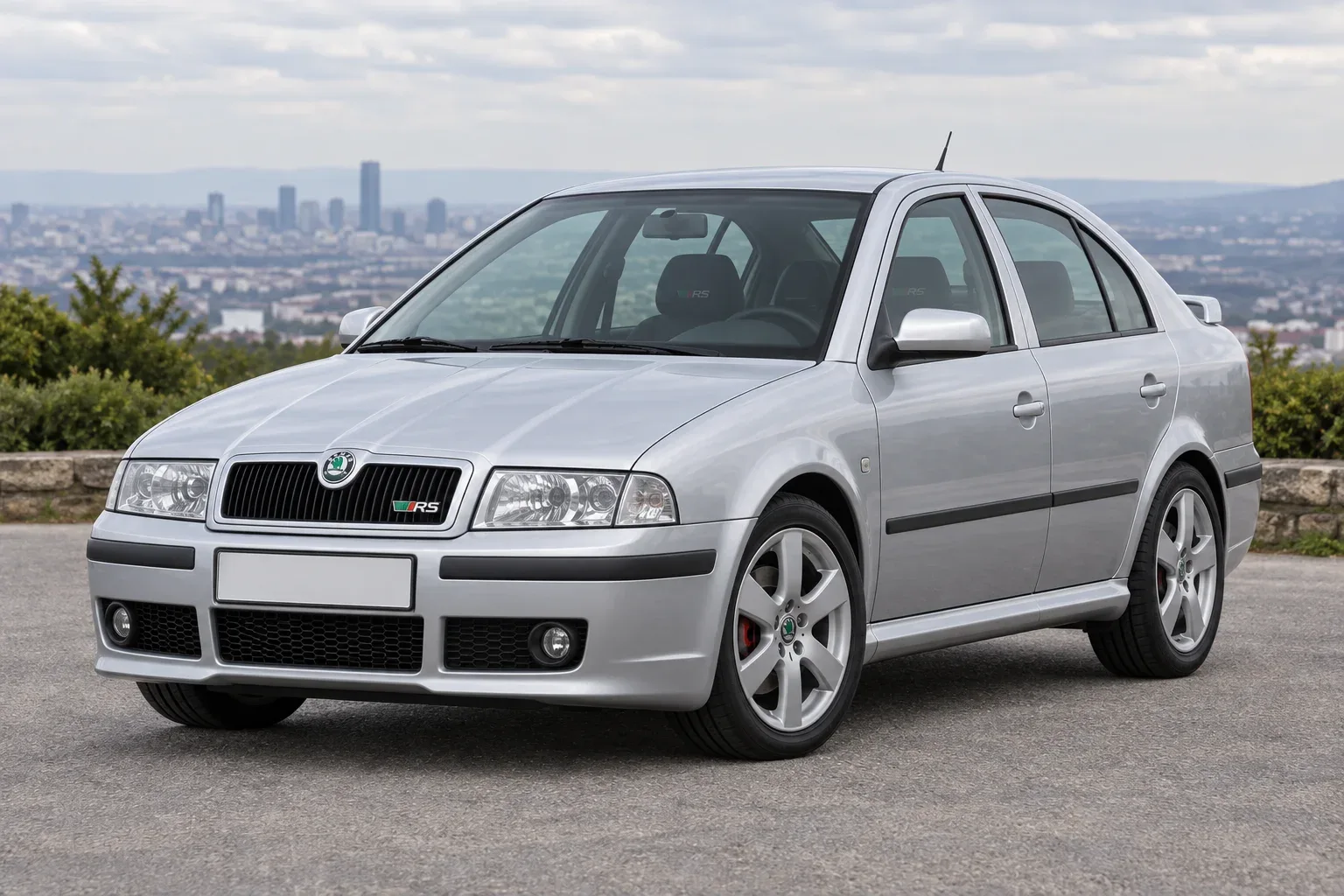
Škoda Octavia RS 1
Valuation of the Škoda Octavia RS 1 (2001–2006): condition, paperwork, inspection and terms of sale.
Indicative purchase price
Below market value
Final price agreed after inspection.
Value my car1Why buyers choose this model
The highly successful Octavia is not the first ŠKODA model to be developed under the supervision of the VW Group. This title belongs to Felicia. While Felicia was essentially a modified Favorit, Octavia was a brand new car.
2What buyers check
Review
The highly successful Octavia is not the first ŠKODA model to be developed under the supervision of the VW Group. This title belongs to Felicia. While Felicia was essentially a modified Favorit, Octavia was a brand new car. It is based, along with the Audi A3, formed the platform prepared for the fourth-generation Volkswagen Golf.
When the sports version of the RS (Rallye Sport) debuted, the Octavia was in production for four years (since 1996). This happened as part of the modernization of the model. The sports version was distinguished primarily by the front bumper, spoiler on the trunk lid and the tip of the exhaust pipe made of stainless steel.
Standard were 16-inch wheels with tires 205/55 R16. For an additional fee, 17-inch wheels with 205/50 rubber were installed. Initially, the RS existed only in the hatchback body. A practical wagon appeared two years later – again as part of the next modernization.
There's a lot more difference in the cabin. The front sports seats are covered with leather combined with a bright fabric. The upholstery is easily dirty and has an average resistance to wear.
It is worth noting that the anatomical seats are very comfortable and thinner than usual. This allows the RS to offer more space for the rear passengers’ knees. The differences can be seen on the instrument panel and the central panel.
Fighting overhangs
With a body length of 4513 mm, the wheelbase is only 2508 mm, which indicates the presence of large overhangs. A long car on a short base is generally not suitable for dynamic driving. In particular, the long rear overhang acts as a lever. And on the rear axle installed a simple beam, which is also not suitable for rapid maneuvering.
In the first generation, Octavia offered multi-element kinematics (three levers per wheel) only in combination with all-wheel drive. RS never got it.
Suspension with a rigid beam has limited opportunities to maintain maximum grip of the wheels with the road. The problem can be partially solved by using very rigid shock absorbers, which in turn require appropriate body rigidity. The engineers did. Used tight shock absorbers and a couple of additional amplifiers, located under the slope in the trunk between the floor and the arches of the rear wheels. The stiffness of the body increased, but the practicality suffered a little. This became clear when it became necessary to transport bulky objects. Additional stiffness ribs interfered with placement.
As mentioned above, two years after the release of the RS, a version with a wagon body appeared, which cost more. Today, such instances are a rarity, as a total of 3,663 wagons from 17,637 RS were produced. Unlike the hatchback, the station wagon had no additional stiffness ribs, and only 16-diameter wheels were put.
Walking
In order to improve the handling characteristics, the sports versions receive an upgraded suspension. The improvements can be both partial and global. The Renault Megane RC is an example of the latter.
In the case of the first-generation Octavia RS, the manufacturer made only minor adjustments. This means that the lower transverse lever is the same as on the civilian version. The biggest change lies in the attachment of the transverse stability stabilizer. In a normal Octavia, it's attached directly to the levers. This is most appropriate in terms of reliability, but there are limitations in terms of effectiveness. In the RS version, as in the all-wheel drive station wagon, the manufacturer used a more efficient solution - a stabilizer attached directly to shock absorbers using rods, which are popularly called pits.
Overall, the running RS is stiffer than that of a regular Octavia. And the ground clearance is 15 mm less.
The civilian version has never been a master of rapid change of direction, not particularly outstanding abilities and the rally version. However, the RS steering is pleasant and seems more accurate than the civilian version.
The conventional Octavia had not very effective brakes. This does not apply to the RS, since the front brake discs have a diameter of 312 mm (in the ordinary 1.8 Turbo, 288 mm discs are used), and ventilated discs are installed at the rear. The brakes are excellent even by modern standards.
Engine
The 1.8-litre, turbocharged, 20-valve four-cylinder engine is still the showcase of Audi that was behind this magnificent engine. In the first half of the 90s, the five-valve-per-cylinder scheme was considered a very modern solution. In 1994, the engine with such a number of valves was the first to introduce Ferrari in the face of an eight-cylinder engine for the F355 model. The VW Group followed suit two years later. In addition to the atmospheric engine, the Germans offered a turbocharged option. The standard version of the turbo engine produced 150 hp, but Octavia RS installed a more powerful version of the AUQ with 180 hp. Both versions have the same compression ratio of 9.5:1, but different boost pressure, which is naturally higher in the 180 hp variant. Therefore, for the most powerful engine, it is recommended to use fuel with an octane number of 98, while the 150-horsepower is enough to use 95-th. Another difference is the electronic gas pedal. 150-horsepower engine, regardless of marking and emission standard, used mechanical control of the throttle. So what is the advantage of the “five-valve” scheme? Increased engine power. It depends not only on the working volume, but also on the speed of updating the mixture in the cylinders. The more valves, the more mixture gets into the combustion chamber over the same period of time. Three intake valves will always have more cross-sectional area of the mixture flow than two valves. Today, the use of five valves per cylinder in direct fuel injection engines is not possible, as space is required to accommodate the fuel injector.
Prices are rising
The first RS was produced until 2005. The same year, the second-generation Octavia was offered, but so far without a PC version. Even the youngest specimens are now over 14 years old. The days when the car was on the price floor are long gone.
There are two groups of sports models on the market. The first is represented by modified copies, which are often far from the original. Many owners thought they had to improve their car. But such samples today are unlikely to have any value. Especially when a number of them have a hard life and hundreds of thousands of kilometers behind them. In such conditions, even the most durable technique cannot stand.
The second group is good cars in their original condition and with a small mileage. It's a real tasty piece. The problem is that they are few, and as soon as they are put up for sale, they immediately disappear, despite the rather high cost. And the year of release usually doesn't matter.
There should be no problems with spare parts. Skoda has been supplying a full range of spare parts for at least 15 years after the model was discontinued. Given that the Octavia Tour was in production until 2010, many original spare parts will still be available for some time.
Skoda Octavia RS WRC Edition
In 2001, Skoda Auto celebrated its 100th anniversary in motorsport. The Octavia RS WRC Edition was released on this occasion. It can be identified by its white color with stickers and 17-inch white Spider wheels. Xenon headlights are standard equipment. On the central panel was installed a plate with a serial number. All the copies were only front-wheel drive. A total of 75 cars with left wheel and 25 with right wheel were produced.
Technical changes in this edition are in vain. All standard, including the 1.8 20V Turbo 180 hp.
Model history
1996 – presentation of the Octavia of the first generation
2000 – Restyled model in September. As part of the update, the RS version in the hatchback body with an engine of 1.8 20V Turbo 180 hp is presented.
2002 – autumn modernization in the face of the 2003 model year. Replace the small right mirror with the large one. The appearance of the RS version in the wagon body.
2004 – The second generation Octavia is introduced. Production of the first generation, the Octavia Tour, continues.
2005 – The second generation RS version was introduced.
3Pre-purchase checklist
Review
- The upholstery is easily dirty and has an average resistance to wear.
Fighting overhangs
- The problem can be partially solved by using very rigid shock absorbers, which in turn require appropriate body rigidity. The engineers did.
- This became clear when it became necessary to transport bulky objects.
Engine
- Therefore, for the most powerful engine, it is recommended to use fuel with an octane number of 98, while the 150-horsepower is enough to use 95-th.
- For large runs, you may need to replace the auxiliary short chain connecting the camshafts.
- Probably the most common fault is the failure of ignition coils.
- The problem is that the control electronics cannot recognize which cylinder is not working, and therefore shut off the fuel supply to it.
- In motors, the owners of which in the past neglected the rules of service, can occur wear thrust bearings crankshaft.
- There is an opinion that the problem contributes to its not too successful L-shaped shape.
Prices are rising
- The problem is that they are few, and as soon as they are put up for sale, they immediately disappear, despite the rather high cost. And the year of release usually doesn't matter.
- There should be no problems with spare parts.
Model history
- Replace the small right mirror with the large one. The appearance of the RS version in the wagon body.
4Challenges of selling privately
- Overview: Upholstery is easily dirty and has medium resistance to wear.
- Overhang control: The problem can be partially solved by using very rigid shock absorbers, which in turn require appropriate body rigidity. The engineers did.
- Driving: In order to improve the handling characteristics, the sports versions receive an upgraded suspension.
- Engine: For large mileages, it may be necessary to replace the auxiliary short circuit connecting the camshafts. 1.
- Prices go up: The problem is that there are few of them, and as soon as they are put up for sale, they immediately disappear, despite the rather high cost. And the year of release usually doesn't matter.
- Skoda Octavia RS WRC Edition: In 2001, Skoda Auto celebrated its 100th anniversary in motorsport.
- The story of the model: Replace the small right mirror with a large one. The appearance of the RS version in the wagon body.
Shows, bargaining and re-registration take time: buyers look, promise to think and disappear. Fair price after inspection closes the auction on the spot. If money is needed urgently, the purchase takes away waiting and repeat displays.
5How selling to us works
Leave a request with the car data. We will discuss the preliminary assessment and inspection. After checking the status and documents, we agree on the final price and terms of the transaction.