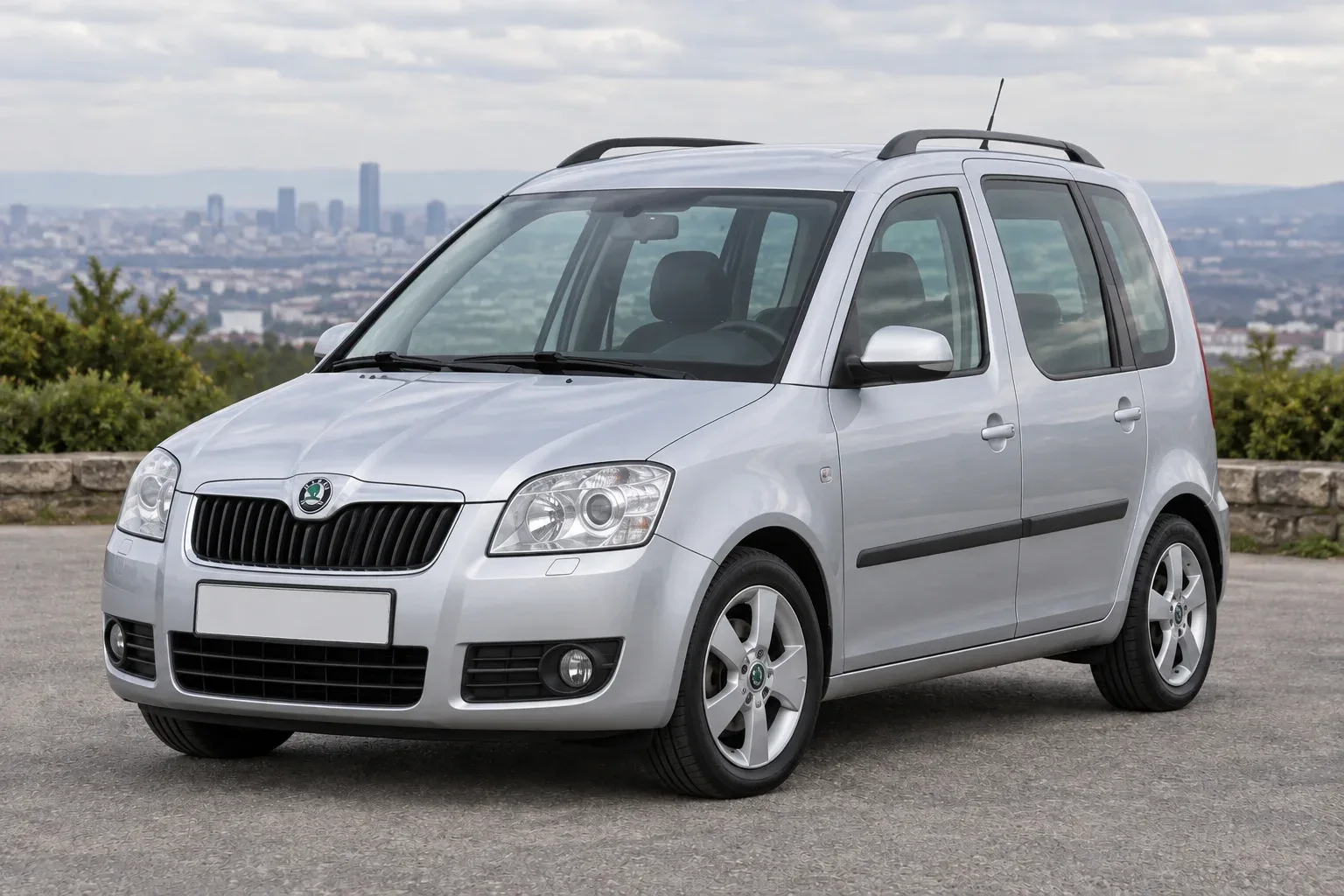
Škoda Roomster
Valuation of the Škoda Roomster (2006–2015): condition, paperwork, inspection and terms of sale.
Indicative purchase price
Below market value
Final price agreed after inspection.
Value my car1Why buyers choose this model
When Skoda became part of the German concern Volkswagen AG, the Czech company began to expand its list of offers from year to year. In 1996, Škoda Octavia debuted, and in 2006, Roomster appeared in dealerships.
2What buyers check
Model history
When Skoda became part of the German concern Volkswagen AG, the Czech company began to expand its list of offers from year to year. In 1996, Škoda Octavia debuted, and in 2006, Roomster appeared in dealerships. Three years earlier, a concept car designed by Thomas Ingenlath and Peter Wood was presented at the Frankfurt exhibition. First, Rumster was going to Kvasiny, and then the production was moved to Vrchlabi. Both locations are in the Czech Republic. It is noteworthy that the prototype was 5 cm shorter than the production version, but had a wheelbase 9 cm longer. In addition, the conceptual sample was only one rear side door sliding type on the sidewalk, which in the "live" car was replaced by a pair of conventional. The Rumster was built on the PQ34 platform, the one that underlies the Audi A4, Skoda Octavia I, Audi TT and Volkswagen Golf IV. Most of the components are derived from the ŠKODA Fabia. In 2007, the Czechs launched a cargo version called Praktik. Three years after its debut, the Roomster was restyled. The headlights were slightly changed and the radiator grille was revised. The range was replenished with new colors of body color and several models of discs. But that's not all. In the line of engines appeared turbocharged gasoline engine with direct injection of fuel 1. 2 TSI, available with an optional DSG box. At the same time, two diesel units 1. 4 and 1. 9 TD PD with pump injectors disappeared in the list of engines. They were replaced by 1. 2 and 1. 6 TD CR with a modern Common Rail injection system. The crash tests according to the Euro NCAP Roomster methodology were defended by 4 stars.
Engines
Among gasoline engines, atmospheric volumes of 1.4 and 1.6 liters are considered the best. In the urban cycle, they consume 9-10 l / 100 km. Motors do not pose any serious problems during operation. Among the general - you can distinguish short-lived ignition coils. However, with these units, you do not have to count on good dynamics. Not the best choice – Roomster with an engine displacement of 1.2 liters in versions of HTP and TSI. 1. 2 HTP does not provide good dynamics. Acceleration to 100 km / h takes almost 16 seconds. This disadvantage is not compensated by low fuel consumption: in the city its value reaches 9 l / 100 km. In addition, there are frequent problems with ignition coils. Avoid examples with 1. 2 HTP, designated by the BME code and developing 64 hp. This option lasted only a year. He suffered from chronic overheating of the oil, which is caused by the catalyst being too close to the cylinder block. In the BGZ version, a heat shield is installed under the casing of the catalyst with a 69 hp recoil. This prevented excessive heat transfer. However, a number of other factors contribute to wear. For example, the lack of traction forces the engine to be turned often (oil consumption increases). In addition, high heat load contributes to the accumulation of sludge clogging hydraulic valve pushers. This leads to a gradual loss of pressure in the compression stroke. Unfavorable affects and unusually small oil supply - about 2.8 liters. If you want to choose a car with HTP, it is better, not older than 2010.
Design features
The Skoda Roomster has a classic modern layout: a transverse engine in the front of the car and a front axle drive. Unfortunately, even the pseudo-off-road version of the Scout does not have an all-wheel drive transmission.
The powertrains are combined with one of three gearboxes: a 5-speed manual transmission, a 6-band automatic transmission or a 7-speed automatic with dual clutch DSG.
The front suspension is based on Macpherson struts, and the back is an elastic beam. But with the front axle, it's not that simple.
Until March 16, 2008, the front suspension was completely identical to the first-generation Fabia. Its feature is the rear mounting of the lower transverse lever. It is a finger inserted into an aluminum bracket. Since March 17, 2008, the front suspension has been copying the 2nd generation Fabia design. Ie rear support received a pressed Silentblock with a vertical axis of symmetry.
Typical defects and malfunctions
Apart from certain unstable elements in the engines, the Czech minivan does not cause any other serious problems. But there are shortcomings. Fortunately, their elimination does not require large financial costs, but it irritates many owners. For example, weak door seals that allow water to enter the cabin. In winter, it is easy to damage the paintwork on the edges of the trunk lid on frozen snow or ice. Over the handles of the rear doors, swelling appears over time, and the black coating begins to peel. Fortunately, this is just an aesthetic problem. A delicate element is a simple overlay that can be repainted or replaced. Corrosion of the exhaust system is another common disadvantage. Hidden corrosion under the trunk door seal. Skoda claims that this was the result of mechanical damage before the seal was installed due to a violation of technology. Since May 2007, the technology has been modified. There are also problems with electricity. Shimmering displays, malfunctions in the central lock, rear parking sensors and electric windows. Often burn out bulbs of internal and external lighting. Skoda’s explanation is power surges in the network. The materials of the interior decoration are not distinguished by wear resistance. At first glance, they seem practical, but after a few tens of thousands of kilometers it turns out that this is not the case at all. Rubbed the coating of the steering wheel, door panels and seats, the upholstery of which is also poorly cleaned. Such shortcomings, although cosmetic in nature, but not worthy of cars of the Volkswagen concern.
Faults in detail
Damage to the pipe of the cooling system by the sharp edge of sound insulation of the plastic cover of the engine. The defect was corrected in January 2008.
German auto publication Auto Bild has tested the Skoda Roomster with 1.9 TDI PD. The state of the bearings of the camshaft in the photo is 100,000 km. The Škoda representatives claim that this is normal wear and tear. The engine worked without any extraneous noise.
The inner cavities are covered with a lush layer of wax. Rust doesn't stand the slightest chance.
3Pre-purchase checklist
Engines
- Motors do not pose any serious problems during operation.
- In addition, there are frequent problems with ignition coils.
- The copies of c 1 should be avoided.
- However, a number of other factors contribute to wear.
- This leads to a gradual loss of pressure in the compression stroke.
- 2 TSI not only does not give the car good dynamics, and also often requires serious repairs.
- Most problems are created by a defective tensioner of the HRM chain, which quickly surrenders, the chain slips, and the pistons with valves are damaged.
- However, there were episodes with the ingress of gasoline into the oil, loss of compression and the knocking of valves.
Typical defects and malfunctions
- Apart from certain unstable elements in the engines, the Czech minivan does not cause any other serious problems. But there are shortcomings.
- Fortunately, this is just an aesthetic problem.
- Corrosion of the exhaust system is another common disadvantage.
- Hidden corrosion under the trunk door seal.
- There are also problems with electricity.
- The materials of the interior decoration are not distinguished by wear resistance.
- There are frequent problems with DSG DQ200, the elimination of which requires serious monetary investment.
- This is, first of all, the wear of the clutch and the failure of the mechatronics.
Faults in detail
- The Škoda representatives claim that this is normal wear and tear.
- The inner cavities are covered with a lush layer of wax. Rust doesn't stand the slightest chance.
4Challenges of selling privately
In favor of the Skoda Roomster, the following arguments can be made: low operating costs (subject to the choice of the optimal engine - 1.4), good availability of cheap spare parts, good ergonomics and a small number of serious malfunctions.
Deficiencies? Relatively rigid suspension, lack of dynamic engines, a large number of small defects, conservative style and relatively high cost.
- When Skoda became part of the German concern Volkswagen AG, the Czech company began to expand the list of its offers from year to year.
- Engines: Motors do not pose any serious problems during operation.
- Design features: Skoda Roomster has a classic modern layout: a transverse engine in the front of the car and drive to the front axle.
- Typical defects and malfunctions: Apart from certain unstable elements in the engines, the Czech minivan does not cause other serious problems. But there are shortcomings.
- Faults in details: Representatives for Škoda claim it is normal wear and tear.
Shows, bargaining and re-registration take time: buyers look, promise to think and disappear. Fair price after inspection closes the auction on the spot. If money is needed urgently, the purchase takes away waiting and repeat displays.
5How selling to us works
Leave a request with the car data. We will discuss the preliminary assessment and inspection. After checking the status and documents, we agree on the final price and terms of the transaction.