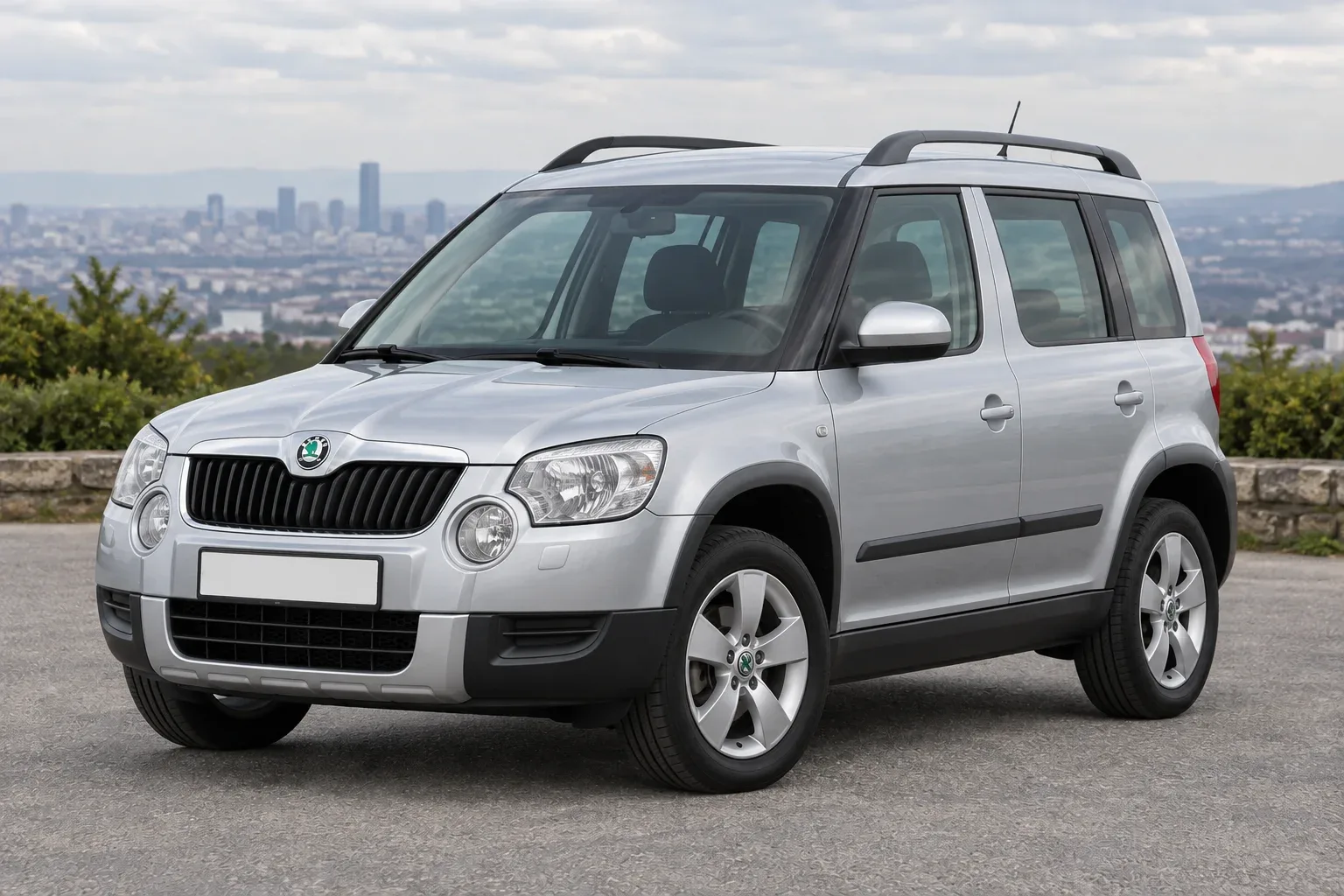
Škoda Yeti 2.0 TDI
Valuation of the Škoda Yeti 2.0 TDI (2009–2013): condition, paperwork, inspection and terms of sale.
Indicative purchase price
Below market value
Final price agreed after inspection.
Value my car1Why buyers choose this model
The Skoda Yeti is very popular in countries such as the Czech Republic and Latvia. In the market of the latter, it loses the first two positions of the Nissan Qashqai and the new VW Passat. However, it is a specific market, as car sales there are estimated in the hundreds, not the thousands. In the Czech Republic, the crossover occupies the fifth line of the sales rating, but this market has its own characteristics. The top five are headed by Skoda cars. Interestingly, in many tests, Škoda Yeti wins or is at the forefront, but still not too popular. In Western Europe, it is not even in the top 50 sales. Let's try to figure out what this is about. If you compare the cost of the Yeti diesel with competitors (in Europe), it turns out that it is cheaper than the diesel Nissan Qashqai and Kia Sorento. So it's not about the price. So maybe it's the appearance that's to blame? You can’t call a beautiful car. Many European women like it, though.
2What buyers check
Forms and contents
The Yeti Škoda, though small, has many advantages. Among compact crossovers, it is one of the most daring on the "off-road". The van-shaped body hides a very functional cabin with a large trunk of 416 liters and three separate self-adjustable seats for second-row passengers. Thanks to the VarioFlex system, after removing the middle seat, you can move the two outer seats to the center and get a comfortable four-seater car. In addition, if necessary, you can get a large trunk, comparable to that in a large station wagon. Like all ŠKODA cars, the Yeti follows the rule: functionality and practicality are above form.
The front panel does not stand out from other cars of the Czech manufacturer and Volkswagen. The landing in the car is relatively low, but against the background of a high body, it seems that we have a combine like the Skoda Rapid, and not an elegant crossover. Perhaps this is the reason for the low popularity of this car?
Design features
The Skoda Yeti is based on the Skoda Octavia 4x4 chassis: an independent rear axle suspension with four transverse levers per wheel and all-wheel drive. For the transfer of traction to the rear axle is responsible Haldex clutch, which works quite efficiently. Due to good geometric terrain and high ground clearance, it is difficult to damage the chassis and bumper. On the road, the SUV behaves like a typical passenger car, providing good comfort and safe handling.
The Czech SUV debuted in 2009, so ESP and airbags were standard equipment, and more advanced trim levels include a multimedia system and climate control. In 2013, a restyling was carried out, which slightly changed the appearance and interior. Engines and transmission were also modified.
Engines
The Yeti ŠKODA is a car based on technical solutions of other VAG models, including powertrains. Before restyling, Yeti was offered only with engines equipped with turbocharging. TSI petrol: 1.2, 1.4 and 1.8 liters working volume, developing power in the range from 105 to 160 hp. Diesel TDI: working volume of 1.6 and 2.0 liters. The smaller had in stock 105 hp, and 2-liter – from 110 to 170 hp.
As for TSI engines, they are not particularly durable, and are less reliable than diesel counterparts. The 1.6 TDI is not recommended, as it is not combined with all-wheel drive. Thus, it can be assumed that the most attractive version is the 2.0 TDI version combined with an all-wheel drive system. This is the car we will discuss in more detail. Unfortunately, officially diesel versions are not yet supplied to Russia. However, in the secondary market representatives of this type are present.
Typical problems and malfunctions
The Skoda Yeti is relatively young, but some of the units in Europe already have a mileage of 200-300 thousand km, so we can draw some conclusions. All diesel units are equipped with a Common Rail injection system. It is worth noting that nozzles do not create mass problems - the fuel injection system is really the best in the class. However, the system uses piezoelectric nozzles, which are expensive and not subject to repair. Therefore, it is better not to save on the “solar” As a rule, does not cause owners to worry and a sufficiently durable turbocharger of variable geometry. As for the fuel system, Skoda recalled some of the cars with a 2.0 TDI engine to replace defective high-pressure highways. They could have collapsed and let it leak. All diesel engines are equipped with a particulate filter, which does not cause serious problems. But if it fails, you will have to pay about $2,000 for the new one. This can be done by installing a cheaper substitute. However, trouble can bring the valve of the EGR system. Cleaning doesn’t always help – sometimes you have to change. Periodic maintenance requires a temporary type of valve timing drive. The recommended replacement interval is 150,000 km. However, common sense suggests that it is better to reduce it to 100-120 thousand km. It is recommended to replace oil every 15,000 km, but it is more reasonable to do it more often - every 8-10 thousand km. It is worth recalling that the 2.0 TDI, like any other modern turbodiesel, does not like regular operation over short distances, frequent starts and stops.
Operating costs
Theoretically, the cost of maintaining the ŠKODA Yeti should be quite high: independent suspension, wheel hubs with non-removable bearings, four disc brakes, an all-wheel drive system, and finally, a diesel engine with a DPF filter. However, as practice shows, the all-wheel drive system is quite reliable, and the maintenance cost is not higher than that of the Skoda Octavia. The availability of spare parts is good and the market is well stocked with substitutes. The mechanics specializing in the VAG group may not have met the Yeti as often as the Golf, Passat and Octavia, but they are all fundamentally no different from each other.
Approximate cost of spare parts
The 2.0 TDI is a very economical and quite dynamic engine. On average, a car consumes about 6-8 liters of diesel fuel, so the cost of daily operation will not be high. Tires are not too burdensome either, even in top-end versions with low-profile 17-inch wheels. The most common tires are the size of 205/55 R16 and 215/60 R16. Good summer wheels will cost about $90-100 apiece, and winter wheels will cost $100-120 apiece.
3Pre-purchase checklist
Forms and contents
- In addition, if necessary, you can get a large trunk, comparable to that in a large station wagon.
Engines
- As for TSI engines, they are not particularly durable, and are less reliable than diesel counterparts. Nor is 1 recommended.
Typical problems and malfunctions
- It is worth noting that nozzles do not create mass problems - the fuel injection system is really the best in the class.
- However, the system uses piezoelectric nozzles, which are expensive and not subject to repair.
- 0 TDI for replacement of defective high-pressure lines. They could have collapsed and let it leak.
- All diesel engines are equipped with a particulate filter, which does not cause serious problems.
- The recommended replacement interval is 150,000 km.
- It is recommended to replace oil every 15,000 km, but it is more reasonable to do it more often - every 8-10 thousand km.
- This is usually where the faults appear.
- If you have DSG, you must be ready for expensive service after about 200,000 km or even earlier, if you do not regularly change the oil - every 60-80 thousand km.
4Challenges of selling privately
Of course you should. It is one of the best crossovers on the market in its class, which perfectly combines functionality and off-road capabilities. The car offers everything you would expect from a crossover, except for one thing – a beautiful appearance. The SUV is worth recommendations under two conditions: the presence of a 2.0 TDI turbo diesel and an all-wheel drive system. An additional “off-road package” is also welcome. If you are going to operate a car every day in the city, it is better to find another option - a more beautiful, cheaper, which may be even better.
- Forms and content: The Yeti Škoda, though small, has many advantages.
- Design features: Skoda Yeti is based on the chassis of the Skoda Octavia 4x4: independent rear axle suspension with four transverse levers per wheel and all-wheel drive.
- Engines: ŠKODA Yeti is a car based on technical solutions of other VAG models, including power units.
- Typical problems and malfunctions: It is worth noting that injectors do not create mass problems – the fuel injection system is really the best in class.
- Operating costs: Theoretically, the cost of maintaining the ŠKODA Yeti should be quite high: independent suspension, wheel hubs with non-removable bearings, four disc brakes, an all-wheel drive system, and finally, a diesel engine with a DPF filter.
Shows, bargaining and re-registration take time: buyers look, promise to think and disappear. Fair price after inspection closes the auction on the spot. If money is needed urgently, the purchase takes away waiting and repeat displays.
5How selling to us works
Leave a request with the car data. We will discuss the preliminary assessment and inspection. After checking the status and documents, we agree on the final price and terms of the transaction.