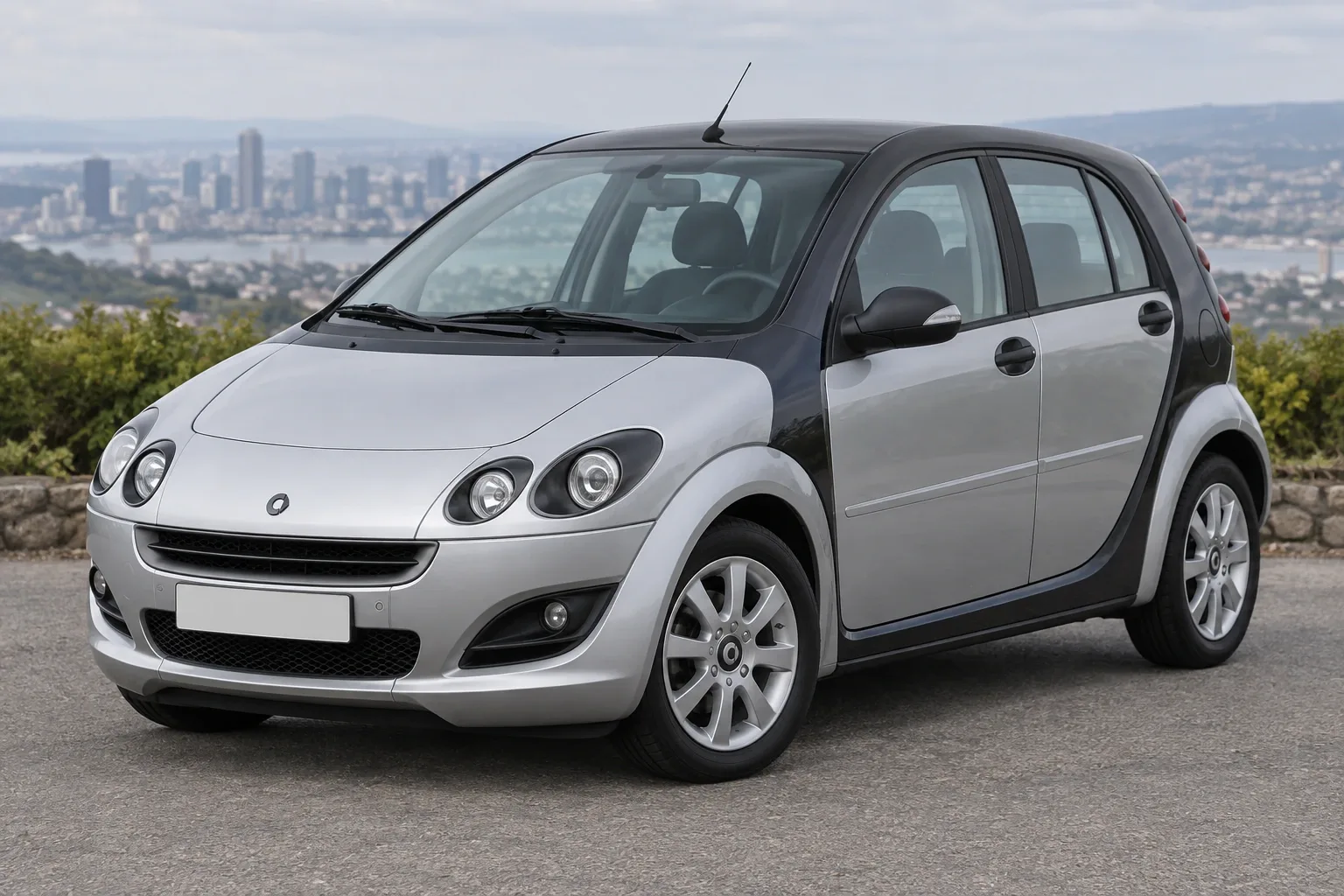
Smart ForFour 1 / W454
Smart ForFour 1/W454 (2004–2006): condition, documents, inspection and terms of sale of the car.
Indicative purchase price
Below market value
Final price agreed after inspection.
Value my car1Why buyers choose this model
Smart brand appeared on the market in 1998, offering a two-seater machine ForTwo. In 2004, the range was replenished by a larger 4-seater ForFour car. Despite the features and questionable practicality, the original Smart ForTwo was a significant sales success. This is especially true in Italy, Rome and Milan. Fortu was expensive because it used expensive technology. To make such a small car with a very short front end meet the strict requirements of passive safety, the manufacturer had to apply an unusual concept with a spatial rigid Tridion frame. The power unit was placed in the back. The small city car showed good results in crash tests.
2What buyers check
It wasn't cheap.
Smart’s efforts to expand the practicality of the model range led to the creation of a larger car, the name of which directly indicates the number of seats in the cabin – “for four”. Despite its undeniable quality and obvious practicality advantages, Smart ForFour has not been able to replicate the success of ForTwo. The car was only produced for two years, which, you will agree, is very small. Over the past three decades, perhaps only the European Ford Cougar has had the same short lifespan on the assembly line.
A lot of effort was made to support sales. For example, Smart ForFour was taken over by the city police of major European cities. But it didn't. One of the reasons for low demand is high cost. The base ForFour was 15% more expensive than the B-segment competitors. This is too much for buyers in the price range. For the purchase of a 4-seater Smart rational reasons were not enough.
Forget about Tridion.
Technically and conceptually, ForFour was different from the smaller brother in everything. Instead of the Tridion frame, a standard self-supporting steel body frame was used. The engine is located transversely in front of the front wheels. It was combined with a 5-speed manual transmission, which was not offered in Fortu. The drive is front.
To simplify the development and production process, Smart has joined forces with Mitsubishi. The result is a common parallel with the Mitsubishi Colt Z30. Both models were even assembled at the same plant - at the Dutch NedCar, where the Mitsubishi Carisma and the first Volvo S40 were previously produced. "ForFour" connects with the Colt not only the general architecture of the body, but also the suspension, gearbox and engines. However, if you put two cars next to each other, you will hardly suspect the similarity. Smart is low, Colt is high.
The Smart’s power frame is made of steel, but the hood, front and rear wings, and all side doors are made of plastic. Inside, they have an aluminum frame with stiff ribs. The plastic hood is too small, which complicates the work in the engine compartment.
Engines
If you decide to buy ForFour, it is better to look at the gasoline engines. They are not Mitsubishi, as some think, but MMC Power, a joint venture between MMC (Smart) and Mercedes-Benz. However, the reliability and performance are not inferior to Mitsubishi Motors products. The base is a three-cylinder gasoline atmospheric tank with a volume of 1. 1 liter, equipped with a balancing shaft driven by a chain. It also combines both distribution shafts. The maximum power of 75 hp is achieved at 6000 rpm, and the peak torque of 100 Nm - at 4000 rpm. Note that in some markets, engine performance has been reduced to 64 hp. The three-cylinder engine is not bad luck, partly due to the low curb weight - less than 1000 kg. It is better to choose a four-cylinder engine. Even a smaller 1.3 liter volume literally energizes the car, and a larger 1.5 gives an almost sports drive. Both engines are obtained from 1. 1 by attaching another cylinder, the diameter of which in all three units is 75 mm. 1. 3 has a shortened stroke of the piston - from 84.8 mm to 75.4 mm. 1.5-liter has the same stroke as 1. 1 - 84.8 mm. Four-cylinder atmospherics use a reliable circuit and a system of changing the phases of the gas distribution on the intake shaft. The balance shaft is no longer there. Gasoline engines are reliable and durable. In a three-cylinder engine, only ignition coils can disturb - their own for each cylinder.
Diesel is best avoided
The 1.5 CDi OM 639 (68 or 95 hp) was a specific engine designed exclusively for the Smart ForFour and Mitsubishi Colt. You won't find him anywhere else. The biggest problem with turbodiesel is a crack in the head of the block. This usually happens after 100-150 thousand km. Cracks occur in the interiors of the cooling system chambers. They are not accessible, so it is impossible to make cracks. The tendency to crack is caused by several reasons. For example, there is no temperature indicator of the coolant. It was available as an option and sticking out of the center of the front panel. Another reason is the low power, especially the weakest modifications (68 hp). In order to travel normally, the manufacturer had to make extremely short gears. Paradoxically, the turbodiesel works better in pairs with a 6-speed automatic transmission. As a result, short gear mechanics forced to spin the diesel. And if the engine warms up - you do not know, because there is no temperature indicator. Thus, the engine, being still cold (after a long parking), experiences heavy loads. It is unlikely that typical owners of this car, especially women, at least a little think about it and start moving in a gentle mode, or heat the engine longer. The disadvantage in the future leads to another defect - premature wear of piston rings. Getting a set of pistons with rings is quite difficult, sometimes the engine is easier to replace. For completeness of the picture, it should be added that the 1.5 CDi turbodiesel has nothing to do with 0.
Service advice
All engines have a timing system drive circuit. In gasoline engines, with the exception of 1.5 Turbo, mechanical adjustment of the valve gap is used. The clearance is monitored over 100,000 km. The diesel engine and the rare 1.5 Turbo are equipped with hydraulic compensators. The oil in the units must comply with the standard Mercedes-Benz MB 229.1 and above.
Transmission
The three-cylinder engine as standard was combined with the manual transmission F5MGA from Getrag. For an additional fee, more powerful versions were combined with the 6-speed automated transmission F6SGA. It was designed specifically for this car and has nothing to do with the 6-speed box in ForTwo. There were actually only 3 gears, and the other three gears provided an additional gearbox.
The F6SGA is slow and not smooth enough. The change in gears is responsible for the electric motor, which is connected to the mechanism of a pair of actuators. One of them is responsible for the inclusion of 1 and 2 transmissions, as well as 5 and 4th. Second for 3 and 4, plus the back. There is also another electric motor that provides control of the clutch.
F6SGA should be avoided. Sometimes the thrust between the electric motor of the clutch and the lever of its control is destroyed, and the thrust is part of the electric motor. If that happens, the car will be squashed.
Walking
The ForFour running doesn’t give many reasons to complain. In addition, it is identical to Colt: in front - McPherson, and behind - a torsion beam. The parts of the suspension are easily accessible, and the choice is wide. The original details provide for the replacement of the ball and Silentblocks along with the lever. However, in the market, these elements can be purchased separately.
The front wheels' hub bearings in the original are assembled with a fist and brake disc shield costing 29,000 rubles. However, as in the case of levers, you can purchase third-party components and replace the worn element separately. For example, the hub of the wheel in the collection will cost 4-6 thousand rubles. Rear stage bearings change in the collection with the hub - from 8 000 rubles for the original and from 2,500 rubles for the analogue.
The transverse stability stabilizer is used only on the front axle. There were two types of stabilizer. In more powerful versions, it relied on long and thin thrusts, and in the basic versions – on short ones.
In rare cases, the power steering fails - the electric motor fails. The defect is unpleasant.
Typical problems and malfunctions
Corrosion protection is above average, so these cars look better than many of the younger models of some brands. The biggest problem of ForFour is body parts, or rather their availability. In the catalogs of famous suppliers of spare parts almost nothing. The only thing you can find is exterior mirrors at a price of 12,000 rubles.
The same is the case with the headlights, and it is a very popular product. Designer optics poorly illuminated the road on the new car. And today ForFour is almost blind at night, because the reflector windows almost everyone turn yellow. In addition, headlights use the not-common combination of H7/H7 light bulbs, which are known to have a limited lifespan and high cost.
Smart is just full of electronics. However, you should not be afraid of this, since failures in its work are a unique phenomenon. And the rare use of a rear windshield wiper leads to acidification of the mechanism.
Model history
2004 – ForFour production begins under the code name W454. Engines: gasoline - 3-cylinder 1.1 12V, 4-cylinder 1.3 16V and 1.5 16V; diesel - 3-cylinder 1.5 CDi.
2005 – Replenishment of a rare version of 1.5 Turbo from Brabus with a capacity of 177 hp. It’s not a 1.5 with a screwed turbine, but a Mitsubishi 4G15, known for the Colt CZT (Ralliart), where it was tuned to 150 hp.
2014 – The next generation of the ForFour, technically based on the third generation of the Renault Twingo. The engine was placed behind, and production was established in Slovenia.
3Pre-purchase checklist
Engines
- Note that in some markets, engine performance has been reduced to 64 hp.
- If the coil fails, the control unit puts the engine into emergency mode, which continues to work on the remaining two cylinders.
Diesel is best avoided
- The biggest problem with turbodiesel is a crack in the head of the block.
- Cracks occur in the interiors of the cooling system chambers.
- They are not accessible, so it is impossible to make cracks.
- The disadvantage in the future leads to another defect - premature wear of piston rings.
- For completeness of the picture, it should be added that the 1.5 CDi turbodiesel has nothing to do with 0.
Transmission
- F6SGA should be avoided.
- Sometimes the thrust between the electric motor of the clutch and the lever of its control is destroyed, and the thrust is part of the electric motor.
Walking
- In rare cases, the power steering fails - the electric motor fails. The defect is unpleasant.
Typical problems and malfunctions
- Corrosion protection is above average, so these cars look better than many of the younger models of some brands.
- The biggest problem of ForFour is body parts, or rather their availability.
4Challenges of selling privately
- It was not cheap: Smart’s efforts to expand the practicality of the model range led to the creation of a larger car, the name of which directly indicates the number of seats in the cabin – “for four”.
- Forget Tridion: Technically and conceptually, ForFour was different from the smaller sibling in everything.
- Engines: If the coil fails, the control unit puts the engine into emergency mode, which continues to run on the remaining two cylinders.
- Diesel is best avoided: The biggest problem with turbodiesel is a crack in the block head.
- Maintenance tips: All engines have a timing system drive circuit. In gasoline engines, except for 1.
- Transmission: Sometimes the thrust between the electric motor of the clutch and the lever of its control is destroyed, with the thrust being part of the electric motor.
- Driving: In rare cases, the power steering fails - the electric motor fails. The defect is unpleasant.
- Typical problems and malfunctions: The corrosion protection is above average, so these cars look better than many younger models of some brands.
Shows, bargaining and re-registration take time: buyers look, promise to think and disappear. Fair price after inspection closes the auction on the spot. If money is needed urgently, the purchase takes away waiting and repeat displays.
5How selling to us works
Leave a request with the car data. We will discuss the preliminary assessment and inspection. After checking the status and documents, we agree on the final price and terms of the transaction.