
Toyota Auris E150
Valuation of the Toyota Auris E150 (2007–2012): condition, paperwork, inspection and terms of sale.
Indicative purchase price
Below market value
Final price agreed after inspection.
Value my car1Why buyers choose this model
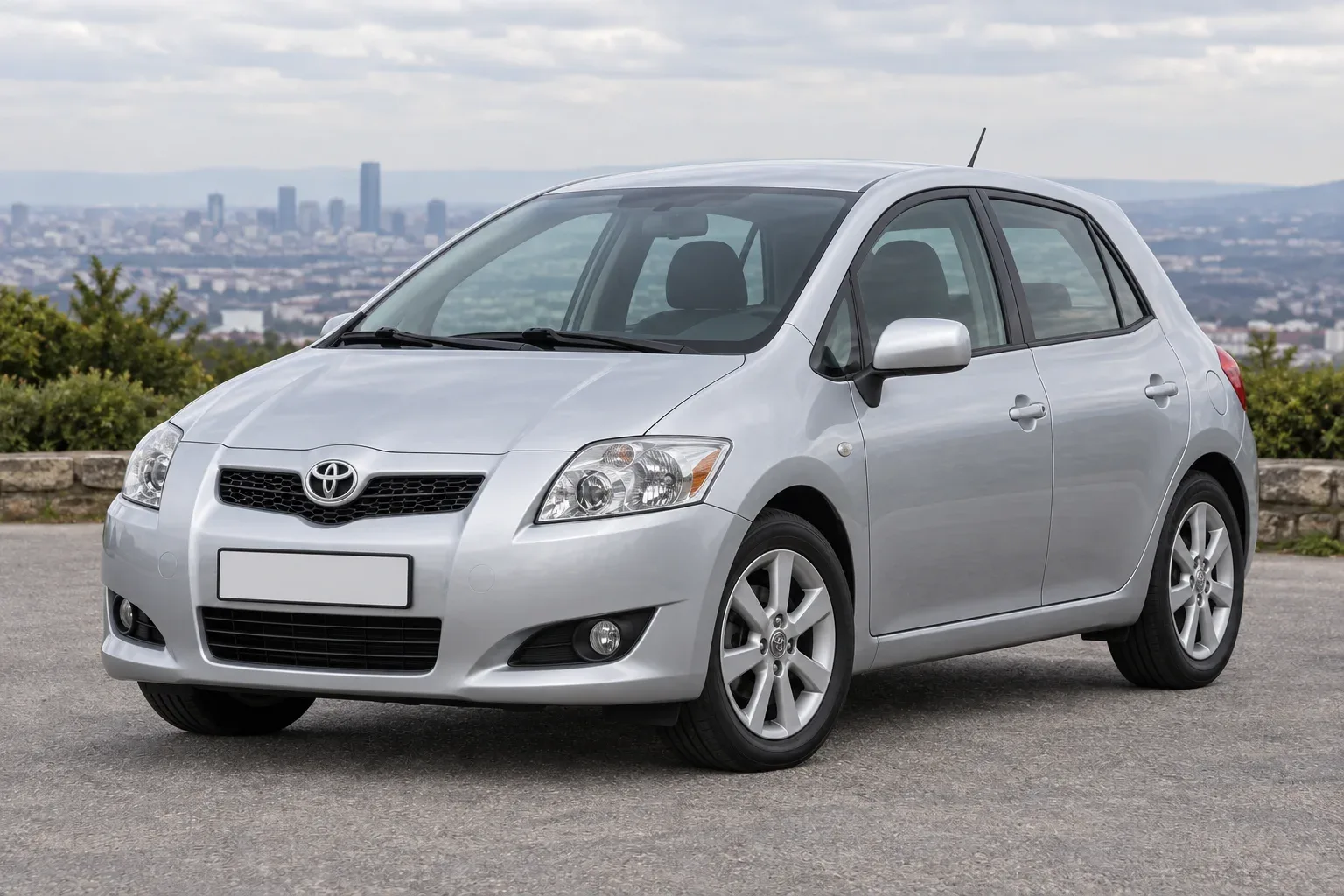
Toyota Auris first generation debuted in 2007, and three years later experienced a small restyling. It is based on the technical base of the tenth generation Toyota Corolla. In some markets, the hatchback completely replaced the Corolla. The car was assembled in England. In many countries, the Corolla sold well, as it was considered a benchmark of reliability. But in developed markets like Germany and France, this argument was losing out to the entrenched image: Corolla is a car for retirees. To break with him, the Japanese came up with a revolutionary idea. After 41 years of existence of the model, they decided to change the name of the bestseller in the hatchback versions to Auris (from the Latin aurum - gold). However, this step was resorted to, first of all, in Europe, as many customers from other countries were not ready to accept the car under a different name. Unfortunately, the idea, except for confusion with the names, did not lead to anything. The failure was also facilitated by a too conservative appearance, which lacked emotions. In the basic version, you can count on 4 airbags, ABS, air conditioning, electric drive of glasses and mirrors, radio with MP3. In the richest - 9 airbags, climate control, ESP and xenon headlights. In the European crash tests conducted in 2006, the car earned 5 stars.
2What buyers check
Engines
The engine set in cars from Japan is usually not too large. And although Toyota Auris does not have a list of engines comparable, for example, with Golf or Focus, but certainly offers a quite good choice. It is not enough to have a more powerful gasoline engine.
This unit can be obtained only in right-hand drive Toyota Blade - a special version of the Toyota Auris. Under its hood, in addition to the 2.4-liter engine, can hide and gasoline V6 volume of 3.5 l / 280 hp. However, the chance to find the top version of Blade in our country is almost zero.
Diesel engines
If you like to “suppress” the gas pedal to the floor, then, of course, you should pay attention to the 177-horsepower turbodiesel with a volume of 2.2 liters. It is quite economical and has a decent dynamics. Acceleration from zero to 100 km / h takes 8.1 seconds. However, turbodiesels of 2.0 and 2.2 liters often make it difficult to fight the breakdown of the gasket under the head of the block. In addition, there is often a problem of increased oil appetite. The aluminum design of the unit and head means that the only effective way to eliminate these defects is to replace the engine! That's what the manufacturer says. The cost of the contract engine is about 40 000 rubles. However, some services are ready to take up repairs - in the region of 20 000 rubles. The cause of the malfunction is a slight subsidence of cylinder casings. In the beginning, Toyota tried to prevent the breakdown by reducing the maximum power. However, this step has proved ineffective. The risk of the problem increases after 100-200 thousand km of mileage. In addition to this defect, in diesel versions with large mileage, the turbocharger, the nozzles of the Common Rail system and the two-mass flywheel fail. Both diesel engines use expensive and unrepairable DENSO nozzles. Minimum problems are created by the weakest diesel 1.4 D-4D with the index 1ND-TV. It has a sufficient thrust reserve and consumes a small amount of fuel. High reliability was achieved due to a simple design. For example, the engine is devoid of a two-mass flywheel, which in most diesel engines requires replacement after 150,000 km.
Petrol engines
Special places in the reliability list are occupied by gasoline units 1. 4 VVT-i and 1. 6 VVT-i. They have a very strong chain of valve timing and do not require unforeseen visits to the service. In 2009, the 1.6 VVT-i was replaced by the more powerful 1.6 Valvematic, which has better elasticity and lower fuel consumption. In the same year, the 1. 4 VVT-i was replaced by 1.33 Dual VVT-i with a capacity of 100 hp. The NR series engine was developed in conjunction with Daihatsu. Unfortunately, contrary to expectations, the new engine became voracious. And with large runs, an increase in oil consumption is possible due to the wear of piston rings. Hybrid version 1.8 HSD is a real exotic. However, the hybrid is also quite reliable. 4-cylinder engines of the ZR series (1. 6 and 1. 8) were spared the problem of the predecessors of the ZZ family - excessive oil consumption. However, new engines sometimes had to add oil - 200-300 ml per 1000 km. Fortunately, this is not a sign of wear or a design defect. The oil consumption was facilitated by the extremely liquid oil SAE 0W-20. In 2008, Toyota tried to solve this problem. The relevant technical note only mentions reprogramming of the engine control unit. No other technical activities are indicated. In the process of operating the ZR engines, one had to face the noise of the phase rotator, which changes with the asterisk. In addition, the pump could leak or make noise (3-6 thousand rubles). Until 2009, the ZR series engines used a conventional throttle. The smaller, with a volume of 1.6 liters, developed 124 hp, and the larger 1.8 liters - 136 hp.
Transmission
Toyota Auris is exclusively front-wheel drive. In a pair of engines, a 5- or 6-speed manual gearbox or a variator was installed. In addition, a MultiMode robotic transmission with electronically controlled clutch was used. There are cases of premature wear of the bearing of the primary shaft of the 6-speed manual transmission. The fault is detected after the engine starts. There is a noise that disappears after pressing the clutch pedal. This usually occurs after 200-250 thousand km. For repairs in the service will ask about 20-30 thousand rubles. Among the minor drawbacks, we can note periodic difficulties with gear shifting, especially from the 4th to the 5th. This is usually caused by progressive corrosion of traction between the lever and the gearbox. The gear selection system after 100,000 km is the main culprit behind the switching problems. Clutch manual transmission usually reaches 200-250 thousand km. The new set is available for 10-15 thousand rubles. MultiMode Automated Transmission (MMT) should be avoided. Often prematurely wears out its clutch (9-14 thousand rubles). The procedure of replacement is quite complicated and expensive (8-12 thousand rubles). After 150-200 thousand km, the clutch compression actuator may fail. He is often resuscitated. Otherwise, you will have to buy a new one (over 50 000 rubles for the original or about 30 000 rubles for an analogue). In the presence of complaints about the work of MMT, official services changed the electronic control unit of the box to a modernized one. Many owners are unhappy with the reliability of the robot.
Walking
On the front axle, classic Macpherson struts work, and on the back - a twisting beam. The latter solution does not provide excellent obedience, but it is more reliable and cheaper to repair. In the top version with 2. 2 D-CAT, a multi-link scheme functions at the back. There were 4 levers for each wheel. The suspension deserves special praise. Many original elements can travel over 150,000 km. Even the racks and sleeves of the stabilizer serve long enough. The endurance of the suspension can result in complications when replacing the front levers. The bolt sours, and it's rolled in the subframe. The subframe will have to be changed or cut, and then brewed. There are known episodes with faulty electromechanical power steering. The system has its own control unit, in which the power steering fails. During the warranty service, the amplifier was changed in the assembly with the steering wheel at the expense of the manufacturer. Today, this method will be too expensive. In a specialized service, they are ready to take on a cheaper replacement of a directly broken relay. And after 150-200 thousand km can knock the steering rack. For bulkheads will ask from 8 to 13 thousand rubles. The original rake costs about 65 000 rubles, and the analogue is available for 17 000 rubles. The shape of the center console is controversial. It turned out too wide, making it difficult to place the legs of tall people. The high-positioned gearbox lever is comfortable, but the plastic around it is easily scratched. The front bearings have to be updated after 150-200 thousand km.
Typical problems and malfunctions
Although Toyota Auris can not boast of the impeccability of the Corolla, but the Japanese hatchback is a fairly reliable car. However, owners often complain about the poor quality of the paintwork, susceptible to scratches.
The body is not prone to corrosion, but surface rust appears on the elements of the exhaust system and chassis parts. And for 10-13 years can rot to holes pipe filler neck (from 7000 rubles for an analogue).
In the inner cavities, traces of rust are sometimes found.
After 150-200 thousand km of attention may require a generator (1-7 thousand rubles for repair) or overtaking clutch (2-5 thousand rubles).
The cup holders are located under the vents and often wed.
The interior is full of rigid plastic, significantly inferior in quality to German and French competitors. Over time, scratches appear on it. Traces of wear also appear on the steering wheel. Often begin to corrosive guide seats.
Often, extraneous sounds are emitted by a heat screen.
3Pre-purchase checklist
Diesel engines
- If you like to “suppress” the gas pedal to the floor, then, of course, you should pay attention to the 177-horsepower turbodiesel with a volume of 2.2 liters.
- In addition, there is often a problem of increased oil appetite.
- The aluminum design of the unit and head means that the only effective way to eliminate these defects is to replace the engine! That's what the manufacturer says.
- However, some services are ready to take up repairs - in the region of 20 000 rubles.
- The cause of the malfunction is a slight subsidence of cylinder casings.
- The risk of the problem increases after 100-200 thousand km of mileage.
- Both diesel engines use expensive and unrepairable DENSO nozzles.
- Minimum problems are created by the weakest diesel 1.4 D-4D with the index 1ND-TV.
Petrol engines
- And with large runs, an increase in oil consumption is possible due to the wear of piston rings.
- 8) have been spared the problem of the ZZ family predecessors - excessive oil consumption.
- Fortunately, this is not a sign of wear or a design defect.
- In 2008, Toyota tried to solve this problem.
- In addition, the pump could leak or make noise (3-6 thousand rubles).
- Surprisingly, although Valvematic is relatively complex, it usually doesn’t cause problems.
Transmission
- There are cases of premature wear of the bearing of the primary shaft of the 6-speed manual transmission.
- The fault is detected after the engine starts.
- For repairs in the service will ask about 20-30 thousand rubles.
- This is usually caused by progressive corrosion of traction between the lever and the gearbox.
- The gear selection system after 100,000 km is the main culprit behind the switching problems.
- MultiMode Automated Transmission (MMT) should be avoided.
- Therefore, in case of another malfunction, they decided to install the classic Aisin U340E automatic machine.
Walking
- The latter solution does not provide excellent obedience, but it is more reliable and cheaper to repair.
- The system has its own control unit, in which the power steering fails.
Typical problems and malfunctions
- The body is not prone to corrosion, but surface rust appears on the elements of the exhaust system and chassis parts.
- And for 10-13 years can rot to holes pipe filler neck (from 7000 rubles for an analogue).
- In the inner cavities, traces of rust are sometimes found.
- rubles for repairs) or overtaking clutch (2-5 thousand rubles).
- The interior is full of rigid plastic, significantly inferior in quality to German and French competitors. Over time, scratches appear on it. Traces of wear also appear on the steering wheel.
- Often begin to corrosive guide seats.
4Challenges of selling privately
The Toyota Auris, in general, lives up to its name due to rare malfunctions. With age, diesel engines are more often let down, so gasoline versions are more preferable. Prices for used cars start at 300 000 rubles and end at 600 000 rubles. What do we get in return? Convenient and spacious interior, simple and intuitive control of onboard devices. The disadvantages include a nondescript design and rather expensive spare parts. First-generation Auris is the choice of motorists who value reliability and safety.
- Engines: The engine set in cars from Japan is usually not too large.
- Diesel engines: In addition, there is often a problem of increased oil appetite.
- Gasoline engines: And with large runs, an increase in oil consumption is possible due to the wear of piston rings. Hybrid version 1.8 HSD is a real exotic.
- Transmission: There are cases of premature wear of the primary shaft bearing of the 6-speed manual transmission.
- Driving: The last solution does not provide excellent obedience, but more reliable and cheaper to repair. Top version with 2.
- Typical problems and malfunctions: The body is not prone to corrosion, but surface rust appears on the elements of the exhaust system and chassis parts.
Shows, bargaining and re-registration take time: buyers look, promise to think and disappear. Fair price after inspection closes the auction on the spot. If money is needed urgently, the purchase takes away waiting and repeat displays.
5How selling to us works
Leave a request with the car data. We will discuss the preliminary assessment and inspection. After checking the status and documents, we agree on the final price and terms of the transaction.