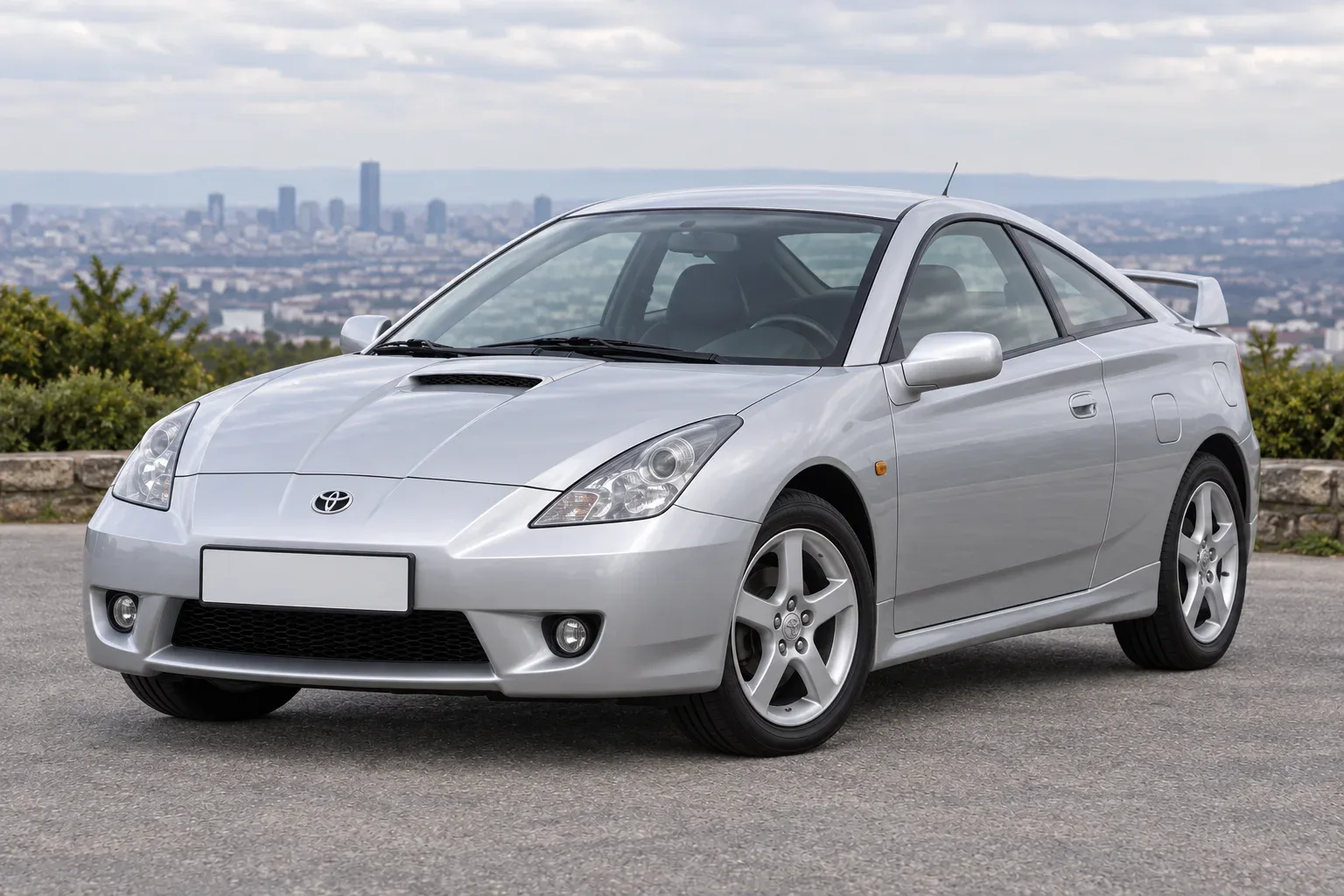
Toyota Celica 7 / T230
Valuation of the Toyota Celica 7 / T230 (1999–2005): condition, paperwork, inspection and terms of sale.
Indicative purchase price
Below market value
Final price agreed after inspection.
Value my car1Why buyers choose this model
The Toyota Celica VII is not as uncompromising as its predecessor, but it is ideal as the first sports car for young drivers. Celique is best suited to the term “rational sports car”.
2What buyers check
Review
The Toyota Celica VII is not as uncompromising as its predecessor, but it is ideal as the first sports car for young drivers. Celique is best suited to the term “rational sports car”. There is no rear axle drive, which means that the driver will not crash into the nearest tree, checking the boundaries of the possible, and will not require large funds for maintenance and repair. This car is for those who obey the call of the heart and the mind at the same time.
Although the model has been produced since 1970, the model gained world fame only at the turn of the 90s. First, the fourth, then the fifth, and then the sixth generation of the model shone on the rally track.
The latest generation Celica went on sale in 1999. Three years later, the car experienced a small facelift. The update affected only a few details: the front bumper, logo and front panel plastic. In 2005, the production of the model was completely discontinued.
Engines
It is worth noting that, despite the similar volume, the engines are completely different, and their nodes are not interchangeable. Both engines are worth the recommendation. However, in a worn specimen, you will inevitably have to change the worn piston rings and crankshaft inserts. There are also cases of stretching of the HRM chain, which in the case of a chain jump leads to failure of the valves. Usually, the chain of the valve timing has to be changed after 200,000 km. It is necessary to update not only the chain, but also two strips - stretch and guide. In addition, it is necessary to refresh the stars of the cranked and camshafts. The full set will pull at least 5000 rubles. In some instances, there is a failure of the stepping engine idling. The oil pressure regulator can also be set. Replacement is not easy, this will require partial disassembly of the engine. As for fuel consumption, the 143-horsepower version in a calm urban rhythm burns about 11 l / 100 km. But if you push harder on the gas pedal, the flow will increase to 15 l / 100 km. More powerful modification consumes on average 1-2 liters more. The sporty nature of Celica is supported by dynamic performance. The weakest 143-horsepower modification accelerates to 100 km / h in 8.7 seconds, although the maximum speed is only 205 km / h. The stronger version of the TS reaches the first hundred in 7.2 seconds and allows you to reach the speed indicator mark of 225 km / h. By the way, the 192-horsepower engine is atmospheric. High impact was achieved through the use of optimal materials, a system of changing the phase of gas distribution and control of the flow of intake and exhaust valves.
Maslozhor
The most prone to oil consumption is the legendary 1ZZ-FE. Some engines consume less oil, others more. Appetite depends on many things - mileage, driving style and frequency of oil renewal.
It is believed that since August 2002 the problem has been resolved. But that's not exactly true. Yes, Toyota has updated the piston rings, but the upgraded engines are happy to consume oil.
The main reason for the high oil consumption is the miscalculation in the piston design. Until July 2005, 1ZZ-FE had four-hole pistons for oil drainage. The temperature in the area of the lower piston ring reached 160 degrees Celsius, although 120 degrees is considered normal. As a result, the oil was sintered, clogging holes and preventing the removal of excess. The excess oil accumulated under the lower ring, expanding it, which led to a decrease in the gap between the cylinder wall and the ring. So the ring wore out over time. After the refinement, the piston received 8 holes for draining the oil and an additional groove for cooling.
There are several ways to solve the problem of oil. Some only change the rings of the piston. Such repairs are economical, but not durable. There are two more thorough methods. The first, and probably the best, is the overhaul. Instead of worn cast iron shells, new ones are installed, and instead of old pistons, modified ones. A set of pistons will cost 13,000 rubles.
Another option is to install a modified Toyota unit, the so-called Optifit. You can also purchase a block from the Avensis T25 since 2006.
1.8 VVTL-i
2ZZ-GE is technically more complex. It uses a two-stage valve lifting system. A pair of intake valves is controlled by two cams. One for low and medium revs, and the other for high control is carried out using a specially designed rocker with a connecting mechanism. The system is similar to that used by Honda - VTEC and Mitsubishi - MIVEC. Instead of cast iron shells in the aluminum block, a thin layer of MMC (Metal Matrix Composit) is applied to the inner walls of the cylinders. This is done to ensure better heat transfer and at the same time reduce the weight of the engine. The 2ZZ-GE cylinders have high wear resistance, but have one catch. There are cases when cracks appeared in the wall of the block, and in places where repair is impossible. This can lead to mysterious losses of oil or antifreeze. There is nothing left to do but replace the block with another. Unfortunately, this fatal defect occurs suddenly, without any warning. It's not even connected to the run. The block could burst after 80,000 km, and possibly far beyond 300,000 km. It's really a lottery. Fortunately, it doesn't happen that often. The 2ZZ-GE engine doesn’t usually eat oil. From the start, it had massive pistons with eight holes. The rods are about twice as thick as those in 1ZZ-FE. 1. 8 VVTL-i suffers from another malfunction - the failure of the screws of the intake valve rod attachment. This causes damage to the engine. As part of the repair, the inlet camshaft, four rods and a rod have to be changed. You can detect the impending problem by removing the valve cover.
Design features
The Celica is built on the Corolla VII platform. Toyota, contrary to the common scheme - "sports car = rear wheel drive", made its model front-wheel drive. This step has reduced production costs. Torque is transmitted through a 5- or 6-speed manual transmission, or through a 4-speed automatic.
To reduce the weight of the car, in comparison with its predecessor, the dimensions were reduced and modern materials were used in the manufacture of body parts and engine. The new engines received an aluminum block instead of cast iron. Thus, the weight of the equipped Selika was 1100 kg. The Skoda Fabia with a 1.2 HTP engine weighs only 40 kg less.
In the front and rear suspension, shock racks with lower transverse levers are used. A fairly dense chassis ensures stability and predictability.
The original appearance, despite its age, still looks fresh, as does the interior of the car. As a coupe, the front seats are spacious. There are only two seats in the back, and that is more for children. The trunk is quite decent – 365 liters.
Seliki's equipment is quite rich. Most of the specimens have climate control, electric mirrors, four airbags and heated seats. In 2003, the thrust control system and VSC (ESP) were included in the list of standard equipment.
Typical problems and malfunctions
Most of the problems we have to deal with are small things. For example, one of the most common problems is the corrosion of the exhaust pipe sealing ring.
Some owners complain about the appearance of foci of corrosion. The paintwork is quite gentle and easily scratched. Lacquer metallic type is much more resistant to damage.
Occasionally, the washing fluid pump fails. With age come into disrepair shock absorbers of the trunk lid. The original ones are roads. But you can pick up analogues - in size. Not all of them are good, some are too strong and others too weak.
Unfortunately, the upholstery of the chairs, does not stand the test of time.
More serious malfunctions, if they occur, are associated exclusively with the negligence of the owner: rigid operation and non-compliance with the maintenance regulations. To avoid problems, it is necessary to change engine oil every 10,000 km, an air filter every 30-40,000 km, oil in the gearbox every 45-60,000 km and check the valve gap every 90,000 km. So neglecting the change of oil in the box, working in tandem with the top engine TS, leads to rapid wear synchronizers 2nd and 3rd gear.
The driver can always rely on the brake system – it is very efficient and resistant to overheating. Unfortunately, this will have to pay for rapid wear of brake discs and pads.
Multi-link rear suspension can scare with its complex design. However, as practice shows, she is very hardy.
3Pre-purchase checklist
Review
- There is no rear axle drive, which means that the driver will not crash into the nearest tree, checking the boundaries of the possible, and will not require large funds for maintenance and repair.
Engines
- It is necessary to update not only the chain, but also two strips - stretch and guide.
- In some instances, there is a failure of the stepping engine idling.
- Replacement is not easy, this will require partial disassembly of the engine.
- In the case of TS, it is very important to use quality fuel.
Maslozhor
- It is believed that since August 2002 the problem has been resolved. But that's not exactly true.
- There are several ways to solve the problem of oil.
- Such repairs are economical, but not durable. There are two more thorough methods.
- The first, and probably the best, is the overhaul.
1.8 VVTL-i
- The 2ZZ-GE cylinders have high wear resistance, but have one catch.
- There are cases when cracks appeared in the wall of the block, and in places where repair is impossible.
- This can lead to mysterious losses of oil or antifreeze.
- 8 VVTL-i suffers another malfunction - the destruction of the screws of the intake valve rod attachment. This causes damage to the engine.
- As part of the repair, the inlet camshaft, four rods and a rod have to be changed.
- You can detect the impending problem by removing the valve cover.
Typical problems and malfunctions
- Most of the problems we have to deal with are small things.
- For example, one of the most common problems is the corrosion of the exhaust pipe sealing ring.
- Some owners complain about the appearance of foci of corrosion.
- Occasionally, the washing fluid pump fails.
- More serious malfunctions, if they occur, are associated exclusively with the negligence of the owner: rigid operation and non-compliance with the maintenance regulations.
- To avoid problems, you need to change engine oil every 10,000 km, every 30-40,000.
- km - oil in the gearbox (ACP and manual transmission) and every 90 thousand km to check the gap of the valves.
- So neglecting the change of oil in the box, working in tandem with the top engine TS, leads to rapid wear synchronizers 2nd and 3rd gear.
4Challenges of selling privately
Toyota Celica VII is a reliable sports car that does not require large financial costs in the operation process. However, before buying a particular copy, you need to carefully check its technical condition, since many cars are already badly overused and can ask for a huge financial investment. The cheapest samples can be purchased for 180-200 thousand rubles.
- There is no rear axle drive, which means the driver will not crash into the nearest tree, checking the boundaries of the possible, and will not require large funds for maintenance and repair.
- Engines: In some instances, there is a failure of the stepping engine idling.
- Maslozhor: It is believed that since August 2002 the problem has been fixed. But that's not exactly true.
- 1.8 VVTL-i: The 2ZZ-GE cylinders are highly durable, but have one catch.
- Design features: Celica is built on the Corolla VII platform.
- Typical problems and malfunctions: Most of the problems that you have to face are everyday trifles.
Shows, bargaining and re-registration take time: buyers look, promise to think and disappear. Fair price after inspection closes the auction on the spot. If money is needed urgently, the purchase takes away waiting and repeat displays.
5How selling to us works
Leave a request with the car data. We will discuss the preliminary assessment and inspection. After checking the status and documents, we agree on the final price and terms of the transaction.