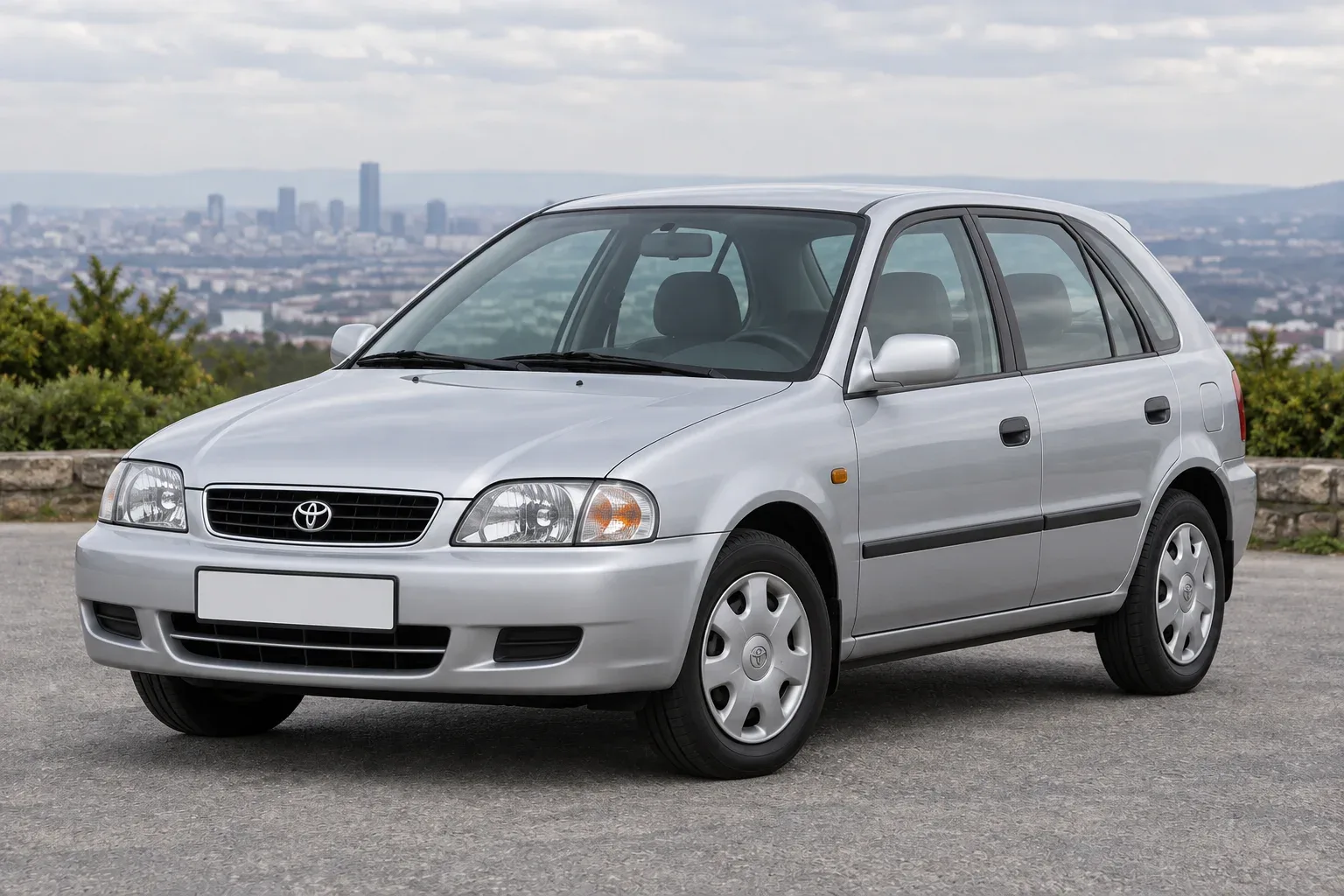
Toyota Corolla E110
Valuation of the Toyota Corolla E110 (1997–2001): condition, paperwork, inspection and terms of sale.
Indicative purchase price
Below market value
Final price agreed after inspection.
Value my car1Why buyers choose this model
Perhaps none of the Corollas has caused as much controversy as the version presented in 1997. The front end, with large oval headlights and slightly smaller ones located nearby, was met with serious criticism. Some saw a connection with the bulging eyes of a frog, others with a disgusting, hefty insect. Ambiguous associations gave rise to taillights, but they did not annoy so much. There were so many dissatisfied statements that Toyota after 30 months of production modernized the car, completely revising the front end. Interestingly, this controversial experiment was limited to the European market. On all other continents, the E110 had regular rectangular headlights from the first days. Despite the stylistic miscalculation, the Japanese manufacturer was satisfied. The eighth-generation Toyota Corolla sold as well as its predecessor. By December 2000, 25,000,000 Corolla models had been sold worldwide. It’s hard to know what exactly the car was looking at, given that it was average in many ways. Neither the body design, nor the interior, full of gray plastic, nor the engine line, nor the driving qualities, nor the trunk volume (hatchback: 3d - 280 liters, 5d - 372 liters, sedan - 390 liters, wagon - 308 liters) did not cause frenzied delight. However, the gasoline engines were quiet and economical, the multi-link rear suspension provided a high level of comfort, the relatively spacious interior gave a feeling of comfort, and the excellent quality of performance was exemplary in its class. These advantages, combined with legendary strength and reliability, apparently predicted the success of the Toyota Corolla. Today it is one of the most attractive offers in the secondary market. Especially for those looking for an inexpensive car that guarantees long-term operation without breakdowns. However, for this to be true, two conditions must be met: proper maintenance and high quality parts. There's no problem with the latter. You can spend well, buying the original, or save a little, using affordable, but high-quality analogues.
2What buyers check
Engines
Toyota Corolla gasoline engines are durable and reliable. Failures are rare. Basically, this is a burnt gasket under the head of the cylinder block or oil leakage through the crankshaft obile from the side of the box. To see the leaks, you need to get under the car. As with many Japanese cars, corrosion is a problem in the exhaust system. For example, because of this, sometimes the housing of the exhaust manifold in the engine compartment rattles. Experts pay attention to the problems arising from the transfer of the engine to gas. This often leads to the burn of the valves. The most reliable are gasoline units of 1.3 and 1.6 liters. Slightly less endurance 1.4 and 1.6 VVT-i. Especially the first, which sometimes pesters with increased oil consumption.
Despite the high fuel prices, it is difficult to recommend diesel engines used in the Corollas from 1997 to 2000. Both 2.0 D and later 1.9 D. The first, atmospheric created by Toyota in the 80s. The second, the brainchild of the French concern PSA (Peugeot, Citroen). However, old and time-tested atmospheric diesels do not have serious problems with durability. But they are weak and do not provide a decent dynamic. If you need a diesel, it is better to look at the 90-horsepower 2.0 D-4D, used since the fall of 2000. The engine is characterized by the presence of turbocharging, the Common Rail injection system, quiet operation and dynamics. However, finding such a version will be very difficult.
Transmission
In gearboxes, working in pair with engines of 1.3 l, the clutch disc wears out quickly. Difficulty turning on the reverse is not a malfunction, but a kind of chronic disease characteristic of many Japanese cars.
Bodywork
The Toyota Corolla is very well protected from corrosion. Oval headlights are a real nightmare for Corolla owners: seals are glued. Self-repair is usually not as effective. The problem disappeared with the oval headlights in late 1999, during a deep facelift. Not all of the items were equipped with a central lock. Installed in workshops are unreliable, unlike the original, which are almost fault-free.
Suspension
The chassis is surprisingly good at handling Russian roads. Only the sleeves and racks of the stabilizer are subjected to rapid wear. Multi-link rear suspension periodically requires a visit to the service to adjust the geometry. This will be indicated by the uneven wear of the tires on the rear axle.
Model history
1997, May – premiere of the eighth generation Toyota Corolla – factory index E110. Body: 3 and 5-door hatchback, 4-door sedan and 5-door station wagon. Engines: 16-valve petrol 1.3 l 86 hp, 1.6 l 110 hp, 1.8 l 110 hp and diesel 2.0D 72 hp
1999, spring - sports version of the G6 with a 1.6-liter engine and a six-speed gearbox.
1999, December - body update, new block headlights (twin headlights with separate far and passing beams). New 16-valve gasoline engines with a phase change system of 1.4 liters VVT-i 97 hp, 1.6 liters VVT-i 110 hp and a new diesel 1.9D 69 hp. Engines 1.3 L and 1.6 L are excluded.
2000, autumn - a new 2.0 D-4D turbodiesel engine with a Common Rail injection system with a capacity of 90 hp.
2001, autumn - premiere of the Corolla of the next, ninth generation.
VIN number
The plate and VIN are placed in the engine compartment on the partition separating the cabin. On the left is the plate, on the right is the identification number.
Position 1-3 is the world manufacturer code: JT1 – Toyota, Japan; SB-1 – Toyota, UK.
Position 4-5 - body type: 52 - 3-door hatchback, 53 - 4-door sedan, 54 - 5-door hatchback, 72 - 5-door wagon.
Position 6: Engine type: E 1.3 16V; A 1.6 16V; C 1.4 16V VVT-i, 1.6 16V VVT-i; C 2.0 D, 2.0 16V D4-D.
Position 8-9 – generation: B1 – E110, 1997 – 2001
The 10th position is unused characters and is inscribed with “0”.
Position 11 – place of production: 0.3 – Japan, E – Great Britain.
3Pre-purchase checklist
Engines
- To see the leaks, you need to get under the car.
- As with many Japanese cars, corrosion is a problem in the exhaust system.
- Experts pay attention to the problems arising from the transfer of the engine to gas. This often leads to the burn of the valves.
- However, old and time-tested atmospheric diesels do not have serious problems with durability.
Transmission
- Difficulty turning on the reverse is not a malfunction, but a kind of chronic disease characteristic of many Japanese cars.
Bodywork
- The Toyota Corolla is very well protected from corrosion.
- Self-repair is usually not as effective.
- The problem disappeared with the oval headlights in late 1999, during a deep facelift.
- Installed in workshops are unreliable, unlike the original, which are almost fault-free.
Suspension
- Only the sleeves and racks of the stabilizer are subjected to rapid wear.
- This will be indicated by the uneven wear of the tires on the rear axle.
4Challenges of selling privately
Choosing the Toyota Corolla is not only about engine selection and equipment. You can also determine where the car is assembled in Japan or Europe (using the VIN decoding). Japanese assembly is considered to be of higher quality, and the installed components are more durable than in similar copies from the UK.
- Engines: As with many Japanese cars, corrosion is a problem in the exhaust system.
- Transmission: The difficulty of turning on the reverse is not a malfunction, but a kind of chronic disease that is characteristic of many Japanese cars.
- Body: Toyota Corolla is very well protected from corrosion.
- Suspension: Only the sleeves and racks of the stabilizer are subjected to rapid wear.
- History of the model: 1997, May - the premiere of the eighth generation Toyota Corolla - the factory index E110.
- VIN number: The plate and VIN are placed in the engine compartment on the partition separating the cabin.
Shows, bargaining and re-registration take time: buyers look, promise to think and disappear. Fair price after inspection closes the auction on the spot. If money is needed urgently, the purchase takes away waiting and repeat displays.
5How selling to us works
Leave a request with the car data. We will discuss the preliminary assessment and inspection. After checking the status and documents, we agree on the final price and terms of the transaction.