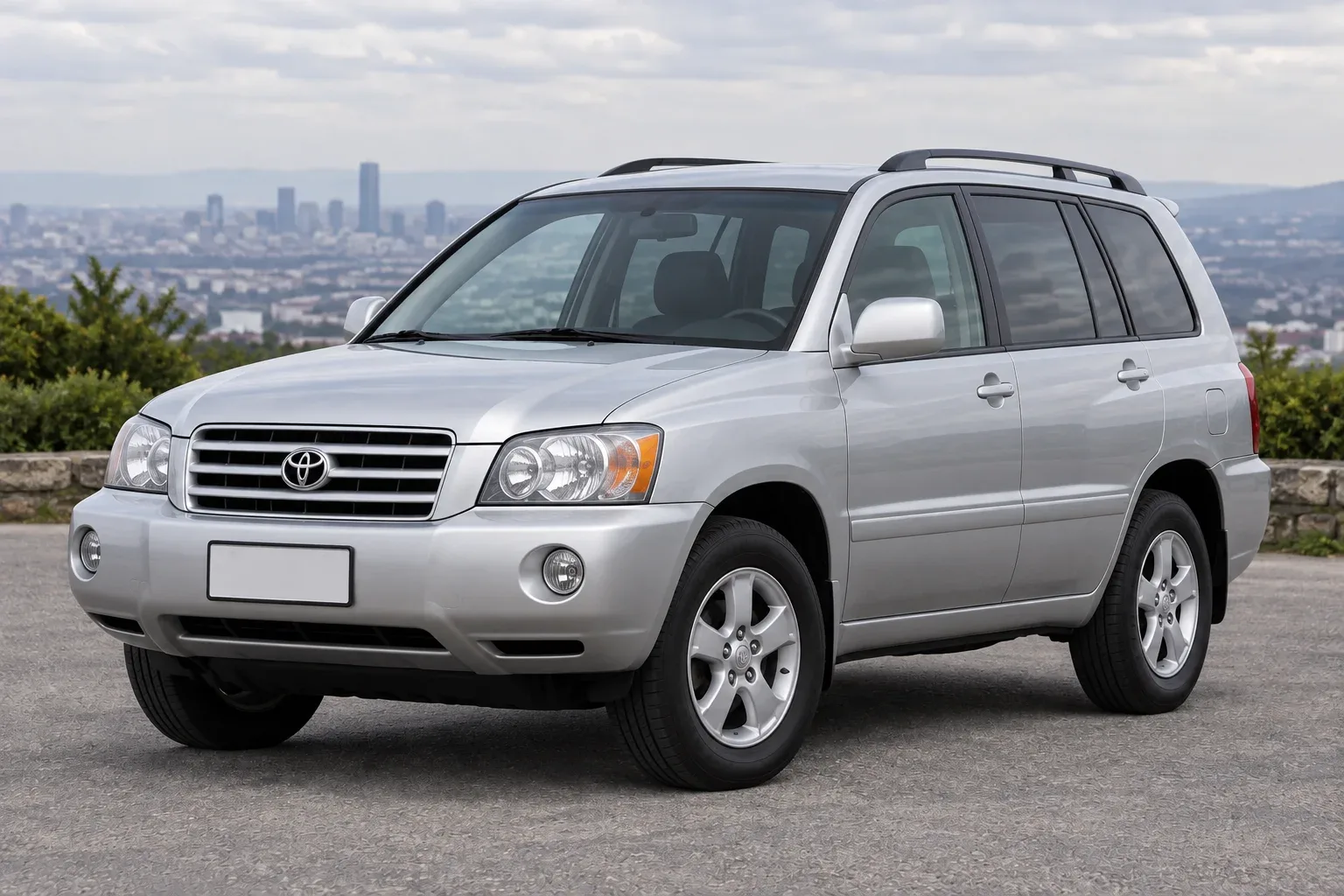
Toyota Highlander 1 / XU20
Valuation of the Toyota Highlander 1 / XU20 (2000–2007): condition, paperwork, inspection and terms of sale.
Indicative purchase price
Below market value
Final price agreed after inspection.
Value my car1Why buyers choose this model
The Toyota Highlander is built on the Toyota K platform, shared with the Camry V30 and Lexus RX. There is an unforgiving connection inside. The interior is a mixture of Camry and RX: design, ergonomics and surface texture. All switches are well-known and intuitive. Large doorways make it easy to get inside. It is one of the few cars that can comfortably accommodate 5 passengers. After restyling in 2004, a bench with two additional seats appeared in the trunk. The adults in the gallery are too crowded. To get the seats to the floor, engineers had to reconfigure the fuel tank. The right-hand drive version of the crossover for Japan and Australia was offered under the name Kluger. The SUV was assembled for all markets without exception in Japan.
2What buyers check
Security
In the crash tests according to IIHS Higlander received a rating of “good”. It is noteworthy that in reality, the Highlander turned out to be one of the safest cars offered on the American market. According to IIHS, among all vehicles of 2001-2005, it had one of the lowest driver mortality rates, and in the SUV category was second only to the Toyota 4Ranner.
Engines
The base in the line was a 2.4-liter 4-cylinder engine (2AZ-FE / 155-160 hp). It was combined with a 4-speed automatic transmission. Interestingly, this combination has quite satisfactory characteristics. Yes, the dynamics are not admired, but the car dutifully responds to the pressing of the gas pedal. It's the choice of those who care more about things like fuel economy than exciting acceleration and refined mechanics. The SUV with the 3-liter V6 (1MZ-FE/220 hp) is much faster than the base version. After restyling, the 1MZ-FE gave way to the 3.3-liter V6 (3MZ-FE / 215-230 hp). It operates quietly, provides unimpeded torque flow and does not consume too much fuel. 6-cylinder units have a temporary type of HRM drive with a recommended threshold of the first replacement of 150,000 km and a subsequent replacement interval of 90,000 km. Only the 4-cylinder engine was equipped with a chain drive valve timing. The chain sometimes stretches after 200,000 km. All engines use the proprietary VVT-i phase change system. It's very reliable. Failures in the system can occur due to failure of the VVT-i valve (from 2 000 rubles). Among the common ailments, it is possible to distinguish periodically refusing oxygen sensors (from 5 000 rubles) and detonation sensors (from 2 000 rubles). In addition, with large runs, cleaning of the throttle valve is often required. "Iron" of engines with proper operation and timely oil replacement will last a long time. Otherwise, expensive repairs or replacements are possible. After 300,000 km, the 3-liter V6 sometimes starts consuming a lot of oil.
Transmission
Before restyling, a 4-speed automatic transmission of the Toyota / Aisin U140 / U240 series was used in pairs with engines. After restyling, six-cylinder engines began to be aggregated with a 5-speed Toyota / Aisin U150 / U250 automatic machine - a modified version of the 4-mortgage. Many of the boxes are interchangeable. Among the improvements - a strengthened planetary range and an updated hydroblock with solenoids. 4-band automatic feels more confident with a 2.4-liter engine. With the V6, especially in a dynamic manner of driving, it gives up sooner. However, both boxes are very reliable - provided the working fluid is updated in a timely manner (every 60,000 km). Often the reason for the box to go into emergency mode is a faulty engine detonation sensor. More serious problems can occur after 300,000 km. However, most of the units come for repair only after 500,000 km: wear out the hydraulic transformer, planetary row, back cover, frictions and bushings of the pump. Replacement of a faulty unit with a contract is advisable when the cost of major repairs exceeds 100-150 thousand rubles. The symmetrical system of permanent all-wheel drive (50:50), of course, is not designed for serious off-road. The Toyota Highlander is an outstanding wagon, and the transmission is designed for additional traction on wet or snowy roads, as well as on easily rugged terrain. The transmission elements are distinguished by enviable longevity. Only crosses of the driveshaft have to be changed, the resource of which is 250-300 thousand km.
Walking
The suspension is completely independent. In front, Macpherson racks work, and in the back - a multi-link design, conditionally similar to the one used in the Camry. Smoothness, working out irregularities and reactions resemble a sedan.
The front-wheel drive version seems lighter and more accurate than the all-wheel drive version, where there is a slight understeering. The steering provides decent feedback.
The components of the chassis last a long time. The first, after 120-180 thousand km, are handed over the rear silent blocks of the front levers. After 150-200 thousand km, a series of shock absorbers (from 5 000 rubles), and a little later - the silent blocks of the rear levers. Front stage bearings have to be changed after 200-300 thousand km (from 2 000 rubles).
After 250-300 thousand km can howl pump GUR (from 7 000 rubles). However, more often you have to deal with leaky hoses of hydraulic booster (from 6000 rubles) - crack from old age.
Characteristic problems and malfunctions
The Toyota body is not prone to corrosion. Rust is more of a sign of body repairs in the past. However, on age-old cars there are local swellings of paint on the doorsteps, trunk doors, front racks or above the windshield.
Such a trifle as the gasket (occupation ring) of the fuel tank filling neck lid often leads to errors and simultaneous burning of the Check, VCS and TRACK OFF indicators. The gasket loses its leakage after 200,000 km. The sealing ring can be selected, or you will have to replace the cover (1.5-2 thousand rubles).
One of the common problems with conventional air conditioning machines is the failure of the temperature regulator or the rate of blowing. It's all about the broken plume that needs to be soldered.
After 250-300 thousand km from the deflectors sometimes begins to blow different temperatures air. The reason is the clogged radiator of the heater (from 2 000 rubles).
Highlander Hybrid
A hybrid version of the Highlander appeared in 2005. The Hybrid Synergy Drive powerplant combines a 3.3-liter engine (3MZ-FE / 208 hp) and an electric motor-generator. In addition, a continuously variable automatic transmission is used here, and the steering system and water pump received an electric drive.
In hybrid models, the rear wheels are driven by an electric motor that is prone to overheating in difficult areas of terrain. In addition, with age, transistors in power keys of an expensive inverter fail. Fortunately, the specialized services have learned to change them. In this version, there were problems with the steering rack.
3Pre-purchase checklist
Engines
- 6-cylinder units have a temporary type of HRM drive with a recommended threshold of the first replacement of 150,000 km and a subsequent replacement interval of 90,000 km.
- Failures in the system can occur due to failure of the VVT-i valve (from 2 000 rubles).
- Among the common ailments, it is possible to distinguish periodically refusing oxygen sensors (from 5 000 rubles) and detonation sensors (from 2 000 rubles).
- Otherwise, expensive repairs or replacements are possible.
- But sometimes the reason is more serious - the occurrence of rings or piston wear.
- The problem was officially recognized and resolved only in 2007.
- There are two options for solving the problem: replacing the engine, or cutting a new thread and installing threaded bushes.
Transmission
- More serious problems can occur after 300,000 km.
- However, most of the units come for repair only after 500,000 km: wear out the hydraulic transformer, planetary row, back cover, frictions and bushings of the pump.
- Replacement of a faulty unit with a contract is advisable when the cost of major repairs exceeds 100-150 thousand rubles.
- Replacing crosses with balancing the driveshaft will require about 10 000 rubles.
Characteristic problems and malfunctions
- The Toyota body is not prone to corrosion.
- Rust is more of a sign of body repairs in the past.
- One of the common problems with conventional air conditioning machines is the failure of the temperature regulator or the rate of blowing.
- It's all about the broken plume that needs to be soldered.
Highlander Hybrid
- In this version, there were problems with the steering rack.
4Challenges of selling privately
The first generation Toyota Highlander does not cause much passion among buyers. However, this car will provide comfort and reliability to its owners for many years and even decades. However, we should not forget that time takes its toll, and Highlander 1 is no longer young.
- Safety: In the crash tests according to IIHS, Higlander received a rating of “good”.
- Engines: System failures may occur due to failure of the VVT-i valve (from 2 000 rubles).
- Transmission: More serious problems may occur after 300,000 km.
- Driving: The suspension is completely independent.
- Characteristic problems and malfunctions: Toyota body is not prone to corrosion.
- Highlander Hybrid: In this version, there were problems with the steering rack.
Shows, bargaining and re-registration take time: buyers look, promise to think and disappear. Fair price after inspection closes the auction on the spot. If money is needed urgently, the purchase takes away waiting and repeat displays.
5How selling to us works
Leave a request with the car data. We will discuss the preliminary assessment and inspection. After checking the status and documents, we agree on the final price and terms of the transaction.