
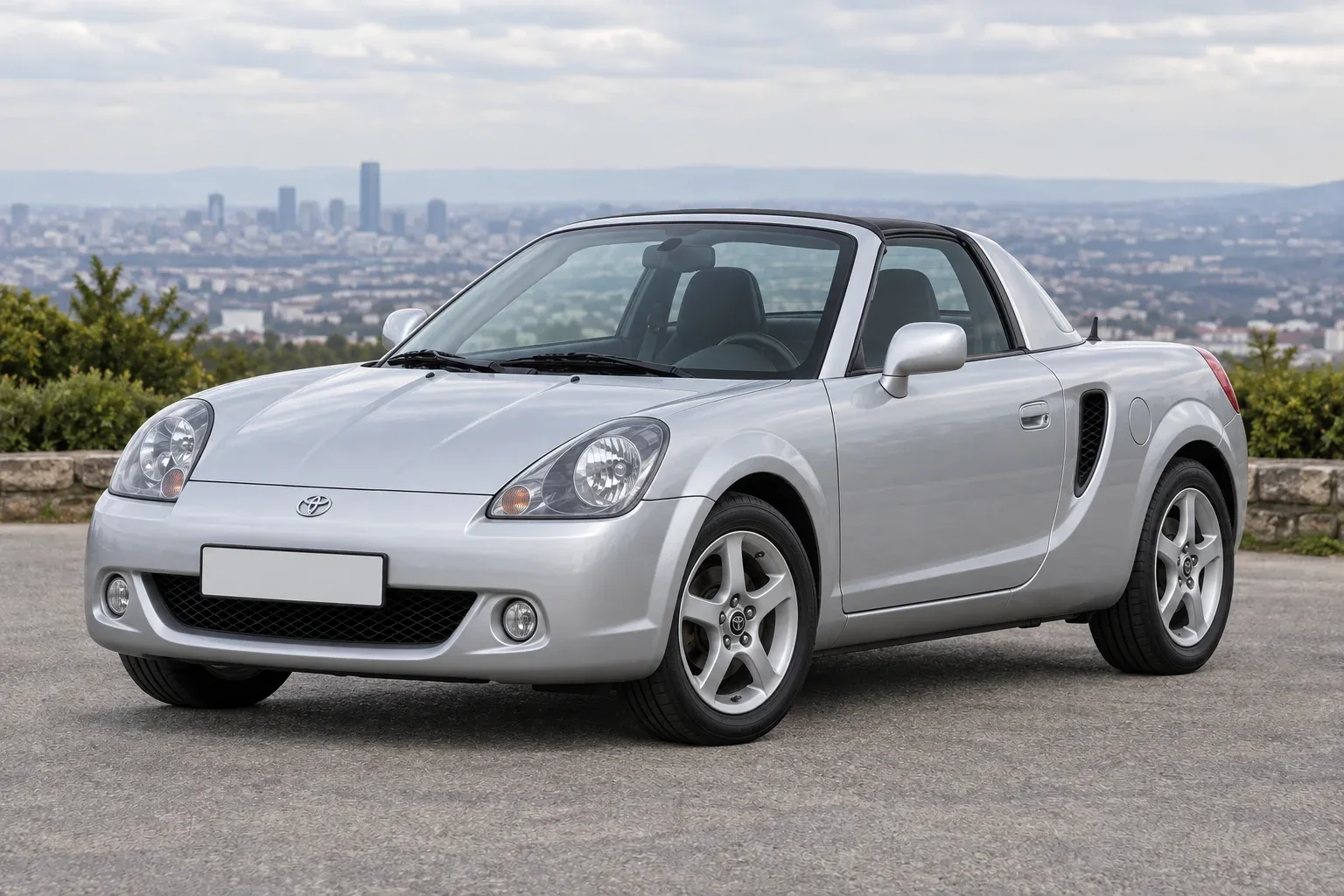
Toyota MR2 III / MR-S
Valuation of the Toyota MR2 III / MR-S (1999–2006): condition, paperwork, inspection and terms of sale.
Indicative purchase price
Below market value
Final price agreed after inspection.
Value my car1Why buyers choose this model
Toyota is one of the few people who could simultaneously create a car for the masses, such as the Corolla, the luxury Lexus LS and a real Land Cruiser SUV. There are brands and cars for lovers of active driving. These include Celica, Supra and a completely unique MR2.
2What buyers check
Racing concept
Having an engine in front of the rear drive axle is perhaps the most racing concept a car can have. In Formula 1, an indicator of the best automotive technology, the concept has been a must-have since the 1960s.
The first Toyota MR2 was introduced in 1984 and was produced until 1989. Underneath the somewhat mysterious acronym MR2 is the phrase "Midship Runabout 2", which means a car with a centrally positioned engine for two.
The second edition of the MP2 became larger and resembled Ferrari cars in its appearance. Unfortunately, before the modernization of 1993-1994, these machines were too incendiary. They failed to offer the first generation of superb controlled handling. After the upgrade, the second generation cars began to go much better.
In 1997, Toyota showed what a successor to the second generation MR2 could be. It was a Toyota MR-S concept. It was a surprise when two years later, a small third-generation sports model was introduced in Tokyo. It almost completely retained the design of the concept.
The MR-S designation was retained for the Asian market. In Europe and the US, Toyota used the traditional MR2. However, today's enthusiasts and connoisseurs call the third generation "mrsa", after the Japanese original. Production of the charismatic Toyota was completed in 2006 without a successor. Today, the sporting flag holds the GT-86, which is more of a Subaru than a Toyota.
Don't bite your fingers.
MR2 was never sold on the Russian market, imported in small quantities, so the choice in the secondary market is very limited. The car has a galvanized body. Japanese cars have always resisted corrosion. MP2 is less prone to corrosion than its closest competitor, the Maxda MX-5. This does not mean that MR2 does not rust at all. The first copies are almost 20 years old today.
Where do you most often look for corrosion? The Toyota MP2 has two weaknesses. First, the back subframe. It could even collapse completely. Rust is formed in the place where the exhaust channels pass. The reason is strong heating and the formation of condensation inside the subframe. At best, the subframe can be saved by welding. If it is too late, then there is simply no other way out than to buy a new subframe. Its cost is about 30 000 rubles.
The second place to look for corrosion is the rear wheel arches. The reason is clogged drainage channels that drain water from the tarpaulin roof. The water is then left in the back. In addition, moisture can cause a lot of damage on the driver's side. In this place is located part of the electrical equipment and one of the control units. Drainage channels can be cleaned by removing the rear wings, which are attached to the body with bolts. This should be done immediately after purchase. This is the only way to avoid extensive corrosion, which at first glance may not be visible.
The only engine
The MR2/MR-S was powered by only one engine, a four-cylinder 16-valve 1.8-liter 1ZZ-FE petrol atmospheric. This unit was used in other Toyota models.
Anyone who thinks that we are talking about a reliable and durable engine that can cope with several hundred thousand kilometers is very mistaken. Today, almost everyone already knows that 1ZZ-FE has a high oil consumption. Many people believe that the units produced after 2002, do not suffer from oil. However, this is contradicted by the fact sheet Toyota, which says that the increased consumption of oil are prone to engines assembled before July 2005. After that, they underwent some changes.
The main reason for high oil consumption is poorly designed pistons. Prior to the 2005 upgrade, the pistons had four holes to drain the oil, which simultaneously cools the pistons. As described in the relevant technical bulletin, the temperature of the piston in the area of the lower oil removable ring reaches 160 degrees. It is desirable that it would have a maximum value of 120 degrees. High temperature leads to sintering of oil and occurrence of rings. This also contributes to the wear of the cylinder walls. Since July 2005, pistons have 8 holes for oil drainage.
What to do if the engine eats oil?
Usually, the problem of increased oil consumption worsens after 150,000 km. There are several ways to solve this. The easiest thing is to constantly monitor the oil level and add it. But this option is acceptable until the appetite exceeds 1 liter per 1,000 km. Another way is to replace the piston rings. This solution, although cost-effective, is short-lived.
There are two more durable solutions. The first is to replace cast-iron cartridges and install original modified pistons. In addition to the original, you can use Kolben Schmidt (KS) pistons. There are eight holes for oil drainage here, but their diameter is slightly larger. The cost of both sets is slightly more than 20 000 rubles. The second solution is even more radical. Installation of a new upgraded engine, from the so-called Optifit category, or purchase of a unit from the Avensis T25 since 2006. Both methods are quite expensive and unprofitable.
Some motorists use another method of repair. For this purpose, in the original pistons with four holes, the diameter of the oil drain channel is increased. At the same time, the cylinders and pistons should be thoroughly cleaned of deposits. This patch is the cheapest and most effective. However, it is only applicable if the cylinders have not yet taken the form of an ellipse. Otherwise, simply increasing the holes in the pistons and improving drainage will not help.
Service advice
The HRM chain is used to drive the gas distribution mechanism. The chain will need to be replaced after 200,000 km. The cost of the original set is about 10 000 rubles.
Toyota prescribes the use of engine oil SAE 5W-30 API SG/SH, ACEA A3/B3, but the engine recommends switching to 5W-40. The cooling system is filled with 10.4 liters of liquid.
Typical problems and malfunctions
Until October 2001, there was a risk of damage to the cylinder walls by catalyst fragments. The result was a high consumption of oil. Today, this problem is most likely already solved.
There are also malfunctions of the oil pressure regulator. It should be checked every 60-80 thousand km.
Do not differ in durability of rear wheel bearings. They change separately. The original is available for 2,500 rubles, and the price tag for analogues starts from 600 rubles.
In the front levers, the rear silenblocks wear out most quickly. They can be replaced separately (from 400 rubles).
Sometimes eccentric bolts of the transverse thrust of the rear suspension sour, with the help of which the angles of the rear wheel installation are adjusted. Old eccentrics have to be cut. The new adjustment bolt will cost 300-500 rubles.
In common.
The third-generation MR2 may seem like a toy, but underneath the slightly flashy exterior lurks real sports equipment. The MR2 has only two real competitors – the Mazda MX-5 (preferably the earlier NB rather than the more modern NC) and the British MG F, later the TF. The Toyota MR2 has almost no trunk. Unlike the two predecessors, the engine was pushed back even further. This made it easier to access, but at the expense of the back cover of the trunk. If in the previous two models behind the engine could still be put something, then here - only in front of it. For this purpose, there are small compartments behind the seats, which are not easy to reach. You can put something in front under the hood. There is a lot of room for the spare wheel. Therefore, many prefer to use a remake instead of a dock. The MX-5 and MG F allow you to bring a week's supply of luggage. MP2/MR-C has an electrohydraulic power steering. Thanks to this, the full stroke of the steering wheel is only 2.8 revolutions. The car responds to commands with the steering wheel. Unprecedented agility contributes to the central location of the engine, providing a small moment of inertia. At the same time, the car retains a sufficient margin of stability on the trajectory. If suddenly the speed on the arc was too high, then first there is a whistling of tires, accompanied by insufficient rotating. At this point, let go of the gas pedal slightly enough, and you will feel how your stern helps to return the car to the desired trajectory. No drifting so familiar to owners of the early second-generation MR2.
What to look for?
The exotics with the engine right behind the seats can be purchased for less than half the price of the oldest Porsche Boxster. However, the Toyota MR2 is easier and cheaper to operate. And thanks to the small weight (975 kg) it is enough and 2/3 of the power of the Porsche engine. Practicality is almost nonexistent. Unlike the Boxter, it has only a small trunk in the front and a couple of modest compartments behind the backs of the front seats.
In the secondary market, finding MR2/MRS is quite problematic. Not only are they few, but many of them have been rebuilt after serious accidents. In a steep turn, the MR2 can take even an experienced driver by surprise. The reason for the sale is also a high consumption of oil. But you won't know until you buy an MRI.
Cars with automated transmissions, which often bother owners of other Toyota models, should be avoided. The robot’s slowness is not consistent with the nature of MR2.
A good bonus will be air conditioning. Unfortunately, most MP2s do not have it. A trip with an open top in the direct rays of the summer sun does not promise anything pleasant. If you close the roof, the sun will not shine on you, but the cabin will quickly turn into a sauna.
Model history
1997 – MR-S concept – prototype of the future MR2
1999 – Production of the second generation model is discontinued. The successor was not much different from the MR-S concept. In Asian markets, the MR-S name was used, while in Europe and the United States, the traditional MR2 was retained. The engine is a 16-valve 1.8, working in pair with a 5-speed manual transmission. The roof was laid out exclusively by hand. For an additional fee (very high) you could get a hard roof.
2000 – Launch of sales in Europe and the USA. In America, first only with a 5-speed automated transmission SMT (another name E-Shift). Cars for Europe were equipped with a 5-speed manual transmission. Mechanics came later in the United States.
2002 – modernization of the car, improved equipment. There was a 6-speed manual transmission. For an additional fee, a 6-band automated SMT transmission was available.
2006 – Production is discontinued without a successor.
3Pre-purchase checklist
Don't bite your fingers.
- Japanese cars have always resisted corrosion.
- MP2 is less prone to corrosion than its closest competitor, the Maxda MX-5.
- Where do you most often look for corrosion? The Toyota MP2 has two weaknesses. First, the back subframe. It could even collapse completely.
- Rust is formed in the place where the exhaust channels pass.
- The second place to look for corrosion is the rear wheel arches.
- This should be done immediately after purchase.
- This is the only way to avoid extensive corrosion, which at first glance may not be visible.
The only engine
- This also contributes to the wear of the cylinder walls.
What to do if the engine eats oil?
- Usually, the problem of increased oil consumption worsens after 150,000 km. There are several ways to solve this.
- But this option is acceptable until the appetite exceeds 1 liter per 1,000 km. Another way is to replace the piston rings.
- The first is to replace cast-iron cartridges and install original modified pistons.
- Some motorists use another method of repair.
Service advice
- The chain will need to be replaced after 200,000 km.
- Toyota prescribes the use of engine oil SAE 5W-30 API SG/SH, ACEA A3/B3, but the engine recommends switching to 5W-40.
Typical problems and malfunctions
- Today, this problem is most likely already solved.
- There are also malfunctions of the oil pressure regulator. It should be checked every 60-80 thousand km.
What to look for?
- In the secondary market, finding MR2/MRS is quite problematic.
- Cars with automated transmissions, which often bother owners of other Toyota models, should be avoided.
4Challenges of selling privately
- Racing concept: Having an engine in front of the rear drive axle is perhaps the most racing concept a car can have.
- Don’t bite your fingers: Japanese cars have always been good at resisting corrosion.
- Single engine: This also contributes to the wear of the cylinder walls.
- What to do if the engine eats oil?: Usually the problem of increased oil consumption worsens after 150,000 km. There are several ways to solve this.
- Maintenance tips: Chain replacement will be required after 200,000km.
- Typical problems and malfunctions: Today, this problem is most likely solved.
- In everyday life: the third-generation MR2 may seem like a toy, but under the slightly flashy appearance lurks real sports equipment.
- What to look for?: In the secondary market, finding MR2/MRS is quite problematic.
Shows, bargaining and re-registration take time: buyers look, promise to think and disappear. Fair price after inspection closes the auction on the spot. If money is needed urgently, the purchase takes away waiting and repeat displays.
5How selling to us works
Leave a request with the car data. We will discuss the preliminary assessment and inspection. After checking the status and documents, we agree on the final price and terms of the transaction.