
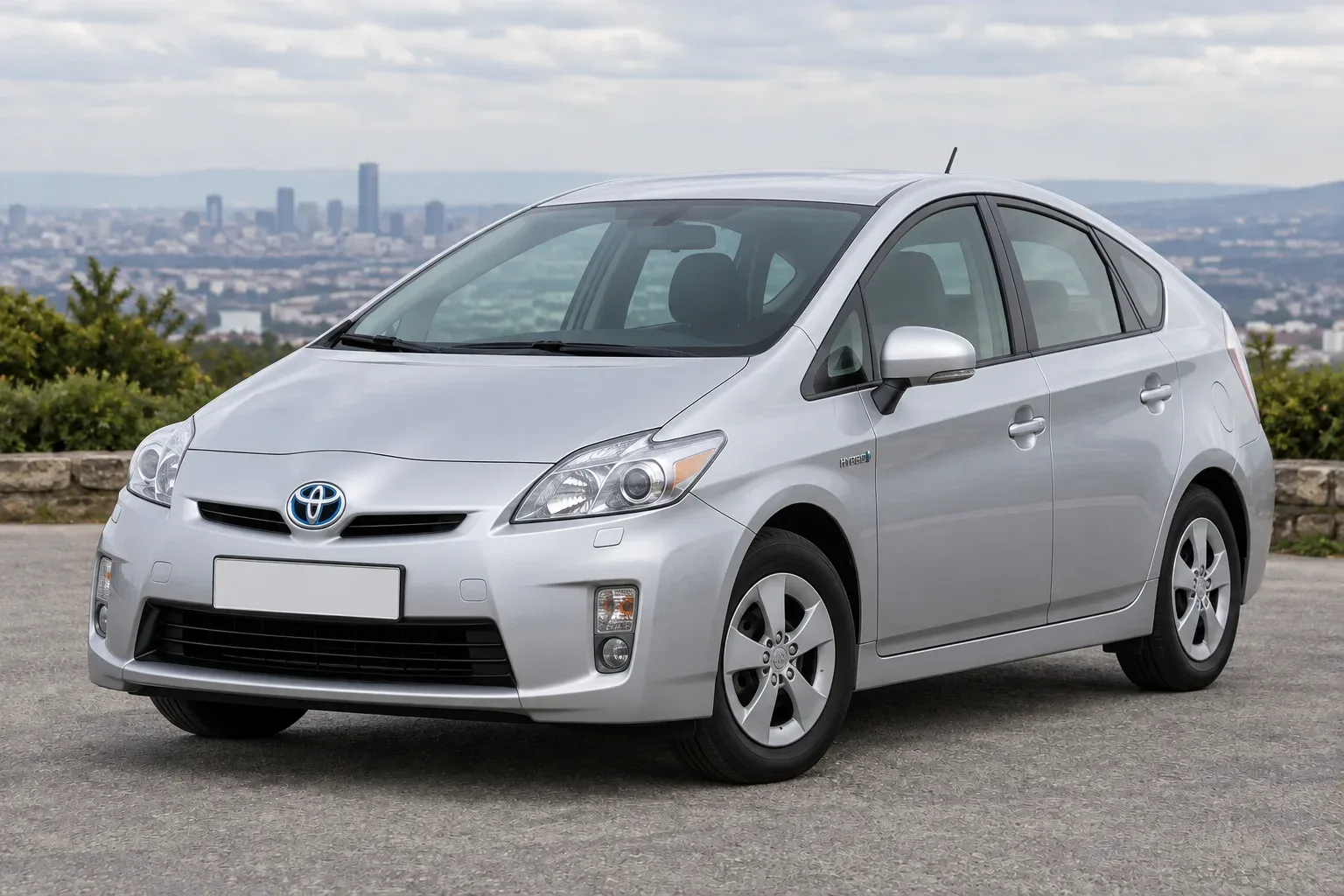
Toyota Prius 3 / XW30
Valuation of the Toyota Prius 3 / XW30 (2009–2016): condition, paperwork, inspection and terms of sale.
Indicative purchase price
Below market value
Final price agreed after inspection.
Value my car1Why buyers choose this model
The Toyota Prius can be viewed from two sides. On the one hand, it is a symbol of ecology, which has turned into an economical spineless car for trips from point A to point B. It is an interesting and rather original way to reduce fuel costs. But what does the vast majority of people really need? To ensure that the car is reliable, relatively fast, comfortable, safe and consumes a minimum of fuel. All of these requirements are met by the third generation Prius. The manufacturer claims that the hybrid is able to do 4 liters of gasoline per 100 km. In fact, moving so as not to irritate others, you will need about 6 liters. If you avoid traveling on the highway, then the average consumption in the city will be about 5 liters. Outside the city, where the hybrid drive is already useless, and the engine has to push a car with heavy batteries, the cost will be at the level of 7-8 liters. Practicality is another strong point of the Toyota Prius. There's a lot of room inside. But comfortably, things are a little worse. Seats do not keep the body from moving, and seat cushions are short. It is also impossible to install the steering wheel correctly. You have to either sit with your arms fully outstretched or with your legs bent. You will have to get used to the extremely slow heating of the cabin in winter. This is primarily due to the engine with high thermal efficiency. The heat energy they provide is simply not enough for frills like crew comfort. To save polar bears, you have to sacrifice something. Even ergonomics are not exemplary. The projection Head-Up display is not as eye-weary as the overloaded small icons digital dashboard above the center panel. It takes time to get used to it. Noise insulation and suspension are not bad in the city and at low speeds, but at a higher pace of movement, tires begin to howl, and the running gear makes itself felt. The rear axle with an elastic beam, reacts boldly to cracks in the asphalt and wavy surfaces. The Toyota Prius does not require any special skills in management.
2What buyers check
Typical problems and malfunctions
The Toyota Prius 3 has no fatal defects. And the powertrain is very reliable. The 1.8-liter internal combustion engine operates on a modified Atkinson cycle (the intake valve remains open for a while even when the piston begins to return, thereby effectively simulating the stroke of a variable-length piston). Instead of the often problematic, limited-life CVR, there is an almost eternal planetary transmission. It works with an electric motor, which also has no characteristic diseases. But that doesn’t mean the car doesn’t require maintenance. The gasoline engine, like any other engine, regularly needs to be updated with oil and filters. And after 300-400 thousand km can burn gasket under the head of the block, or leak the pump of the cooling system. The EGR system valve may soon be brought in. It is easily accessible from above and often comes to life after cleaning. Episodically there are cases of increased oil consumption. If there are any minor mechanical malfunctions, it is usually due to neglect of regular maintenance. Problems also appear after long parking lots, during which the battery is completely discharged. This car should not be “idle”. The Toyota Prius has gone through a couple of big reviews. One concerned cars produced before January 2010, with problems with ABS on broken roads. In February 2014, the second was announced. This time, the repair required a hybrid installation.
Maintenance
The oil in the gearbox and differential is designed for the entire service life and requires only level and condition monitoring every 60,000 km. And yet, when operating in difficult conditions, the manufacturer recommends reducing the control interval to 45,000 km, and a complete replacement of working fluids should be carried out no later than 90,000 km. The difficult conditions include frequent trips on the highway at a speed of about 130 km / h.
You also need to change the coolant. First time after 150,000 km and then every 90,000 km. The coolant of the inverter also requires updating: first through 240,000 km, and then every 90,000 km.
Specifications of Toyota Prius III (XW30/2009-2016)
Number of cylinders/valves per cylinder: 4/4
Diameter / stroke of the piston - 80.5 mm / 88.3 mm;
Maximum power - 100 kW (136 hp);
Weight: curbed / full - 1495 kg / 1805 kg;
Medium/highway/city - 3.9/3.7/3.9 l/100 km;
Track: front / rear - 1,525 / 1,520 mm;
length × width × height - 4460 × 1745 × 1500 mm.
3Pre-purchase checklist
Typical problems and malfunctions
- Instead of the often problematic, limited-life CVR, there is an almost eternal planetary transmission.
- km can burn gasket under the head of the block, or leak the pump of the cooling system.
- If there are any minor mechanical malfunctions, it is usually due to neglect of regular maintenance.
- Problems also appear after long parking lots, during which the battery is completely discharged.
- One concerned cars produced before January 2010, with problems with ABS on broken roads.
- This time, the repair required a hybrid installation.
- The defect affected all the vehicles and it is possible that your car will have a problem ahead of it.
- The need to replace a nickel metal hydride battery (Ni-MH) may only occur after mechanical damage, such as an accident.
Maintenance
- And yet, when operating in difficult conditions, the manufacturer recommends reducing the control interval to 45,000 km, and a complete replacement of working fluids should be carried out no later than 90,000 km.
- The difficult conditions include frequent trips on the highway at a speed of about 130 km / h.
4Challenges of selling privately
Toyota Prius of the third generation is an extremely reliable car, which, subject to operating conditions and maintenance regulations, will be not only economical, but also durable.
- Typical problems and malfunctions: Instead of the often problematic, limited-life CVR, a near-perpetual planetary transmission is installed here.
- Maintenance: The oil in the gearbox and differential is designed for the entire service life and requires only level and condition control every 60,000 km.
- Specifications Toyota Prius III (XW30/2009-2016): Number of cylinders/valves per cylinder - 4/4; Piston diameter/stroke - 80.5 mm/88.3 mm; Maximum power - 100 kW (136 hp).
Shows, bargaining and re-registration take time: buyers look, promise to think and disappear. Fair price after inspection closes the auction on the spot. If money is needed urgently, the purchase takes away waiting and repeat displays.
5How selling to us works
Leave a request with the car data. We will discuss the preliminary assessment and inspection. After checking the status and documents, we agree on the final price and terms of the transaction.