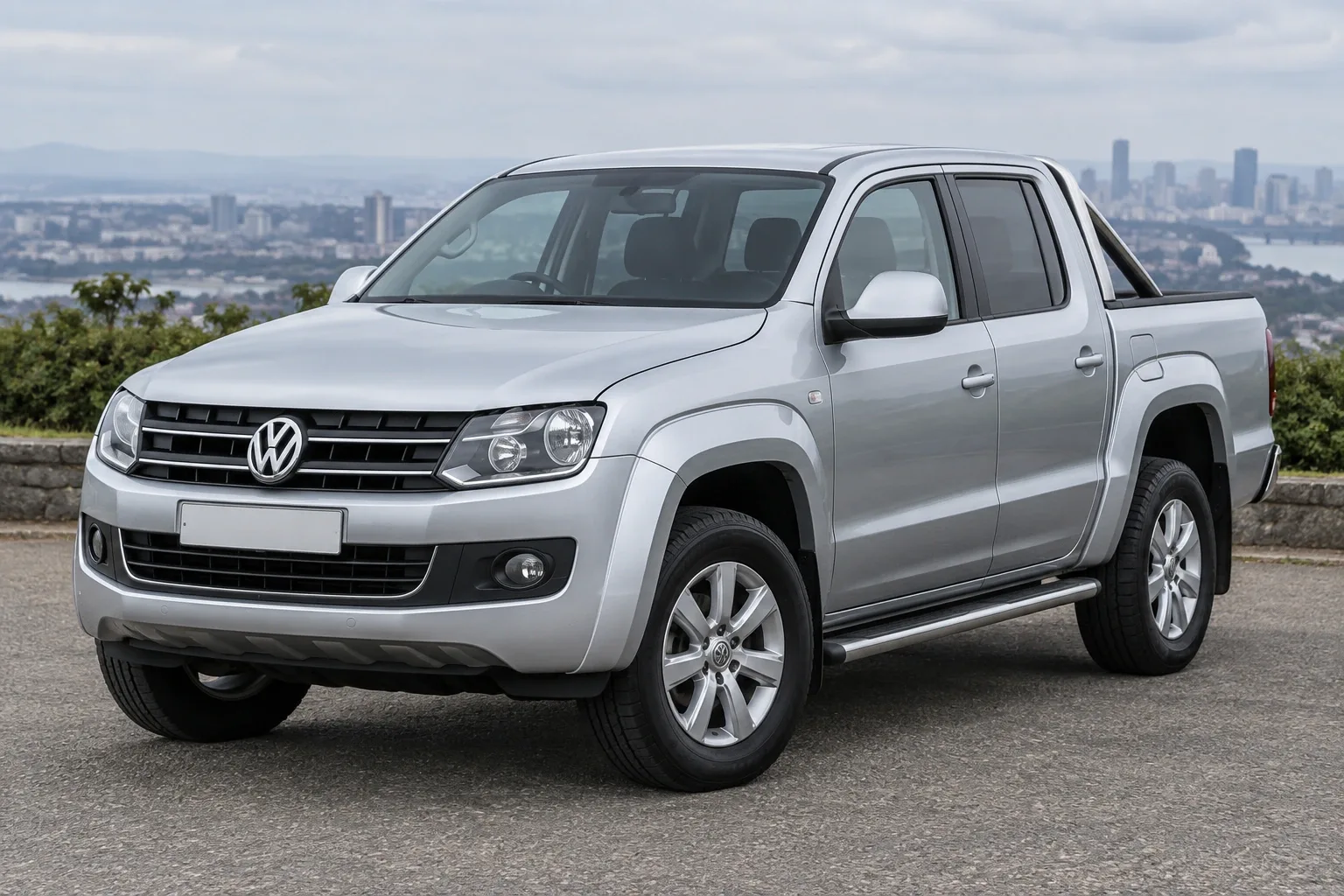
Volkswagen Amarok
Evaluation of Volkswagen Amarok (2010-2021): condition, documents, inspection and conditions of sale of the car.
Indicative purchase price
Below market value
Final price agreed after inspection.
Value my car1Why buyers choose this model
Amarok is not the first off-road pickup in Volkswagen history. In 1988-1996, the VW Taro was offered. It was just a redesigned Toyota Hilux.
2What buyers check
Review
Amarok is not the first off-road pickup in Volkswagen history. In 1988-1996, the VW Taro was offered. It was just a redesigned Toyota Hilux.
This time, Volkswagen has developed a frame pickup truck from scratch. The design was designed by Walter de Silva himself.
Amarok was originally produced in Argentina, South America. In the second half of 2012, an assembly line was opened for the European market in Hanover, Germany. From there, the cars were also delivered to Russia.
Until 2011, only dual-cab options were offered. Then came the version with a single cabin. It was distinguished by a simplified finish.
In the double cabin of the pickup truck is quite spacious even for rear passengers. More than a ton of cargo can be transported in the body. If this is not enough, you can use a trailer with a total weight of more than three tons (c automatic transmission).
The safety kit includes four pillows (front plus curtains) and electronic assistants - ABS, EDS, ASR with electronic differential lock and ESP.
In the Euro NCAP crash tests conducted in 2010, VW Amarok earned 4 stars. Experts considered insufficient protection of the chest during a frontal impact and a blow to the pole, as well as the neck when hitting the rear.
In 2016, the pickup truck experienced a small facelift.
In 2021, production of the model on the Hanover line was discontinued, and Amarok left the European and Russian markets. However, the pickup continued to be assembled in Argentina and Algeria (started in 2019).
Engines
The first pickups with a 2-liter turbo diesel with dual turbocharged BiTDI with a capacity of 163 hp came to the market. A little later, a version with a basic 2.0 TDI with one turbine recoil 122 hp appeared.
In 2011, the Europeans offered Volkswagen Amarok with a gasoline turbo engine 2.0 TSI return 158 hp.
Since 2013, the 2.0 TDI has developed 140 hp, and the 2.0 BiTDI has developed 180 hp.
With the restyling of 2016, the range was replenished with a 3-liter diesel engine in various power options: 163 hp, 204 hp, 224 hp and 258 hp. In Russia, the version of the return of 224 hp was officially supplied, and at the end of 2019, an irrational (in terms of transport tax) modification, developing 258 hp, joined.
2.0 TDI and 2.0 BiTDI
2-liter turbo diesels are the most widespread. The gas distribution mechanism is driven by a belt. The tooth belt is recommended to be updated every 60,000 km (25,000 rubles with work). In engines with CDBA, CNFA, CNFB, CDCA and CNEA indexes, there is another belt that serves to drive the oil pump. He works in hot oil. Mechanics recommend changing it after 150-200 thousand km. The belt itself is inexpensive - 1.5-2 thousand rubles. To access it, you need to lift the engine to remove the oil pallet. In 180-horsepower biturbodiesel with the CSHA index, gears are used instead of a belt to drive the oil pump. After 150-200 thousand km, we often had to face the disappearance of antifreeze without a trace. More often involved in this cooler UGR (18-26 thousand rubles). But sometimes the loss of antifreeze is to blame cracked head of the cylinder block (50,000 rubles for an analog or 143,000 rubles for the original). This problem is affected, first of all, diesel engines with double supercharging 2. 0 BiTDI. And after 200-300 thousand km no, no, and comes to the overhaul of the engine (from 100 000 rubles) due to increased oil consumption. When defective, wear was found in the cylinders, and the diesel engine was also "capitalized" due to faulty injectors. They started pouring fuel, which led to the melting of the piston. Fuel injectors (25-38 thousand rubles per piece) usually travel more than 200-250 thousand km. The sentence to the engine could be made and broken drive belt hinged units. His pieces fell under the belt of the timing system, and sometimes even a special protective casing did not save.
3.0 TDI
The 3-liter turbodiesel has not yet caused serious claims. There are complaints only about errors in the particulate filter and the operation of the regeneration system.
A reliable chain is used for the timing system drive.
Transmissions
The main was a 6-speed manual gearbox 0C6 development ZF.
The clutch of the manual transmission (20-26 thousand rubles) travels 150-250 thousand km. A similar resource and two-mass flywheel (30-45 thousand rubles). For the work on the replacement will take from 10 000 to 20 000 rubles.
A number of manual gearboxes required repairs at a distance of 200-300 thousand km. The owners preferred to search and install used unit (about 100 000 rubles).
Along with the manual transmission, an 8-speed automatic transmission ZF was offered. It became available in Russia since the end of 2012 and was combined exclusively with 2.0 BiTDI / 180 hp (ZF 8HP45) and 3-liter turbodiesel (ZF 8HP70).
The machine is quite tenacious. It has proven itself well in many other models of various brands. The main guarantee of longevity is regular oil renewal (15-20 thousand rubles for a set with oil).
However, it is worth noting that some owners complained of jerks, tremors during switching, or spontaneous withdrawal of the box into emergency mode. Some lucky people even managed to get a replacement box in the warranty period.
However, there were no mass cases of automatic transmission repair. If the machine still has to go through, then in a specialized service will have to leave more than 120 000 rubles.
All-wheel drive system
The least widely used were rear-wheel drive versions. The vast majority of the Volkswagen Amarok sold are all-wheel drive.
In machines with manual transmission, a rigid connection of the front axle (Part-Time type) and a lower gear in the transfer case were used.
In variations with automatic transmission, only permanent all-wheel drive with a Torsen type interaxial differential was used. The thrust between the front and rear axles was distributed in a ratio of 40:60.
All options were completed with an optional forced lock of the rear differential.
After 200,000 km can make noise SRUS front driveshaft. The original is only complete with a cardan (about 80 000 rubles). Contract shaft can be found for 16-20 thousand rubles.
A little later, it can fill the obilate of the tailings of the rear gearbox or the rear half of the axle. In the latter case, you will need to replace the hub bearing, in which the obular is built.
The transfer case of the Part-Time system is usually laid by fans of hard off-road. But long driving on the asphalt with the front axle connected also significantly reduces the service life of the unit.
The new handout costs astronomical money. The restored or used transfer box will be replaced with a faulty one if you pay about 60,000 rubles.
Walking
On the front axle there are double levers, and on the rear - a non-cut bridge on leaf springs. Most owners note a comfortable suspension and good handling (no worse than the mid-size crossover). Ball supports (upper and lower) run more than 100-150 thousand km and according to the regulations change in the collection with levers (7-11 thousand rubles). However, ball (1.5-3 thousand rubles per analogue) can be replaced separately. A little later, the Silentblocks of levers are surrendered (1-2 thousand rubles). After 100-150 thousand km, the turn and shock absorbers comes. Front will cost 10-17 thousand rubles, the rear more affordable - 2-7 thousand rubles. Over time, springs can creak. In this case, the earrings are changed by the Silentblock (1000 rubles). The original is assembled with an earring - 4000 rubles. From overload or frequent loads, the spring leaf can burst. The original is only in the collection (33,000 rubles for the spring). In the market of spare parts offer substitutes (8000 rubles for 2 sheets plus 5000 rubles work). Stage bearings often reach 150-200 thousand km. Front are changed separately: 2-6 thousand rubles plus 6000 rubles for work. The rear in the original are only assembled with a semi-axle (50,000 rubles), but in the service the bearing will be changed separately: about 5000 rubles and the same amount for work. Silent blocks of steering rack (400-700 rubles) become unusable after 100-150 thousand km. And after 150-200 thousand km in repair can go and the reika (knock, flow). For the restoration of its efficiency will have to pay 16-19 thousand rubles.
Other problems and malfunctions
Often owners complain about the weak paint coating. It bulges and peels off at the bottom of the doors and near the door handles. And the hood and wings are overgrown with chips.
Traces of corrosion can be found under the plastic linings of the thresholds. Red spots appear on the frame, but about any fatal consequences of speech yet.
The generator may require attention after 200-250 thousand km. For its bulkhead will ask 6-12 thousand rubles.
Sometimes the standard Webasto heater starts to fail or hum. Failures in operation are usually caused by oxidation of contacts on the control unit, or loss of contact on the control board (5-6 thousand rubles for soldering). Extraneous noise can be emitted by a recycling pump (7-17 thousand rubles).
Over time, the heater motor begins to make noise. In most cases, it is possible to get rid of noise after cleaning and lubrication. In extreme cases, the motor will have to be replaced (from 4000 rubles for an analog or 20 000 rubles for the original).
There are problems with the flaps of the climate installation: the traction breaks, or the servo drive fails (5-10 thousand rubles).
After 200-300 thousand km, the air conditioner compressor was repaired (20 000 rubles for a bulkhead or 20-40 thousand rubles for a new compressor).
3Pre-purchase checklist
2.0 TDI and 2.0 BiTDI
- The tooth belt is recommended to be updated every 60,000 km (25,000 rubles with work).
- Mechanics recommend changing it after 150-200 thousand km. The belt itself is inexpensive - 1.5-2 thousand rubles.
- To access it, you need to lift the engine to remove the oil pallet.
- But sometimes the loss of antifreeze is to blame cracked head of the cylinder block (50,000 rubles for an analog or 143,000 rubles for the original).
- This problem is affected, first of all, diesel engines with double supercharging 2. 0 BiTDI.
- km no-no, and comes to the overhaul of the engine (from 100 000 rubles) due to increased oil consumption.
- When defective, wear was found in the cylinders.
- Over time, the oil begins to poison the gasket of the valve cover and sealing rings under the nozzles. The cost of repairs will exceed 7000 rubles.
Transmissions
- A number of manual gearboxes required repairs at a distance of 200-300 thousand km.
- However, there were no mass cases of automatic transmission repair.
All-wheel drive system
- In the latter case, you will need to replace the hub bearing, in which the obular is built.
Walking
- The reiki itself can be repaired (knocking, flowing).
- There are problems with the pump GUR (from 7000 rubles for an analog to 27 000 rubles for the original). Repairs will result in the amount of 8-12 thousand rubles.
Other problems and malfunctions
- Traces of corrosion can be found under the plastic linings of the thresholds.
- Failures in operation are usually caused by oxidation of contacts on the control unit, or loss of contact on the control board (5-6 thousand rubles for soldering).
- There are problems with the flaps of the climate installation: the traction breaks, or the servo drive fails (5-10 thousand rubles).
- km had to repair the air conditioner compressor (20 000 rubles for bulkhead or 20-40 thousand rubles for a new compressor).
4Challenges of selling privately
Before buying a Volkswagen Amarok should be carefully checked. Many of the units served as workhorses in commercial parks. 2-liter double-charged diesels are potentially less reliable. The most preferred cars with a 2-liter turbodiesel and one turbine. 3-liter turbodiesel in addition to reliability will please with good dynamics.
- Amarok is not the first off-road pickup in Volkswagen history. In 1988-1996, the VW Taro was offered.
- Engines: The first pickup trucks with a 2-liter turbo diesel with dual turbocharged BiTDI with a capacity of 163 hp came to the market.
- A number of manual gearboxes required repairs at a distance of 200-300 thousand km.
- All-wheel drive system: In the latter case, you will need to replace the hub bearing in which the obular is built.
- Walking: km in repair can go and the reika itself (knock, flow).
- Other problems and malfunctions: Traces of corrosion can be found under plastic sill linings.
Shows, bargaining and re-registration take time: buyers look, promise to think and disappear. Fair price after inspection closes the auction on the spot. If money is needed urgently, the purchase takes away waiting and repeat displays.
5How selling to us works
Leave a request with the car data. We will discuss the preliminary assessment and inspection. After checking the status and documents, we agree on the final price and terms of the transaction.