
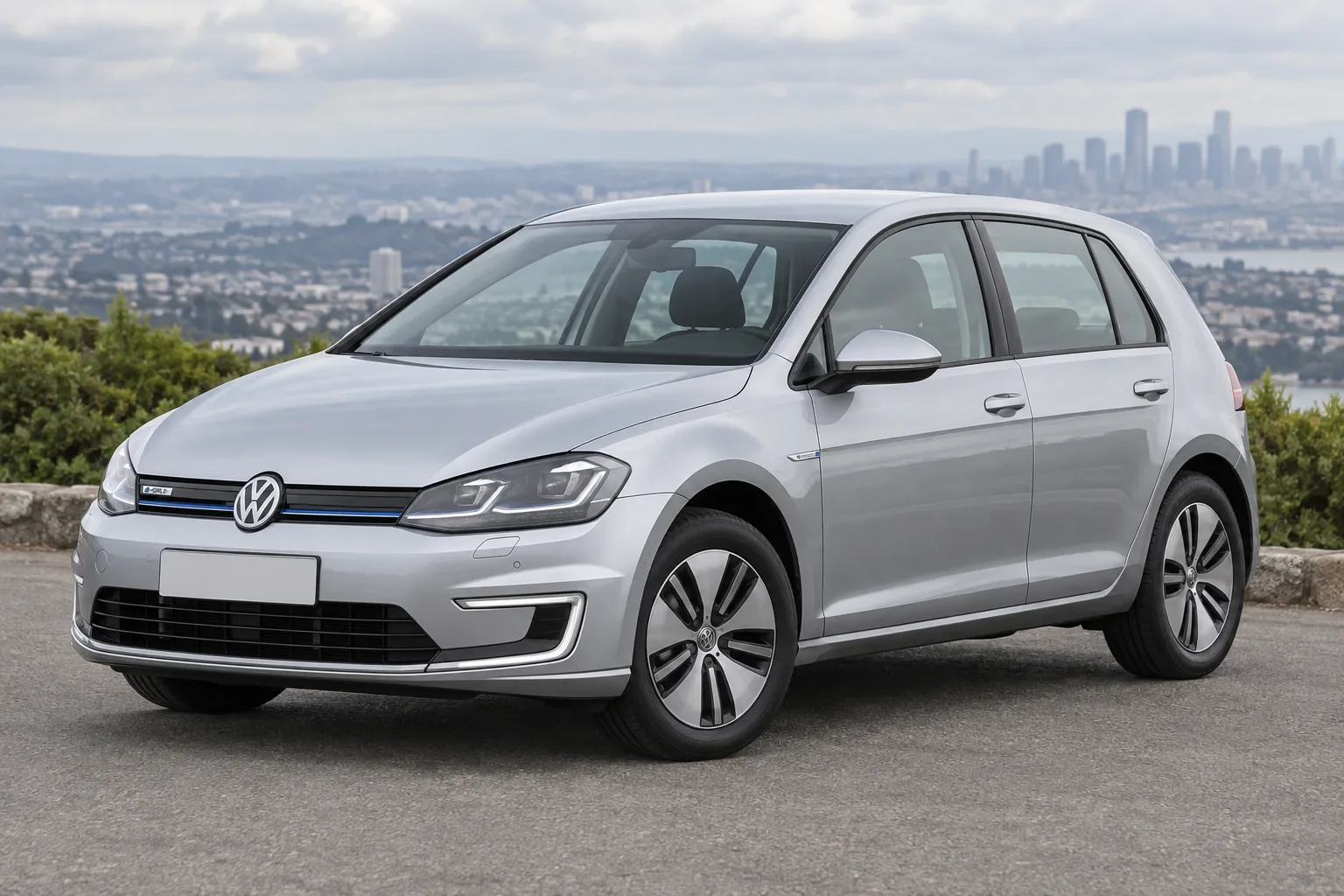
Volkswagen e-Golf 7
Evaluation of the Volkswagen e-Golf 7 (2012-2021): condition, documents, inspection and conditions of sale of the car.
Indicative purchase price
Below market value
Final price agreed after inspection.
Value my car1Why buyers choose this model
The seventh-generation electric Golf went on sale in early 2014 and quickly became one of the best-selling electric vehicles in Europe. In Norway, subsidies sold it even better than the conventional combustion engine version. The reason for this popularity is not difficult to guess. In addition to the favorable price, the car is almost identical to the base model. It does not differ either externally or in controllability. A person who is not used to electric cars can sit in an e-Golf and feel the same as in a Golf with a “automatic”. Even the gearbox selector is almost the same.
2What buyers check
Power reserve.
In the first three years of production (2014-2017), the e-Golf was equipped with a 24.2 kWh lithium-ion battery. According to the manufacturer, he could travel 190 kilometers, but in reality the power reserve was in the range of 130-150 km.
The 2017 facelift significantly increased the range as the e-Golf was equipped with a 35.8 kWh battery. With it, it is able to overcome about 200 kilometers in real conditions or even 300 kilometers in the city.
When choosing a used car, you should pay attention to the version with an optional heat pump, which allows you to significantly save energy during heating. Waste heat is used for heating here. The heat pump is more common in updated models, older versions were usually sold without it.
The conventional resistive (electric) heater with a capacity of 5.5 kW in the standard version significantly reduces the power reserve in winter.
Design features
Volkswagen took the regular Golf 7 and made minimal changes to it. The body is mostly identical, but the gender differs significantly. For example, there is much less space under the seats in the back. This was necessary in order to place under the floor a bulky battery block. The central tunnel was also raised a little to accommodate the electronics.
Below you can see a fully enclosed chassis with a battery pack screwed up by massive bolts.
The rest is the same, even the engine mounts are identical. So you can simply abandon the electric motor, and install an internal combustion engine in its place without any problems.
Most parts are suitable from the regular Golf, unlike, say, the electric Fiat 500e, which has almost nothing to do with the version with the internal combustion engine.
The e-Golf has very good driving qualities, similar to the versions with an internal combustion engine, and the characteristics of the electric motor make it very dynamic. What’s more, even by the standards of electric vehicles, it’s very quiet at all speeds, including the speed limit on the freeway, which is not a given, as the Hyundai Kona makes clear.
Battery
But unfortunately, the electric Golf has a feature characteristic of older electric vehicles. Namely, the battery block under the floor is not cooled or heated, although liquid cooling was originally envisaged during the development. The cells of the package placed in an aluminum case are heated and expanded during operation. However, they have nowhere to go, which further increases the temperature and evaporates the electrolyte. This can be seen, for example, when driving on the freeway in summer, when the Golf cannot charge at a higher power level (usually not more than 20 kW) after connecting the car to a fast charger. In this case, you need to wait a few tens of minutes for the battery to cool down enough again. When the battery temperature rises to 60°C, the available power of the motor decreases. First of all, it affects the battery life. If their temperature often exceeds the ideal norm (15-35 °C), degradation occurs more quickly. But it is the battery life (ie, its residual capacity) should be of interest to those who want to purchase a used e-Golf. Replacing a battery is extremely expensive and economically inexpedient. Finding out the state of health (SOH) setting, i.e. the percentage of remaining battery capacity, is not so easy. While in other brands, this information can be read by anyone using diagnostics or even using the OBD2 connector with bluetooth and mobile app, Volkswagen hides it.
E-Golf 24.2 kWh/85 kW (24.2 kWh, 85 kW (115 hp), 270 Nm, 2014-2017)
The front electric motor received a power of 85 kW, which means a top speed of 140 km / h and acceleration from zero to 100 km / h in 10.4 seconds. From a household outlet, it charges in ten and a half hours, the on-board charger produces a maximum of 3.7 kW and only one phase. When using a 380V wall block or cable, it charges in less than seven hours.
E-Golf 35.8 kWh/100 kW (35.8 kWh, 100 kW (136 hp), 290 Nm, 2017-2020)
The updated version managed to squeeze into the same space a battery with a capacity of 35.8 kWh, of which approximately 31.5-32.5 kWh are usable. The engine power increased to 100 kW, which allowed to increase acceleration to 9.6 seconds and a maximum speed of 150 km / h. The power of the on-board charger has grown to 7.2 kW, it operates in two phases and is charged in five hours. However, from the household outlet, it has been charging for sixteen hours. Fast charging remained the same – 40 kW and about 40 minutes to charge from 10 to 80%.
Cons
Higher charge consumption in versions without a heat pump
Service recommendations
The service interval for e-Golf is 12 months or 30,000 km. During the inspection, the condition of the 12-volt battery, the condition of the brakes, as well as the condition of high-voltage and charging cables are diagnosed.
Every 60,000 km or two years, the cabin filter and brake fluid are replaced, and the condition of the electric motor and traction battery is checked.
Every four years, a chassis inspection and fluid leak monitoring are required.
Electro-Golf 1 (1976)
The electric Golf has a surprisingly long history, with the first prototype being unveiled in 1976. He had to be content with an electric motor with a capacity of 20 kW (27 hp), with which he could accelerate to 80 km / h. Lead-acid batteries with a capacity of 13.4 kW/h provided a power reserve of about 50 km. They were placed in the rear seats, so the first-generation Golf electric car was only a two-seater. Only a few were produced, which Volkswagen tested in the following years.
Golf I CitySTROMer (1981)
On the basis of the first generation, a more advanced version was released, which had lead-acid batteries in the trunk and space for four passengers. At the same time, the weight almost doubled - up to 1500 kg compared to the version with the ICE. Despite the lower battery capacity of 11.4 kWh, the range increased to about 60 kilometers, and the maximum speed with a 24-kilowatt electric motor (33 hp) – up to 100 km / h. 25 Golfs were built, of which 20 were used as utility vehicles by RWE.
Golf II Citystromer (1985)
70 of these were built, which were used again as utility vehicles by power companies and then sold to private owners.
Golf III CitySTROMer (1993-1996)
The third generation Golf became the basis for the electric car, which could already be called serial, since it was first offered to the general public. However, it cost twice as much as a car with an internal combustion engine. A total of 120 copies were produced. It was developed in collaboration with Siemens and carried 96-volt lead-gel batteries with a capacity of 17.3 kWh under the hood and under the boot floor. A few thirds of electric golfs are still in operation in Europe.
Golf VI Blue-e-Motion (2010)
It received a lithium-ion battery with a capacity of 26.5 kWh with a power reserve of about 150 km. Installed in front of the 50-kilowatt electric motor (for a short time 85 kW (115 hp)) could accelerate the car to 135 km / h. Several more prototypes were built, which were even given to journalists for testing. However, mass production never came to fruition, and the first modern electric car Volkswagen became the e-Up in 2013.
2013: The production version of the e-Golf was presented at the Frankfurt Motor Show.
2014: Launch of sales in Europe in February, in the US in November It was offered with a 24.2 kWh battery and an 85 kW electric motor.
2017: Facelift, which included increasing the battery capacity to 35.8 kWh and increasing the power of the electric motor to 100 kW.
BMW i3 I01 (2013-2022)
The stylish BMW electric car has been produced with minor updates for nine years. Due to the great popularity of the model, it is presented wider than the e-Golf, and the prices for the cheapest copies have already fallen below the mark of 1,500,000 rubles.
Three types of batteries were consistently available. The oldest and cheapest (until 2017) are content with just 18.2 kWh and a range of about 130 km, and the newest (since 2019) already have a battery larger than Volkswagen.
Unique in the world of electric vehicles are the REX versions with a two-cylinder internal combustion engine, which serves as an energy generator for the battery.
Kia Soul EV (2014-2019)
After the upgrade in 2017, the capacity increased to 30 kWh, and the power reserve exceeded 200 km. The advantage is a large and practical cabin, and since 2017 - the ability to quickly charge 100 kW. In the domestic offer is usually about a dozen copies, the cheapest already cost below 1,500,000 rubles.
Renault Zoe ZE/ZE40 (2012-2019).
From 2016 to 2019, a modernized version of the ZE40 with a 41 kWh battery was sold, with which it could travel for 300 km. The cost of used ZE40 starts from 2 300 000 rubles, and older ZE with smaller batteries (more expensive than 1 000 000 rubles) are practically not found among the ads. Beware of suspiciously cheap specimens from abroad, the price can be quoted without the battery.
Skoda Citigo IV (2019-2020)
Although it is built on the basis of a smaller Volkswagen, its battery is slightly larger than the e-Golf, which means that it has a larger range. There are almost no sales announcements.
Technical characteristics of the VW e-Golf
Combined energy consumption - 15.3 kWh/100 km
3Pre-purchase checklist
Power reserve.
- When choosing a used car, you should pay attention to the version with an optional heat pump, which allows you to significantly save energy during heating.
Design features
- This was necessary in order to place under the floor a bulky battery block.
- So you can simply abandon the electric motor, and install an internal combustion engine in its place without any problems.
Battery
- In this case, you need to wait a few tens of minutes for the battery to cool down enough again.
- Replacing a battery is extremely expensive and economically inexpedient.
- While in other brands, this information can be read by anyone using diagnostics or even using the OBD2 connector with bluetooth and mobile app, Volkswagen hides it.
- Mechanics specializing in the repair of electrified cars estimate that the battery capacity decreases by 10% after every 18,000 kilometers of mileage.
- However, it should be taken into account that the number displayed on the display also takes into account the previous trip.
- Those who need fast charging more often should make at least one in three charges on slow alternating current.
- There are no problems with the rest of the car.
- The electric motor, power electronics and charger have liquid cooling, and there were no problems.
Service recommendations
- During the inspection, the condition of the 12-volt battery, the condition of the brakes, as well as the condition of high-voltage and charging cables are diagnosed.
- Every 60,000 km or two years, the cabin filter and brake fluid are replaced, and the condition of the electric motor and traction battery is checked.
- Every four years, a chassis inspection and fluid leak monitoring are required.
4Challenges of selling privately
We may be on the cusp of a new era of electromobility. If you want to get in now and don’t want to spend millions on a new car, you can choose one of the most affordable paths to an electric car – a used Volkswagen e-Golf.
The e-Golf list of offers is mainly from the companies’ fleets, white, with reasonable equipment including heated seats and LED headlights.
Today, the prices for used electric versions have reached the mark of 1,500,000 rubles for the oldest models, and the e-Golf is fresher with a mileage of less than 100,000 km can be bought for 2,000,000 rubles.
The facelift version with a more capacious battery will offer a really useful power reserve - really about 250 km. And this is enough not only for a calm and harmless movement around the city, but also for long trips on the freeway.
The still-modern-looking Golf will certainly serve as a city car for many years to come without much maintenance. The biggest concern for the future owner is the battery. It may still be in good condition, but if something in the future will knock the car out of order, it will probably have to spend money on replacing it.
- Range: In the first three years of production (2014-2017), the e-Golf was equipped with a 24.2 kWh lithium-ion battery.
- Design features: So you can simply abandon the electric motor, and install an internal combustion engine in its place without any problems.
- Battery: Replacing a battery is extremely expensive and economically inexpedient.
- Cons: Higher charge consumption in versions without a heat pump
- Service recommendations: Every 60,000 km or two years, the cabin filter and brake fluid are replaced, and the condition of the electric motor and traction battery is checked.
- Golf II Citystromer (1985): 70 of this generation were built, which were again used as utility vehicles by power companies and then sold to private owners.
- Specifications of the VW e-Golf: Combined energy consumption - 15.3 kWh/100 km
Shows, bargaining and re-registration take time: buyers look, promise to think and disappear. Fair price after inspection closes the auction on the spot. If money is needed urgently, the purchase takes away waiting and repeat displays.
5How selling to us works
Leave a request with the car data. We will discuss the preliminary assessment and inspection. After checking the status and documents, we agree on the final price and terms of the transaction.