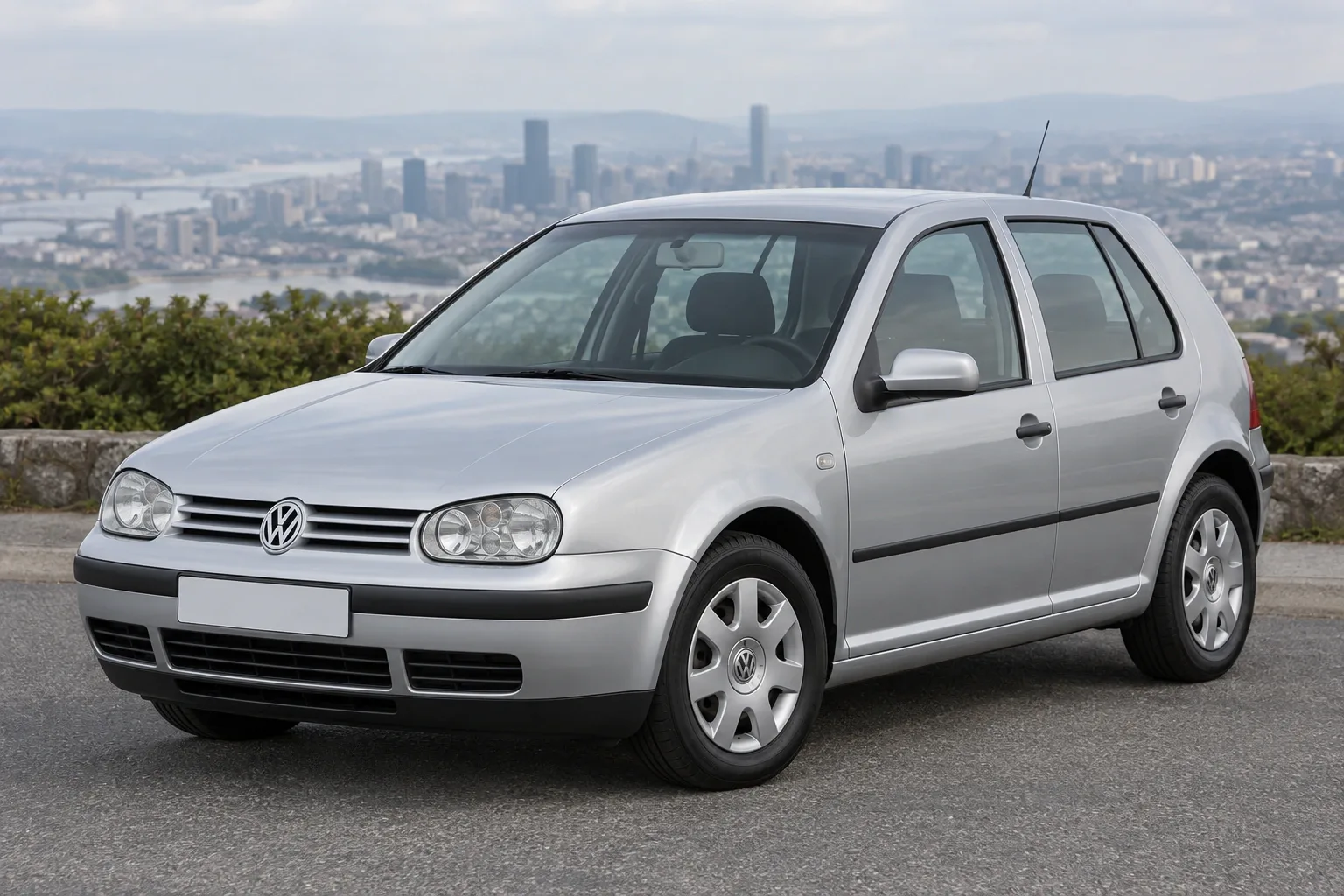
Volkswagen Golf 4
Evaluation of the Volkswagen Golf 4 (1997–2003): condition, documents, inspection and conditions of sale of the car.
Indicative purchase price
Below market value
Final price agreed after inspection.
Value my car1Why buyers choose this model
A few years ago, the fourth Volkswagen Golf was the most popular car in the secondary market, along with the VW Passat B5. Today, many buyers are opting for more modern varieties of Golf, but the fourth generation still has a lot to offer. This is one of the best options for those looking for an inexpensive, compact and cheap car to repair and operate. The model was launched into production in September 1997. Despite the great similarity with the Golf 3, the fourth Golf was not a deep restyling, but an independent model. It was built on the new A4 platform, which formed the basis of the VW New Beetle, Skoda Octavia, Audi A3, Audi TT, SEAT Leon, SEAT Toledo. Golf IV had many common units and assemblies. The fourth-generation VW Golf family is quite diverse. Actually, the Golf 4 itself was offered in the back of a three- and five-door hatchback. The wagon, which went on sale in May 1999, was traditionally called the Golf Variant. The sedan, which was put on the conveyor in September 1998, bore the name Bora (for the American market - Jetta) and was distinguished by other external body parts. Bora Variant differed from Golf Variant elements of the front of the body. And the Golf Cabrio was, in fact, the previous model, that is, the Golf 3, which underwent a facelift in the style of the Golf 4. Basic equipment could boast at least two airbags, seat belts with pyrotechnic tensioners, ABS, electric windows and mirrors. In addition to the base, three main packages were also introduced: Comfortline, Trendline and Highline. Since September 1999, it was possible to order the ESP exchange rate stability system. On later versions, it is quite common to find not only side airbags placed in the backs of the front seats, but also window ones. As a result, one of the best indicators in the class for passenger safety.
2What buyers check
Engines
A wide range of power units opens the engine with a volume of 1.4 liters and a capacity of 75 liters. with. Fans of a ride with the breeze this unit is clearly not suitable. In order not to get out of the flow, it constantly has to be twisted, which, accordingly, affects the resource. Among the disadvantages are the clogged ventilation system of crankcase gases and a large oil consumption (wear of piston rings). Following it is an 8-valve 1.6-liter engine with a capacity of 100 hp and a 105-horsepower version with 16 valves. Both with distributed fuel injection. These engines are the most common for the Golf 4, they are also recognized as the most successful. The engine can pass without serious interventions more than 300,000 km. The main thing is to change the oil in time, monitor its level and not overheat the engine. Of the characteristic "sicknesses" it is worth highlighting the flow of antifreeze through cracked plastic pipes of the cooling system and the thermostat body, malfunctions of the throttle and ignition coils. The 8-valve version was best recommended. With the same literage produced and the FSI engine with a capacity of 110 liters. with. It has direct injection and is poorly adapted to our operating conditions. The main problems of this engine are fuel equipment, which often fails due to poor-quality gasoline (recommended 98th gasoline), and the cost of troubleshooting is much higher than on engines with distributed injection. The engine suffers from the formation of soot on the valves, ailments of electronics and short-lived elements of the gas distribution mechanism.
Transmission
The Volkswagen Golf 4 offered 5- and 6-speed manual transmissions, as well as 4- and 5-speed automatic transmissions. The latter could boast of the function of manual speed switching. All the boxes are quite reliable. On the mechanical gearbox, the gearshift lever is sometimes unbalanced. "Treatable" in most cases by replacing the switching mechanism (about $ 160 with work). On many "boxes" with a 1.6-liter engine, it is often difficult to turn on the first gear. The oil in the “mechanics” is recommended to be changed every 90,000 km, and the replacement of the clutch depends on the style of driving and the experience of the person sitting behind the wheel. The average figures are 120,000-200,000 km. In the "automatic machines" to change the oil every 60 000 km, and pour only recommended by the plant. But there are nuances. When buying, you need to find out from the seller with what frequency he updated the oil in the automatic transmission. It does not change completely, but partially, since the new in most cases, having high detergent properties, dissolves the old sediments and disables the box. Don’t believe the services that claim that the oil is poured for the entire life of the box. Starting with a 1.8-liter engine, it was optionally possible to order 4 MOTION all-wheel drive. In versions with a motor of 2.8 liters and R32, it was already in the basic configuration. All-wheel drive makes the VW Golf 4 extremely resistant on slippery roads and gives an unforgettable driving experience. The flip side of these modifications is the complexity of maintenance and the high cost of spare parts related to all-wheel drive elements.
Walking
The chassis of most Volkswagen Golf 4 has a simple design, it is reliable, inexpensive to maintain and quite comfortable for its class. The front suspension was McPherson, and the rear had options. On the front-wheel drive versions, a simple H-shaped beam was used, and in the presence of all-wheel drive, a multi-link suspension was installed, complicating and increasing the cost of maintenance.
Wear suspension directly depends on the driving style and speed of passage of the pits. The first to make themselves felt racks and bushings of the stabilizer - on average every 50-60,000 km. But the cost of spare parts and works is a penny - about $ 60 for everything. When driving actively to 150 000 km can "die" shock absorbers ($ 150 with work). The rest of the suspension elements on average serve more than 100,000 km. The front pads (depending on the style of driving) "walk" 20–30 thousand km, and the discs – 80–90 thousand km. The rear pads "live" about 60-70 thousand km. Repair suspension is not burdensome in financial terms, as today there are quite a lot of substitutes in various price ranges.
With age, the steering rack begins to knock.
Body and salon
Body Golf 4 without exaggeration can be called the reference in its class. Thanks to galvanizing, the manufacturer gave a 12-year warranty against end-to-end corrosion. The chips of paint to metal, which survived several Moscow winters, did not give rise to rust. All body panels are perfectly adjusted, and the gaps between the elements are minimal. As a result, there is almost no aerodynamic noise at any speed. So if you have a car with corrosion, then most likely it was in an accident and was poorly restored. The only drawback is the freezing of doors in the openings when the temperature passes through 0 ° C. The manufacturer even produced a special lubricant, which made it a little easier to penetrate the cabin. The interior is strict and comfortable for its class. Many adjustments allow you to find the right position behind the wheel of a driver of any height. The center console a la BMW is deployed towards the driver. From ergonomic miscalculations - the inconvenience of using a climate control unit. It is out of sight of the driver, you have to be distracted by the buttons while driving. In the configurations with mechanical control of the "climate" there is no such problem. The disadvantages of the cabin are scuffling on the plastic of the doors and on the edges of the front panel. With age, the plastic of the cabin begins to creak. At the end of production, the build quality improved somewhat. Due to the age and huge mileage (counters are twisted several times, which is very easy to do in this model), the state of the seats, steering wheel and gear lever is often not the best.
Typical problems and malfunctions
Electricity is not a big deal. Although often fails the motor of the rear "janitor". The trapezoid of the front windshield wiper may sour. Many people try to lubricate it, but it either doesn’t help or helps temporarily (“treated” by replacing the trapezoid – an average of $100 with work).
The stop light switch located in the pedal assembly may also fail. Often before failure, it lights various control lamps on the dashboard, related to stabilization and braking systems, but it works itself. When the brake signals are completely broken, they go off. In the presence of automatic transmission in addition to the "stops" is blocked selector box - and the car immobilized. In order not to call the tow truck, you can try to throw the chip off the switch, most likely the selector will be unlocked. The cost of the switch is $15, the replacement work is $10.
Cars produced before mid-2001 often had defects in windows. In addition, the climate control display, electric windows and the central lock may fail.
3Pre-purchase checklist
Engines
- Among the disadvantages are the clogged ventilation system of crankcase gases and a large oil consumption (wear of piston rings).
- Of the characteristic "sicknesses" it is worth highlighting the flow of antifreeze through cracked plastic pipes of the cooling system and the thermostat body, malfunctions of the throttle and ignition coils.
- The main problems of this engine are fuel equipment, which often fails due to poor-quality gasoline (recommended 98th gasoline), and the cost of troubleshooting is much higher than on engines with distributed injection.
- These powertrains are more complex and expensive to repair, although they have a pretty decent resource.
- They are available for sale, usually when it comes time for major repairs.
- It will cost $100 if the mechanical part fails and $400 if the electrical part fails.
- A conventional turbine will cost about $150 to repair, and with variable geometry, $300.
- The new components are on average twice as expensive to replace a two-mass flywheel with a clutch will cost $ 600.
Transmission
- The oil in the “mechanics” is recommended to be changed every 90,000 km, and the replacement of the clutch depends on the style of driving and the experience of the person sitting behind the wheel.
- In the "automatic machines" to change the oil every 60 000 km, and pour only recommended by the plant. But there are nuances.
- When buying, you need to find out from the seller with what frequency he updated the oil in the automatic transmission.
Walking
- Wear suspension directly depends on the driving style and speed of passage of the pits.
- Repair suspension is not burdensome in financial terms, as today there are quite a lot of substitutes in various price ranges.
Body and salon
- Thanks to galvanizing, the manufacturer gave a 12-year warranty against end-to-end corrosion.
- The chips of paint to metal, which survived several Moscow winters, did not give rise to rust.
- So if you have a car with corrosion, then most likely it was in an accident and was poorly restored.
- In the configurations with mechanical control of the "climate" there is no such problem.
- The disadvantages of the cabin are scuffling on the plastic of the doors and on the edges of the front panel.
Typical problems and malfunctions
- Although often fails the motor of the rear "janitor".
- In addition, the climate control display, electric windows and the central lock may fail.
4Challenges of selling privately
The fourth-generation VW Golf has retained all the advantages of its “ancestors”, adding comfort and significantly increasing active and passive safety, which somewhat complicated the on-board electronics, which sometimes fail. Otherwise, high reliability and excellent maintainability, combined with affordable prices for spare parts, make the car one of the best options in the class for purchase on the secondary market.
- Engines: Among the disadvantages are the clogged ventilation system of crankcase gases and the high oil consumption (wear of piston rings).
- Transmission: The oil in the “mechanics” is recommended to be changed every 90,000 km, and the replacement of the clutch depends on the driving style and experience of the person sitting behind the wheel.
- Driving: The wear of the suspension directly depends on the driving style and the speed of passing the pits.
- Body and salon: Thanks to galvanizing, the manufacturer gave a 12-year warranty against through corrosion.
- Typical problems and malfunctions: Although often the motor of the rear "janitor" fails.
Shows, bargaining and re-registration take time: buyers look, promise to think and disappear. Fair price after inspection closes the auction on the spot. If money is needed urgently, the purchase takes away waiting and repeat displays.
5How selling to us works
Leave a request with the car data. We will discuss the preliminary assessment and inspection. After checking the status and documents, we agree on the final price and terms of the transaction.