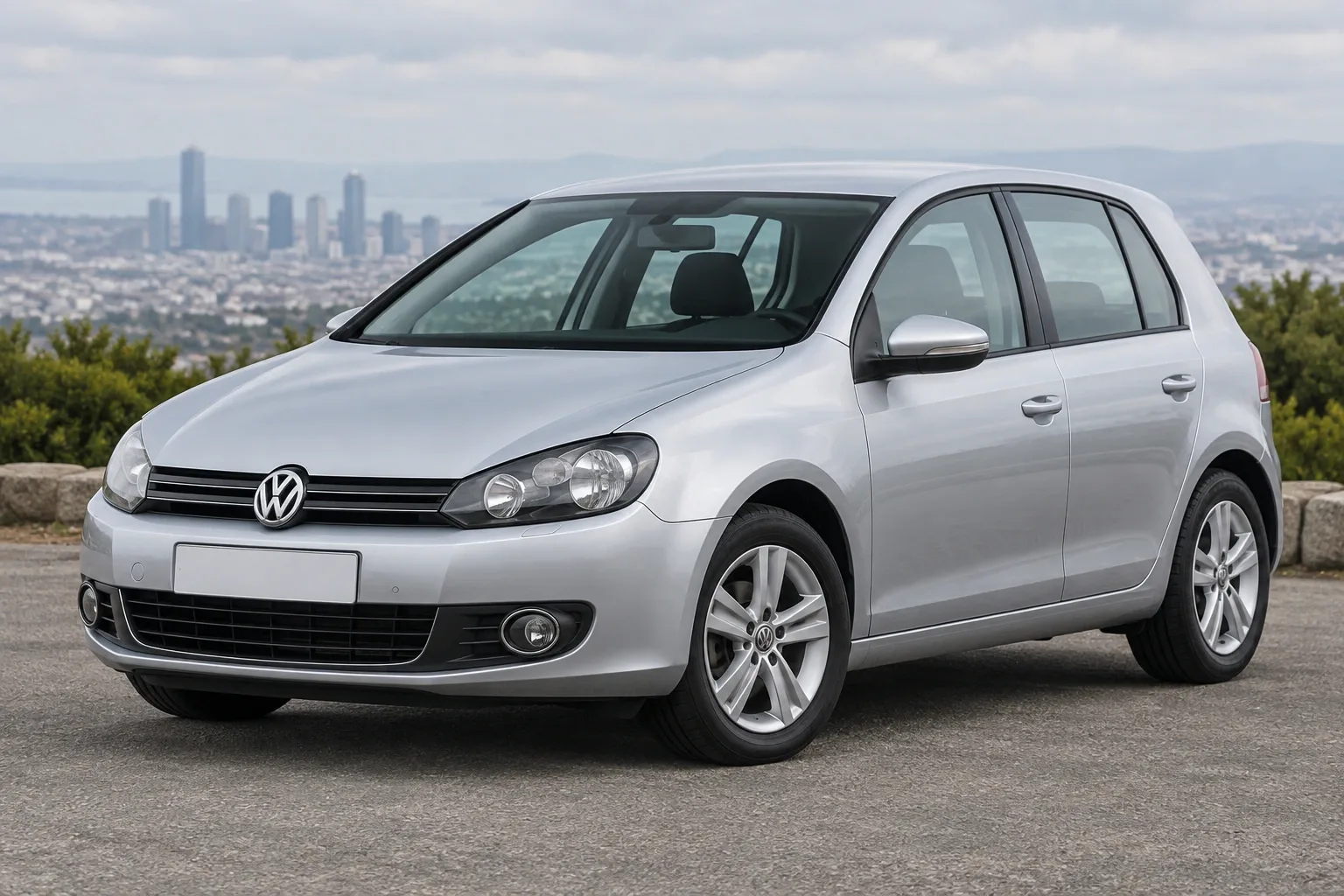
Volkswagen Golf 6
Volkswagen Golf 6 (2008–2013): condition, documents, inspection and conditions of sale of the car.
Indicative purchase price
Below market value
Final price agreed after inspection.
Value my car1Why buyers choose this model
Many people have wondered what really makes the Volkswagen Golf the sixth generation from the fifth. The car was launched in October 2008 and was built on the same platform as its predecessor, the A5 (PQ35). Golf 6 was going in the back of a 3- and 5-door hatchback, station wagon and convertible. Thanks to the updated front part, the sixth generation model began to look much more dynamic than its predecessor. The Volkswagen Golf 6 stands out from its competitors. Even though the boot capacity is slightly smaller than that of rivals, the Golf never gave up the position of a popular family car. At least in Europe.
2What buyers check
Engines
1.4 l / 80 hp / 16 valves - since 2008;
1.6 l / 102 hp / 8 valves - since 2008;
2.0 TSI / 211 hp - since 2009, the sports version of the GTI;
2.0 TSI / 271 hp - since autumn 2009, Golf R 2.0;
2.0 TSI/235 hp – limited edition for the Golf GTI “Edition 35” since 2011.
Gasoline engines
The base was a time-tested 4-cylinder 16-valve 1.4-liter unit. If speed is not the main thing for you, then the VW Golf 6 with this engine will take you anywhere. Compared to the technically complex TSI, the atmospheric is very reliable. Its undeniable advantages are simple design and inexpensive service. However, sometimes after 200-250 thousand km the engine begins to "take" oil. 8-valve 1.6-liter unit is the latest evolution of the engine, known even from the first Octavia. The engine is more fast, but also more voracious. After 200,000 km, he also begins to consume oil. For bulkhead with the replacement of rings in the service will ask 70-90 thousand rubles. In 2010, to replace the gasoline aspirated engines with a volume of 1.4 and 1.6 liters, a turbo engine 1. 2 TSI was prepared. But because of numerous problems with the “newcomer” in Volkswagen and did not dare to completely abandon the old units. All three engines were offered at the same time. The main problem 1. 2 TSI is premature wear of the chain-type timing system drive. The noise will tell you about the problem at launch. Another disadvantage is the failure of the actuator of the turbocharger. There are problems with the TNVD (14-18 thousand rubles). Another problem is the increased consumption of oil. The manufacturer has modified engine control software several times to prevent this disaster. In some cases, there was even a drop in the degree of compression due to the "imprinting" of valves into the head (low-quality material). Also, when frequent traffic in the city, gasoline gets into the oil, which leads to the appearance of sediments. 1.
Diesel engines
Traditionally, the least popular in Russia are diesel units. However, German turbo diesels have proven themselves well. At least the mechanics and iron are very reliable. But it wasn't entirely without problems. VW offered a choice of two 4-cylinder 2.0 TDIs. The Mk6 was equipped with engines exclusively with the Common Rail injection system. The fundamental difference between the 110-horsepower and more powerful 140-horsepower (and since 2003, 170-horsepower) unit in the absence of a balancing shaft in the weakest version. The presence of a balancing shaft means the presence of a small hexagonal shaft responsible for driving the oil pump. In the past, a gentle knot has brought to death not a dozen blocks. But by the time Golf 6 came out, the problem had already been solved. In 2008, the manufacturer increased the shaft and began to make it from more durable materials. In 2009, 1.6 TDI was added to the list of offers. In its design, it resembles a 2-liter turbodiesel, only without a balancing shaft. The little TDI is very reliable. He doesn’t like it when someone “flys” on him all day on the left lane of the country highway. Such regimes significantly reduce its resource. Originally, the 2.0 TDI was equipped with piezoelectric nozzles. But there are modifications and electromagnetic nozzles (it all depends on the year of release and engine code). Like all Common Rail nozzles, they only require quality diesel fuel. Electromagnetic injectors are about a third cheaper. 1. 6 TDI uses only electromagnetic injectors. Resource - over 200,000 km.
Transmission
Golf 6 has a few triumphant things to do. First of all, it is a proprietary 4MOTION all-wheel drive system. None of the class rivals can boast of anything like this. Interestingly, the Golf offers permanent all-wheel drive since the second generation. The sixth version uses an electro-hydraulic multi-disc coupling Haldex fourth generation.
All-wheel drive system is standard equipment of the hottest modification with the letter R. Civil versions could get 4Motion only in the presence of diesel units 1.6 TDI (105 hp) and 2.0 TDI (140 hp). All-wheel drive modifications appeared in the list of proposals in 2009. While conventional cars with 1.6 TDI were serially equipped with a 5-speed manual transmission, all-wheel drive – 6-speed.
Transmissions
Many Volkswagen Golf VI are equipped with an automated gearbox with dual clutch DSG. Definitely, a 6-speed DSG with wet clutches is an order of magnitude more reliable than a 7-speed DSG. The first is available only with 2.0 TSI and 2.0 TDI engines.
Weaker engines could only be combined with DSH7. This kind of bundle makes sense, unless you plan to push around in traffic jams often. Otherwise, large investments in repairs after 100-150 thousand km are guaranteed.
Cheapest repair / replacement of mechatronics - about 30-65 thousand rubles. To eliminate the consequences of the destruction of the fork 6th and rear gear may need 90-130 thousand rubles.
The DSH clutch runs over 100-150 thousand km. The new set is available for 35-50 thousand rubles. In the case of wear of the flywheel, costs will increase by 30-50 thousand rubles.
After 150-200 thousand km, sometimes a manual transmission also fails - a hum appears due to premature wear of bearings. For repairs will ask about 30-50 thousand rubles.
The clutch of the manual transmission can make noise (the so-called "tarakhtun") after 100,000 km. The new modified clutch is available for 16-24 thousand rubles.
Transmission maintenance
The automated DSG transmission requires an oil change every 60,000 km. We should not forget about the periodic adaptation of the clutch.
Updating the liquid is also necessary for the Haldex clutch (through 40-60 thousand km). The transmission fluid must comply with the specification VW G 060 175 A2.
In the manual transmission, oil should be changed every 80-100 thousand km, and in the automatic transmission - after 60-80 thousand km.
Suspension
From the very beginning, the sixth generation of the model received as many as four versions of the suspension. In addition to the standard, was provided reinforced (for increased loads), sports and, finally, adaptive ACC with shock absorbers variable stiffness. The latter offered three rigidity modes: comfortable, standard and sports.
However, the standard chassis provides the optimal compromise between comfort and handling. Classic shock absorbers (2-6 thousand rubles) care for up to 150-200 thousand km. The resource of adaptive ones is only slightly less, but they cost twice as much.
There are also differences in the front suspension. At first, steel levers copied from the fifth generation model were used. During the production process, they were replaced with aluminum. It depends on the engine. In some versions, new levers began to be installed in the autumn of 2008, and in others - in the spring of 2010.
In any case, the levers, balls and bushings are completely interchangeable. Moreover, ball supports (2-4 thousand rubles) have a rather high service life, even exceeding the resource of the front axle silent blocks (100-150 thousand km). The back-lever silentices are almost eternal.
In general, the suspension of the Golf in terms of endurance is considered a strong middle peasant.
Other problems and malfunctions
In addition to the above shortcomings, there are others. For example, sometimes the fan of the heater begins to work at high speed (in versions without Climatronic). The problem is solved by replacing the resistor. And the insufficiently effective cooling of the cabin in hot weather is often associated with the failure of the Delphi air conditioner compressor.
After 150-200 thousand km there are problems with the ignition lock - the lock fails, or the contact group wears out. The new castle can be purchased for 5-9 thousand rubles.
The trunk lock can also be brought (2-3 thousand rubles).
With age, chips appear on the rapids and wheel arches, which begin to bloom (the LCP peels off). In advanced cases, it comes to end-to-end corrosion.
The Golf is a good car, though. The interior doesn't age. Peeling rubberized elements is a thing of the past. The salon hides its age very well, showing no signs of wear and tear even after 150,000 km. It does not make the owner or electrician nervous.
3Pre-purchase checklist
Gasoline engines
- The base was a time-tested 4-cylinder 16-valve 1.4-liter unit.
- But because of numerous problems with the “newcomer” in Volkswagen and did not dare to completely abandon the old units.
- 2 TSI - premature wear of the chain type timing system drive. The noise will tell you about the problem at launch.
- Another disadvantage is the failure of the actuator of the turbocharger. There are problems with the TNVD (14-18 thousand rubles).
- Depending on the degree of damage, major repairs cost a tidy sum of 130-200 thousand rubles.
- Mechanical compressor type Roots most powerful version of the engine with double supercharge (compressor plus turbocharger) does not cause problems.
- Usually, the actuator has to be repaired (25,000 rubles).
- The 8 TSI also has problems with the timing circuit, which can jump when the engine is turned off.
Diesel engines
- At least the mechanics and iron are very reliable. But it wasn't entirely without problems.
- But by the time Golf 6 came out, the problem had already been solved.
- But there are modifications and electromagnetic nozzles (it all depends on the year of release and engine code).
- Electromagnetic injectors are about a third cheaper.
- 6 TDI uses only electromagnetic nozzles. Resource - over 200,000 km.
- But remember, you need to change not only the belt, but also the rest of the elements (rollers and tensioner).
- Replacement of the belt is recommended at 180,000 km, but mechanics advise to do it earlier - after 100,000 km.
- At full wear, at best, it will simply burst, at worst - it can fall under the belt of the timing system.
Transmissions
- Otherwise, large investments in repairs after 100-150 thousand km are guaranteed.
- Cheapest repair / replacement of mechatronics - about 30-65 thousand rubles.
- In the case of wear of the flywheel, costs will increase by 30-50 thousand rubles.
- Sometimes the manual transmission also brings down the km - there is a hum due to premature wear of bearings. For repairs will ask about 30-50 thousand rubles.
Transmission maintenance
- We should not forget about the periodic adaptation of the clutch.
- Updating the liquid is also necessary for the Haldex clutch (through 40-60 thousand km).
- In the manual transmission, oil should be changed every 80-100 thousand km, and in the automatic transmission - after 60-80 thousand km.
Other problems and malfunctions
- The problem is solved by replacing the resistor.
- km there are problems with the ignition lock - the lock fails, or the contact group wears out.
- In advanced cases, it comes to end-to-end corrosion.
- The salon hides its age very well, showing no signs of wear and tear even after 150,000 km.
4Challenges of selling privately
The sixth-generation Volkswagen Golf is perhaps less revolutionary than the fifth edition. But the car was very mature. However, without problems typical for the company's products, it did not. Serious troubles can be avoided by choosing the "right" engine and observing operating conditions.
- Engines: 1. 4 l / 80 hp / 16 valves - since 2008; 1. 6 l / 102 hp / 8 valves - since 2008; 2. 0 TSI / 211 hp - since 2009 sports version GTI; 2. 0 TSI / 271 hp - since autumn 2009, Golf R 2. 0; 2. 0 TSI / 235 hp.
- Transmission: The Golf 6 has a few triumphant things to do.
- Transmissions: Otherwise, major investments in repairs after 100-150 thousand km are guaranteed.
- From the very beginning, the sixth generation of the model received as many as four versions of the suspension.
- Other problems and malfunctions: The problem is solved by replacing the resistor.
Shows, bargaining and re-registration take time: buyers look, promise to think and disappear. Fair price after inspection closes the auction on the spot. If money is needed urgently, the purchase takes away waiting and repeat displays.
5How selling to us works
Leave a request with the car data. We will discuss the preliminary assessment and inspection. After checking the status and documents, we agree on the final price and terms of the transaction.