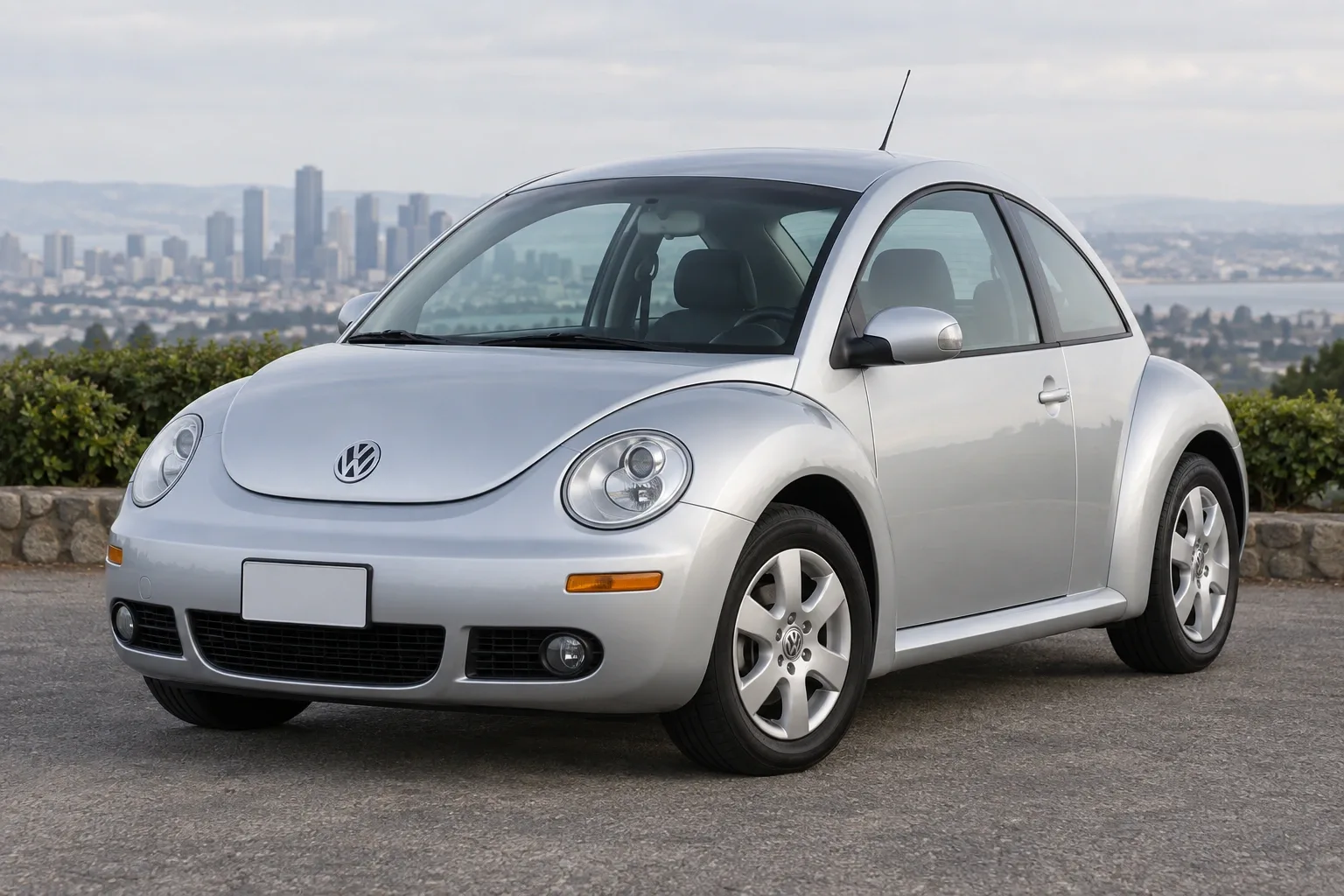
Volkswagen New Beetle
VW New Beetle evaluation (1998–2010): condition, documents, inspection and conditions of sale of the car.
Indicative purchase price
Below market value
Final price agreed after inspection.
Value my car1Why buyers choose this model
In 1998, Volkswagen resurrected the famous beetle in a new form, naming it the New Beetle (1998-2005). The model has a very original appearance and successfully imitates the shape of the once popular car.
2What buyers check
Review
In 1998, Volkswagen resurrected the famous beetle in a new form, naming it the New Beetle (1998-2005). The model has a very original appearance and successfully imitates the shape of the once popular car. The German concern did not strive for originality in technical matters and built the Volkswagen New Beetle on the platform of the well-known and time-tested fourth-generation Golf.
As befits a modern car, this model has an engine located in the front and drive to the front wheels. Inside, only proven components previously used in VW models are used. This approach ensured a high level of reliability, as well as easy availability to the original spare parts and their replacements. As a result, the maintenance of the car, although somewhat exotic (made in Mexico), does not cause any trouble and does not require high costs.
However, the model itself in the secondary market is not cheap, as it does not belong to the category of budget cars. However, buying a Volkswagen New Beetle, the owner acquires, first of all, a cute, original and well-designed car with a pleasant interior, excellent driving qualities and engines that provide good dynamics.
The cabin, especially in the rear and the trunk (210 liters) are terribly small. But in this car, practicality is not as important as aesthetics. You just have to accept that.
Engine
Volkswagen New Beetle came to the market in 1998 with a modest engine lineup: a 2-liter gasoline unit with a capacity of 115 hp and a turbodiesel 1.9 TDI 90 hp. In 1999, the range of gasoline units expanded - there were engines with a working volume of 1.6 liters (100 hp) and 1.8 Turbo (150 hp). A year later, under the hood of the New Beatle got three more gasoline engines - 1.6 liters with a capacity of 102 hp, 2.3 l 170 hp and 3.2 l 225 hp - for the sports version of the RSi with 4Motion all-wheel drive. At the same time, a new 1.9 TDI turbodiesel with a capacity of 100 hp was proposed. with pump injectors. In 2001, gasoline engines of 1.4 liters (75 hp) and 1.8 Turbo (180 hp) appeared. In 2005, the gasoline group joined 2.5 l - 150 hp and 105-horsepower turbodiesel 1.9 TDI (with pump injectors). For the average car owner, power units with a working volume of 2.0 liters, 1.6 liters and 1.9 TDI with a capacity of 100 and 105 hp are preferred. Motors 1.4 liters and 1.9 TDI with a capacity of 90 hp can be recommended for calm and very economical drivers. In turn, stronger gasoline engines are a good offer for those who prefer to have high dynamics, but are willing to bear significant maintenance and repair costs.
Exploitation
The Volkswagen New Beetle has a number of nasty vices that annoy owners. The first is a frequently failing contactor responsible for turning on stop lights. The second is the lock of the trunk lid, which ceases to obey every now and then. The third is an extremely difficult replacement of incandescent lamps for the front headlights.
The New Beatle gasoline engines are quite reliable and durable. If something fails, it is only attachments, such as a generator or a coolant pump.
Less stable is diesel, which usually has problems with the air flowmeter and seals in the fuel supply system. With large runs, you can expect the failure of the turbocharger. Care must be taken when purchasing versions with automatic transmission. After 100,000 km, machines typically require expensive repairs.
Model history
2005 – a small restyling (changed shape of the front headlights, direction indicators, rear bumper and wings, appeared two-tone taillights)
3Pre-purchase checklist
Review
- The German concern did not strive for originality in technical matters and built the Volkswagen New Beetle on the platform of the well-known and time-tested fourth-generation Golf.
- Inside, only proven components previously used in VW models are used.
Engine
- In turn, stronger gasoline engines are a good offer for those who prefer to have high dynamics, but are willing to bear significant maintenance and repair costs.
Exploitation
- The first is a frequently failing contactor responsible for turning on stop lights.
- The third is an extremely difficult replacement of incandescent lamps for the front headlights.
- If something fails, it is only attachments, such as a generator or a coolant pump.
- Less stable is diesel, which usually has problems with the air flowmeter and seals in the fuel supply system.
- Care must be taken when purchasing versions with automatic transmission.
- After 100,000 km, machines typically require expensive repairs.
4Challenges of selling privately
The Volkswagen New Beetle is not a family car. The three-door body, the modest space behind the first row of seats and the small trunk limit the functionality. The New Beatle is a car for individualists who value original appearance and rarely carry passengers or luggage.
The strengths of the model are the refined aesthetics and reliability that arise from time-tested technical solutions.
- In 1998, Volkswagen resurrected the famous "beetle" in a new form, naming it the New Beetle (1998-2005).
- Engine: In turn, stronger petrol engines are a good offer for those who prefer to have high dynamics, but are willing to bear significant maintenance and repair costs.
- Operation: The first is the often-failing contactor responsible for turning on the stop lights.
- Model history: 2005 - a small restyling (changed shape of the front headlights, direction indicators, rear bumper and wings, appeared two-tone taillights)
Shows, bargaining and re-registration take time: buyers look, promise to think and disappear. Fair price after inspection closes the auction on the spot. If money is needed urgently, the purchase takes away waiting and repeat displays.
5How selling to us works
Leave a request with the car data. We will discuss the preliminary assessment and inspection. After checking the status and documents, we agree on the final price and terms of the transaction.