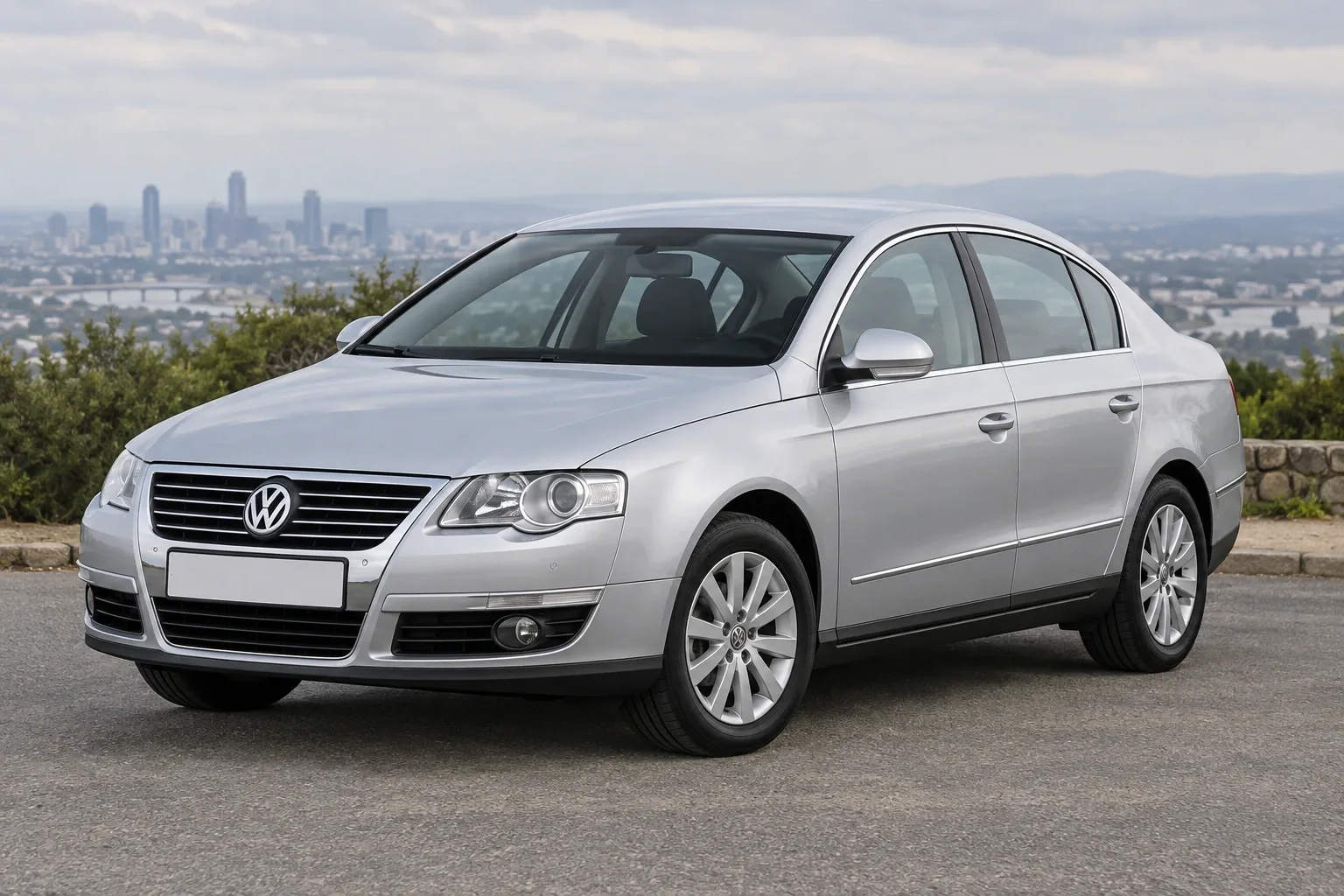
Volkswagen Passat B6
Volkswagen Passat B6 (2005–2010): condition, documents, inspection and conditions of sale of the car.
Indicative purchase price
Below market value
Final price agreed after inspection.
Value my car1Why buyers choose this model
The sixth generation Passat debuted in March 2005. Its release continued until 2011. After that, the Passat of the seventh generation B7 came. The model was assembled in Germany and Russia (Kaluga).
2What buyers check
Engines
The VW Passat was offered with a large set of different gasoline and diesel engines. The petrol line is presented: atmospheric 1.6 liters (102 hp), 2.0 FSI (150 hp), V6 3.2 FSI (250 hp) and 3.6 liters (284 and 300 hp); supercharged 1.4 TSI (122 hp), 1.8 TSI (152 and 160 hp) and 2.0 TSI (200 hp). The diesel lineup looks like this: 1.9 TDI (105 hp) and 2.0 TDI (140 hp).
Petrol engines
Engine 1.6 has a belt drive timing system, and 1.6 FSI - chain. Gasoline 2.0 FSI and TFSI are equipped with a belt drive of the exhaust camshaft and a chain drive of the intake camshaft (from the graduation). In 1.8 TSI, the timing system drive is carried out by a chain. Diesel 1.9 and 2.0 liters have a belt drive timing system.
The belt drive of the timing system is recommended to be changed every 90 thousand km. In most cases, the life of the chain drive is at least 200,000 km.
Owners of Passats with a 1.6 FSI engine with a run of more than 80 - 100 thousand km sometimes complain of knocking in the zone of the chain drive immediately after a cold start for 2-3 seconds. The reason is a short-term disruption of the regulator of gas distribution phases, which must be replaced.
The 2.0 FSI is more likely to cause problems in winter by refusing to start. The "disease" is caused by one of three reasons: a weak battery, expired candles and an incorrect engine control program. The engine's frothing is a consequence of the failure of the ignition coils. After 100,000 km, the rod of the hydrotensioner often wears out, which ceases to hold the oil pressure, the chain weakens and begins to make noise. Repair will cost about 7 000 rubles (4 000 rubles. – tensioner and 3 000 rubles. – work).
1.8 TSI
1.8 TSI is represented by modifications of BZB and CDA. BZB motors assembled before mid-2010 have the risk of chain jumping by one or more teeth, which can cause valve damage. Such cases occurred after 70-90 thousand km. The reason for this is the “surrendered” chain tensioner. One of the concomitant reasons for chain jumping is a situation in which the car is placed on a backward slope with the speed on, without manual brake. At this point, the engine does not work, the oil pressure in the system is absent, and the tensioner is weakened, and the pusher TNVD contributes to the formation of a fold of the chain in the area of the camshafts. When starting the engine, the tensioner does not have time to pull the chain, and it skips. To prolong the life of the chain drive of the timing system, you need to follow a few simple rules: change engine oil more often, monitor ignition passes (when they appear, take measures to eliminate), and do not leave the car on a slope without the parking brake on. One of the weaknesses of the 1.8 TSI is the crankshaft oil, which plays an important role in the cycle of gas formation and ignition. When the valve VKG (ventilation of crankcase gases) fails, it is difficult to remove crankcase gases from the block, which leads to an increase in pressure and the extrusion of the crankshaft oal. After replacing the VKG valve, the engine is idling unstable (troit) due to air sucking through the extruded oment. At the same time, the visible leak from under the gland is usually not noticeable. The valve and the crankshaft oil are suitable for replacement after 90 – 120 thousand km.
2.0 TSI
2.0 TSI is more common on the Passats from overseas - from the American mainland. The first problems arise with the engine after 150 – 180 thousand km. There is a whistling of the VKG valve, or the motor of the intake valves or the turbine pass valve fails. There are also problems with ventilation of the fuel tank, wear of the TNVD pusher occurs and ignition coils are surrendered. The normal oil consumption for this engine is about 1 liter per 10,000 km.
Diesel engines
Among diesel engines, the most reliable is the 1.9 TDI. Of the 2-liter TDI, the most unpretentious is considered to be BMP. 2. 0 TDI BKP has problems with the pump injectors "SIMENS", which have to be changed when running 60 - 80 thousand km. Especially strong live up to 100 - 150 thousand km. The presence of problems with the pump injectors SIEMENS officially recognized by the concern VW and the manufacturer of injectors. Since the beginning of 2013, Volkswagen has started an indefinite campaign in Russia to replace free problem injectors regardless of the car’s mileage. Another “source of problems” is the hexagon of the oil pump drive with a resource of 150 – 200 thousand km. Its wear and subsequent reduction of pressure in the system leads to failure of the turbine, camshaft and hydraulic compensators. It is better to change the oil pump drive every 150 thousand km, to exclude serious engine repairs. Since 2009, 2-liter diesel engines have come with the fuel injection system "Common Rail" and received the designation SVA. These diesel engines are characterized by jamming of the throttle and the intake manifold in the open position - with a run of more than 200,000 km, the problem arises due to the sealing of the throttle shaft, through which the oil enters the potentiometric part, and the valve remains open. To determine the "disease" can be squeezed choke cover throttle. A new valve with drive costs about 7-8 thousand rubles, intake manifold 24 - 27 thousand rubles. In winter, there may be problems with starting any of the engines due to the location of the starter - directly behind the radiator.
Transmission
To transfer torque from the engines to the drive shafts, 5 or 6-speed manual transmissions, a 5-speed Tiptronic automatic and an automated DSG box with two clutches were used, allowing you to switch gears without breaking power.
The most reliable of all boxes is mechanical. In rare cases, when running more than 100 - 120 thousand km, you have to change the bracket on the manual transmission due to the backlash. The clutch tends more than 200 – 250 thousand km.
Some owners of the VW Passat with a hydro-automatic automatic transmission face a problem - jerks and tremors when changing gears. Complaints appear after 60 – 100 thousand km. In specialized services, the oil, hydroblock and wire harness are replaced. In most cases, the problem can be overcome. Some specialized services, given the high probability of a problem, recommend changing the oil in the box every 30 – 60 thousand km. It is known that the "hydraulic machine" - the brainchild of the famous Japanese manufacturer of boxes Aisin Warner. Similar boxes with similar problems are equipped with cars Toyota Camry V6 sixth generation, Volkswagen Tuareg 1 and Porsche Cayenne. Toyota Camry reliably knows that the problem with automatic transmission occurs due to the products clogged with wear of the channels of the hydroblock. Another possible reason for the jerks is an incorrect automatic transmission control program, but the manufacturer does not offer otherwise.
DSG
The DSG transmission used on the Passat is of two types: DSG-6 with wet clutch and DSG-7 with dry clutch. As the most advanced type of automatic transmission in terms of efficiency and speed of gear shifting, it is still raw and unreliable. The big disadvantage of such boxes is not repairability; jerks and vibrations when dialing speed in 2nd gear or not turning on gears. DSG6 is much more reliable than the “seven”, and complaints from owners about it are much less. The manufacturer claims that with careful operation of the box, its life should be at least 300 thousand km. But in reality, these numbers are not achievable.
The problem is mainly with DSG7. Authorized services when used, replace mechanotronics (80-90 thousand rubles) and clutch (25-60 thousand rubles). The clutch resource averages about 60,000 km. Some services specializing in the repair of boxes, suggest that the cause of troubles DSG-7 in the absence of automatic adjustment of the box to wear the clutch discs. This requires an adjustment to the box control program every 15,000 km, but the manufacturer does not make such recommendations. Recently, reinforced discs have been installed when replacing the clutch. The oil in such a box is recommended to be changed every 60,000 km. To do this, you will have to spend about 10 000 rubles (6 thousand rubles – oil, 1 thousand rubles – filter and 3 thousand rubles – work).
Walking
The first to surrender the Silentblocks - at a run of about 50 - 70 thousand km, and then the turn of levers is 100 - 120 thousand km. By this time, the turn and racks of the stabilizer (1.5 – 2.5 thousand rubles) come. After that, when running more than 120 – 140 thousand km, most likely, will have to replace the bearings of shock pillars. The rear hub bearings will have to be replaced in the assembly with the hub after 100 - 120 thousand km (5 - 12 thousand rubles), the front - after 180 - 200 thousand km. Sometimes it is necessary to replace the internal SWAT.
The second generation steering rods often start knocking when running more than 100 - 120 thousand km. Replacement of the rake at the "officials" will cost 50-70,000 rubles, the "unofficials" - 20-40,000 rubles. Reika is changed to a reinforced, third generation. In some cases, it is possible to get rid of knocking for a short time after pulling up the rake.
Body and salon
The quality of the body metal and paint coating is generally not bad. On the very first specimens that did not get into an accident, in the area of the front doors and rear arches, some owners found small swellings of paint. As practice shows, in place of chips, "rust" does not appear for a long time. Do not neglect regular car washing, otherwise the back door seal, covered with dirt, acts as an abrasive and wipes the LCP at the point of contact.
When running more than 80 – 100 thousand km, episodic problems often arise - doors, a gas tank hatch or a trunk lid do not open. To avoid this, periodic prevention of locks with silicone lubrication will help. The gas tank lid lock could freeze. In the lock of the trunk lid, the lubrication thickens over time, and the return spring weakens, which leads to the failure of the lock. And problems with door locks are caused by cable traction - a break or taking the wrong position due to wear.
Crickets don't like the Passat salon too much. Only occasionally creak glove box and velvet rubber bands on the door windows.
Other problems and malfunctions
If the temperature of the air flows entering the driver's legs is not uniform (cold on the right, and normal on the left), then the cabin filter cover is most likely not tightly closed. But sometimes, the reason for this is the heater radiator (about 25 – 30 thousand rubles) or the heater’s pecking motor. With a run of more than 80 – 100 thousand km can sound the engine of the inflow fan. It is more often manifested with the onset of cold. The squeak can also appear in corners. The reason is the pollution of the engine, standing up to the filter and passing through all the dirty air. You can cure the disease after cleaning and lubricating the lower sleeve, which emits extraneous sounds. On warranty cars, dealers made a replacement for a new fan. On Passats B6 2005 – 2006. installed air conditioner company DENSO, which is not reliable and wedges when hit by condensate. Besides, it's not repairable. The replacement will cost 20,000 rubles for an air conditioner compressor and 14,000 rubles for work. Due to the failure of the relay 15th terminal on the Passat with a 1.8 TSI engine with a mileage of more than 60 - 80 thousand km, the dashboard may be extinguished and the engine stopped. For the relay from the driver's side under the wheel will have to give about 300 rubles. The control unit of the electronic locking of the steering column ELV can fail after 80 – 100 thousand km. As a result, the steering column is not blocked or unlocked, and the engine may not start or stall on the move. The unit is installed at the bottom of the steering shaft, and VAG recommends replacing and adapting it (4-5 thousand rubles).
3Pre-purchase checklist
Petrol engines
- The belt drive of the timing system is recommended to be changed every 90 thousand km.
- km sometimes complain of knocking in the zone of the chain drive immediately after a cold start for 2-3 seconds.
- The reason is a short-term disruption of the regulator of gas distribution phases, which must be replaced.
- The 2.0 FSI engine is more likely to cause problems in winter, refusing to start.
- The engine's frothing is a consequence of the failure of the ignition coils.
- Repair will cost about 7 000 rubles (4 000 rubles. – tensioner and 3 000 rubles. – work).
1.8 TSI
- Replacement of the oil will cost 10 – 15 thousand rubles.
2.0 TSI
- The first problems arise with the engine after 150 – 180 thousand km.
- There is a whistling of the VKG valve, or the motor of the intake valves or the turbine pass valve fails.
- There are also problems with ventilation of the fuel tank, wear of the TNVD pusher occurs and ignition coils are surrendered.
Diesel engines
- 0 TDI BKP has problems with pump-nozzles "SIMENS", which have to change when running 60 - 80 thousand km.
- The presence of problems with the pump injectors SIEMENS officially recognized by the concern VW and the manufacturer of injectors.
- Since the beginning of 2013, Volkswagen has started an indefinite campaign in Russia to replace free problem injectors regardless of the car’s mileage.
- Another “source of problems” is the hexagon of the oil pump drive with a resource of 150 – 200 thousand km.
- Its wear and subsequent reduction of pressure in the system leads to failure of the turbine, camshaft and hydraulic compensators.
- It is a long way to avoid serious engine repair.
- These diesel engines are characterized by jamming of the throttle and the intake manifold in the open position - with a run of more than 200,000 km, the problem arises due to the sealing of the throttle shaft, through which the oil enters the potentiometric part, and the valve remains open.
- In winter, there may be problems with starting any of the engines due to the location of the starter - directly behind the radiator.
- The engine liquid cooling pump is recommended to be changed together with the timing system belt. Its resource is about 120 – 140 thousand km.
Transmission
- km have to change the bracket on the manual transmission due to the backlash.
- Some owners of the VW Passat with a hydro-automatic automatic transmission face a problem - jerks and tremors when changing gears.
- In most cases, the problem can be overcome.
- Some specialized services, given the high probability of a problem, recommend changing the oil in the box every 30 – 60 thousand km.
- Similar boxes with similar problems are equipped with cars Toyota Camry V6 sixth generation, Volkswagen Tuareg 1 and Porsche Cayenne.
- Toyota Camry reliably knows that the problem with automatic transmission occurs due to the products clogged with wear of the channels of the hydroblock.
DSG
- The big disadvantage of such boxes is not repairability; jerks and vibrations when dialing speed in 2nd gear or not turning on gears.
- The problem is mainly with DSG7.
- Some services specializing in the repair of boxes, suggest that the cause of troubles DSG-7 in the absence of automatic adjustment of the box to wear the clutch discs.
- This requires an adjustment to the box control program every 15,000 km, but the manufacturer does not make such recommendations.
- The oil in such a box is recommended to be changed every 60,000 km.
Walking
- Sometimes it is necessary to replace the internal SWAT.
- Replacement of the rake from the “officials” will cost 50 – 70 thousand.
- In some cases, it is possible to get rid of knocking for a short time after pulling up the rake.
Body and salon
- As practice shows, in place of chips, "rust" does not appear for a long time.
- Often there are episodic problems - the doors, the hatch of the gas tank or the trunk lid do not open.
- In the lock of the trunk lid, the lubrication thickens over time, and the return spring weakens, which leads to the failure of the lock.
- And problems with door locks are caused by cable traction - a break or taking the wrong position due to wear.
Other problems and malfunctions
- air conditioner of DENSO company was installed, which is not reliable and wedges when it enters the condensate system. Besides, it's not repairable.
- The replacement will cost 20,000 rubles for an air conditioner compressor and 14,000 rubles for work.
- Due to the failure of the relay 15th terminal on the Passat with a 1.8 TSI engine when mileage is more than 60 - 80 thousand.
- The control unit of the electronic locking of the steering column ELV can fail after 80 – 100 thousand km.
- The unit is installed at the bottom of the steering shaft, and VAG recommends replacing and adapting it (4-5 thousand rubles).
4Challenges of selling privately
After reading it, it is difficult to answer the question: “Is the Volkswagen Passat B6 reliable enough?” The experience of operating these cars as a taxi in Europe, says that YES, reliable! Passats without serious investments roll back there for 350 – 450 thousand km. Yes, our operating conditions make their own adjustments, but they are not able to significantly reduce the life of the car. In addition, the listed malfunctions rarely appear in a scoping on one particular instance.
- Engines: The VW Passat was offered with a large range of different petrol and diesel engines.
- Transmission: km have to change the bracket on the manual transmission due to the backlash.
- Replacement of the rake from the “officials” will cost 50 – 70 thousand.
- Body and salon: As practice shows, in place of chipped "rust" does not appear for a long time.
- Other problems and malfunctions: air conditioner of DENSO company was installed, which is not reliable and wedges when condensate enters the system. Besides, it's not repairable.
Shows, bargaining and re-registration take time: buyers look, promise to think and disappear. Fair price after inspection closes the auction on the spot. If money is needed urgently, the purchase takes away waiting and repeat displays.
5How selling to us works
Leave a request with the car data. We will discuss the preliminary assessment and inspection. After checking the status and documents, we agree on the final price and terms of the transaction.