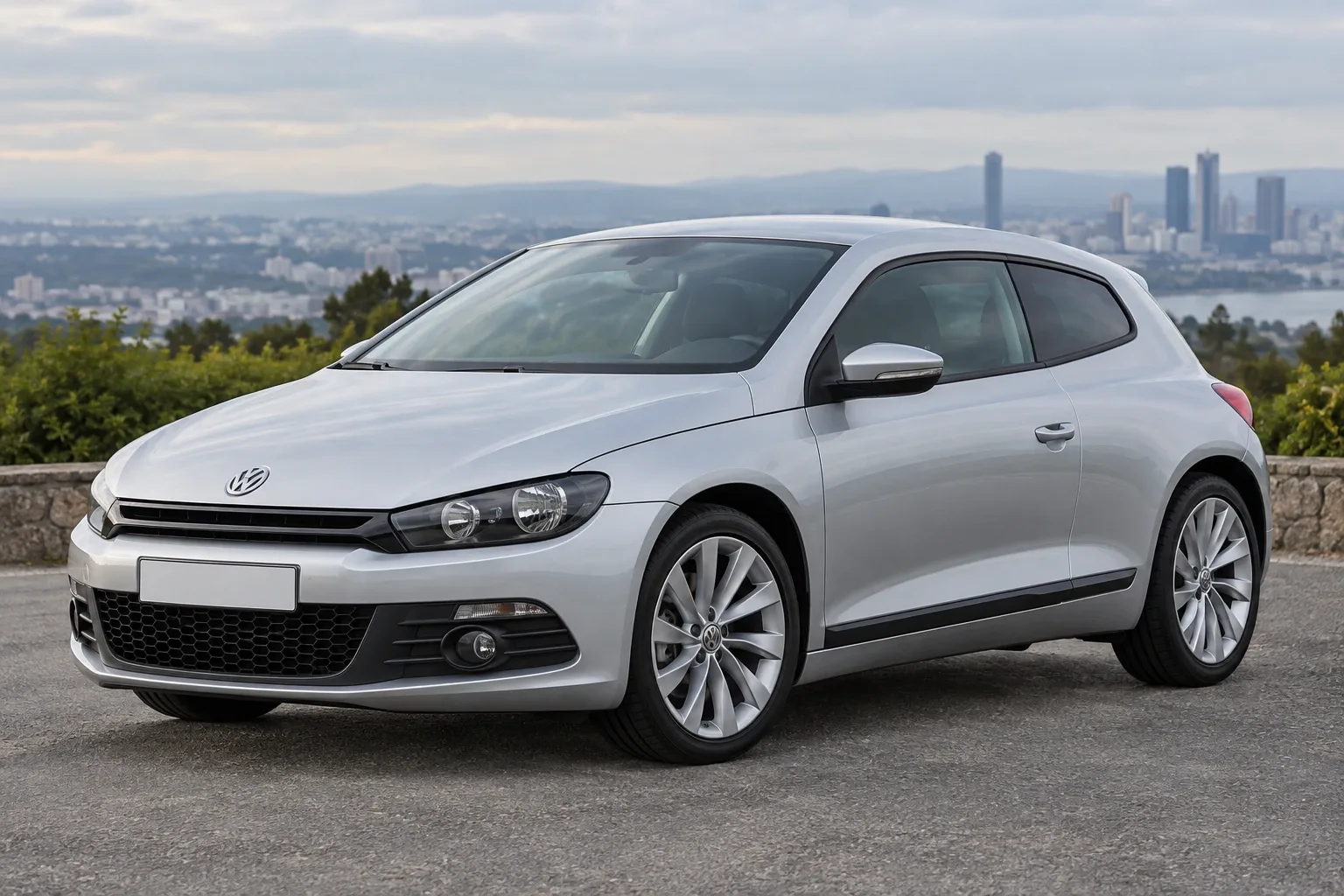
Volkswagen Scirocco 3
Volkswagen Scirocco 3 (2008–2017): status, documents, inspection and conditions of sale of the car.
Indicative purchase price
Below market value
Final price agreed after inspection.
Value my car1Why buyers choose this model
The Scirocco debuted as a sports front-wheel drive coupe in early 1974. The novelty immediately became a bestseller. Only in the first 9 months of production, 25,000 units were sold, and for all time - 500,000 cars.
2What buyers check
Model history
The Scirocco debuted as a sports front-wheel drive coupe in early 1974. The novelty immediately became a bestseller. Only in the first 9 months of production, 25,000 units were sold, and for all time - 500,000 cars. The second generation was replaced in February 1981. Production of the model range was discontinued in September 1992 with the result of 800,000 units.
Volkswagen revived the model in 2009, introducing the third-generation Scirocco. The car was assembled at the AutoEuropa plant in Palmela, Portugal.
Design features
The Volkswagen Scirocco is based on the fifth Golf (2004). However, the same cars cannot be considered. The main difference is the side doors. They, repeating the concept of the Audi TT first generation, are devoid of frames for glass. The door and window controls are the same as those used in the VW Passat CC. The windows look great, but sometimes they are on the agenda. In particular, the tightness is violated. Over the years, rubber ages, changes its properties and as a result, at best, wind whistles at high speeds, at worst, water ingress. Scirocco uses a complex glass management system, which is controlled by two units. One is the on-board network unit, and the other is the so-called gateway, or intelligent power distribution unit, in which all the car data buses intersect. Each time the door is opened, the glass is lowered slightly and rises after closing. Yes, many cars learned this in the 90s. But here we have a slightly different algorithm. The glass is lowered not at the moment of opening the door, but during unlocking the door lock or removing the ignition key. If you do not dare to sit down or go out, then after a couple of tens of seconds the glass will rise again. According to the mechanics, the Sirocco side glass control system works quite reliably. If suddenly the glass began to live its own life, then most often it is possible to get rid of a simple calibration of the mechanism. Specialized services must carry out this procedure at each service.
Engines
From the beginning until today, the basic engine is the 4-cylinder turbo engine 1.4 TSI. The weakest power of 122 hp was equipped with a turbocharger, and a more powerful recoil of 160 hp was also equipped with a mechanical compressor. Both units have a chain-type timing system drive, which caused a lot of problems. Mechanics recommend that everyone who has one of these engines installed, and the mileage has reached 80,000 km, replace the chain with accompanying components (tensioner, guides). To date, the 7th modification of the chain drive has been carried out. Therefore, you need to be careful when ordering a remplekt, so as not to purchase "old" parts. From the point of view of dynamics, of course, the most emotions are caused by the 160-horsepower version of the coupe. It is much more obedient than the model with a 2.0 TSI, burdened with extra pounds in the nose. In addition, the combination of turbine and compressor gives the engine a very interesting and unprecedented character. What about reliability? A mechanical compressor like Roots never delivers problems, unlike a turbocharger. During the production of the model, only three recalls were organized because of the turbine. Two of them were designed to update the boost management programme. The latter, prescribed the replacement of the throughpass valve gasket. But these are small things compared to the increased oil consumption that is observed in many. Some resorted to replacing the crankcase ventilation system, but this did not eliminate the problem. The reason is much more serious – the unsuccessful design of pistons, which, in extreme cases, can even crack.
Transmission
The sports coupe was equipped with several types of boxes. In a pair with 122-horsepower 1.4 TSI was 6-speed mechanics (MQ200). The more powerful 1.4-liter turbo engine (160 hp) was equipped with reinforced 6-speed mechanics (MQ250) and a robot DSG7 (DQ200). 2-liter gasoline and diesel units were equipped with even more durable manual transmission 6 (MQ350) and DSG6 (DQ250).
The weak point of the 7-speed DSG is the “dry” clutch, which also requires regular adaptation. DSG6 is much more reliable. Mechanics are no problem.
Walking
The Sirocco is built on the fifth-generation Volkswagen Golf platform, so both models have a similar shape of levers. The rear bridge differs from the fifth Golf more significantly, in particular, due to the wider track.
The two-door hatchback is considered quite durable. However, in diesel versions, the service life of the front suspension is somewhat shorter (due to the higher mass of the block).
Until June 22, 2009, aluminum levers were used on the front axle of the Scirocco, and then steel. The levers are completely interchangeable, as the geometric dimensions and subframe remain unchanged. Regardless of the type of lever, the design provides for the replacement of the ball support, the Silentblock and the rear support.
At large runs, the silent blocks of the rear transverse levers are surrendered. As a result, the wheels of the driven axis become a house.
Electromechanical power steering, the same as in the Golf, but like the suspension, has different settings. Scirocco is a bit stiffer and therefore more agile.
On the market you can find cars with adaptive suspension DCC, which is known for Passat CC and was offered only for an additional fee. Thanks to the excellent setup of conventional shock absorbers, searching for instances with DCC makes no sense. In addition, optional shock absorbers are less reliable and cost significantly more. Replace the defective adaptive shock absorbers with the usual will not work, since the DCC suspension communicates via the data bus with a number of other systems (engine, ABS / ESP, etc.). So, without finding dampers DCC, the controllers will give out errors.
Operation and maintenance
The engine is strict on the quality of the oil, which must comply with the VW 507.00 standard. Automated DSG transmissions require a transmission fluid replacement every 60,000 km. Do not neglect the updating of oil and in the "mechanics", conducting the procedure at least once in 80-100 thousand km.
3Pre-purchase checklist
Design features
- Due to the ingress of moisture into the door handle, the micro-switch, which is its integral part, fails.
Engines
- Both units have a chain-type timing system drive, which caused a lot of problems.
- Mechanics recommend that everyone who has one of these engines installed, and the mileage has reached 80,000 km, replace the chain with accompanying components (tensioner, guides).
- Therefore, you need to be careful when ordering a remplekt, so as not to purchase "old" parts.
- A mechanical compressor like Roots never delivers problems, unlike a turbocharger.
- Some resorted to replacing the crankcase ventilation system, but this did not eliminate the problem.
- So far, problems with the temporary type of timing system drive have not been recorded.
- As a rule, younger copies cause fewer problems.
Transmission
- The weak point of the 7-speed DSG is the “dry” clutch, which also requires regular adaptation. DSG6 is much more reliable. Mechanics are no problem.
Walking
- Regardless of the type of lever, the design provides for the replacement of the ball support, the Silentblock and the rear support.
4Challenges of selling privately
Volkswagen Sirocco could not avoid birth diseases, the elimination of which requires considerable costs. But the car is ready to please with an attractive appearance, excellent dynamics, excellent handling and a high level of safety (5 stars according to EuroNCAP).
- Model history: The Scirocco debuted as a sports front-wheel drive coupe in early 1974. The novelty immediately became a bestseller.
- Design features: Due to the ingress of moisture into the door handle, the micro-switch, which is its integral part, fails.
- Engines: Both units have a chain-type timing system drive, which caused many problems.
- The weak point of the 7-speed DSG is the “dry” clutch, which also requires regular adaptation. DSG6 is much more reliable. Mechanics are no problem.
- Driving: Regardless of the type of lever, the design provides for the replacement of the ball support, the Silentblock and the rear support.
- Operation and maintenance: The engine is strict on oil quality, which must comply with VW 507.00.
Shows, bargaining and re-registration take time: buyers look, promise to think and disappear. Fair price after inspection closes the auction on the spot. If money is needed urgently, the purchase takes away waiting and repeat displays.
5How selling to us works
Leave a request with the car data. We will discuss the preliminary assessment and inspection. After checking the status and documents, we agree on the final price and terms of the transaction.