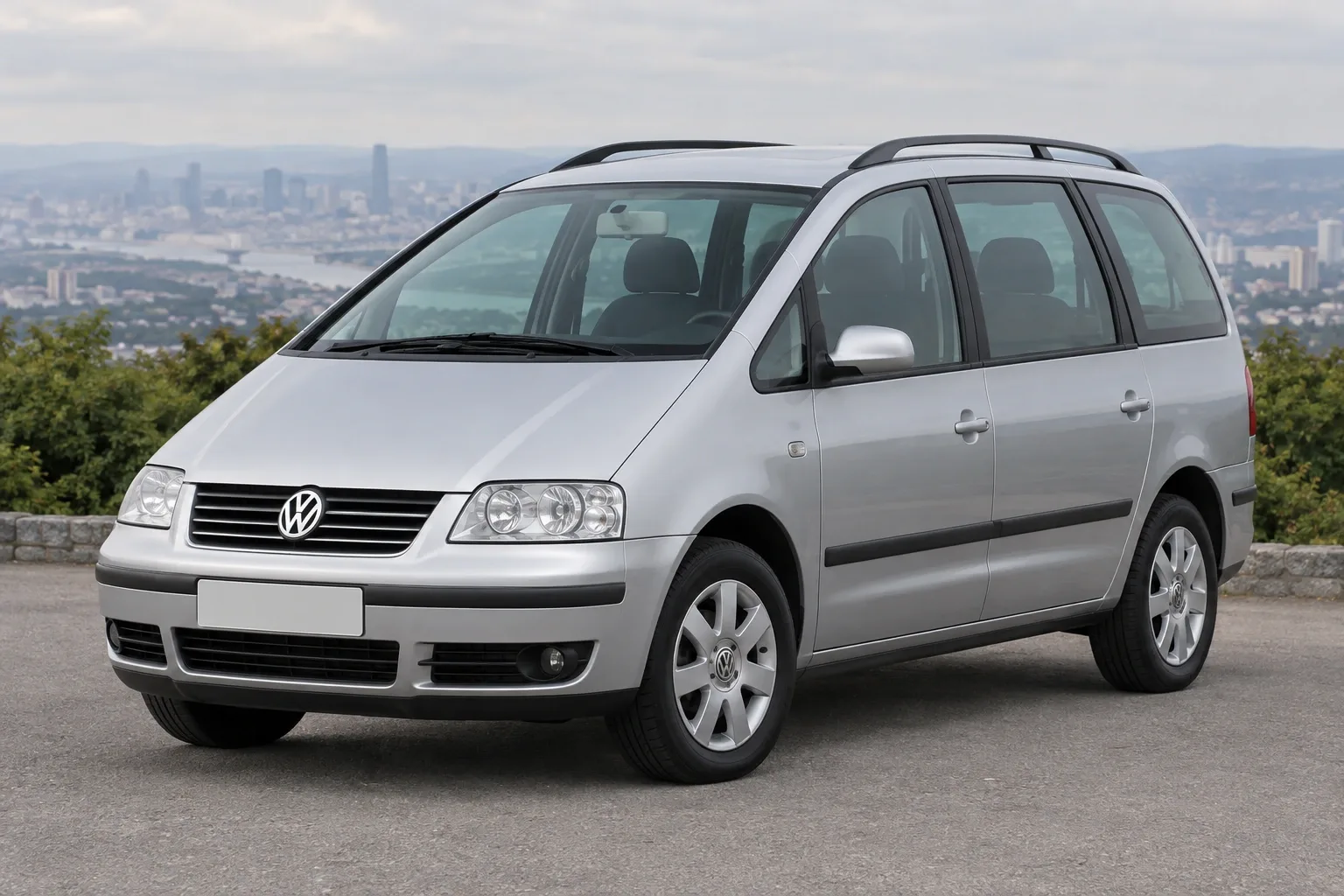
Volkswagen Sharan
Volkswagen Sharan Assessment (1995–2010): condition, documents, inspection and conditions of sale of the car.
Indicative purchase price
Below market value
Final price agreed after inspection.
Value my car1Why buyers choose this model
The first generation of Volkswagen Sharan was assembled in 1995-2000 in Portugal. The minivan was the fruit of a collaboration with Ford. The German company was responsible for the transmission and powertrains, and Ford for the body of the car. As a result, a good roomy van appeared, but not without flaws. In addition to the Sharan, twin models were produced - the Ford Galaxy and Seat Alhambra, which were almost identical, except for minor stylistic differences and a slightly different engine line. Unfortunately, the beginning of the journey was not easy for the model. In cars until 1998, armrests fell off, finishing elements “dissolved”, and during the movement on bad roads there were knocks and creaks. Even after a thorough facelift in 2000, the creaky salon remained the trademark of the German van. The most stylistic changes minivan has undergone in the front. Its front end was similar to the VW Passat of that time. The state of the salon is more envious of the care of the owner. In well-groomed specimens, despite the plastic of not the highest quality, there are practically no scratches and cracks. The Sharan is a very comfortable and spacious car. 7-seater versions are usually richly equipped. The front seats are large and comfortable. You just need to get used to the steering wheel, very elevated, like on buses. On the second row of the Volkswagen Sharan, passengers have a lot of space. By today’s standards, the rear seats are quite large and too heavy (23 kg). After restyling, the mechanism of attaching seats to the floor was upgraded. Previously, when installing chairs, jewelry accuracy was required, otherwise the fixation mechanism failed. This is worth paying attention when buying – the chairs must be securely fixed in the locks.
2What buyers check
Engines
One of the most interesting powerplant options that can be found under the hood is the 1.9 TDI. The 130-horsepower version of this engine has a pump-nozzle, a two-mass flywheel and a variable geometry turbine. But concerns about possible malfunctions and subsequent repairs are overshadowed by decent dynamics: "Decent" is the most accurate word to describe the capabilities of the 1.9 TDI. The 1.8-ton minivan accelerates to 100 km / h in almost 13 seconds. Due to the large frontal area and, accordingly, decent drag, you should not dream of typical diesel economy. The average result is about 8 l / 100 km.
Turbine 1.9 TDI is delivered after 300-350 thousand km. For repairs will need about 20 000 rubles. The pump-nozzles reach up to 400,000 km. The price of a new nozzle is 85 000 rubles, but it can usually be repaired - about 7000 rubles.
The 2-liter diesel has one vulnerability - the hexagon of the oil pump drive. Mechanics recommend changing it preventively after 100,000 km of mileage.
The top in the line was 2.8 VR6 recoil 204 hp Unfortunately, the engine is prone to overheating and damage to the gasket under the head. There are also problems with the chain drive of camshafts.
Transmission
The diesel engine has to work with “mechanics”, the mechanism of selection of gears which lacks accuracy. Until 2000, the situation was even worse, and the inclusion of gears was often accompanied by grinding.
The clutch of the manual transmission usually serves more than 200-250 thousand km. For a full set will have to pay 30-40 thousand rubles.
In addition to the manual transmission, the minivan was equipped with a machine - a 4-speed until 2000, and after a 5-speed one.
4-speed automatic 01P - own development of VW-Audi. He turned out to be very reliable and enduring. Its repair may be needed after 400,000 km, which will require more than 60,000 rubles. One of the operational disadvantages is damage to the side cover (7000 rubles).
The 5-speed 09A/09B is designed by Jatco (JF506E). In terms of repairless mileage, it is only slightly inferior to the old 01P. Usually suffer hydrotransformer, frictions, brake tape solenoids and hydroblock.
The suspension bearings of the right semi-axle fail after 200,000 km (about 2000 rubles for an analogue). Internal SRUS (from 5000 rubles per analog) can wear after 250-300 thousand km. And after 350-400 thousand km owners have to face wear of the slits of the intermediate drive shaft (29 000 rubles for the original).
Walking
The possibilities for transforming the Volkswagen cabin are almost limitless, making it highly versatile. Large volumes of internal space provoked the owners to use a minivan to transport all kinds of cargo. The result is suspension problems. With frequent loads, the rear levers suffer. Sometimes springs break.
In the seven-seat version, two additional seats were installed in the trunk. Unfortunately, with seven passengers, the cargo compartment is very limited. If the second and third row of seats are removed from the van, the trunk will accommodate up to 2610 liters of luggage.
In the front suspension, the stabilizer racks and steering thrust are subject to rapid wear. They are not very strong and the bearings are not very strong.
The consolation is that three Sharan-Galaxy-Alhambra twins don’t have any problems finding quality substitutes. Although after the modernization in 2000, the strength of the chassis has improved, it is not necessary to neglect the check of its condition.
Other problems and malfunctions
Due to the age of rust most actively attacks the dorestyling samples. Risk zones - rapids, wheel arches, niches of taillights, a platform for the front jack. It is obtained by brake lines (about 2000 rubles), air conditioning tubes (8,000 rubles) and the exhaust system. Seven-seater modification is a version that must necessarily have air conditioning. The large glazing area provides a great view, but in summer this results in third-row passengers without a climate setup just sintering. As a rule, the well-known “climatronics” is responsible for the comfortable state of the atmosphere in the cabin. The climate is relatively reliable. If the air stopped cooling, then, most likely, the air conditioner cooler located in front of the engine radiator “weaked”. It is worth recalling that the use of the air conditioning system, from which the "Freon" escaped, threatens to jam the compressor. The liquid circulating in the system together with the gas provides lubrication to the compressor. Eventually, a loud metal rumble will begin to sound from the engine compartment. Replacement of the compressor will be inevitable (24 000 rubles for an analogue). As for heating, in diesel versions, an additional heater comes to the rescue. The radiator of the heater (3,000 rubles) loses its efficiency or begins to leak after 400,000 km. When inspecting a seven-seat minivan, it is necessary to check the operation of the third-row seat belts. They should be effortlessly stretched and easily drawn in.
3Pre-purchase checklist
Engines
- But concerns about possible malfunctions and subsequent repairs are overshadowed by decent dynamics.
- For repairs will need about 20 000 rubles. The pump-nozzles reach up to 400,000 km.
- The price of a new nozzle is 85 000 rubles, but it can usually be repaired - about 7000 rubles.
- Mechanics recommend changing it preventively after 100,000 km of mileage.
- There are also problems with the chain drive of camshafts.
Transmission
- Its repair may be needed after 400,000 km, which will require more than 60,000 rubles.
- In terms of repairless mileage, it is only slightly inferior to the old 01P.
- The suspension bearings of the right semi-axle fail after 200,000 km (about 2000 rubles for an analogue).
- Internal SRUS (from 5000 rubles per analog) can wear after 250-300 thousand km. And then 350,000-400,000.
- km owners have to face wear of the slits of the intermediate drive shaft (29,000 rubles for the original).
Walking
- Large volumes of internal space provoked the owners to use a minivan to transport all kinds of cargo. The result is suspension problems.
- In the front suspension, the stabilizer racks and steering thrust are subject to rapid wear.
- The consolation is that three Sharan-Galaxy-Alhambra twins don’t have any problems finding quality substitutes.
- Although after the modernization in 2000, the strength of the chassis has improved, it is not necessary to neglect the check of its condition.
Other problems and malfunctions
- Due to the age of rust most actively attacks the dorestyling samples.
- Replacement of the compressor will be inevitable (24 000 rubles for an analogue).
- When inspecting a seven-seat minivan, it is necessary to check the operation of the third-row seat belts.
- This is important because the Volkswagen Sharan has earned only three stars out of five possible in EuroNCAP crash tests.
- Owners also face minor electrical faults.
- For example, the electric drive of wipers fails.
- To top it all off, years take with them a generator (5,000 rubles for repair) and a starter.
4Challenges of selling privately
And yet, do not be afraid of Volkswagen Sharan. Just, given the many shortcomings, the choice of a worthy copy should be approached very carefully!
- Engines: But concerns about possible faults and subsequent repairs are overshadowed by decent dynamics.
- Transmission: Its repair may be needed after 400,000 km, which will require more than 60,000 rubles.
- Driving: Large volumes of internal space provoked the owners to use the minivan to transport all kinds of cargo. The result is suspension problems.
- Other problems and malfunctions: Due to age, rust most actively attacks pre-restyling samples.
Shows, bargaining and re-registration take time: buyers look, promise to think and disappear. Fair price after inspection closes the auction on the spot. If money is needed urgently, the purchase takes away waiting and repeat displays.
5How selling to us works
Leave a request with the car data. We will discuss the preliminary assessment and inspection. After checking the status and documents, we agree on the final price and terms of the transaction.