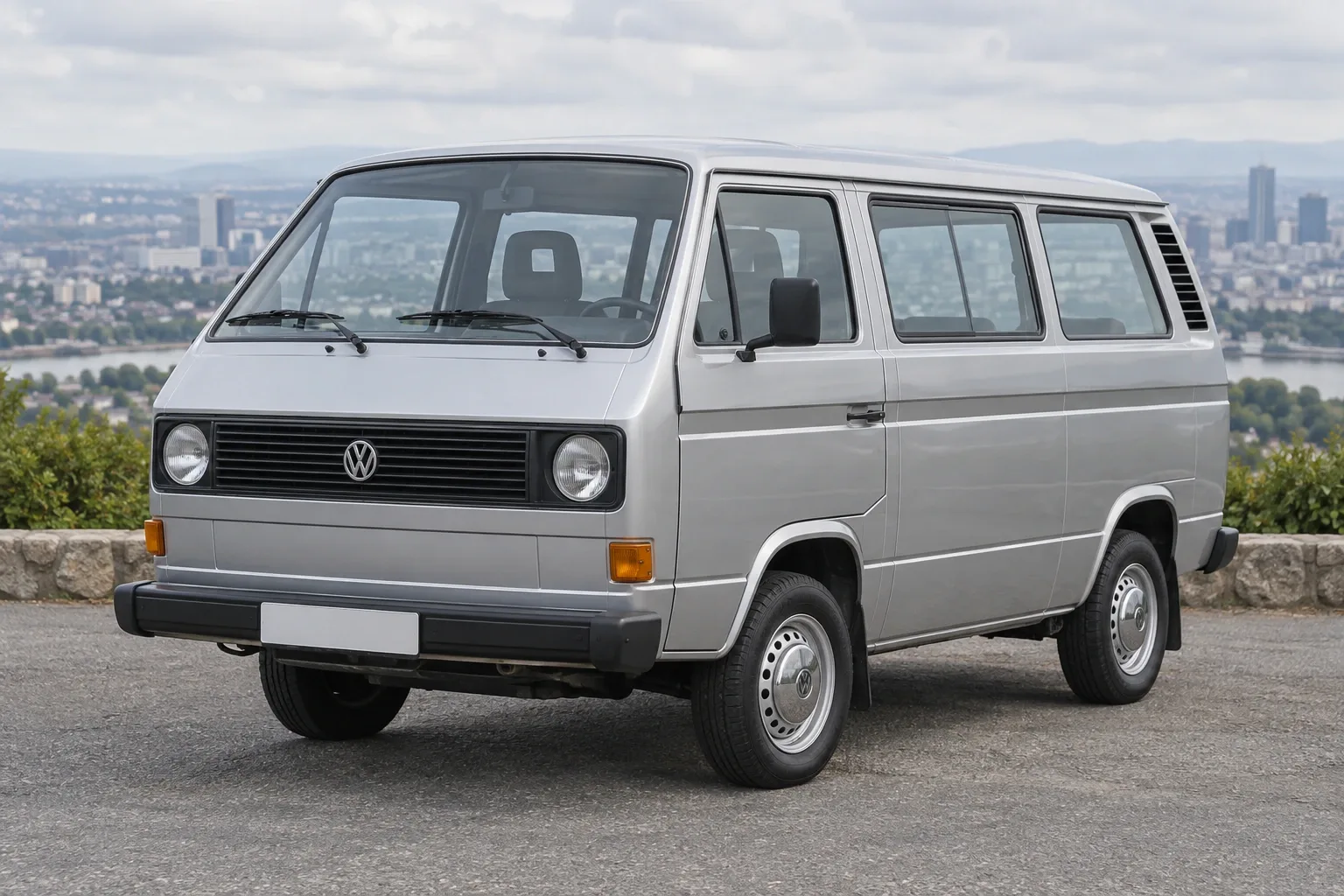
Volkswagen T3
VW T3 evaluation (1971–1991): condition, documents, inspection and conditions of sale of the car.
Indicative purchase price
Below market value
Final price agreed after inspection.
Value my car1Why buyers choose this model
What cars can we say without exaggeration that they are “cult”? Of course, about Volkswagen vans with an engine located behind. In particular, T3. Prices for well-groomed specimens are growing, and it is becoming increasingly difficult to restore running cars. Today you can find exclusive offers worth more than 1,000,000 rubles! But you can find a good option for 150-200 thousand rubles. The basic versions of the Volkswagen T3 worked on construction sites, served in the police and ambulance. Most of them were driven to death long before the model became a cult. Even in rich Germany, special versions of Caravelle and Multivan could only be afforded by wealthy buyers. And exclusive options could be seen near elegant forks or in the parking lots of luxury hotels. The latter had a better chance of maintaining good shape than those who worked for someone else’s good. When looking for the Volkswagen T3, you need to understand that the car is not new. So, do not be surprised by the corrosion. It affects mainly welded seams. Plenty of foci can be found under plastic linings. In addition, rust attacks the lower edge of the window frames. And water, penetrating inside, destroys electrical equipment. Thus, the repair of the body will be needed for sure. After recovery, it is necessary to further protect against corrosion. Experienced owners advise spraying penetrating anticorrosive material in the body cavity. In some places, you will have to drill holes. Another important element is the sliding doors. If they move and the handle isn't broken, then it's all very well. Body parts are easily available, but prices are starting to rise. The front panel is very simple - nothing distracts the driver. It sits in front of the front axle, so maneuvering is an unusual experience compared to passenger cars.
2What buyers check
Engines
Gasoline versions (50-112 hp) are of the greatest interest to collectors. This is the last Volkswagen to be equipped with gasoline-powered boxer engines. Until 1982, the engines had air cooling, and then liquid. The first ones were more reliable, although they suffered from oil leaks. It is worth noting that in cars with air-cooled engines in winter, the cabin is never warm. Cars with liquid-cooled engines can be recognized by an additional grille that appeared directly above the front bumper. Unfortunately, in units of this type, the bolts of the cylinder heads were often corroded, and the gaskets of the HBC burned out. In addition, the radiator is located in the front, and the “pipelines” often leak. In the worst case, the problems were long before 100,000 km. Daily inspection of the cooling system is a mandatory ritual. Reliable 2.1-liter boxer with electronic injection and water cooling. The consumption of 14-16 liters in the city is the norm, not the exception. With good care, it is able to stretch 250-300 thousand km. The rules are the same as for turbo engines: after the load, do not immediately jam, but let work for 1-2 minutes. For serious purposes, it is better to consider options with diesel engines. They are not bad for long distance routes, although they work much louder. By the way, diesel engines have the usual inline arrangement of cylinders. The market has the most offers with engines 1.7 D and 1.6 TD. Turbodiesel volume of 1. 6 liters and recoil 70 liters. with. too weak. In addition, it is not highly reliable.
Walking
The T3, with good handling, has a surprisingly comfortable suspension. And the running gear itself seems eternal.
In order to place the engine in the stern, engineers had to work on the rear suspension. To do this, they developed a brilliant and costly diagonal lever with spaced springs and shock absorbers. The front suspension is completely independent with springs and double transverse arms. Rack-type steering.
On holiday.
Will the VW T3 allow you to spend time on a long trip with comfort? It is a Caravelle version or even better, a Caravelle Carat. Large and spacious interior, velour upholstery, improved sound insulation, six comfortable separate seats. Behind, a 2.1-liter water-cooled opposition bumbles imperceptibly. When pressed deeper on the gas pedal, it sounds almost as beautiful as a Porsche 911 engine. The temperament of this car is definitely lacking. But this unit is probably the fastest. The Carat version is designed primarily for fans of good equipment. At the turn of the late 80s and early 90s, the minivan received a power steering, air conditioning, electric windows and an audio system. Simpler modifications could not boast of something like this. The limited-edition Multivan Whitestar Carat looks no less luxurious: twin headlights, cast discs and large plastic bumpers painted in body color. Here the interior is more practical - equipped with a folding sofa bed and a coffee table. This car allowed you to save money on the hotel, and in the middle of the week courageously solved everyday tasks. Westfalia is designed for picnic trips. Inside there is a gas oven, refrigerator and a folding roof with tarp walls. The model is easily recognized by the superstructure on the roof. In addition to these modifications, versions were offered: Joker, California and Atlantica. Another interesting version appeared in 1984 – Syncro. It's a four-wheel drive minivan. Its vulnerable elements: viscous coupling and rear axle lock.
Model history
1980, November - offered 1.6-liter diesel with a capacity of 50 hp
1982, September - transition to gasoline engines with liquid cooling capacity of 60 and 78 hp.
1983, September - introduction of a 1.9-liter petrol unit with a return of 90 hp.
1985, February - restyling. There was an all-wheel drive version of Syncro and a 1.6-liter turbodiesel (70 hp). Gasoline unit 1.9 l / 90 hp. replaced 2.1 l / 95 and 112 hp.
1986, September - the basic version received a 1.7-liter diesel with a capacity of 57 hp.
1987 – ABS was offered as an option. A special version of Magnum was introduced.
The Volkswagen T3 was produced in Graz, Austria. After the completion of production, the model was assembled in South Africa until 2003.
Typical problems and malfunctions
Corrosion affects the welded seams of the body and window frames.
Sliding doors and broken handles.
Problems with the head of the block and its gasket in gasoline units with liquid cooling.
Non-functioning pointers on the dashboard.
Difficulty with the inclusion of gears: grabs the nest of the bracket. It should be lubricated periodically.
The box often required repairs after 100,000 to 200,000 km.
Faulty heating system: either cold or too hot.
In the long thrusts of the gear selection mechanism, a tangible backlash occurs over time.
3Pre-purchase checklist
Engines
- Unfortunately, in units of this type, the bolts of the cylinder heads were often corroded, and the gaskets of the HBC burned out.
- In addition, the radiator is located in the front, and the “pipelines” often leak.
- In the worst case, the problems were long before 100,000 km.
- Daily inspection of the cooling system is a mandatory ritual.
On holiday.
- They required a very expensive repair after 200,000 km.
Typical problems and malfunctions
- Corrosion affects the welded seams of the body and window frames.
- Problems with the head of the block and its gasket in gasoline units with liquid cooling.
- Difficulty with the inclusion of gears: grabs the nest of the bracket. It should be lubricated periodically.
- The box often required repairs after 100,000 to 200,000 km.
- In the long thrusts of the gear selection mechanism, a tangible backlash occurs over time.
4Challenges of selling privately
The Volkswagen T3’s undeniable advantage is its simple design. If necessary, any mechanic can repair it. Due to the fact that old “beads” rust faster than they wear mechanically, there is a fairly rich range of spare parts on the market.
- Engines: Unfortunately, in units of this type, the bolts of the cylinder heads were often corroded, and the gaskets of the HBC burned out.
- Chasing: T3, with good handling, has a surprisingly comfortable suspension. And the running gear itself seems eternal.
- On vacation: They required a very expensive repair after 200,000 km.
- Model history: 1980, November - offered 1.6-liter diesel with a capacity of 50 hp
- Typical problems and malfunctions: Corrosion affects the welded seams of the body and window frames.
Shows, bargaining and re-registration take time: buyers look, promise to think and disappear. Fair price after inspection closes the auction on the spot. If money is needed urgently, the purchase takes away waiting and repeat displays.
5How selling to us works
Leave a request with the car data. We will discuss the preliminary assessment and inspection. After checking the status and documents, we agree on the final price and terms of the transaction.