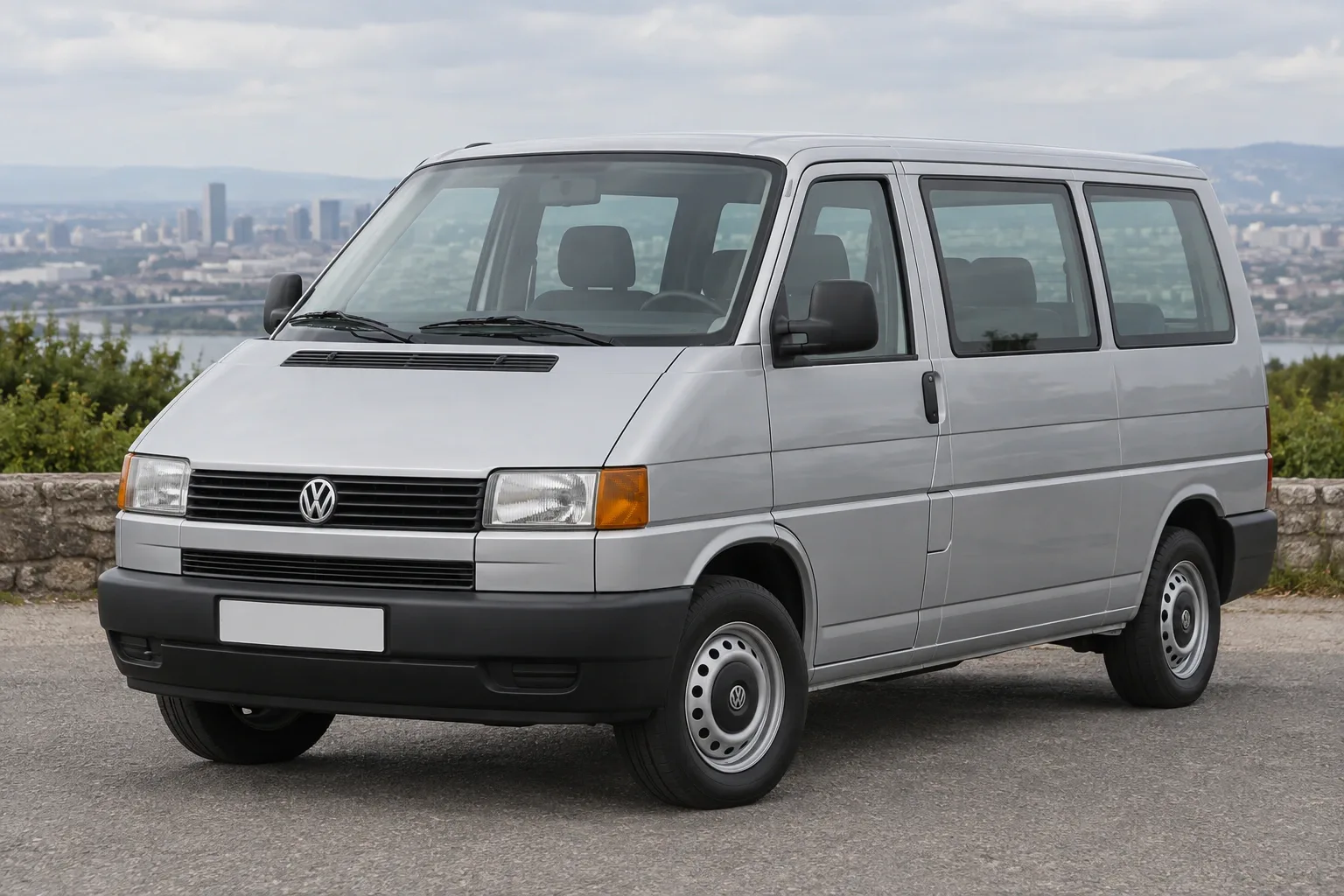
Volkswagen T4
VW T4 evaluation (1989–2003): condition, documents, inspection and conditions of sale of the car.
Indicative purchase price
Below market value
Final price agreed after inspection.
Value my car1Why buyers choose this model
The Volkswagen T4 is considered very reliable. He is selflessly resisting the influence of time. But is he as good today as he used to be? What faults are hidden in its design?
2What buyers check
Model history
The Volkswagen T Series has a long tradition. The first such car was created in the late 40s of the twentieth century. It was designated Typ 2 (T1). The successor to T2 appeared in the second half of the 60s and stayed on the conveyor for about 10 years. In 1979, the next generation, the T3, was introduced and lasted until 1992. In South Africa, production continued for another 12 years.
In the early 90s, the design and construction of the T3 was already very outdated, and Volkswagen released the T4. The new generation was innovative not only in terms of style, but also in terms of powertrain. It was in this model that the Germans decided to abandon rear-wheel drive, replacing it with the front-wheel drive. Those who wish could purchase an all-wheel drive version of Syncro 4x4 for an additional fee. The engine location has also changed: it was moved from the rear of the car to the front.
The minibus was offered in four major versions - Transporter, Carravella, California and Multivan. The transporter is a utilitarian base van. The other versions are luxury passenger models.
In the autumn of 1995, the Volkswagen Transporter T4 received a new diesel engine, and the Carravelle and Multivan versions experienced a light facelift. The most notable differences: a new grille, headlights and hood, giving the van a more aggressive appearance. Inside, a new steering wheel appeared, and there were a few minor changes to the dashboard. Gradually, updates appeared in other versions. The Volkswagen T4 was assembled until 2003 in Germany, Taiwan and Indonesia.
Engines
Microbuses usually do not have a wide range of powertrains. But Volkswagen did not stint, offering a large selection of engines. The most popular were, of course, diesel units. No wonder, vans with a gasoline engine under the hood consume too much fuel, and for users of vehicles of this type is very important low consumption. Diesel engines, like cars, are from the 90s. The higher the power, the better the dynamics, but also more often visits to the service. The weaker R4s are more difficult to accelerate the T4 transporter. Until recently, these engines were considered very reliable, but today due to giant mileage increasingly begin to fall. 1. 9 D and 2. 5 TDI (150 hp) may require major repairs after 300-350 thousand km. The remaining diesel engines easily nurse 450-500 thousand km. Since the car is very many years old, malfunctions can catch any of the modifications. Old diesel engines primarily suffer from fuel leaks and failure of TNVD. In addition, often fail not only candles incandescent, but also the incandescent control system itself. In younger TDIs, the turbocharger, flowmeter and fuel injection system fail. If you do not want to spend a lot of money on repairs in the car service, then you should pay attention to gasoline engines. Their resource is over 500-700 thousand km. They break down much less often, but the saved on repairs simply burns up along with the fuel during trips. Regardless of the chosen version of the gasoline engine, you should not expect that the city fuel consumption will be less than 10 liters per 100 km.
Transmission
The Volkswagen T4 has broken with tradition forever: rear-wheel drive and an engine located behind the rear axle. The minibus became front-wheel drive with an engine in the front. The power selection from the engine is carried out using a 5-speed mechanics or a 4-speed automatic.
In the all-wheel drive version of Syncro 4x4, the distribution of torque between the axles is carried out through a viscosity coupling, which, when the front wheels slip, connects the rear wheels. The presence of Syncro will require additional operating costs: a suspension bearing and an elastic clutch of the driveshaft, the glands of the gearboxes or a buzzing rear gearbox.
Some owners are trying to turn the usual versions into all-wheel drive. Fortunately, such modernization is quite possible and successfully solved in specialized services.
Characteristic problems and malfunctions
If you buy a Volkswagen T 4 first years of production, then you need a thorough inspection of the body for corrosion. Rust often appears on the trunk door, rear wings, hood, on the frame of the windshield and vertical seam on the left side of the body, as well as on the platform of the sliding door. The younger the specimen, the less the risk of starting to rot. Another weakness of the German carrier is the leakage in the power steering system. Many cars relatively often require replacement of steering rods, repair of the power pump and steering rack. The most quickly in the suspension are delivered racks and sleeves of the stabilizer. Ball supports, Silent-blocks of levers and shock absorbers serve more than 100-150 thousand km. Russian roads contribute to rapid wear and tear and hub bearings. After all, nothing lasts forever! They do not have excessive stamina and gearboxes. In the case of automatic machines after 200-250 thousand km, the hydraulic transformer, the hydro-blocking clutch, the valves in the hydraulic unit and solenoids fail. For repairs will need at least 50 000 rubles. The clutch of the manual transmission (15-25 thousand rubles) will serve 250-350 thousand km. In the mechanics itself, the gears of the 5th gear, bearings and synchronizers wear out. The vacuum brake booster pump is another vulnerable spot. In cars without ABS, the brake force regulator ceases to work with age. In addition, owners of the VW T4 periodically complain of loss of tightness of the cooling system. When inspecting the car, it is also necessary to check the ease of moving sliding doors.
3Pre-purchase checklist
Model history
- It was in this model that the Germans decided to abandon rear-wheel drive, replacing it with the front-wheel drive.
Engines
- ) may require major repairs after 300-350 thousand km.
- Since the car is very many years old, malfunctions can catch any of the modifications.
- In addition, often fail not only candles incandescent, but also the incandescent control system itself.
- If you do not want to spend a lot of money on repairs in the car service, then you should pay attention to gasoline engines. Their resource is over 500-700 thousand km.
- They break down much less often, but the saved on repairs simply burns up along with the fuel during trips.
- Unfortunately, gasoline units are not completely free from technical malfunctions.
- In highly running copies, it may be necessary to overhaul the engine.
- The solution is found - the replacement of the injector with the VAZov "January".
Characteristic problems and malfunctions
- If you buy a Volkswagen T 4 first years of production, then you need a thorough inspection of the body for corrosion.
- Rust often appears on the trunk door, rear wings, hood, on the frame of the windshield and vertical seam on the left side of the body, as well as on the platform of the sliding door.
- The younger the specimen, the less the risk of starting to rot.
- Many cars relatively often require replacement of steering rods, repair of the power pump and steering rack.
- Russian roads contribute to rapid wear and tear and hub bearings. After all, nothing lasts forever!
- For repairs will need at least 50 000 rubles. The clutch of the manual transmission (15-25 thousand rubles) will serve 250-350 thousand km.
- In addition, owners of the VW T4 periodically complain of loss of tightness of the cooling system.
- When inspecting the car, it is also necessary to check the ease of moving sliding doors.
4Challenges of selling privately
Years fly, and the van, despite its former solidity, today is not so perfect and can often break down. After the purchase, one way or another, something will have to be repaired. Prices for used copies range from 200 to 600 thousand rubles. Most of them are already on the verge of exhaustion.
What is the benefit of the Volkswagen T4? A huge trunk, ergonomic interior, economical diesel engines and a relatively rich equipment of top versions. The biggest advantage is good accessibility to a wide range of spare parts and a variety of body options.
- Model history: It was in this model that the Germans decided to abandon rear-wheel drive, replacing it with front-wheel drive.
- Engines: ) may require major repairs after 300-350 thousand km.
- Transmission: The Volkswagen T4 has broken with tradition forever: rear-wheel drive and an engine located behind the rear axle.
- Characteristic problems and malfunctions: If you buy a Volkswagen T 4 of the first years of production, then a thorough inspection of the body for corrosion is necessary.
Shows, bargaining and re-registration take time: buyers look, promise to think and disappear. Fair price after inspection closes the auction on the spot. If money is needed urgently, the purchase takes away waiting and repeat displays.
5How selling to us works
Leave a request with the car data. We will discuss the preliminary assessment and inspection. After checking the status and documents, we agree on the final price and terms of the transaction.