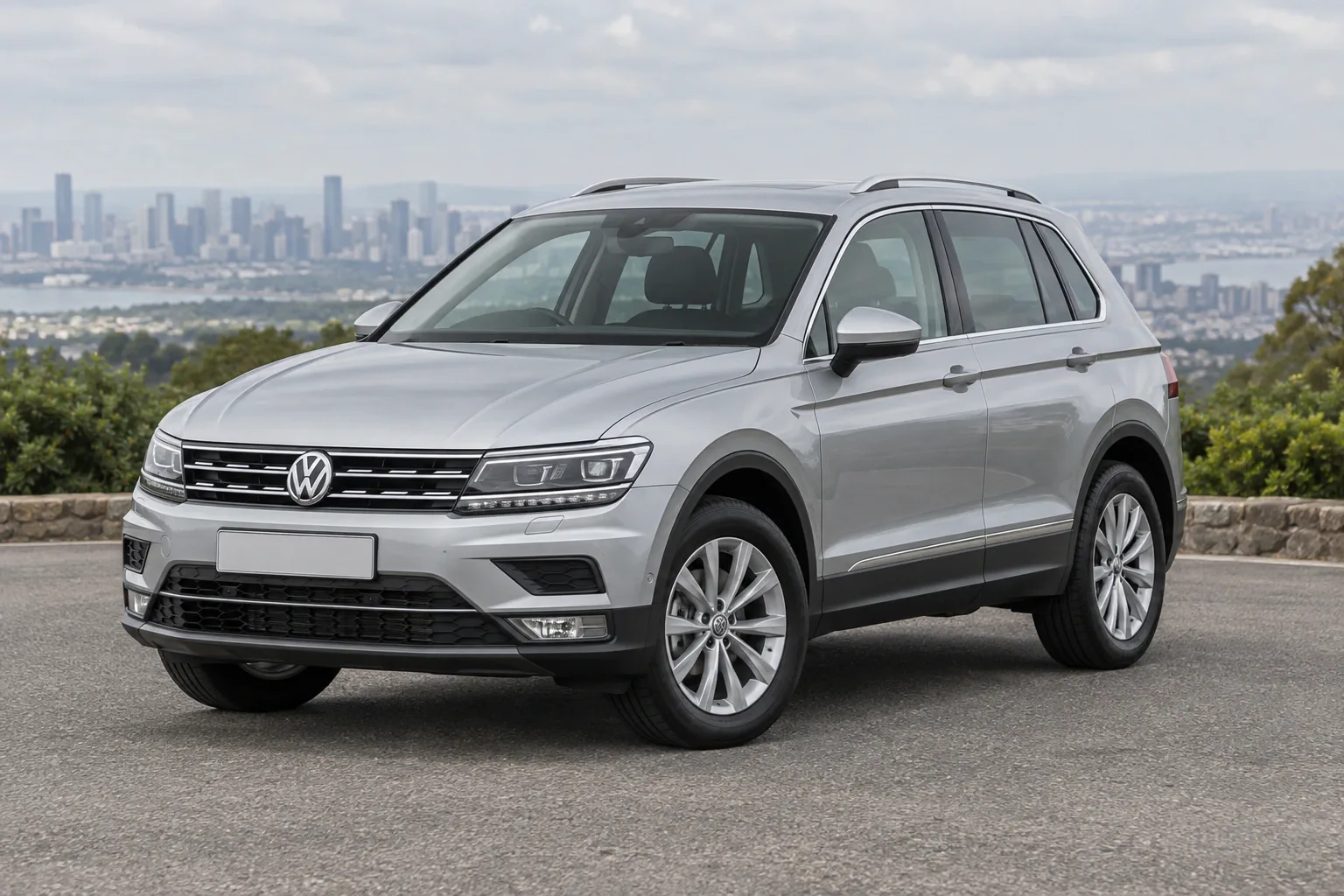
Volkswagen Tiguan 2
Volkswagen Tiguan 2 (2016–2024): condition, documents, inspection and conditions of sale of the car.
Indicative purchase price
Below market value
Final price agreed after inspection.
Value my car1Why buyers choose this model
When Volkswagen introduced the first-generation Tiguan in 2009, it was clearly better than the Skoda Yeti. Not only in terms of space and comfort in the rear seats, the size of the trunk, but also the running gear. If Yeti had to be content with a suspension from Golf and Octavia, Tiguan borrowed details from Passat and got something quite special. For example, the MQ 500 and DQ 500 transmissions from more powerful all-wheel drive cars. They were the most enduring in the entire VW concern and are designed for the transverse location of the engine. The car, which is not much larger than the Golf, regularly attracted attention on the European autobahns, while towing a medium-sized yacht. That, in fact, allowed him the allowed 2500 kg of trailer. But let’s not idealize the first generation. It has been hit hard by the dieselgate scandal. And it’s not just nitrogen oxides, which, moreover, were not even higher than the vast majority of competitors. In hindsight, the software modifications the manufacturer tried to use to reduce emissions from the older EA 189 engines were highly vindictive. They put increased strain on the EGR valve and, by shifting the NOx/PM trade-off towards soot, led to increased pollution and more frequent regeneration of the particulate filter. Both components began to fail massively. The offer to purchase particulate filters from the manufacturer at a bargain price, so that the initial buyers did not stone him, did not last very long. Today, particulate filters are expensive again, and perhaps too expensive for a used car. And with a machine that starts to have problems, the desire to make even the usual investments is reduced. So most of the first Tiguans are now abandoned specimens, vainly waiting for a miracle. The motivation to invest in them is weak, if only because the design language of VW has changed a hell of a lot, and it is clear to all the neighbors that this is just an old car.
2What buyers check
Transmission
Who wants to switch gears in such a car, and who needs an SUV without all-wheel drive? That is why the most popular version combines a DSG gearbox and 4Motion all-wheel drive.
Both of these things are very reliable, but only if you have the right maintenance. The DSG is required to change oil every 60,000 km (except for the new DQ 381 type, which is gradually introduced from 2018 - there it is changed after 120,000 km), and in the interaxial coupling (which is still called Haldex) - after three years without mileage restriction. This manufacturer’s order is already at the limit of real possibilities. Anyone who does not want the pump oil intake to get clogged with sawdust from the linings, and the clutch stops rotating the rear wheels, must change a special liquid every 60,000 km, as was prescribed before.
Worse, many independent car service providers in this century still believe that inspection is about replacing engine oil and inspecting brakes and chassis. And since it is now common for leasing companies in Europe to drive new Skoda and Volkswagen cars into independent workshops (competition for low payments has led to a completely intractable situation), the main advice when buying Tiguan from abroad is obvious: make sure that it has a complete service history, listed in the database of the Elsa Pro brand. It is better to have proof of the oil change in the gearbox in the original database. Some owners were burned on cars with a service book, certified by the seal of independent workshops, which ended with the replacement of the gearbox.
1.4 TSI ACT (R4/16V, 150 hp, 6MT or 7 DSG, 2016-2018)
An underrated engine that pulls well even in the heavy Kodiaq. The manufacturer would prefer not to use a system of disconnecting a pair of medium cylinders at low load (ACT). In such a heavy car, it still saves nothing, and the intake valves of the disconnected cylinders without cooling are overgrown with swelling. the 125-horsepower version is rare and only with front-wheel drive.
1.5 TSI ACT (R4/16V, 150 hp, 6MT or 7 DSG, as of 2018)
Technologically and in terms of cleanliness, the 1.5-litre engine represents a big advance, but it doesn’t bring anything new to the driver. The dynamics have remained the same at best, with many even claiming that the responses have become softer. For a long time, the heating phase was accompanied by jerks and indecisiveness of the engine, but now this problem had to be solved by updating the software.
2.0 TSI B-cycle (2.0 R4/16V, 179 or 190 hp, 6MT or 8DSG, as of 2016)
The 2-litre Audi EA 888 was not liked by many buyers - it was always quiet but never economical. Everyone thought that the fuel consumption in such a large car (DSG and four-wheel drive as standard) would reach twelve liters. However, a more economical version of the engine with special gas distribution phases and a high degree of compression is used here, which with a small force consumes up to nine liters in combined mode, and for long trips about 7.5 l / 100 km. The great advantage of this version is the resistance to the formation of sodium on the intake valves, since along with direct injection, distributed is used, which washes away the deposits with gasoline.
The manual transmission is very rare on the old version with a capacity of 179 hp. The rarer, more powerful 220 or 230 hp variant doesn’t make much sense – it’s far less economical and only marginally more dynamic.
2.0 TDI (R4/16V, 150 hp, 6MT or 7DSG, 2016 to 2020)
Until 2018, the weaker version of the TDI EA 288 engine was considered better at low rpm than the more powerful 190-horsepower version, and even quieter. However, after switching to stricter emissions measurements in the WLTP cycle, he lost his vigor and experienced obvious difficulties outside the city - he was struggling to climb on the freeway in the last gear.
2.0 TDI (R4/16V, 190 hp, 7DSG, 2016 to 2020)
The more powerful TDI variant is notorious for its unexpectedly poor performance, especially in the Passats and Superbach, where its lower gear torque had to be cut even further due to the weak six-speed DQ 200 transmission. He also suffered from turboholes due to a large turbocharger, and when the pressure in the intake tract finally rose, the moment had to be cut again because of the gearbox. Here, the Tiguan received a gearbox DQ 500, which allows the engine to work at full strength. However, the response at the start at intersections occurs late, the gas has to be pressed two seconds earlier.
Characteristic problems and malfunctions
TDI engines overheat after a cold start: the water pump’s jammed protective ring prevents it from turning on when the coolant temperature rises. During short trips, the engine is cooled only by the stove all winter, so the consequences of a malfunction often manifest themselves in the spring. Engine malfunction light, very limited power (TDI): until 2020, the turbocharger was pneumatically controlled. If a rodent (cup) damages the hose, you will drive in emergency mode like a diesel without turbocharging. The malfunction of AdBlue lights up, and after 1000 km it is impossible to start the engine: the control line for urea nozzles also does not like it when a rodent bites it (marten). Under the new requirements, manufacturers should not operate a vehicle with a faulty emission control system, so only 1,000 km is allocated to eliminate it. Unstable operation of 1.4 and 1.5 TSI ACT engines: disabling two medium cylinders leads to the fact that their intake valves often work on cold, and they form a charge. As a result, these cylinders suck less air and have less dynamic compression. Solved by sandblasting with granules from the shell of walnuts. Traction and fluctuations of the 1.5 TSI engine after cold start: when the catalytic converter warms up faster and the engine lags far behind and has less torque. The disadvantage manifests itself when the generator is turned on and loads the engine.
Service recommendations
All engines are equipped with a gear belt drive timing interval of 210,000 km. If the age of the car does not exceed ten years, then the belt can really last 200,000 km, as this is a special new very durable belt, reinforced with fiberglass.
However, on diesel engines, the service life is often shortened due to loss of coolant or leaky water pump. The coolant leak occurs after about 150,000 km. Since it is still necessary to disassemble everything, there is no sense in putting back the details that will work out their resource in a few tens of thousands of kilometers.
Before the introduction of particulate filters in gasoline engines, it was still possible to use old VW 502.00 oil with SAE 5W-40 viscosity with a fixed replacement interval (10,000 km or a year, whichever comes first). However, since the summer of 2018, only ash-free oils have become available. In 2.0 TDI engines until 2020 and less powerful TSI turbo engines, it is recommended to use the VW 504/507.00 SAE 5W-30 or 0W-30, in 2.0 TSI engines and the 150-horsepower version of the new TDI Evo (from autumn 2020) a new super premium oil VW 508/509.00 SAE 0W-20 is required.
Model history
2016: The model appears. 1.4 TSI, 2.0 TSI and 2.0 TDI. In autumn - the top version 2.0 BiTDI (239 hp).
2017: 20 cm long version of Allspace, seven-seater - on request.
2018: The 1.4 TSI engine is replaced by the new 1.5 TSI. The 2.0 TSI and 2.0 TDI engines are equipped with a more compact and modern DSG DQ 381 transmission. The 2.0TDI engine remained with the original DQ 500 transmission.
2020: 2.0 BiTDI discontinued. New diesel engines 2.0 TDI from the line EA 288 Evo - cast iron 150 hp, aluminum 200 hp. At the end of the year, there were strong petrol versions 2.0 TSI (245 hp) and 2.0 TSI R (320 hp) at the end of the year.
Pluses
Lots of space in the back, even in the standard version.
Folding bracket for towing a trailer weighing up to 2.5 tons
Cons
Shortage of used cars in the market (private owners own their cars longer)
Third row seats only in a rare version of Allspace
Higher maintenance costs in versions with DSG 4Motion
Attractive instances are quickly disappearing from the used car market
Technical data
Engine - diesel 4-cylinder 16-valve with turbocharging
Maximum power - 190 hp at 4000 rpm
Peak torque - 400 Nm at 1900-3300 rpm
Transmission - 7-speed dual clutch
Fuel consumption in the combined cycle - 5.7 l / 100 km
Seat Tarraco (since 2018)
The Seat Tarraco is another SUV built on the Volkswagen Group’s MQB platform. It is the same length as the Tiguan Allspace. In addition, as standard, received a steeper progressive steering (in VW only for an additional fee) and a smaller steering wheel, which makes it more agile. However, its engines meet more stringent environmental requirements and therefore lost a fair share of vivacity.
Skoda Kodiaq (since 2016)
The ŠKODA KODIAQ is the same size as the elongated Tiguan Allspace. Engineers have tried to make it more comfortable, which was only partially possible - because a significant swing or correction of direction in the headwind is usually not considered comfortable for the crew. The variants with the optional DCC chassis, including the RS variant, are managed noticeably better.
3Pre-purchase checklist
Transmission
- Worse, many independent car service providers in this century still believe that inspection is about replacing engine oil and inspecting brakes and chassis.
- And since it is now common for leasing companies in Europe to drive new Skoda and Volkswagen cars into independent workshops (competition for low payments has led to a completely intractable situation), the main advice when buying Tiguan from abroad is obvious: make sure that it has a complete service history, listed in the database of the Elsa Pro brand.
1.5 TSI ACT (R4/16V, 150 hp, 6MT or 7 DSG, as of 2018)
- For a long time, the heating phase was accompanied by jerks and indecisiveness of the engine, but now this problem had to be solved by updating the software.
2.0 TDI (R4/16V, 150 hp, 6MT or 7DSG, 2016 to 2020)
- However, after switching to stricter emissions measurements in the WLTP cycle, he lost his vigor and experienced obvious difficulties outside the city - he was struggling to climb on the freeway in the last gear.
Characteristic problems and malfunctions
- During short trips, the engine is cooled only by the stove all winter, so the consequences of a malfunction often manifest themselves in the spring.
- Engine malfunction light, very limited power (TDI): until 2020, the turbocharger was pneumatically controlled.
- The malfunction of AdBlue lights up, and after 1000 km it is impossible to start the engine: the control line for urea nozzles also does not like it when a rodent bites it (marten).
- The pump must be disassembled, the receiving basket cleaned and the oil in the system replaced several times.
- Scream from the front axle: a typical problem of all cars on this platform.
Service recommendations
- However, on diesel engines, the service life is often shortened due to loss of coolant or leaky water pump.
- 0 TDI until 2020 and less powerful TSI turbo engines are recommended to use the VW 504/507.00 SAE 5W-30 or 0W-30, in engines 2.
Seat Tarraco (since 2018)
- However, its engines meet more stringent environmental requirements and therefore lost a fair share of vivacity.
4Challenges of selling privately
- Worse, many independent car service providers in this century still believe that inspection is about replacing engine oil and inspecting brakes and chassis.
- Characteristic problems and malfunctions: All winter, during short trips, the engine is cooled only by the stove, so the consequences of a malfunction often manifest themselves in the spring.
- Service recommendations: However, on diesel engines, the service life is often shortened due to loss of coolant or leaky water pump.
- Model history: 2016: The appearance of the model. 1. 4 TSI, 2. 0 TSI and 2. 0 TDI. In autumn - the top version of the 2. 0 BiTDI (239 hp).
- Pros: Lots of space at the back, even in the standard version of the folding bracket for towing a trailer weighing up to 2.5 tons
- Cons: Shortage of used cars on the market (private owners own their cars longer) Third row seats only in the rare version of Allspace Higher maintenance costs in versions with DSG 4Motion Attractive instances are quickly disappearing from the used car market
- Technical data: Engine - diesel 4-cylinder 16-valve with turbocharger Maximum power - 190 hp.
Shows, bargaining and re-registration take time: buyers look, promise to think and disappear. Fair price after inspection closes the auction on the spot. If money is needed urgently, the purchase takes away waiting and repeat displays.
5How selling to us works
Leave a request with the car data. We will discuss the preliminary assessment and inspection. After checking the status and documents, we agree on the final price and terms of the transaction.