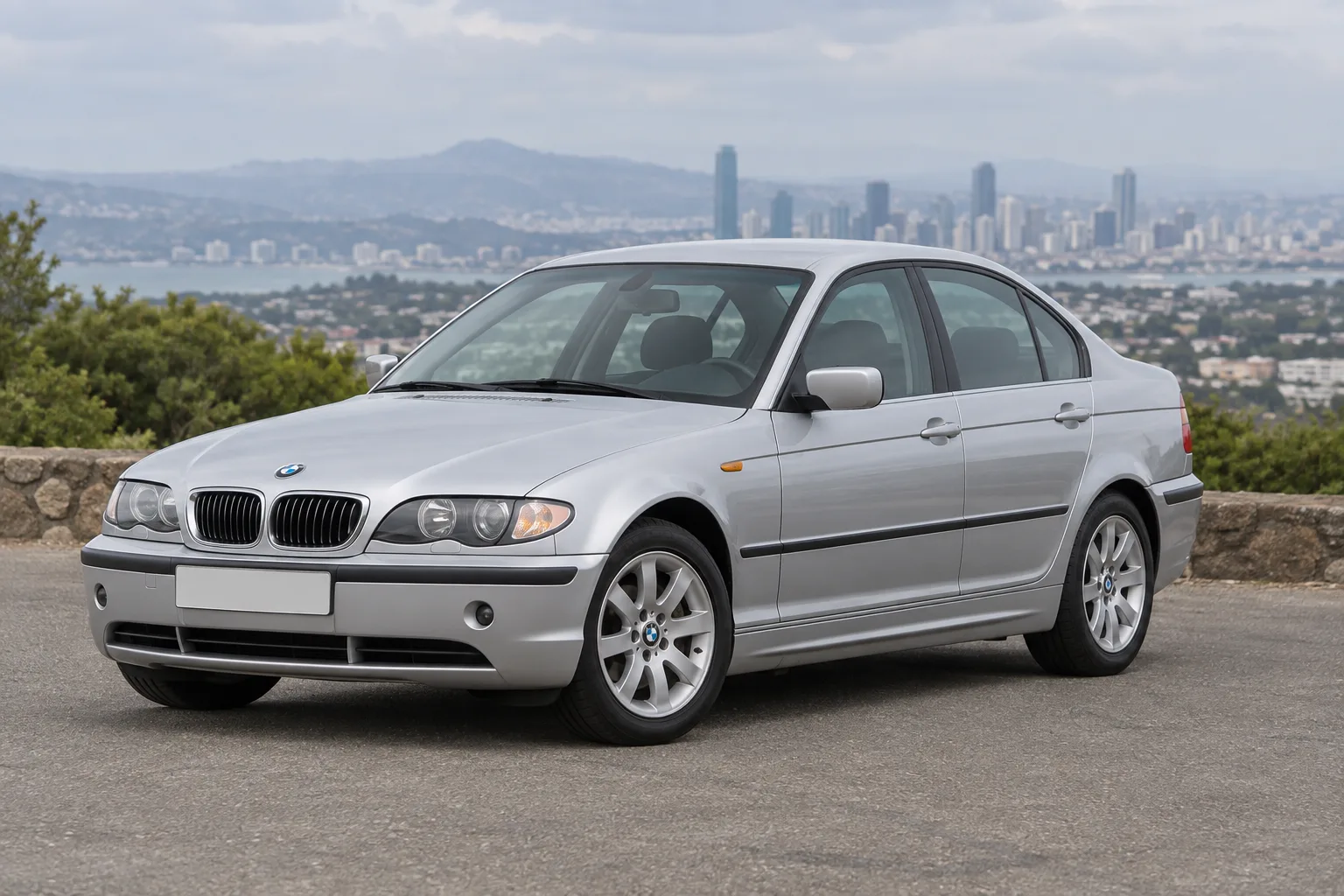
BMW 3 Series E46
Evaluation of the BMW 3 Series E46: condition, documents, inspection and conditions of sale of the car.
Indicative purchase price
Below market value
Final price agreed after inspection.
Value my car1Why buyers choose this model
1. Reference handling
At one time, the handling and behaviour of the BMW 3 E46 were recognized as benchmarks in the class, and the Troika often won ratings assessing the degree of conformity with expectations and customer satisfaction. The obedient behavior of the legendary BMW E46 is considered exemplary - this is due to the successful combination of McPherson struts in the front, multi-link rear suspension, effective brakes, well-balanced and informative steering.
2. A design that still fascinates me.
Even today, the “three” still excites. Perfectly cut proportions look great. The attractive coupe looks the most aggressive.
3. The legendary M3
After a rather disastrous M3 series E36, the new generation gave hope for success. The top model was only available in the coupe and convertible body and certainly stood out from the conventional versions. Equipped with a fantastic-sounding inline “six” with a power of 340 hp, the M3 accelerated to 100 km / h in less than 5 seconds. Torque was transmitted to the rear wheels through a manual box or a sequential SMG (both units - 6 stages). The best was the limited version of the CSL (1401 copies) - lighter, more powerful (360 hp) and gives even more pleasure behind the wheel.
4. Rich range of engines
The range of power units is very rich: several gasoline and diesel engines with a working volume of 1.8 to 3.0 liters.
5. A huge choice in the secondary market
The E46 is one of BMW’s most popular models, so the choice in the aftermarket is huge. The interior is typical for the Bavarian school: everything is subordinated to the driver, and the quality of the finish is excellent. The dashboard is clear and concise. The fabric upholstery of the seats is well preserved even with large runs.
2What buyers check
1. Corrosion of the body
Age takes its toll. On the old BMW 3 Series E46 of the first years of production, the rapids and bottom rot. Foci of corrosion are found on the edges of body panels: wheel arches, doors, hood and trunk lid.
2. Engine and cooling system
Gasoline:
Basic M43 (1.9): not distinguished by excellent dynamics, suitable only for calm drivers. Sometimes it comes to the snatching of the snails. The engine is voracious. A typical problem is the failure of the stepper engine of the throttle valve (uneven work at idling).
N46 (2.0, 143 and 150 hp): a good choice. Sometimes problems with the tensioner chain timing system. Fortunately, when the chain jumps, the valves with the pistons are not usually found.
R6 (320i): 150-horsepower (170-horsepower since September 2000) captivates with honed manners. High smoothness and torque, comparable to turbo engines. With proper operation and timely maintenance up to 300 000 km have to face only failures of the air flow sensor, the position sensors camshaft and crankshaft, as well as the valve ventilation crankcase gases. Even Vanos’ complex gas distribution system rarely causes problems. Over time, the cooling system pump begins to leak (3000 rubles).
M54 (3.0): the last reliable inline "six" BMW. Subsequent N-series aggregates received far fewer positive reviews. It has an electronic throttle, an aluminum block with cast-iron cylinders and Double Vanos. The disadvantage is the blockage of the valve of the crankcase gas ventilation system (renew every 2-3 oil changes). The increase in oil consumption after 300-400 thousand km is caused by the “aging” of oil caps. From time to time it is necessary to repair Vanosy (2000 rubles for a remake of + 6000 rubles. for work).
Diesel:
M47 (2.0): Diesel engines are traditionally more difficult and expensive to maintain, especially with a DPF filter. The safest choice is the M47 in an earlier version with the VP44 TNVD, the repair of which is not too expensive (7-14,000 rubles).
TU with Common Rail: turbo diesels have become more economical, but due to large mileage, you have to reckon with faults of fuel injectors (amenable to relatively inexpensive repairs). A certain batch of Common Rail engines suffered from shaft failure. Trouble can deliver auxiliary equipment: turbocharger and flaps in the intake manifold. The flaps can get into the engine - damage. In most cars, they have already been removed.
M57 (3.0, 184 and 204 hp): deserve recommendations. It's a decent dynamic and pretty reliable. Disadvantages: higher operating costs, expensive parts and problems with flaps in the intake manifold.
3. Transmission
In addition to the manual transmission, the E46 was equipped with a 5-speed automatic GM 5L40E. Restyled copies with petrol 2.2 and 2.5 were paired with a 5-speed automatic transmission ZF 5HP19. The ZF box is considered more durable.
In case of malfunction of automatic transmission for repair will have to pay 70-80 thousand rubles, for the contract box - 40-80 thousand rubles. Automatic boxes sometimes do without repair for 300-400 thousand km.
One of the age-related problems is the uplifting rear gearbox. If the car twitches when switching, most likely require the replacement of the cross of the driveshaft (9000 rubles with balancing) and the semi-axle (from 33 000 rubles. for the original). Update has to and elastic coupling of the driveshaft (4000 rubles for an analogue).
In addition to rear-wheel drive, all-wheel drive versions of xDrive were offered (exclusively with 6-cylinder units).
4. Suspension and steering
The durability of the suspension for the BMW 3 E46 is the most painful issue, which is exacerbated by roads of questionable quality. Typical malfunctions of the running gear: worn levers and broken springs of the rear axle, which sometimes can not withstand even a small load.
One of the serious problems (powerful sedans and station wagons): the rooted mounting points of the rear axle subframe. The defect was common in cars built before March 2000, but it eventually began to appear in younger models. When inspecting, make sure that there are no cracks on the bottom and extraneous noises when changing the load.
Support cups (glasses) of front shock absorbers: cracks and deformations are also found there. The defect helps prevent the installation of struts between racks (4-5 thousand rubles).
Loud terrible sounds from the front suspension signal the wear of ball supports. In the original levers, they change only in the collection (10,000 rubles), but high-quality analogues allow you to replace (1000 rubles).
On age instances, it is often necessary to update the aged brake hoses, the brakes are pecked. Over time, it is possible to change or repair the expensive steering rack (20 000 rubles for restoration). The pump GUR can also fail (11 000 rubles for an analogue). Knocking in the steering wheel can be caused by wear of the elastic clutch of the steering shaft (3000 rubles) or cross.
5. Electricity and electronics
The driver's door window often breaks down. Sometimes the block of climate control (10 000 rubles) or the comfort unit (26,000 rubles) fails.
6. Service history and mileage
Most of the copies put up for sale will not be suitable for anything. Often this is the result of poor maintenance, garage tuning or a dubious past. To find a good option, it will take a very long time.
3Pre-purchase checklist
Body and corrosion
Check the thresholds and bottom for through corrosion.
□ To inspect the edges of the body panels: wheel arches, doors, hood, trunk lid.
Check for cracks in the bottom of the rear axle subframe.
Examine the support cups (glasses) of the front shock absorbers for cracks and deformations.
Check the condition of the LCP for rust foci.
Engine and cooling system
Check the engine for cold and hot.
Check for inserts (M43) to be turned.
Check the work of the stepper engine of the throttle valve (M43) - uniformity of idling.
Check the tensioner of the chain of the timing system (N46).
Check the operation of the Vanos system (R6, M54).
Check the valve for ventilation of crankcase gases (M54).
Check oil consumption and condition of oil caps (after 300-400 thousand km).
Check the pump of the cooling system (leakage, 3000 rubles).
Check the air flow sensor, camshaft position sensors and crankshaft (R6).
Diesel additionally
□ Check the VP44 TNVD (M47, 7-14,000 rubles for repairs).
Check the fuel injectors (Common Rail).
Check the turbocharger.
Check the valves in the intake manifold (M57) - are not removed, are there any traces of a cliff.
Check the DPF filter.
Transmission
Check the type of automatic transmission: GM 5L40E or ZF 5HP19 (ZF is more durable).
Check the operation of the automatic transmission on all modes.
Check the rear gearbox for soaring.
Check the crosses of the driveshaft (9000 rubles with balancing).
Check the semi-axis (from 33 000 rubles. for the original).
Check the elastic coupling of the driveshaft (4000 rubles for an analogue).
Check the xDrive system (with 6-cylinder units only).
Suspension and steering
Check the rear axle levers and springs.
Check the state of ball supports (in the original change only in the lever collection - 10 000 rubles).
Check the brake hoses for ageing.
Check the brakes (wedge).
Check the steering rack (20 000 rubles for restoration).
Check the pump GUR (11 000 rubles for analogue).
Check the elastic coupling of the steering shaft (3000 rubles) and the cross.
Check the presence of struts between the racks (4-5 thousand rubles).
Electricity and electronics
Check the window of the driver's door.
Check the climate control unit (10 000 rubles).
Check the comfort unit (26 000 rubles).
Documents and history
Check the service book and checks about the maintenance.
Check the actual mileage.
Check legal purity (pledges, restrictions, accidents).
Check the number of owners.
Make sure that the car was not a participant in the garage tuning.
Test drive.
Check the stability on the straight line, no leads.
Check the brakes.
Check the operation of the automatic transmission in different modes.
Check for extraneous noises, knocks, vibrations (especially from the front suspension).
Check the operation of all systems during the movement.
4Challenges of selling privately
1. A huge choice in the market
The E46 is one of BMW’s most popular models, so the choice in the aftermarket is huge. The buyer will always find a cheaper or “history” option.
2. Specific "sores"
Buyers are afraid of corrosion of sills and bottom, twisting of liners (M43), problems with the chain tensioner (N46), blockage of the valve ventilation of crankcase gases (M54), the valve in the intake manifold (diesels), torn attachment points of the subframe and cracks in the support cups.
3. Expensive consequences
Repair automatic transmission - 170-180 thousand rubles, restoration of steering rack - 20 000 rubles, pump GUR - 11 000 rubles, comfort unit - 26 000 rubles.
4. Many "tired" copies
Most of the cars on sale are the result of poor maintenance, garage tuning or a dubious past.
5. The durability of the suspension is the most painful issue
It is made worse by roads of dubious quality. Worn-out levers, broken springs of the rear axle, torn mounting points of the subframe - all this scares away buyers.
6. Time and nerves
Shows, bargaining, re-registration - it takes power. Buyers come, look, promise to think and disappear. Every show is your time, nerves and day off.
7. Bidding "in place"
Even if you have a fair price, the buyer will still knock. Often – 10-20% of the initial amount.
8. Urgent is playing against you.
If you need money quickly, you have to accept the first offer, which is almost always understated.
9. It's hard to find a good option.
To find a good option, it will take a very long time - most copies will not work for anything.
5How selling to us works
Leave a request with the car data. We will discuss the preliminary assessment and inspection. After checking the status and documents, we agree on the final price and terms of the transaction.