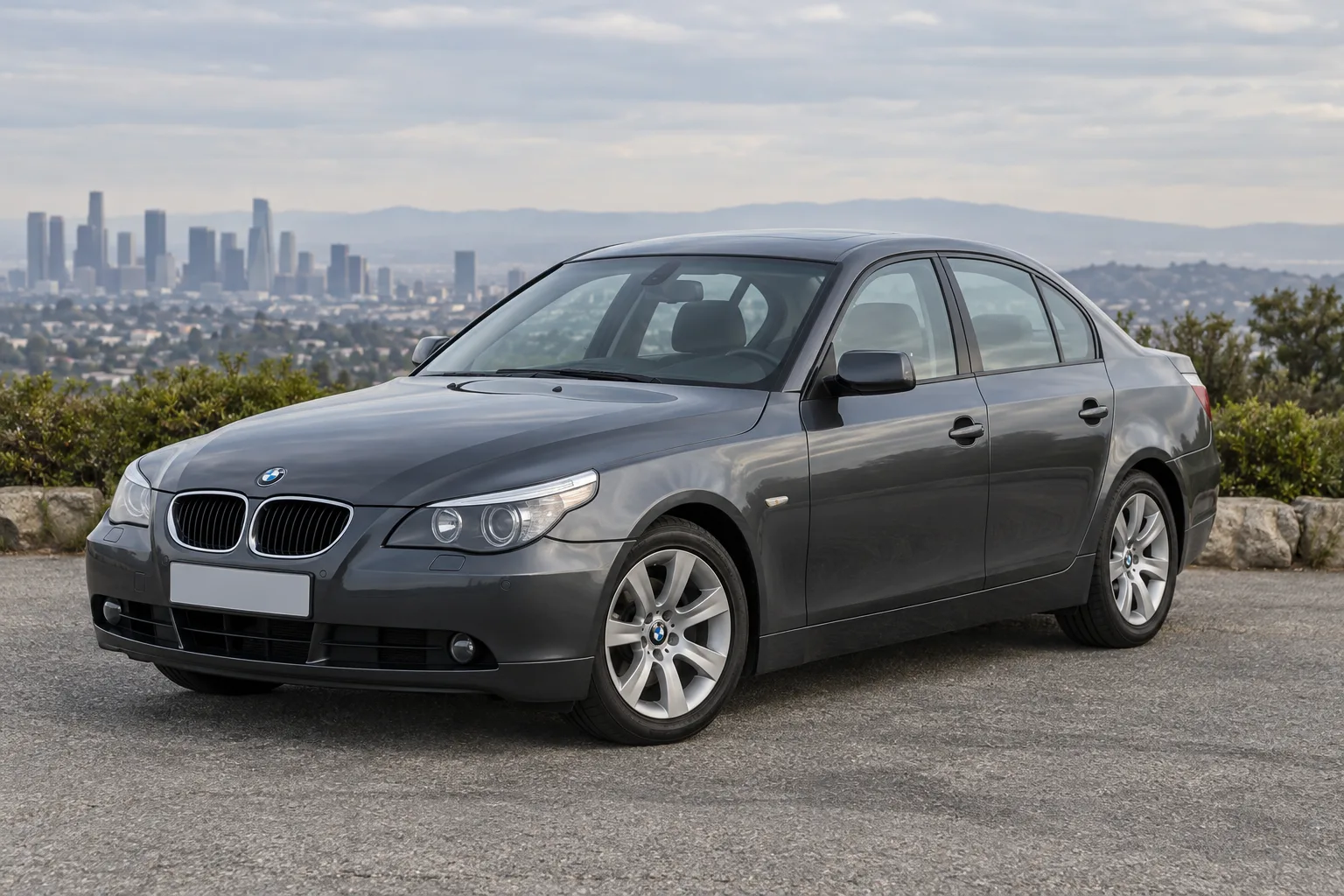
BMW 5 Series E60
Evaluation of the BMW 5 Series E60: condition, documents, inspection and conditions of sale of the car.
Indicative purchase price
Below market value
Final price agreed after inspection.
Value my car1Why buyers choose this model
1. Innovative technologies
The fifth generation received the designation E60 (E61 – station wagon) and many innovative solutions, including suspension with aluminum levers. Some control units (brake and multimedia) are connected by an optical cable. In 2003, these solutions were presented as NASA technology.
2. The “six” is the perfect source of traction.
The inline “six” has high torque and works very softly – even if we talk about a diesel engine.
3. Quality of salon materials
The quality of the materials is very high. There are no signs of wear even after 200,000 km. The interior is flawless, and the back row is a real limousine: plenty of legroom and the ability to control the climate in your zone.
4. Predominance of gasoline versions in the market
Ads with petrol modifications significantly dominate diesel. For ten petrol BMWs there is one diesel version. The vast majority of the copies were imported from abroad.
5. Renovated interior after restyling
After the update, a rubber coating appeared on the selector of the iDrive controller, and its management became more intuitive.
6. Good salon and quality materials
The BMW 5 Series is well-built. Despite the mileage of more than 200,000 km, the cabin is still in excellent condition: there are no bruises, cracks and deformities on leather seats. Plastic is scratch-resistant.
7. Spacious cabin and trunk
There is plenty of room in the cabin both in front and behind. Five adults can easily accommodate. The trunk of the sedan is 520 liters, the station wagon is 500 liters. Folding the back sofa, the volume of the station wagon increases to 1615 liters.
8. Reliable three-liter M54V30
Among the mechanics there is an opinion that the three-liter M54V30 is the most successful. This is a 6-cylinder engine of the old type with a multi-point injection system. It is inferior in power to the N52, but it is much less problematic – less sensitive to fuel quality.
9. Body protected against corrosion
The body is carefully protected from corrosion. The ones that didn’t see the accidents look new. The design combines the aluminum alloy front with the rest of the steel, giving the ideal weight distribution along the 50:50 axes.
10. Affordable entry price
The first-year BMW 5 E60/E61 can be purchased for a price comparable to the price of a new budget car.
2What buyers check
1. Cost of content and willingness to invest
The E60 is only for those who can afford it. Those who are calm, without grinding, will be able to leave a little less than a thousand dollars in good service in order to ensure that the “five” is properly served with quality consumables. The car is independent of the engine under the hood of the roads in service.
2. mileage and twisting marks
In the announcements for the sale of the BMW 5 in 2007, the mileage is indicated within 130-150 thousand km. And if you consider that most of the copies are imported at the age of 2-3 years, with a real mileage of about 100,000 km or more, then there is no doubt - the counter is adjusted.
The key is just one of the elements where the mileage is written. In the BMW 5 more than a dozen modules with fixed mileage. This makes it difficult to completely eliminate the “traces” of deception.
In the case of the diesel fives, it is necessary to realize that these cars were bought by wealthy customers to really drive a lot. 50,000 km is not something special for Europe.
3. Engine 530i (petrol, N53/N52)
The good news is that buyers of gasoline modifications should not be afraid of serious engine malfunctions. In 2007, the modernized 3-liter atmospheric N53 entered production. Compared to the N52, it has several important differences: direct fuel injection, rejection of the Valvetronic system.
Importantly, the old N52 was still delivered outside European markets after the modernization. The new N53 requires the highest quality fuel without sulfur, which is not available in Russia, the United States, Australia and Southeast Asia.
The N53 engine solved the problem of the N52, which was a faulty hydraulic compensator that started knocking loudly before reaching 100,000 km. The reason is poor quality oil and its deficiency. In some cases, the head regeneration was required for repair.
Gasoline engines use a variable-length intake manifold, which creates many problems in diesel engines. But in the BMW 530i, its design is much simpler – based on a single controlled flap (DISA system).
Typical faults of the BMW 530i E60:
Knocking valve gap hydraulic compensators (N52 without direct injection). The cost of repairs up to $1,000.
Faulty ignition coils - 40-50 dollars apiece, there are 6 of them.
A clogged oil separator filter. Oil consumption increases to 0.7-0.8 l / 1000 km, the engine begins to sweat. Replacement of the separator with work - 40-60 dollars.
4. Engine 530d (diesel, 3.0d)
To be sure, diesel engines have many more typical faults – they have more advanced “peripheral” equipment. Most often, owners complain of flaps in the intake manifold of variable length. In some cases, the flaps broke off - their remains fell into the cylinders. Some simply remove the “unpredictable” valves, but BMW’s motorists claim that this will have a bad effect on the engine.
The probability of malfunctions in 530d is much higher than in 530i. Once a 3-liter BMW diesel was really reliable and durable - we are talking about the legendary 3.0d with a capacity of 184 hp. The more horsepower became, the more complex and problematic the unit became. Nevertheless, the engine is relatively reliable: the injectors remain operational even after 300,000 km, and the 3-liter diesel engine practically does not consume excess oil.
Typical faults of the BMW 530d E60:
Damage to the damper pulley of the drive of the attachments is a frequent problem. The cost of repairs is from 150 to 400 dollars.
“Weakening” of the valves in the intake manifold is the Achilles heel of the older diesel engines 3.0d. The resource of the valve is about 200,000 km. Restoration of the node - about $ 400. Deletion is about $100.
Failure of the hydraulic transformer. The cost of the new one is more than $ 2000.
A set of thermostats is about $100.
Faulty module of incandescent candles - 50-100 dollars.
5. Transmission
In the BMW 530d with automatic transmission, the hydraulic transformer wears out quickly. In diesel cars with manual transmission - two-mass flywheel. In automatic transmission sometimes there are "fogging" in the area of the socket (connector) of the wiring (in both versions - 530i and 530d).
On the pre-restyling 6-speed “automatic” ZF in the cold often “breaks” the adapter mechatronics. The adapter’s fragile plastic walls cannot withstand the pressure of thickened oil. Since June 2008, the adapter has received thicker walls.
After the mark of 100,000 km, tremors may appear during switching. Solutions: change of oil with adaptation, flashing of the ECU, in rare cases - replacement of mechatronics.
6. Suspension
The suspension of the BMW diesel wears out much faster due to the heavier weight. The suspension of the BMW 5 is a 4-lever front and 6-lever rear. All levers are aluminum. The first repairs were made after 90-130 thousand km.
7. Body and aluminum front
Aluminum requires completely new methods of body repair after an accident. The deformed front part (sparters and wheel arches) cannot be straightened - it must always be changed to a new one. When buying, check that the front part is not stretched in the process of eliminating the consequences of an accident. A non-professional to determine the artisanal repair is quite difficult.
8. Electricity and electronics
For the first few years, the main source of irritation was the iDrive system. The Bavarians tried to fix the situation with endless software updates. Often, the BMW 5 E60 tires of minor malfunctions: leaks from the air conditioning system, failures of parking and tire pressure sensors, false messages about pressure.
With age, heating mats in the seats fail. In the station wagon, due to the failure of the contactor in the button, the glass of the trunk door ceases to open. The headlight control unit of the SMC may fail. If the music stops playing, navigation does not work or Bluetooth disappears, the Car Communication Computer unit is to blame, repairs of 6-16,000 rubles.
9. BMW M5
The BMW M5 version requires a separate chapter. The risk of getting expensive repairs is very high. There are many cases where the engine has been required to be replaced during the warranty period. The electrohydraulic part of the SMG and the rear differential are subject to rapid wear.
3Pre-purchase checklist
Body and geometry
Check the thickness of all body elements, including the hood and front wings (they are aluminum - factory thickness of the LCP up to 180 μm).
Check the gaps between the panels, the smoothness of the joints.
⁇ To inspect the spars and wheel arches - the deformed aluminum part can not be straightened, only changed.
Check whether the front part was not stretched when eliminating the consequences of the accident.
Examine the bottom and thresholds for corrosion.
Check the presence of all small parts (gratings, moldings, stubs) - they are often not put in budget repairs.
Engine and cooling system
Check the engine for cold and hot.
Check for the thud of hydraulic compensators (N52).
Check the Valvetronic (N52) and Vanos system.
Check the condition of the ignition coils.
Check the oil flow (clogged filter separator).
Check the crankcase gas ventilation valve (CVG).
Check the thermostat, pump, radiator, expansion tank.
Check the pump (after 100-120 thousand km).
Check the engine pallet for cracks (E70 disease, but also relevant for E60).
Check the status of the timing system chain (closer to 300,000 km).
Check the nozzles and TPHD (for engines with HPI).
Check the DPF filter and its sensors (diesel).
Diesel additionally
Check the intake and exhaust manifolds (cracking after 200,000 km).
Check the vortex valves.
Check the damper pulley of the crankshaft.
Check the turbocharger.
Check the piezo nozzles.
Transmission
Check the operation of automatic transmissions on all modes, especially switching 1-2 and 3-4.
Check for shocks, jerks, delays.
Check the condition of the hydraulic transformer.
Check the adapter of mechatronics (dorestyling).
Check the automatic transmission pallet for leaks.
Check the condition of the two-mass flywheel (ICT, diesel).
Check the xDrive system (handlebox, front semi-axles).
Suspension and steering
Check the stabilizer racks (first handed over).
Check the levers, Silentblocks, balls.
Check the floating hub of the rear transverse lever.
Check the eccentric bolt of the upper transverse lever (grown into aluminum).
Check the operation of Dynamic Drive (hydraulic leaks).
Check active steering (skewed steering wheel is a sign of a problem).
Check air suspension (wagons) - compressor.
Electricity and electronics
Check the iDrive operation.
Check the work of the CCC unit (music, navigation, Bluetooth).
Check the operation of the SMC unit (headlamps).
Check the operation of parking and tyre pressure sensors.
Check the heating of the seats.
Check the operation of the air conditioner.
Check the operation of windows and locks.
Check for errors in the memory of blocks.
Documents and history
Check the service book and checks about the maintenance.
Check the actual mileage through the dealerships (more than 10 modules with mileage).
Check legal purity (pledges, restrictions, accidents).
Check the number of owners.
Check the availability of warranty for units and assemblies (Premium Selection).
Test drive.
Check the stability on the straight line, no leads.
Check the brakes.
Check the operation of the automatic transmission in different modes.
Check for extraneous noises, knocks, vibrations.
Check the operation of all systems during the movement.
4Challenges of selling privately
1. Complex construction
The E60 has one of the most complex designs among the secondary market. In the fight with electronics BMW 5 E60 sometimes give up even experts, and four-channel diagnostics requires a high-end computer.
2. Expensive service
The E60 is only for those who can afford it. The car is independent of the engine under the hood of the roads in service. The price tag for services makes you grab your heart, especially from the official dealer.
3. Curved runs in the market
The ads indicate a mileage within 130-150 thousand km, and most of the copies are imported at the age of 2-3 years with a real mileage of about 100,000 km or more. In the BMW 5, more than a dozen modules with fixed mileage make it difficult to completely eliminate the “traces” of deception.
4. Specific "sores"
Buyers are afraid of knocking hydraulic compensators (N52), faulty ignition coils, clogged oil separator filter, and in diesel versions - a flap in the intake manifold, a hydraulic transformer, thermostats and an incandescent plug module. They are also afraid of stretching the timing system chain, problems with the ZF mechatronic adapter, active stabilizer, flooding of the ECU through the drain, glitch of the handheld block and creaking of the cabin.
5. Expensive consequences
Replacement of the ECU motor - about 100 000 rubles. The handout in the collection is about 120 000 rubles. Rear gearbox - 90-100 thousand rubles. Replacement of the particulate filter is 100 000 rubles. Active front stabilizer - 70-80 thousand rubles. The windows are about 70,000 rubles. Flooded ECU engine - about 100 000 rubles. Gel battery - 20-25,000 rubles. Replacement of electropumps at dealers - 25-30 thousand rubles. Replacement of the engine pallet - 25 000 rubles. + 18 000 rubles. work. Repair automatic transmission - more than 60-80 thousand rubles (or $ 2000).
6. Diesel versions are worn out
Diesel engines have a giant torque, but they are all worn out, and therefore, the likelihood of breakdowns and expensive repairs is high.
7. Difficult body repairs
Aluminum requires completely new methods of body repair after an accident. The deformed front part cannot be straightened out - it must always be changed to a new one. A non-professional to determine the artisanal repair is quite difficult.
8. Risks of M5
The BMW M5 version requires a separate chapter: the risks of getting into expensive repairs are very high. There are many cases where the engine has been required to be replaced during the warranty period. The electrohydraulic part of the SMG and the rear differential are subject to rapid wear.
9. Minor malfunctions
Leaks from the air conditioning system, failures of parking and tire pressure sensors, false reports of pressure, problems with electronics - all this complicates the sale.
10. High risk of theft and many cars after an accident
Among the disadvantages of the model is a high risk of theft and many cars after an accident. It scares away customers.
11. Time and nerves
Shows, bargaining, re-registration - it takes power. Buyers come, look, promise to think and disappear. Every show is your time, nerves and day off.
12. Bidding "in place"
Even if you have a fair price, the buyer will still knock. Often – 10-20% of the initial amount.
13. Urgent is playing against you.
If you need money quickly, you have to accept the first offer, which is almost always understated.
5How selling to us works
Leave a request with the car data. We will discuss the preliminary assessment and inspection. After checking the status and documents, we agree on the final price and terms of the transaction.