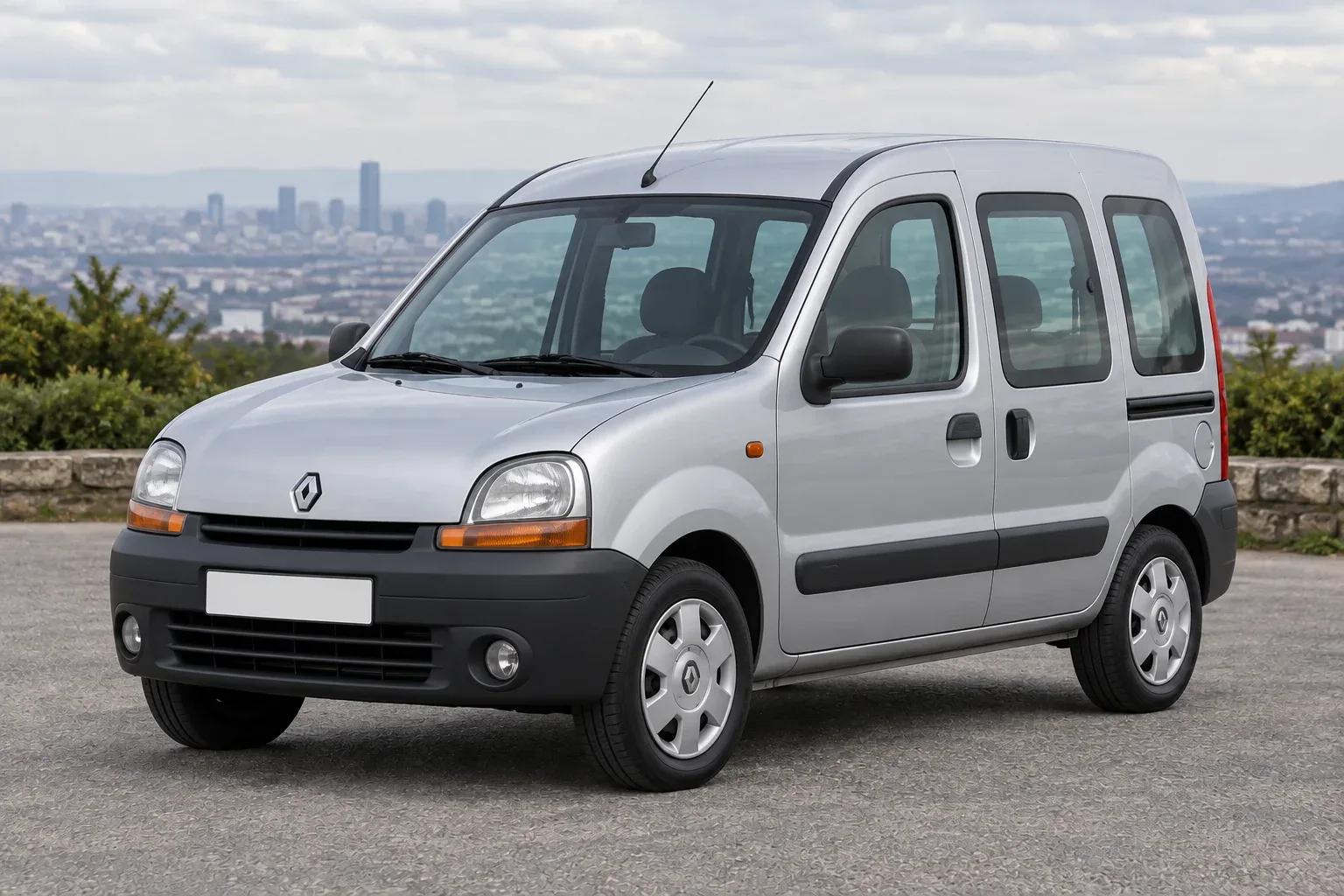
Renault Kangoo 1
Valuation of the Renault Kangoo 1 (1997–2009): condition, paperwork, inspection and terms of sale.
Indicative purchase price
Below market value
Final price agreed after inspection.
Value my car1Why buyers choose this model
Most commercial vehicles are very similar to each other. However, the Renault Kangoo I is one of the few in the class to have an all-wheel drive modification and for the first time offered sliding rear doors.
2What buyers check
Model history
Renault Kangu’s technology began in 1997 when the French presented their futuristic prototype Pangea during an exhibition in Geneva. The serial version of the model appeared in car dealerships a year later. Although Kango was not very different from the conceptual Pangaea, the technical difference between the two is huge. In the same year, the French began to offer a special “off-road version” Pampa, which after the first facelift in 2001 was equipped with all-wheel drive. This is a very interesting decision, considering that few competitors have this option. The pump features additional black plastic linings, increased clearance and tinted headlights. At first, the car was offered only with one rear sliding door. A year later, the manufacturer installed sliding doors on both sides. This practical solution has not been offered by any of the competitors for some time. In 1999, the French delivery car became the most popular car in the class not only in France, but also in other European countries. In terms of sales, he pushed even minivans and minibuses. Two years later, in 2001, Renault decided to rejuvenate the Kangoo I a little and carried out a thorough restyling. What's changed? First of all, the headlights, the hood, the grille and the front bumper. The taillights were slightly adjusted and higher quality plastic was used. The cabin noise insulation has also improved markedly. Two years later, Reno undertook another modernization. This time the changes were purely cosmetic.
Engines
R4 1. 5 DCI (58, 65, 69, 71, 83, 86-90 hp)
The range of powertrains seems rich, but the list of offers clearly lacks higher power engines. On the other hand, in a car of this kind, dynamic performance usually fades into the background. Not all of the above versions are available in our market. Which ones are worth choosing? Preferring gasoline engines is easier to determine. Regardless of the engine chosen, only one problem will have to be solved – short-lived ignition coils. Weak 1-liter engine you are unlikely to find, as well as a “sleepy” 1.2 liter. Not worth noting and 1.4-liter unit, which has the same power as the 16-valve 1.2 liters, but consumes much more fuel. In terms of dynamics, the best is 1.6 liters: it allows you to reach the first hundred in about 11 seconds. Unfortunately, it asks for a lot of gasoline - about 10 l / 100 km, and at large runs you need to be ready to replace the gasket under the head. The cost of such an operation, together with the replacement of the belt of the HRM, is about $ 500. Those who choose diesel, face a dilemma: to bet on stability or dynamics. Most will certainly prefer less power and higher reliability. 1.9 DTI is best for them, which is rare. It is devoid of serious shortcomings (with large mileage can refuse TNVD – 200-500 dollars) and is very economical, but poorly copes with the weight of the car and quite noisy. In addition, the car with this engine has an inefficient heating system. In severe frosts, glass often freezes. Atmospheric 1.
Design features
Most of the members of this class have drive only on the front axle. But in the model range of Renault Kangoo there was a place for the all-wheel drive version of the Pampa. With engines, two gearboxes were aggregated: a 5-speed mechanics and a 4-speed automatic. On the front axle are the McPherson struts, and on the back - the torsion beam. But the all-wheel drive version has a system of independent levers on the rear axle.
The Renault Kang is a very safe car. In the crash tests of EuroNCAP, he earned 4 stars.
Typical malfunctions
The reliability of French cars is often controversial. Some copies are constantly broken, while others are operated without any problems. The same goes for Kang. What to look for to avoid getting caught by a time bomb? First of all, you should carefully inspect the body, exhaust system and suspension. The first years of the series were intensely rusted. Do not forget to check the operation of the sliding door mechanism and the rear door locks. After years of operation, they can create difficulties. The guide mechanism of the drive of sliding doors gets sand, which quickly wears out the movable elements. The bare rails of sliding doors are quickly covered with corrosion. You also need to check the transmission and engine - often suffer from oil leaks. The disadvantages include too soft fastening of the transmission. This is expressed by the noticeable moves of the gearbox lever when adding and reducing gas. Replacing pillows under the engine and gearbox improves the situation, but does not completely get rid of the "childhood ailment." It is also worth looking at the cooling system, which regularly lost its tightness in cars of the first years. Corrosion of the exhaust system is a common phenomenon. In the front suspension, the racks and sleeves of stabilizers, ball supports of levers wear out relatively quickly (they change separately). And with frequent trips on bad roads with a full load, the geometry of the wheels usually leaves behind. In the future, expensive repairs will be required. It will cost about $300 to fully regenerate.
Technical characteristics of Renault Kangoo I
Renault Kangoo 1.9D. It has been in use for 22 years and has covered 500,000 km without an engine overhaul so far. The glow plugs have been replaced several times before winter, along with the steering rack, radiator and heater. Current faults include failed central locking, a broken rear-door lock, parking sensors, windscreen washer and radiator-fan relay; an unreliable onboard computer (it starts on the third attempt or whenever the engine feels like it); the ignition switch and steering-column combination switch; oil leaking from the breather oil separator; no low-speed wiper setting; some doors opening while driving; and a weak cooling-system impeller that rusts and eventually breaks up. The door locks cannot be repaired. The EGR valve is questionable and probably needs replacing or removing. Plastic parts crumble with age. This is a short list of the main faults encountered during use. My previous Moskvich 2140 covered the same mileage with everything working properly, apart from needing an engine overhaul. Give me back my Moskvich AZLK, or a VAZ-21011 or 2103!
Great car in straight hands, but that's who understands cars.
I had a displeasure driving a Renault Kango van, 1.2 16V. Very unstable car in the side wind. Badly "holds" the road with snow porridge or loose gravel. I didn't have time to clean the sand salon. A terrible vacuum cleaner. The reason is the ventilating gills above the rear right wheel. When the ventilation was sealed with construction tape, the sand did not get inside. I don't want a car like that myself!
3Pre-purchase checklist
Model history
- In terms of sales, he pushed even minivans and minibuses.
Engines
- Regardless of the engine chosen, only one problem will have to be solved – short-lived ignition coils.
- Unfortunately, it asks for a lot of gasoline - about 10 l / 100 km, and at large runs you need to be ready to replace the gasket under the head.
- It is devoid of serious shortcomings (with large mileage can refuse TNVD – 200-500 dollars) and is very economical, but poorly copes with the weight of the car and quite noisy.
- If someone is important dynamics, then you should pay attention to the dCi units, which are very soft work.
- Unfortunately, in samples with large mileage, we increasingly have to face failure of injectors, fuel pump, turbocharger (about $ 500) and valve of the exhaust gas recirculation system.
- Many of these problems have been largely eliminated since 2005.
Typical malfunctions
- Some copies are constantly broken, while others are operated without any problems. The same goes for Kang.
- First of all, you should carefully inspect the body, exhaust system and suspension.
- The bare rails of sliding doors are quickly covered with corrosion.
- You also need to check the transmission and engine - often suffer from oil leaks.
- Replacing pillows under the engine and gearbox improves the situation, but does not completely get rid of the "childhood ailment."
- Corrosion of the exhaust system is a common phenomenon.
- In the future, expensive repairs will be required.
- The need for repair will prompt light knocks.
Technical characteristics of Renault Kangoo I
- In operation 22 years, it has passed 500,000 km, while without a repair.
- Several times there were replacements of candles before winter, the replacement of the steering rack, the radiator with the stove. What doesn't work in the car today is no C.
- The EGR is questionable, most likely need replacement or dismantling.
- This is a short list of the main malfunctions in the operation.
- In the previous car Moskvich -2140, for the same mileage, everything worked without complaints, was made excessive overhaul of the engine. Give me back my Muscovite AZLK. Either VAZ-21011, or 2103!
4Challenges of selling privately
The list of possible faults is quite large. So will you be able to enjoy the smooth operation of the first-generation Renault Kangoo? Yes, but provided that you get a well-groomed copy, it is better after the first restyling.
Prices in the secondary market range from $3,000 to $8,000. What does the buyer get in return? Very functional and roomy interior (the trunk 600-2400 liters), comfortable suspension and relatively economical engines. An important advantage of Kangoo is the many versions of the body, so you can choose both a car for family and for work. The biggest drawbacks are the high risk of malfunction, poor quality plastic, unsatisfactory resistance to corrosion of pre-restyling versions (until 2001) and rather sluggish engines.
Over time, the mechanism of fixing the spare wheel sours.
- The history of the model: In terms of sales, he pushed even minivans and minibuses.
- Engines: Regardless of the engine chosen, only one problem will have to be solved – short-lived ignition coils.
- Structural features: Most representatives of this class have drive only on the front axle.
- Typical faults: Some instances are constantly broken, while others are operated without any problems. The same goes for Kang.
- Technical specifications of the Renault Kangoo I: In operation for 22 years, it has passed 500,000 km, while without a repair.
Shows, bargaining and re-registration take time: buyers look, promise to think and disappear. Fair price after inspection closes the auction on the spot. If money is needed urgently, the purchase takes away waiting and repeat displays.
5How selling to us works
Leave a request with the car data. We will discuss the preliminary assessment and inspection. After checking the status and documents, we agree on the final price and terms of the transaction.