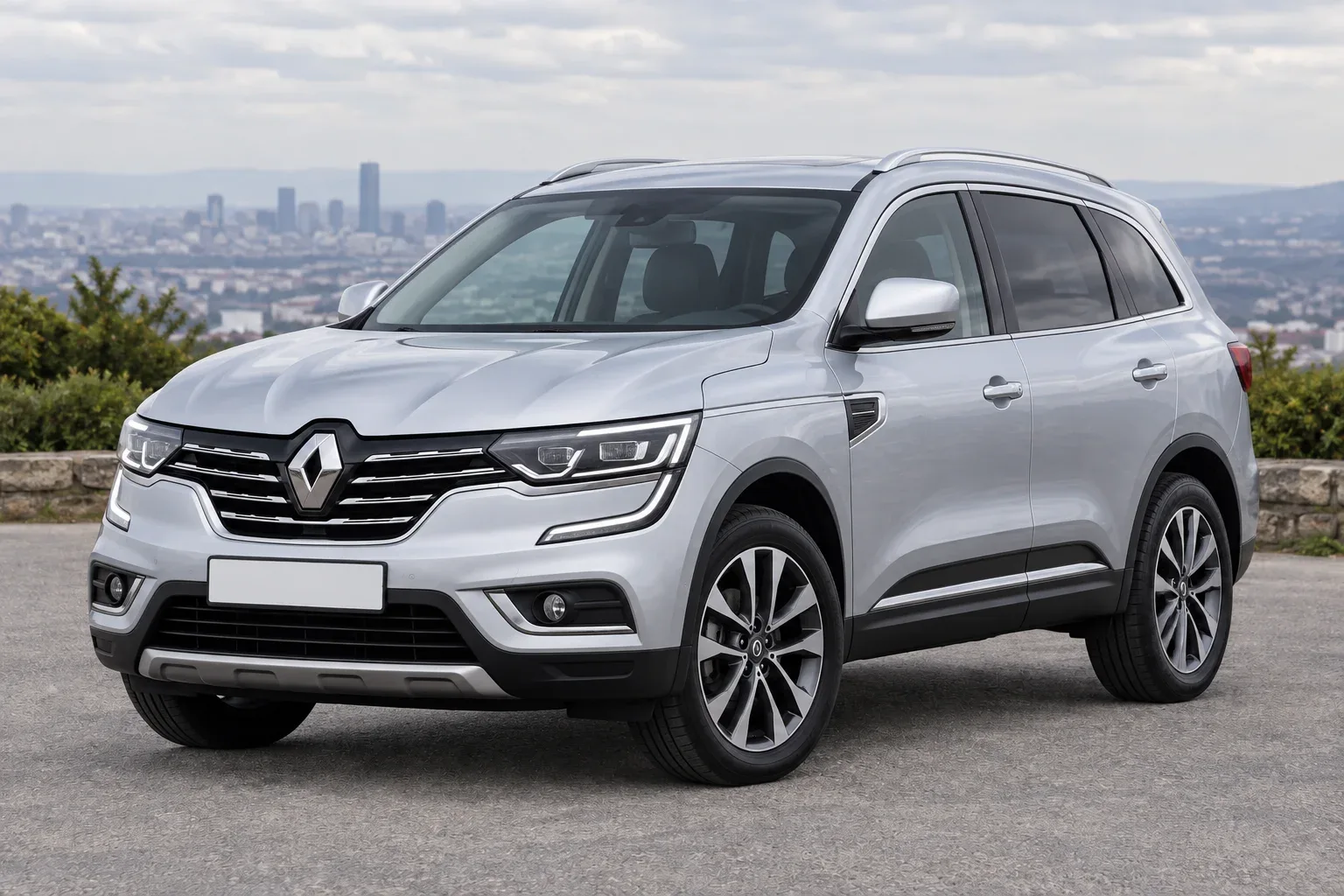
Renault Koleos 2
Valuation of the Renault Koleos 2 (2016–2023): condition, paperwork, inspection and terms of sale.
Indicative purchase price
Below market value
Final price agreed after inspection.
Value my car1Why buyers choose this model
The second-generation Renault Koleos is not a pure-blooded Renault. Like its predecessor, this model is again technically linked to the Nissan X-Trail. The Frenchman shared 54 percent of the details with him. It was assembled in Busan, South Korea, as it was primarily targeted at Asian markets (up to 75% of production), where it was sold under the Samsung QM6 brand in some regions. The European version of the Koleos was interesting because in the first half of its existence (phase 1, period 2017-2019) it did not have a gasoline engine at all. Another interesting point is the non-standard use of a CVT type continuously variable transmission (here it is called the X-Tronic) for the most common diesel engine. In its brothers, the Renault Talisman and Espace V, the diesel was combined with an automated transmission EDC with two clutches. The two-clutch EDC box (already seven-speed) in Koleos can be found paired with a very rare 1.3-liter gasoline turbo engine.
2What buyers check
X-Tronic
Japanese variator Jatco JF017E, designed for 380 Nm, combined with a 2-liter turbodiesel. CVT is competently configured and has decent reliability. Unlike previous variators, here, not step electric motors are used to change the gear ratio, but hydraulics with solenoids. Problems with the CVT usually do not occur even in cars, often moving on highways or with load. There are no mass complaints in America and Canada, where this box is used in the Nissan Rogue (American version of the X-trail), which sells hundreds of thousands, but this does not mean that nothing happens to the CVT in principle. The X-Tronic has weaknesses. First of all, high internal resistance (due to the high contact force of the conical pulleys), which means that efficiency decreases with increasing speed. Someone with a heavy leg and who constantly claims the left lane of expressways will surely go crazy with the expense. It’s a good box for the city, but outside of it, you shouldn’t expect anything other than a leisurely smooth ride. Second, acoustic noise. The transfer of torque through the steel chain to the steel pulleys initially results in higher noise levels and also facilitates the transmission of vibration from the engine. Since the input hydrodynamic transformer here works only as a starting clutch and most of the time is in rigid engagement (locked), it has practically no damping effect. If you could compare, for example, version 2.0 dCi 175 4WD with manual transmission and 2. ## Design features
If the manufacturer really wanted to, he could cram a third row of seats into the cabin. But then the Wheel 2 would not have been able to boast of such a vast space for rear passengers, nor the full size of their seats. An interesting paradox arose. On long-distance journeys, this SUV provided passengers with a higher level of comfort than the flagship Renault Espace V. The Espace has a less rigid body, which is why more shocks and vibrations are transmitted to the body from the road, and the second row seats are "three-quarter" in size due to the seven-seat layout and floor folding system. The Koleos 2 is different from other big Renaults of the time, lacking in technical refinements. Here you won’t find electronically controlled shock absorbers, all-wheel steering or a multi-touch mode switch. Adaptive cruise control has only been introduced in recent years. However, it works somewhat strangely, since the radar is integrated with a camera located behind the windshield - the so-called RaCam system. In addition, the system does not have spatial imagination, like systems with radar in the grille. Being vitally dependent on the purity of the windshield, in the rain the radar will go blind. That is why, with precipitation, a light bulb of inaccessibility of emergency braking often flashes. The simpler Asian character makes you put up with the noisy operation of the ventilation system, and in the case of the pre-restyling Phase 1 - with the buttons of lowering the glasses without backlighting.
Despite the numerous advantages and rich equipment, the pre-restyling Koleos will not become a master of first impressions. In the trunk (498 liters) there is no single bag hook, the windows do not have automatic mode (while the Captur has it on all four windows). The multimedia system is old school - in terms of graphics, and sometimes in sensitivity (sometimes you have to poke very hard into the display). # # Phase 2
The updated version of Phase 2 dominates all areas. The R-Link 2 infotainment system has a faster processor and can already work with Apple CarPlay via full-screen mode. USB inputs under the climate control panel (they were previously in the armrest) have also become much more practical. Headlight washers are an option, and more powerful LED headlights with a modified design began to be installed from the 2021 model year. More comfortable front seats, with pillow extensions, light massage function and adjustment memory (coupled with the profile of the access card) became available in top-end configurations. Two-way adjustable rear seat backrests. A better location of the microphone speaker - closer to the driver. Buttons of windows with backlighting and automatic opening of the front windows. For the 4x4 diesel version, Phase 2 provides a hillside assistance system. ## Reliability
Specialists engaged in service Renault, consider Koleos somewhat simple in technical terms, but in terms of reliability leave positive reviews. Koleos escaped most of the childhood illnesses that plagued the Talisman and Espace 5 models. The build quality has improved, and the multimedia system has worked much more stable. After the 2019 restyling, Reno did not use the more modern infotainment system EasyLink, which is more of an advantage than a disadvantage. R-Link2 was already a sophisticated system and had better aftermarket support. Plus, its advantage is that it hasn't yet had an OBD Firewall. As a result, the R-link models are the last Renaults to be fully diagnosable outside of the branded service. And they are also the latest to allow car services with Clip or DDT4ALL diagnostics to go deep factory settings and turn off, for example, stop start or smart charging. ##1.3 TCe "TCe 160" (1.33, R4/16V, 2020-2023)
The only gasoline engine in the European version of Koleos appeared after the facelift (Phase 2) and was combined exclusively with front-wheel drive and an automated gearbox with a dual clutch EDC (Magna 7DCT300 with wet clutches and servo switching engines). A quiet and responsive engine, supported by tightly selected gears, copes with even such a heavy car. In addition, it warms up faster in the morning, is very reliable and in the future cheaper to repair than diesel engines. Consumption on long trips can fall to 6 l / 100 km, and in urban traffic jams you can expect an average of 8 liters. # 1. 6 dCi "dCi 130" (R4/16V, 2017-2018)
Diesel 1.6 liters (without AdBlue) was offered only until the fall of 2018. It was combined exclusively with front-wheel drive and a mechanical six-speed, maximum in medium equipment. Of the diesel engines, it has the softest stroke and the lowest fuel consumption (average 6 l / 100 km), but also a pronounced turbo effect. Also, it has more quirks compared to the two-liter turbo diesel. #1.7 Blue dCi "dCi 150" (1.75 L, R4/16V, 2019-2020)
An extremely rare engine, available only for a short time in phase 2 and only with front-wheel drive. In fact, it is a significantly upgraded 1.6 dCi (which does not exclude the periodic tendency to absorb condensate from the intake in cold regions). Technically, the engine has become much more complex (including the AdBlue system). The fast response of the throttle and characteristic abilities in the lower rpm range are lost here in the mandatory X-Tronic continuously variable variator. Dynamics are sluggish, flow rate unremarkable (from 6.5 to 7 liters). ## 2. 0 dCi "dCi 175" (R4/16V, 2017-2019)
The most common engine in the pre-restyling model (Phase 1). It’s a simpler, older version of the two-liter diesel, still without AdBlue. It fights nitrogen oxides with an LNT catalyst and high volume EGR, which deprives it of economical efficiency. In the most common combination with all-wheel drive and low-efficiency X-Tronic CVT, the engine consumes an average of eight liters. A slightly more economical and quiet combination of all-wheel drive with a six-speed manual box could carry a two-ton trailer. The ICS version was released a little. All-wheel drive was a must for the x-tronic. #2.0 Blue dCi "dCi 190/185" (R4/16V, 2019-2020/2020-2023)
All-new two-liter diesel with AdBlue for the restyled model (Phase 2). It is much more complex technically, but with a more reliable mechanical basis. The turbodiesel has a faster response to the movement of the throttle and consumes about a liter of less fuel. Compared to the old 2.0 dCi, noise is reduced, delay on pressing the gas pedal is reduced, and it is better suited for x-tronic (mandatory here). The original 190-horsepower version (dCi 190) was exceptionally all-wheel drive and sometimes suffered from increased oil consumption. Fortunately, the problem was easily solved by updating the engine control program. The later 185-horsepower version (dCi 185) did not have such a malfunction. It was available in a cheaper front-wheel drive configuration. ## Faults and problems
Emergency braking system failure in bad weather: a feature due to the specific design of the radar combined with the camera placed behind the windshield. Non-working electric parking brake, which is accompanied by a tanning control light bulb (sometimes, on Phase 1 cars): the cause is software, solved by updating the software of the control unit. Scream from the front axle (first years): the sound came from the shock absorber stop, which was lubricated on the SRT with a special lubricant. Scream from under the front seats (rarely): weakening of the bolts of the mounting guides or wear of the frame of the seats. Oil leak (1.6 dCi): usually through the valve timing cover. The cost of elimination can vary significantly in different car service stations, as some masters can re-seal the lid without resorting to the recommended engine dismantling. Increased oil consumption 2.0 Blue dCi: applies only to the "dCi 190" variant (engine code M9R-730). It is solved by updating the engine software. The reason is excessive intake pressure caused by errors in the control of the valve. The light bulb of the faulty emission purification system is lit, but the engine does not go into emergency mode (diesels, especially 1. 6 dCi): the lambda sensor behind the catalytic converter is defective. EGR circuit failure (1. 6 dCi with high mileage): jamming of the EGR valve or loss of leakage of the exhaust cooler. ## Maintenance recommendations
All versions are equipped with a chain of HRM, it is changed only in case of stretching, which so far has been extremely rare at 1. 6 dCi. Valve gaps are compensated by hydraulic pushers on all engines. The belts of the auxiliary power units, including pulleys, change after 140,000 km/6 years, the brake fluid after 3 years, the air filter after 60,000 km/4 years. The prescribed interval for engine oil replacement is either 30,000 km/2 years or 20,000 km/1 year, depending on the engine and VIN number. In reality, it is better to adhere to an even shorter interval - 8-10 thousand km 1. 6 dCi/2. 0 dCi - 5W-30, standard RN0720;
1. 3 TCe/1. 7 BlueDCi/2. 0 BlueDCi - 0W-20, RN17FE (alternative 5W-30, RN17). In the cooling system, use only yellow liquid - Glaceol RX type D. For the X-Tronic, it is better to use Nissan NS-3 oil. Oil replacement is not part of the normal service schedule and should be ordered separately (ideally 60,000 km). EDC Automated Transmission: Vaico V20-4300 oil or other equivalent oil approved for Getrag/Magna 7DCT300 transmissions. The official interval for oil change is usually no more than 90,000 km/4 years. The hydraulic circuit here controls only the clutch and it does not have an oil filter, so more frequent replacement of the working fluid will only benefit (after 60,000 km).
3Pre-purchase checklist
X-Tronic
- Problems with the CVT usually do not occur even in cars, often moving on highways or with load.
- Wear products (small steel sawdust) are constantly captured by magnets and a built-in filter.
Design features
- The anti-corrosion coating looks resilient, but it's more of a rule for Renault over the last 20 years.
Reliability
- And they are also the latest to allow car service providers with Clip or DDT4ALL diagnostics to go into deep factory settings and turn off, for example, a stop start or smart charging.
1.3 TCe "TCe 160" (1.33, R4/16V, 2020-2023)
- In addition, it warms up faster in the morning, is very reliable and in the future cheaper to repair than diesel engines.
2.0 Blue dCi "dCi 190/185" (R4/16V, 2019-2020/2020-2023)
- Fortunately, the problem was easily solved by updating the engine control program.
Malfunctions and problems
- Emergency braking system failure in bad weather: a feature due to the specific design of the radar combined with the camera placed behind the windshield.
- Scream from under the front seats (rarely): weakening of the bolts of the mounting guides or wear of the frame of the seats.
- The cost of elimination can vary significantly in different car service stations, as some masters can re-seal the lid without resorting to the recommended engine dismantling.
- The light bulb of the faulty emission cleaning system is lit, but the engine does not go into emergency mode (diesels, especially 1).
- 6 dCi with high mileage): jamming of the EGR valve or loss of leakproofness of the exhaust cooler.
- Minor problems with the R-Link2 infotainment system: there were occasional various system freezes, failures in receiving a radio signal or Internet connection. They almost disappeared after the update.
- Failure of the supercharger control system (very rarely by 1).
Service recommendations
- Oil replacement is not part of the normal service schedule and should be ordered separately (ideally 60,000 km).
- The hydraulic circuit here controls only the clutch and it does not have an oil filter, so more frequent replacement of the working fluid will only benefit (after 60,000 km).
4Challenges of selling privately
The brand’s flagship SUV was a continuation of its predecessor of a strange shape, which did not make a deep impression, and now few people remember it. The second generation is much more interesting, thanks to the European design and technology shared with the X-trail T32.
After all, the ratio of price and functionality is a very good purchase. Compared to the ubiquitous Kodiaq, Koleos is worth a hundred thousand cheaper. Price tags for used cars start from 1.7 million rubles, for 2 million you can take a good five-year plan with a reasonable mileage. Most of them are two-liter, all-wheel drive, with a CVR and often very well equipped. The Koleos is a comfortable family car, but the lack of a seven-seat version, which has remained the prerogative of the sister X-trail, may be considered a weak point by many.
- X-Tronic: Variator problems don’t usually occur even in cars that are often on highways or on loads.
- Design features: The anti-corrosion coating looks resilient, but it's more of a rule for Renault over the last 20 years.
- Equipment: Despite the numerous advantages and rich equipment, the pre-restyling Koleos will not become a master of the first impression.
- Reliability: Renault service specialists consider the Koleos to be somewhat rustic in terms of technicality, but leave positive reviews in terms of reliability.
- Failures and problems: Emergency braking system failure in bad weather: a feature due to the specific design of the radar combined with the camera placed behind the windshield.
- Service recommendations: Oil replacement is not part of the normal service schedule and should be ordered separately (ideally 60,000 km).
- Pros: Comfortable seats (especially in phase 2) Torsional rigidity, good paintwork and corrosion protection Manufacturing quality better than Kadjar, Talisman and Espace 21 cm Explanatory four-wheel drive with a lockable clutch Simple, durable and comfortable suspension Covered rapids that allow you to sit down without soiling your feet Good integrated navigation TomTom Powerful, durable brakes
- Cons: Medium trunk and fixed variability High fuel consumption on the track at diesels with X-Tronic CVR Higher noise level of the most common combination of dCi 175 + X-Tronic Unsatisfactory LED headlights (until 2021). The halogens are worse.
Shows, bargaining and re-registration take time: buyers look, promise to think and disappear. Fair price after inspection closes the auction on the spot. If money is needed urgently, the purchase takes away waiting and repeat displays.
5How selling to us works
Leave a request with the car data. We will discuss the preliminary assessment and inspection. After checking the status and documents, we agree on the final price and terms of the transaction.